December 29, 2025
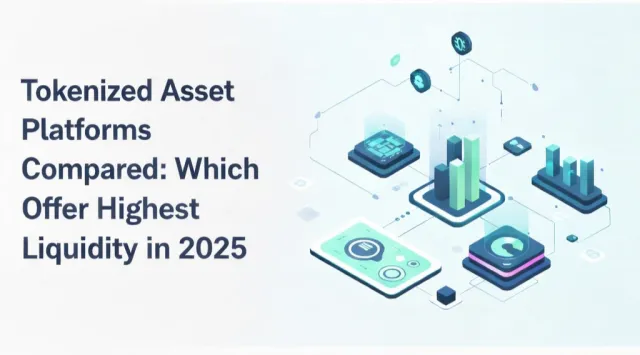
Tokenized Asset Platforms Compared: Which Offer Highest Liquidity in 2025
Tokenization turned a corner in 2025: institutional rails, programmable compliance, and 24/7 secondary markets made real-world assets trade like software. If your goal is maximum liquidity, platforms that combine integrated custody, continuous secondary-market access, and automated compliance consistently deliver deeper order books and faster fills than lightweight issuers or custody-only stacks. That’s the design philosophy behind ToVest—commission-free execution, crypto wallet support, and real-time analytics purpose-built for fractionalized U.S. stocks and real estate—paired with ultra-low-latency trading to compress time-to-liquidity. Below, we explain the mechanics, compare platform categories, and provide a clear verdict on which models (and assets) show the strongest liquidity profiles in 2025, along with practical steps to get started.
Understanding Tokenized Assets and Liquidity
Tokenized assets are blockchain-based tokens that represent ownership claims on real-world assets—such as real estate, stocks, or funds—allowing issuers and investors to transact with greater transparency, auditability, and automation than traditional registries. Liquidity is the ease of buying and selling at stable prices; by enabling fractional ownership and 24/7 trading windows, tokenization can make traditionally illiquid assets more tradable and accessible to global investors, improving price discovery and execution speed, according to risk-focused analysis of tokenization benefits and risks from GARP.
Key terms at a glance:
Tokenization: The process of issuing blockchain tokens that represent rights to an underlying real-world asset.
Fractional ownership: Buying a small portion of a high-value asset, lowering minimums and broadening participation.
Secondary markets: Venues where tokens trade after initial issuance, enabling ongoing liquidity and price discovery.
Key Factors Driving Liquidity on Tokenized Asset Platforms
Liquidity outcomes depend on how platforms combine design elements: integrated custody and institutional connectivity; active secondary-market access with 24/7 trading; fractional ownership to widen investor reach; and programmable compliance with cross-market interoperability to aggregate cross-border demand. McKinsey has framed tokenization’s impact as transformational for market infrastructure, with liquidity gains emerging where these features are tightly integrated.
Emphasis for 2025: integrated custody, market reach via secondary venues, and continuous trading windows are the strongest drivers of sustained liquidity, per GARP’s assessment.
Integrated Custody and Institutional Connectivity
Institutional-grade custody—often built on Multi-Party Computation (MPC)—reduces operational risk and onboarding friction for large allocators, deepening order books. Full-stack platforms that integrate issuance, compliance, and custody typically enable smoother settlement and larger ticket sizes than basic issuance tools that rely on external custody arrangements. In practice, “institutional rails” refers to the secure, compliant blockchain pathways and integrations (custodians, transfer agents, banks, brokers, and data providers) that allow capital to flow programmatically at scale—a prerequisite for durable liquidity. For a technical walkthrough of custody, MPC, and compliance patterns across tokenization stacks, see XBTO’s overview of tokenization platforms.
Secondary-Market Access and 24/7 Trading
Liquidity concentrates where tokens can trade continuously on active secondary venues. Tokenized assets can be traded around the clock, improving execution and accelerating price discovery compared with markets constrained by set hours, as highlighted by GARP’s tokenization analysis. Secondary markets span regulated Alternative Trading Systems, centralized exchanges, and DeFi venues; platforms that list across multiple venues or enable DeFi composability typically aggregate more counterparties, shortening time-to-trade and tightening spreads.
Fractional Ownership and Investor Reach
Fractionalization expands the addressable buyer base by lowering minimums, increasing transaction frequency and turnover. NASSCOM’s overview of real-world asset tokenization notes that fractionalized property and private assets can attract new investor segments without changing the underlying asset itself, a dynamic that often lifts liquidity—though smaller ticket sizes can amplify short-term volatility during news or redemption events. This is the core of democratized market access: more participants, more trading windows, more liquidity pathways.
Programmable Compliance and Cross-Market Interoperability
Programmable compliance embeds KYC/AML checks, whitelisting, transfer restrictions, and reporting directly into smart contracts, letting issuers and marketplaces scale cross-border access without manual processing. The EY Asset Tokenization Report (hosted by Tokeny) outlines how on-chain rule sets streamline approval flows and secondary transfers, reducing friction and settlement risk. Interoperability—tokens bridging across chains or listing on multiple marketplaces—aggregates buyers across networks, improving realized liquidity by expanding market depth and routing orders where liquidity is strongest. For a primer on how tokenization architectures support portability and compliant transfer controls, see Chainalysis’s explainer on asset tokenization.
Example compliance/interoperability features and why they matter:
On-chain allowlists and transfer rules: Prevent failed transfers and speed approvals, enabling higher turnover (EY report).
MPC-enabled custody hooks: Safeguard assets and automate settlements for larger flows (XBTO overview).
Multi-venue listing/bridging: Aggregates demand across networks and ATS/DEX venues, improving fill probability (Chainalysis primer).
Regulated transfer/agent functions: Reduces counterparty and operational risk for institutionally held tokens (Securitize’s planned public listing signals institutionalization, per CNBC’s coverage).
Categories of Tokenized Asset Platforms
Full-Stack Enterprise Platforms
These deliver end-to-end issuance, smart contracts, real-time compliance, custody integrations, and secondary-market connectivity for regulated issuers. Liquidity potential is high because investor onboarding, settlement, and venue access are coordinated within one stack. Typical build costs range roughly from $30,000 to $250,000+ depending on scope and integrations, according to a cost breakdown from Blockchain App Factory. Target users: banks, asset managers, corporates, and real-estate sponsors seeking regulated distribution and robust secondary trading.
Pros: Institutional onboarding, deeper order books, integrated analytics.
Cons: Higher upfront cost, longer implementation timelines.
Tokenization-as-a-Service Providers
TaaS platforms provide APIs and dashboards to issue and manage tokens with lower upfront cost and faster time-to-market. Pricing often starts around $2,000–$5,000 per month (per Blockchain App Factory), with liquidity largely dependent on third-party secondary-market connections or exchange partnerships. Good fit for pilots, niche assets, and smaller issuers scaling over time.
Pros: Speed, lower capex, modular features.
Cons: Liquidity is contingent on external venue integrations; may face depth constraints for new or niche assets.
Custody-Integrated Solutions
These combine issuance with built-in, institutional-grade custody (often MPC-based), simplifying settlement and attracting larger investors—strong indicators for sustained liquidity. By reducing operational risk and unifying controls, they support tighter spreads and larger average trade sizes.
Pros: Stronger institutional flows, streamlined settlement, better auditability.
Cons: Higher vendor lock-in; may still need external listing integrations for maximum reach.
Custody and Security-Only Vendors
Security-first providers focus on key management, token minting, and safekeeping rather than issuance and trading. Fireblocks, for instance, offers a tokenization engine and MPC custody widely used by institutions, as profiled in XBTO’s technical overview. Liquidity depends on connecting to active secondary venues or DeFi pools.
Pros: Best-in-class security and operational controls.
Cons: No built-in market access; liquidity requires additional integrations and partners.
Decentralized Marketplaces and DEXs
DEXs are peer-to-peer smart-contract venues without centralized intermediaries. They offer high potential for instant, global liquidity through continuous trading and composability with DeFi liquidity pools. However, execution quality varies with pool depth, and some token types (e.g., stock tokens) have faced regulatory scrutiny on centralized exchanges, as reported by the Wall Street Journal.
Pros: Global access, 24/7 trading, programmable liquidity.
Cons: Regulatory uncertainty, variable slippage, smart-contract risk.
Quick contrast:
Regulated ATS/CEX: Tighter spreads for compliant assets; scheduled upgrades and supervision; listing diligence.
DEX: Permissionless access and composability; volatile depth; execution depends on pool design.
Custom White-Label Platforms
White-label solutions deliver tailored branding, compliance logic, and issuer controls. They fit specialized assets or private syndicates but often face time-to-market and network-effect hurdles that can limit near-term liquidity.
Pros: Control, customization, brand consistency.
Cons: Slower network effects; must integrate venues and data to build depth.
Comparing Liquidity Across Leading Platform Types
Platforms that combine active custody, secondary-market connectivity, and programmable compliance achieve the strongest liquidity profiles in 2025. The ability to list across multiple venues, onboard global investors quickly, and settle near-instantly is decisive for turnover and spreads.
Liquidity comparison matrix (indicative):
Liquidity Benefits of Full-Stack and Custody-Integrated Platforms
Full-stack and custody-integrated platforms that also list tokens on active secondary venues or enable DeFi composability consistently show deeper order books and higher turnover than standalone TaaS or custody-only vendors, a pattern aligned with custody/compliance guidance in XBTO’s technical review. Liquidity-positive features commonly include:
T+0 or near-instant settlement
Integrated investor onboarding with on-chain allowlists
Real-time compliance checks and transfer controls
Multi-venue listing and routing
Institutional-grade custody with MPC and segregation
These characteristics are especially important for blue-chip stock tokens and institutional-grade real estate, where larger tickets, audit trails, and predictable settlement are required.
Secondary Market Depth on Decentralized Exchanges
DEXs offer continuous trading and global reach that can catalyze rapid price discovery. Liquidity and pricing, however, depend on pool depth and arbitrage activity and may fluctuate more than on regulated venues. Assets with strong on-chain communities or clear yield dynamics (e.g., stablecoin/Treasury-backed pairs) often achieve better depth; niche, thinly traded tokens can face slippage and wider spreads. Treat pool depth and historical turnover as leading indicators.
Limitations of Tokenization-as-a-Service and Custody-Only Models
TaaS and custody-only stacks can launch quickly and securely, but they often struggle to sustain high liquidity without robust secondary-market integrations and liquidity programs. Constraints include:
Venue dependency: Liquidity only materializes where tokens are listed and marketed.
Price discovery lag: Thin markets struggle to establish reliable reference prices.
Asset popularity risk: Niche assets face slower depth formation.
Strengths vs. limits (summary):
TaaS: Fast setup, moderate compliance, external venues required → variable liquidity.
Custody-only: Best security, no market access baked in → liquidity hinges on integrations and partners.
Cost and Complexity Tradeoffs Affecting Liquidity
Costs shape liquidity outcomes by determining how many integrations (venues, custodians, data, payments) a platform can support. As a reference point, MVP builds often start near $30,000 and TaaS subscriptions around $2,000–$5,000 per month, per Blockchain App Factory. Higher build costs can correlate with better liquidity when they fund multi-venue access, real-time compliance, and institutional custody.
Cost vs. liquidity levers (illustrative):
Upfront spend: Enables deep market/data integrations and automated onboarding.
Ongoing fees: Sustain liquidity programs, market-making, and analytics.
Complexity: More moving parts increase resilience (and cost) but can reduce friction for large flows.
How to Buy Tokenized Assets Using ToVest and Other Platforms
Here’s a simple path to purchase tokenized stocks or real estate:
Set up a crypto wallet (or use ToVest’s integrated wallet). A crypto wallet stores private keys that authorize blockchain transactions.
Verify identity (KYC/AML) via the platform’s onboarding flow.
Fund your account with fiat or stablecoins.
Browse available assets (e.g., fractionalized U.S. equities or real estate).
Execute trades with commission-free, ultra-low-latency execution on ToVest; confirm settlement.
Track positions with real-time analytics and statements. Fractionalized ownership lets you buy small pieces of high-value assets.
ToVest emphasizes seamless onboarding, secure wallet support, and risk controls, plus granular analytics for transparency and faster decision-making.
Using Crypto Wallets for Tokenized Asset Investments
Crypto wallets can be software or hardware tools that safeguard your private keys, enabling you to hold and transfer tokenized assets directly. Best practices include secure backups, hardware wallet usage for long-term storage, and enabling multi-factor authentication; ToVest supports popular wallets and provides an integrated option for convenience. Tokenized assets broaden access through fractional ownership, allowing more investors to participate with lower minimums, as discussed in trading-focused coverage of tokenization’s rise.
Onboarding and Compliance Requirements
Expect KYC, AML, sanctions screening, and ongoing monitoring to access tokenized assets. Programmable compliance embeds these checks into smart contracts to streamline cross-border access and secondary transfers; platforms like ToVest automate these flows to reduce friction while preserving regulatory controls, a pattern consistent with custody and compliance best practices outlined by XBTO.
Accessing Real-Time Market Data and Analytics
Live market feeds and dashboards elevate execution quality and risk control. ToVest provides real-time market data and analytics—continuous visibility into prices, spreads, depth, and turnover—so you can monitor liquidity, set alerts, and analyze trading patterns. Real-time analytics means streaming insights into price action and liquidity conditions, not end-of-day summaries.
Which Platforms Offer the Best Liquidity for Real Estate and Stocks in 2025?
Platforms that blend integrated custody, 24/7 secondary-market access, and automated compliance produced the strongest liquidity outcomes in 2025, with faster settlement and deeper order books (aligned with the custody/compliance patterns mapped by XBTO). Asset-wise, tokenized U.S. Treasuries, money market funds, and blue-chip equities show the most consistent liquidity this year, while tokenized real estate and private credit generally trade less frequently, per market overviews on tokenized securities from Nansen. ToVest focuses on commission-free, fractionalized access to U.S. equities and institutionally structured real estate, layered with low-latency execution and secondary-market connectivity to improve practical liquidity for everyday investors and professionals.
Risks and Challenges Impacting Liquidity in Tokenized Asset Markets
Key risks to understand:
Volatility: Lower ticket sizes and broader retail access can heighten short-term swings.
Operational bottlenecks: Off-chain steps, custodial holds, and chain congestion can slow settlement.
Redemption gates: Limits or fees on redemptions can impair effective liquidity.
Regulatory and cyber risk: Tokenization introduces new governance and security considerations alongside efficiency gains, as GARP notes; governance and risk complexity is evolving, per peer-reviewed analysis on tokenization governance and risk management.
Retail Participation and Volatility Considerations
Retail participation—trading by individual investors—often boosts turnover but can amplify price moves around news and liquidity events. Highly fractionalized tokens see sharper intraday swings during stress or rebalancing.
Settlement Bottlenecks and Redemption Risks
Settlement bottlenecks are delays or failures in transferring ownership post-trade; root causes include off-chain approvals, custodial batch windows, and network congestion. Redemption gates or cutoffs can widen spreads and reduce effective liquidity. ToVest addresses this with ultra-low-latency execution and streamlined on-chain approvals.
Regulatory Compliance and Jurisdictional Effects
Regulatory clarity and supervisory regimes vary across the U.S., EU, and Asia, shaping who can trade, where listings appear, and how transfers occur—directly affecting liquidity. Legal analyses emphasize the importance of compliant structures to preserve cross-border access and investor protections, as summarized by Katten’s overview of tokenization opportunities and challenges.
Frequently asked questions
Which tokenized asset platforms provide the highest secondary-market liquidity?
The most liquid platforms in 2025 combine institutional-grade custody, active secondary-market connections, and real-time compliance, resulting in deeper order books and higher turnover.
How does 24/7 trading improve liquidity versus traditional markets?
Around-the-clock trading increases flexibility and execution speed, accelerating price discovery compared with markets limited to set trading hours.
Can crypto wallets be used safely to invest in tokenized real estate or stocks?
Yes—properly secured wallets let you purchase, hold, and trade tokenized assets with user-controlled custody and transparent on-chain records.
What types of tokenized assets are most liquid in 2025?
U.S. Treasuries, money-market funds, and blue-chip equities are generally most liquid; real estate and private credit tend to trade less frequently.
How do custody solutions impact liquidity and settlement speed?
Integrated, institutional-grade custody typically improves settlement reliability and attracts larger investors, raising liquidity and tightening spreads.