How to Earn Reliable Passive Income with Stablecoins – A Step‑by‑Step Guide
December 16, 2025
Stablecoins make it possible to earn steady, predictable returns in crypto without the whiplash of price swings. By holding digital assets pegged to reserves like the U.S. dollar, you can deploy capital into lending, staking, and yield-bearing products that generate cash‑like income while preserving principal. This step‑by‑step guide shows you how to choose stablecoins, set up a secure wallet, acquire assets, and start earning—plus how to monitor performance and manage risk. Whether you’re diversifying an existing portfolio or building a conservative crypto sleeve, the methods below emphasize price stability, high liquidity, and repeatable stablecoin passive income strategies backed by real data and practical safeguards.
Understanding Stablecoins and Their Role in Passive Income
Stablecoins are digital assets designed to maintain a stable value, typically via a 1:1 peg to a reserve asset such as the U.S. dollar, euro, or commodities, held in cash, short‑term treasuries, or other liquid instruments. This structure gives them price stability and makes them useful as cash equivalents in the crypto economy, especially during volatility when they act as a safe haven and liquidity bridge between trades, protocols, and exchanges, as explained in the BingX explainer on stablecoins (reserve backing and pegs) BingX overview of how stablecoins work.
Because their prices target stability, stablecoins enable predictable earnings through lending, staking, and structured yield products, and they sit at the center of many stablecoin yield strategies in decentralized finance, per the Trust Wallet guide to stablecoin earning Trust Wallet’s beginner guide to stablecoin earn.
Step 1: Choose the Right Stablecoin for Your Investment
Start with rigorous due diligence on collateral type, transparency, attestation/audit cadence, reserve quality, and whether the token has depegged before. Major fiat‑backed options include USDC and USDT; yield-bearing stablecoins such as sDAI or USDY pass through conservative returns—often 2–5%—from assets like short‑duration U.S. Treasuries, as outlined in Transak’s overview of yield‑bearing stablecoins Transak on yield‑bearing stablecoins and reserves.
Common collateral approaches:
- Fiat‑collateralized: Backed 1:1 by cash and cash equivalents held with banks/custodians.
- Commodity‑backed: Peg maintained with assets like gold or short‑term treasuries.
- Protocol‑based (crypto‑collateralized/algorithmic): Backed by crypto reserves or algorithmic mechanisms; potentially higher risk of depeg.
Compare before you buy:
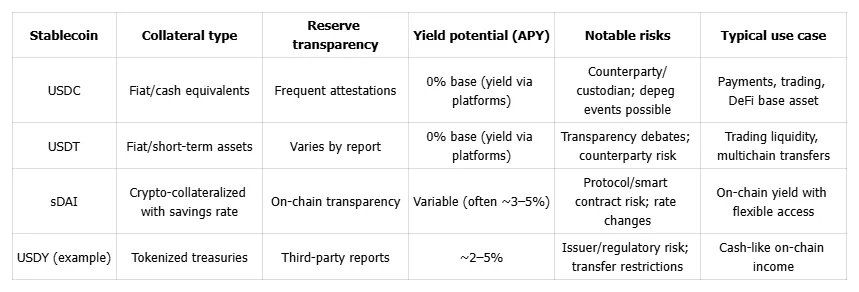
Tip: Favor stablecoins with clear attestations, robust reserve disclosures, and well‑documented risk management. A clean depeg history and responsive governance are strong signals.
Step 2: Set Up a Secure Wallet for Stablecoin Storage
A crypto wallet is a digital tool to store, manage, and transact digital assets. Custodial wallets (on centralized exchanges) manage keys for you; non‑custodial wallets (like MetaMask or Phantom) give you full control and access to DeFi. For beginners, centralized options are straightforward; self‑custody offers flexibility for on‑chain strategies, as noted in the Transak overview Transak on yield‑bearing stablecoins.
Security best practices:
- Enable two‑factor authentication on custodial accounts.
- Back up and protect your seed phrase/private keys; never share them.
- Consider a hardware wallet for larger balances or long‑term holdings.
- Your wallet choice affects access to DeFi staking, lending, and liquidity pools, a point echoed in Coingape’s review of stablecoin income methods Coingape on earning with stablecoins.
Step 3: Acquire Stablecoins Safely and Efficiently
Buy stablecoins through reputable exchanges (e.g., ToVest, Binance), fiat on‑ramps like Transak, or via peer‑to‑peer transfers. First‑time purchases typically require KYC and basic identity checks—use them to verify platform legitimacy. When depositing or withdrawing, confirm the network (ERC‑20 vs. BEP‑20 vs. other L2s) to avoid irreversible mistakes. Expect fees for purchasing, converting to yield‑bearing tokens, and on‑chain transfers; plan purchases to minimize repeated small transactions.
ToVest users can combine fast on‑ramping with real‑time market dashboards and research—see our latest market report for data‑driven allocation ideas ToVest market report.
Step 4: Explore Methods to Earn Passive Income with Stablecoins
Stablecoin income methods vary by risk, complexity, and custody model. Here’s a quick comparison:
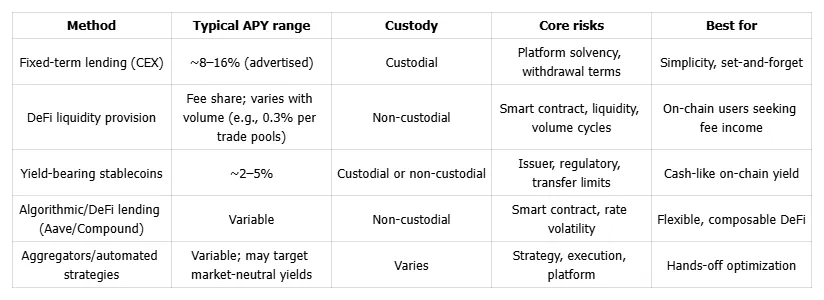
The Rapid Innovation DeFi income guide details how fees, volumes, and APYs fluctuate by protocol and market conditions Rapid Innovation’s DeFi passive income guide.
Fixed-Term Lending on Centralized Platforms
Fixed‑term lending means locking stablecoins for a set period in exchange for a fixed rate, often paid daily or weekly. Major platforms advertise straightforward yields and simple UX; some list rates up to the mid‑teens, but always verify terms, lock‑ups, and withdrawal conditions. Kraken/Binance offer easy onboarding post‑verification, and platforms promoting “up to 16%” tend to bundle tiered rates, loyalty, or token incentives, as discussed in the Stoic.ai USDC staking guide Stoic.ai on centralized staking and rates. Review regulatory posture and any stated insurance before committing funds.
Staking and Liquidity Pools in Decentralized Finance
Liquidity pools are smart‑contract vaults where you deposit token pairs to facilitate trading and earn a share of fees. Stablecoin pairs (e.g., USDC/USDT) can minimize impermanent loss while capturing fee‑based income; fee tiers often include 0.3% per trade pools on major DEXs, per the DeFi income guide above Rapid Innovation’s DeFi passive income guide. Stick to audited, reputable protocols like Uniswap, Curve, Aave, and confirm each transaction on your wallet.
Yield Farming Strategies
Yield farming rotates capital across platforms to harvest the highest net yield, sometimes layering token incentives, liquidity mining, or recursive lending/borrowing. Returns vary widely; some 2025 stablecoin farming strategies cited 21–22% APY under favorable conditions—often with higher complexity and risk, according to this analysis of 2025 stablecoin farming strategies Winter 2025 stablecoin farming strategies. Consider automated optimizers like Yearn.finance if you value convenience, but understand smart contract and depeg risks.
Algorithmic and Decentralized Lending Protocols
Algorithmic lending protocols (e.g., Aave, Compound) set variable rates via supply/demand and let you retain self‑custody while earning. These protocols are composable with other DeFi products, enabling advanced strategies like collateralized loops or hedged positions. Yield‑bearing stablecoins may source returns from such markets or from tokenized treasuries, as described in Transak’s overview Transak on yield‑bearing stablecoins.
Step 5: Deposit Stablecoins and Start Earning Interest
- Choose your platform or protocol and verify supported networks and tokens.
- For centralized platforms: complete KYC, deposit stablecoins, select a product (e.g., flexible vs. fixed term), confirm estimated APY, and note lock‑ups or withdrawal windows.
- For DeFi: connect your non‑custodial wallet, approve token spend, deposit to the pool or lending market, and review variable APR/APY, collateral factors, and potential rewards.
- Confirm every transaction detail (network, asset, contract address) to avoid irreversible mistakes.
- Document your start date, terms, and expected yield for easy tracking.
Coingape’s overview highlights how withdrawal times can range from instantaneous to several days depending on product design Coingape on earning with stablecoins.
Step 6: Monitor Your Stablecoin Investments and Optimize Returns
- Track yields, liquidity, and protocol health using dashboards like DeFiLlama, Dune Analytics, or DeFi Pulse; watch fee volumes for DEX strategies, per the DeFi step‑by‑step guide Rapid Innovation’s DeFi passive income guide.
- Set alerts for APY changes, unusual on‑chain activity, or peg deviations; centralized platforms sometimes notify about product changes or rate updates, as seen in Coingape’s roundup of practices Coingape on earning with stablecoins.
- Rebalance between platforms and methods as rates, incentives, and risks evolve.
- Keep concise records—allocations, realized APYs, lock‑up dates—to make optimization decisions quickly.
Managing Risk When Earning Yield on Stablecoins
Key risks include loss of peg, smart contract exploits, platform insolvency, liquidity crunches, and regulatory changes. Mitigate by diversifying across platforms and stablecoin types, using audited protocols, and allocating only what you can afford to risk. Enable 2FA, secure keys, start small, and consider automated rebalancing or alerting. Both Coingape and the DeFi step‑by‑step guide emphasize blending conservative methods (fixed‑term lending, yield‑bearing stablecoins) with careful diligence to manage downside Coingape on earning with stablecoins and Rapid Innovation’s DeFi passive income guide.
Frequently Asked Questions
What Are Stablecoins and Why Are They Suitable for Passive Income?
Stablecoins are crypto assets pegged to reserves like the U.S. dollar, making them price‑stable and well‑suited for steady income via lending, staking, and yield products.
How Do Yield-Generating Stablecoins Work?
They hold income‑producing reserves (such as short‑term treasuries) and automatically pass through interest to holders, typically accruing daily and redeemable on demand.
What Are the Safest Ways to Earn Interest on Stablecoins?
Use fixed‑term lending on reputable centralized platforms and well‑audited DeFi protocols with strong track records and clear disclosures.
How Much Passive Income Can I Expect from Stablecoins?
Expect around 2–5% APY from yield‑bearing stablecoins and potentially 8–16% on some fixed‑term or incentive‑driven products, depending on market conditions and risk.
How Can I Keep My Stablecoins Secure While Earning Yield?
Use secure wallets, enable 2FA, protect seed phrases, and diversify across platforms and stablecoins to reduce single‑point risks.