10 Real-World Asset Platforms to Boost Your 2026 Portfolio
January 12, 2026
Real-world asset (RWA) platforms digitize ownership of physical and financial assets—from real estate and industrial equipment to commodities and IP—so investors can buy, sell, and manage them with unprecedented speed and transparency. Tokenization is the process of converting rights to a physical asset into digital tokens on a blockchain, enabling fractional, tradable ownership accessible across borders. As asset management software adds automation, real-time data, and flexible pricing, it is quickly reshaping how portfolios are built and maintained heading into 2026, with buyers prioritizing faster deployment and tighter financial controls, according to a 2026 market review of asset platforms. See the 2026 asset management software list for context on the shift to automation, mobile access, and compliance-driven reporting.

For investors asking how to invest in real-world assets through RWA platforms: decide your target asset class (e.g., tokenized equities, real estate, equipment), pick a regulated platform with clear custody and reporting, and match capabilities—like predictive maintenance or automated depreciation—to your portfolio goals. For market depth and benchmarks, the RWA market tracker and a practical overview of real-world asset tokenization provide helpful grounding.
ToVest: Fractional Investing with Tokenized Real-World Assets
ToVest is a regulated, blockchain-powered fintech that bridges traditional finance with tokenized markets. It supports both fiat and leading stablecoins (USDT/USDC) and operates under U.S. money services business requirements, giving global investors compliant access to diversified portfolios. Fractional investing means buying small slices of high-value assets—like U.S. stocks or commercial real estate—so you can construct granular portfolios without large upfront capital.
What stands out is the capital-efficient, real-time trading stack: ultra-low latency execution, live market data, and risk tools built for both individuals and institutions. For investors, that translates into:
- Tokenized access to U.S. equities and global RWAs
- Instant settlement rails across fiat and stablecoins
- Fractional, rules-based portfolios with transparent fees
- Institutional-grade controls: KYC/AML, custody segmentation, and audit-ready reporting
If you want direct exposure to tokenized securities and real assets in one regulated interface, ToVest delivers a streamlined onramp without requiring you to juggle multiple wallets or platforms.
IBM Maximo: Enterprise Asset Management for Heavy Industry
IBM Maximo is designed for mission-critical operations where uptime, safety, and compliance are non-negotiable—think power grids, transportation, and multi-plant manufacturing. As an enterprise asset management (EAM) system, it blends AI-driven analytics, IoT sensor integrations, and condition monitoring to orchestrate preventive and predictive maintenance at scale, as highlighted in the 2026 asset management software list.
Typical scenarios include coordinated shutdown planning, regulatory inspection scheduling, and spare-parts optimization across sites. Maximo often requires higher deployment budgets and timelines than midmarket tools, but the tradeoff is deep control over complex environments that prioritize reliability, traceability, and lifecycle governance.
SAP EAM: Scalable Compliance-Oriented Asset Management
SAP EAM is built for large, regulated enterprises that need rigorous audit trails and tight integration with financial systems. It provides asset registers, automated depreciation, and direct linkage to core accounting—capabilities finance teams prize for speed and accuracy in close processes, per the 2026 asset management software list.
Fixed-asset automation refers to automatically tracking, valuing, and depreciating assets in line with policy and accounting standards. For organizations subject to strict reporting rules, SAP’s embedded controls and end-to-end traceability reduce manual errors and accelerate audits.
UpKeep: Mobile-First Maintenance and Preventive Workflows
UpKeep gives maintenance teams a fast, mobile-first path to centralize work orders, asset histories, and preventive maintenance schedules. With app-driven checklists and notifications, it helps SMBs and distributed teams increase reliability and cut downtime quickly. Analysts note its rapid time-to-value for pilots and midmarket rollouts in a recent EAM tools guide.
For organizations seeking quick ROI without heavy IT lift, UpKeep’s intuitive onboarding and smart PM scheduling provide a practical starting point before expanding into deeper analytics.
Asset Panda: Configurable Asset Tracking and Audits
Asset Panda is known for customization and mobility. Teams can build bespoke asset fields, workflows for leases and contracts, and audit-ready reporting with extensive barcode/QR scanning—useful in education, nonprofits, construction, and field services. A 2026 equipment software roundup even calls it the “king of customization,” underscoring its flexibility for unique tracking needs.
If your organization needs tailored forms, granular permissions, and on-the-go audits—without committing to a monolithic EAM—Asset Panda is a strong fit.
Dynamics 365 Business Central: Finance-Driven Fixed-Asset Automation
Dynamics 365 Business Central appeals to finance teams that want asset tracking natively connected to real-time accounting. It automates depreciation, maintains fixed-asset registers, and streamlines month-end reporting—features highlighted in the 2026 asset management software list.
Automated depreciation means the software calculates and posts periodic value decline based on your policies (straight-line, declining balance, etc.), creating consistent audit trails and reducing manual spreadsheet work. With ERP and predictive maintenance integrations, Business Central unifies operational and financial views of asset performance.
ServiceNow ITAM: Lifecycle and License Management Platform
ServiceNow IT Asset Management unifies hardware and software lifecycle oversight with discovery, usage metering, and license compliance. For tech-heavy enterprises, its license intelligence features surface renewal risk, identify underused subscriptions, and align costs to business units—capabilities recognized in the 2026 asset management software list.
Comparison snapshot:
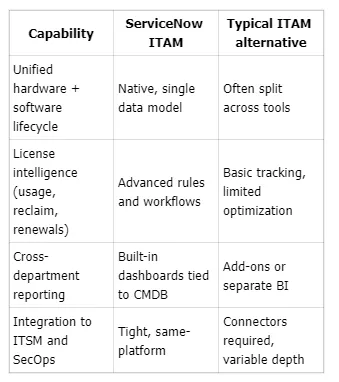
If you need end-to-end software governance plus hardware control with audit-ready proof, ServiceNow stands out for its scale and cross-functional visibility.
Asset Infinity: RFID Tagging and Sustainability Workflows
Asset Infinity combines QR/barcode/RFID tagging with cloud dashboards and predictive analytics for loss prevention and maintenance planning. Its 2026 overview cites multi-sector deployments in manufacturing, healthcare, and logistics, where real-time location and utilization reduce shrinkage and downtime.
Predictive analytics in asset management uses historical and live telemetry to forecast failures, prioritize maintenance, and optimize spares—improving uptime while lowering total cost.
Cheqroom: Equipment Tracking with Cost-Conscious Pricing
Cheqroom emphasizes accessible pricing and simple equipment workflows for SMBs and creative teams. Its Pro plan offers flat-rate pricing with unlimited users/items and mobile-first audit trails to support straightforward compliance, as detailed in a 2026 equipment software review.
It’s ideal for organizations prioritizing fast setup, self-serve asset catalogs, and booking/check-out flows. For deeper CMMS or complex integrations, you may eventually outgrow it.
Fabrico: Manufacturing Performance and Maintenance Economics
Fabrico focuses on manufacturing efficiency, tying asset decisions to economics and performance. It incorporates Total Cost of Ownership (TCO) and Overall Equipment Effectiveness (OEE) to weigh maintenance vs. replacement and prioritize high-impact interventions. Its 2026 industrial review notes direct connections to PLC/OEE data for real-time decision-making.
How Fabrico drives strategy:
- Collects sensor/PLC and maintenance data in near real time
- Analyzes TCO, OEE, and downtime costs at the asset and line level
- Recommends actions: PM intervals, parts stocking, retrofit/replace
- Tracks outcomes to refine models and budgets iteratively
AppFolio Investment Manager: Real-Estate Investment and Reporting
AppFolio Investment Manager serves CRE syndicators and GPs, combining investor relations with property-level data. It delivers tailored reporting, waterfall models, and audit-friendly documentation—features highlighted in a 2026 investment software roundup.
This platform is purpose-built for commercial real estate rather than broader asset classes, making it a strong back office for firms focused on fund/vehicle transparency and LP communications.
How to Choose the Right Real-World Asset Platform for Your Portfolio
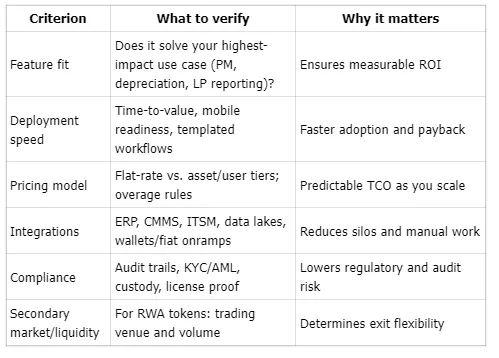
Start with your asset priorities, then map to capabilities. If you manage equipment-heavy operations, look for predictive maintenance and mobile workflows. For finance-driven organizations, prioritize automated depreciation and ERP integration. Real-estate investors should favor robust investor reporting and compliance. The 2026 asset management software list and equipment management reviews emphasize evaluating deployment speed, pricing models, and long-term operating costs before committing.
Key criteria checklist:
Frequently asked questions
What are real-world assets and how does tokenization work?
Real-world assets are tangible or financial assets—like real estate, commodities, or equities—whose ownership rights are represented as digital tokens on a blockchain, enabling fractional, globally tradable stakes.
What are the benefits of adding real-world asset platforms to my portfolio?
They expand diversification, improve access to private markets, and can enhance liquidity and yield opportunities relative to traditional-only portfolios.
How can I assess the safety and trustworthiness of an RWA platform?
Look for regulatory registration, independent audits, transparent asset custody, and clear investor rights documentation and reporting.
How liquid are tokenized real estate and other real-world assets?
Liquidity is often better than traditional formats but ultimately depends on the platform’s secondary market design and actual trading volume.
Do I need a crypto wallet or can I use traditional fintech apps for RWA investing?
Both options exist: some platforms require a crypto wallet, while others—like ToVest—support a familiar fintech interface with fiat and stablecoin rails.