15 มกราคม 2569

Crypto‑to‑US Stock Investing Risks & Opportunities in 2026

Investors can now move between crypto and U.S. stocks more easily than ever—funding brokerage accounts with digital assets, buying spot bitcoin ETFs, or accessing tokenized shares that mirror listed equities. The benefits are clear: new diversification levers, fractional access, and potentially faster settlement. The trade‑offs are equally real: higher volatility, evolving regulation, and custody complexity. This guide explains the 2026 landscape, from institutional adoption and tokenization to correlation math, risks, and practical allocation playbooks. ToVest’s role is straightforward: provide clear, research‑backed guidance and tools so retail investors can harness innovation without taking on avoidable risks. Strategic Overview Institutional demand, maturing ETF wrappers, and rapid advances in tokenization are blurring the line between crypto and U.S. equity investing. Spot bitcoin ETFs have embedded crypto exposure into mainstream portfolios, while tokenized securities are bringing fractional, 24/7 access and programmable features to traditional assets. At the same time, regulators are clarifying parts of the rulebook—particularly around ETFs and stablecoins—though market structure and DeFi oversight remain in flux. For individual investors, the question isn’t whether crypto and stocks intersect; it’s how to size and implement exposure responsibly. ToVest helps investors evaluate risk, diversification, and execution options with transparent education and portfolio analytics. Institutional Trends Shaping Crypto and US Stock Integration Institutionalization refers to the adoption of crypto by large, traditional financial players via regulated vehicles, mandates, and standardized custody. The trend is accelerating in 2026: global assets in crypto ETFs and ETPs are estimated above $200 billion, with continued penetration expected through ETF wrappers into 401(k)s and mandates this year, according to a recent outlook on five key crypto trends for 2026 from Forbes. Products like spot bitcoin ETFs and diversified digital‑asset ETPs are increasingly owned by intermediaries rather than retail alone; in fact, investment advisors now hold a substantial portion of ETP assets, with research from Grayscale’s 2026 outlook noting that roughly half of crypto ETP assets sit with advisor channels, a sign of mainstream portfolio integration. Table: Where integration stands versus early adoption Broader education from mainstream firms—such as Schwab’s balanced take on crypto’s role and risks—underscores that institutional acceptance is growing, even as prudent risk controls remain paramount. Tokenization and New Access to Traditional Assets Tokenization is the process of converting traditional assets, such as stocks or bonds, into digital tokens on a blockchain, enabling fractional ownership, programmable features, and 24/7 trading. Regulatory plumbing is adapting: Forbes notes the SEC approved the DTCC to provide tokenization services, a milestone for bringing traditional finance workflows on‑chain. The World Economic Forum highlights that tokenization enables fractional, programmable, tradable representations of assets on blockchains, broadening access and improving operational efficiency. Key benefits investors care about: Fractional access that lowers entry points and widens participation. Faster settlement and improved liquidity from always-on markets and on-chain rails. Programmatic rebalancing, composability with other assets, and transparent audit trails. Use cases range from tokenized stocks and bonds to real-world assets like funds, real estate, and collectibles—expanding the investable universe beyond listed equities and Treasuries. At the same time, investors should understand tokenized-stock design and counterparty risks, which Bankrate has flagged as a distinct set of issues compared with owning underlying shares through traditional brokers. Tokenization benefits versus traditional finance: Lower minimums vs. full-share constraints 24/7 trading vs. market-hour windows Real-time settlement vs. T+1/T+2 cycles On-chain transparency vs. fragmented back offices Regulatory Landscape and Its Impact on Investment Strategies Regulatory clarity refers to the establishment of clear, consistent legal rules governing financial activities, which helps investors manage compliance uncertainty. Progress is real yet uneven in 2026. Money.com’s predictions highlight proposals like the GENIUS Act, which would define rules for issuing, reserves, and oversight of stablecoins, and anticipate additional IRS guidance providing greater clarity on crypto taxes. Fidelity’s investor education also emphasizes that taxes, reporting, and regulatory oversight remain essential considerations for crypto users. Even with improvements, uncertainty still matters. Schwab cautions that evolving rules and market structure can affect access, liquidity, and product design, keeping some institutions cautious. Practical takeaways: Prefer regulated ETFs/ETPs for core exposure while rulebooks mature. Stress-test allocations for sudden policy changes (listing venue restrictions, tax treatments, or custody rules). Monitor new rules for DeFi protocols and tokenized assets, including redemption mechanics and disclosures. Checklist: What’s clear vs. still evolving in 2026 Correlation Dynamics and Portfolio Diversification Benefits Correlation measures how closely the returns of two assets move in relation to each other. Low or negative correlation means the assets behave differently, which can improve diversification. Rolling 90‑day correlations show bitcoin’s correlation with the S&P 500 has rarely exceeded 0.50, according to Bitwise’s 2026 predictions, supporting the case for crypto as a diversifier. Bitwise also expects crypto-specific factors—like supply halving effects and on-chain flows—to further reduce correlation with equities in 2026. How much crypto might help? Some large-bank strategists suggest that a modest 1–4% allocation can enhance diversification without dominating portfolio risk, as discussed in a 2026 market outlook video from Bank of America. A simple way to evaluate diversification benefits: Estimate crypto’s expected volatility and correlation to your stock sleeve (use rolling correlations from reputable sources). Start with a small slice (1–2%) and model portfolio volatility and drawdowns. Stress-test for equity-down and crypto-down scenarios separately. If the risk/return improves, consider scaling toward 3–4% with periodic rebalancing. Prefer liquid, regulated vehicles to minimize implementation and custody frictions. For a foundational comparison of crypto and stocks—including volatility, liquidity, and time horizon trade-offs—see Bankrate’s overview contrasting the two asset classes. Risks of Crypto-to-US Stock Investing Risk in investing refers to the potential for loss or the variability of investment returns, arising from factors such as market swings, regulatory changes, or technology failures. Primary risks to weigh: Regulatory shock: Unexpected rules can trigger rapid repricing or access limits, especially for tokenized or on-chain instruments, as noted in 2026 outlooks from Money.com. Liquidity and custody: New token rails reduce settlement friction but introduce orchestration and redemption risks until standards mature; Bankrate’s analysis of tokenized stocks explains why structure and counterparties matter. Volatility: Bitcoin remains far more volatile than the S&P 500; 2026 reassessments still show a persistent volatility gap, per Investing.com research. Valuation concentration: Niche crypto equities and ETPs can concentrate exposure to a few winners, raising idiosyncratic risk; Bitwise’s predictions discuss dispersion risks in crypto markets. Consumer protection and scams: State regulators continue to warn about fraud and loss risks in crypto markets, per guidance from the DC Department of Insurance, Securities and Banking. Comparing risk profiles Consider stress-testing your portfolio for rule changes, liquidity squeezes, and high-volatility scenarios before adding or sizing crypto allocations. Opportunities in Crypto-Backed US Stock Investments Opportunities include new diversification levers, innovative token‑based products, and access to asset classes that were previously hard to reach. Crypto ETFs/ETPs and tokenized securities create lower-friction ways to gain exposure without handling private keys—useful for modest allocations inside diversified portfolios, as highlighted in Bitwise’s 2026 view. Money.com notes that many investors see 2026 dips as long‑term entry points. Adoption momentum is rising: about 30% of Americans owned cryptocurrency in 2026, and 61% planned to buy more, according to Security.org’s annual consumer report. Where investors can benefit: Lower entry barriers via fractionalized stocks and funds. Potential sources of alpha from less-correlated digital assets. Tactical slices such as 1–4% crypto exposure to balance diversification and risk, echoing bank strategist guidelines. Top opportunity areas for 2026: Regulated spot crypto ETFs inside retirement and advisory accounts Tokenized Treasurys and investment-grade credit for yield and liquidity Blue-chip crypto plus quality miners or infrastructure equities as satellite exposure Dollar-cost averaging into diversified crypto baskets to reduce timing risk ToVest’s Strategic Guidance for Crypto and US Stock Allocations Treat crypto exposure as a strategic, experimental sleeve: size allocations modestly, prefer regulated ETPs or tokenized instruments with clear redemption mechanics, and stress-test for regulatory, liquidity, and correlation shocks. ToVest’s philosophy is to balance innovation with simplicity and transparency. Best practices: Keep total crypto exposure small relative to your equity sleeve (1–4%) and rebalance periodically. Prioritize high-quality assets and ETFs with transparent holdings, oversight, and robust liquidity. Use ToVest’s portfolio analysis to track rolling correlations, simulate drawdowns, and monitor regulatory headlines. Educate continuously; start with ToVest’s portfolio management guide and risk management primers for step-by-step frameworks. A quick ToVest checklist for implementing a crypto-to-stock allocation: Define your objective: diversification, return enhancement, or liquidity. Choose vehicle(s): spot ETF/ETP for core, tokenized instruments only where redemption mechanics are clear. Set size and rules: begin at 1–2%, cap at 4%, and pre-commit to rebalancing bands. Run stress tests in ToVest for policy, liquidity, and volatility scenarios. Execute and monitor: track slippage, spreads, and correlation drift; revisit quarterly. Continue learning with ToVest’s market outlooks and educational modules. Explore ToVest’s latest outlooks and portfolio how-tos to turn these steps into an actionable plan: see our market trends briefing, portfolio academy module, and risk analysis walkthrough. Frequently asked questions How volatile is Bitcoin compared to US stocks? Bitcoin is still materially more volatile than broad U.S. equity benchmarks like the S&P 500, even if high-growth tech names occasionally show significant swings. What is the expected correlation between crypto and US equities? Historically low and variable; bitcoin’s rolling correlation with the S&P 500 has rarely exceeded 0.50, implying diversification potential. How will regulatory changes affect crypto-to-stock investments in 2026? ETF and tax clarity are improving access, but evolving rules for DeFi and tokenized assets mean investors should favor regulated vehicles and stay alert to policy updates. What role do tokenized stocks play in modern portfolios? They offer fractional access, programmability, and extended trading hours, but investors must understand issuer structure and redemption mechanics. How can investors balance risk and opportunity in crypto and US stocks? Use a modest crypto sleeve within a diversified stock portfolio, prefer regulated products, and rebalance and stress-test regularly.

blog banner

7 มกราคม 2569

Real‑World Asset Investing 2026: Top RWA Platforms and Trends

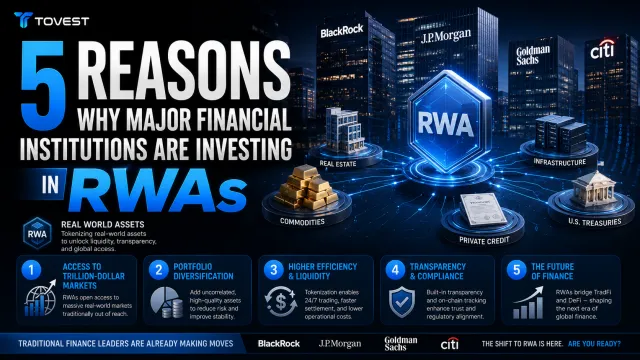
Real-world assets (RWAs) are tangible or traditional financial assets—like real estate, equities, commodities, or bonds—whose ownership and trading rights are represented on blockchains. By 2026, RWA investing has moved into the mainstream as tokenization standardizes issuance and secondary trading while improving liquidity and transparency. Industry coverage shows tokenized assets scaling rapidly—Forbes reported real‑world asset tokenization hit $24 billion in 2025 as major financial institutions ramped up pilots and products. As an investor, you can access RWAs through compliant platforms, complete digital onboarding, fund with fiat or stablecoins, and purchase fractional tokens that reflect direct claims on the underlying asset. This guide covers top platform categories, 2026 trends, how to invest, key risks, regulatory context, and practical selection tips. ToVest: Blockchain-Powered Tokenized Real-World Asset Platform ToVest is a blockchain investing gateway that provides tokenized, fractional ownership of U.S. equities and real estate to a global audience. The platform is designed for daily usability and institutional-grade safeguards: 24/7 markets, instant execution, margin and leverage tools, seamless fiat and stablecoin funding, and rapid settlements across a regulated, auditable workflow. Security features include multi-layer custody with cold storage, 2FA, and continuous monitoring. Feature-by-feature, here’s how ToVest helps you capitalize on RWA opportunities: For deeper background on tokenization mechanics and investor protections, see our explainer on the evolution of RWAs and digital market structure on the ToVest blog. Tokenized Real Estate Platforms Tokenized real estate platforms fractionalize legal property ownership so investors can buy digital shares in residential or commercial assets. Smart contracts record ownership and automate cash flows, enabling 24/7 access and transparent performance data. Returns typically come from rental income distributed on-chain and potential price appreciation over time, with secondary marketplaces providing liquidity when available, as outlined in RWA.io’s 2026 outlook. Common uses include: Diversifying into global property markets without local residency or large capital outlays Lowering entry minimums via fractional ownership Accessing liquidity through regulated secondary trading venues What to compare across platforms: Cash-flow tokens and distribution schedules Legal structuring and investor protections Programmable claims and auditability of property-level data Asset-Backed Debt Marketplaces Asset-backed debt marketplaces issue loans or receivables—consumer, SME, or real estate—on-chain as tradable tokens with embedded repayment mechanics and risk tiers. The scale is compelling: fixed income is a roughly $130 trillion market, and on-chain wrappers are pulling these instruments into programmable, transparent formats according to 2026 industry predictions. Typical instruments include: Mortgage-backed securities (MBS) Asset-backed securities (ABS) Consumer and credit card receivables SME and invoice financing Key platform capabilities: On-chain data rooms for collateral and performance Automated audits and reporting streams Default risk scoring and triggers Programmable repayment pipelines and waterfalls Tokenized Funds and ETFs Tokenized funds and ETFs pool assets—public equities, bonds, or alternatives—and issue blockchain-based tokens that represent investor shares and rights. Investors gain instant exposure with fractional access and intra-day liquidity, even for traditionally illiquid strategies. Examples include tokenized U.S. equity ETFs, on-chain money market funds, and diversified private equity vehicles, with operational improvements such as real-time settlement and automated compliance. How tokenized funds compare to conventional ETFs: Commodity Tokenizers Commodity tokenizers convert physical assets—gold, silver, oil—into blockchain-based tokens, turning stores of value into 24/7 tradable instruments with built-in audit trails. Gold and silver remain strategic hedges: gold set repeated record highs since October 2023 amid macro uncertainty, a trend expected to support demand into 2026, as noted by FXEmpire’s hard-asset analysis. Common offerings: Vault-backed gold and silver Oil exposure and energy baskets Broad commodity indices What to look for: Independent audits and attestations Custody transparency and vault insurance Programmable transfer controls to meet jurisdictional rules Securitization and Asset-Backed Securities Chains Blockchain-native securitization platforms mint on-chain ABS—such as MBS or collateralized loan obligations—split into tranches for targeted risk and yield. Managers and allocators are tilting toward structured credit; Morgan Stanley’s 2026 fixed-income themes highlight MBS/ABS as key overweight areas for yield and diversification. Innovations reshaping structured products: Programmable waterfalls for cash-flow priority Real-time risk scoring and collateral monitoring Embedded insurance and automated triggers Transparent, auditable performance reporting Use cases span real estate, private credit, and diversified structured finance. Key Trends Driving Real-World Asset Investing in 2026 Macro catalysts: Inflation dynamics and fiscal deficits continue to push flows toward tangible and inflation-sensitive assets, supportive of hard-asset allocation through 2026. Technical advances: On-chain data integration unlocks real-time performance tracking, while AI-driven valuations and oracles support dynamic, transparent pricing. Regulatory maturation: Jurisdictions are clarifying token issuance, custody, and transfer rules, helping pilots evolve into repeatable, compliant products at scale. Stablecoin rails: Mainstream adoption enables faster settlement, cross-border access, and lower operating frictions. Institutionalization: Larger asset managers are adopting tokenization to compress costs, unbundle liquidity, and broaden distribution. How to Invest in Real-World Assets through RWA Platforms Research and select a compliant, audited platform (e.g., ToVest) with clear asset disclosures and legal structures. Complete KYC/AML onboarding to verify identity and eligibility. Fund your account with fiat or stablecoins to streamline global settlement. Browse the marketplace and evaluate tokenized assets by collateral, yield, liquidity, and risk. Allocate capital by purchasing tokens that represent claims on the underlying asset; fractional ownership allows multiple investors to own pieces of high-value assets, enhancing accessibility and liquidity. Track performance on-chain, review statements, and rebalance as markets evolve. Practical checks before you invest: Benefits of Using RWA Platforms for Investment Global market access via digital onboarding and borderless funding Fractional ownership with low minimums across property, credit, and commodities Increased liquidity for assets previously difficult to trade, with transparent secondary markets Real-time transparency through on-chain reporting and audit trails 24/7 markets with faster settlement and fewer intermediaries Programmable features such as automated audits, risk scoring, and embedded insurance for stronger investor confidence Independent research on tokenization details how on-chain issuance and settlement reduce frictions and open new distribution channels across private and public markets, supporting the liquidity and access advantages noted above. Risks and Challenges in Real-World Asset Investing Key risks include smart contract vulnerabilities, platform solvency or custody failures, evolving legal enforceability, local compliance limits, and market risks like limited liquidity or price gaps. Industry analyses note that enforceability, liquidity, interoperability, security, and privacy remain open questions as the market scales. Comparison of risk factors: Investor protections: perform due diligence, favor platforms with third-party audits, review legal documentation, diversify exposures, and size positions for liquidity risk. Legal and Regulatory Considerations for RWA Investing Legal wrappers define investor rights to income, collateral, and governance, while regulated transfer modules enforce eligibility and cross-border rules. As regulators clarify issuance, custody, and secondary trading, institutional adoption accelerates and investor confidence improves. Best practices include selecting platforms with clear licensing, robust KYC/AML, transparent disclosures, and adherence to applicable securities law in your jurisdiction. Frequently Asked Questions about Real-World Asset Investing What are the advantages of tokenized real-world assets? Tokenized assets offer superior liquidity, lower minimums via fractional ownership, and transparent, auditable ownership records for global investors. How do stablecoins facilitate real-world asset transactions? They provide fast, low-cost settlement across borders, reducing banking delays and mitigating currency risk during transfers. What should investors look for when choosing an RWA platform? Prioritize regulatory compliance, third-party security audits, clear asset documentation, and programmable risk controls such as automated reporting. How is asset ownership verified and secured on blockchain platforms? Ownership changes are recorded immutably on-chain; tokens represent verifiable claims secured by cryptography and governed by legal wrappers. What risks should investors consider in RWA markets? Watch for regulatory uncertainty, limited liquidity in some markets, smart contract vulnerabilities, and counterparty or custody risks.

blog banner

9 มกราคม 2569

International Investing: Expanding Your Horizon

Understanding Global Markets International investing involves allocating capital into securities (stocks, bonds, or funds) issued by entities located outside your domestic borders. While home-country bias is common, looking abroad opens doors to thousands of opportunities that aren't available locally. Why Diversify Globally? Decoupled Performance: Foreign markets don't always move in sync with the U.S. or your home market. This "low correlation" helps stabilize your portfolio when domestic prices dip. High-Growth Potential: While developed economies offer stability, emerging markets often provide rapid growth driven by young demographics and industrialization. Currency Diversification: Holding assets in Euros, Yen, or other currencies can act as a hedge, potentially increasing returns if your home currency weakens. Types of Global Markets Investors typically categorize the world into three distinct zones: Developed Markets: Countries with robust infrastructure, stable legal systems, and mature economies (e.g., UK, Japan, Germany). Emerging Markets: Regions transitioning toward industrialization with high growth potential but higher volatility (e.g., India, Vietnam, Brazil). Frontier Markets: Developing nations in early growth stages, offering the highest risk and reward (e.g., parts of Africa or the Middle East). Risks to Consider Exchange Rate Risk: The value of your investment can rise or fall simply based on the fluctuating value of foreign currencies relative to your own. Geopolitical Factors: Changes in trade laws, political unrest, or shifts in foreign government regulations can impact asset prices suddenly. Strategic Allocation Experts, including firms like Vanguard, often suggest that international securities should make up a significant portion of a balanced portfolio. A common benchmark is to allocate approximately 40% of your equity portion to international stocks and 30% of your fixed-income portion to international bonds. Here is the professional English version of your supplemental sections and conclusion, designed to be insightful and persuasive for an international investment guide. Strategic Tools for Global Market Access Understanding the markets is one thing, but choosing the right "vehicle" is the ultimate factor in determining costs and efficiency. International ETFs (Exchange-Traded Funds): This is the most efficient and popular route. ETFs such as VEU (All-World ex-US) or VWO (Emerging Markets) allow you to gain exposure to thousands of companies with a single trade. American Depositary Receipts (ADRs): These allow you to purchase shares of foreign giants—such as Alibaba or Toyota—directly on major domestic exchanges without needing a foreign brokerage account. Global Mutual Funds: Ideal for those seeking active management. Professional fund managers filter and select the best-performing businesses, especially in volatile or less transparent regions. Critical Insights on Investor Psychology and Management Investing internationally is not just about crunching numbers; it is a test of patience and discipline: Overcoming "Home Bias": Most investors feel a false sense of security keeping their capital within their own borders. However, ignoring the remaining 50% of the global market capitalization is a massive missed opportunity for diversification. Managing Information Gaps: News from foreign markets may arrive with a delay or be harder to interpret. Utilizing Passive Investing (index funds) can alleviate the stress of monitoring global tickers 24/7. The Long-Term Perspective: Emerging markets can remain stagnant for years before a major breakthrough. Do not abandon your position due to short-term political fluctuations or temporary volatility. Conclusion: The Answer to Sustainable Financial Security Expanding an investment portfolio beyond national borders is an essential step for any sophisticated investor. International investing is not a high-risk "gamble" in uncharted lands; rather, it is a proactive defense strategy. By allocating a strategic portion (typically 20% to 40%) to developed and emerging markets, you do more than just hedge against domestic economic shocks—you position yourself to capture the growth of human innovation on a global scale.

blog banner
ToVest