Crypto‑to‑US Stock Investing Risks & Opportunities in 2026
15 มกราคม 2569
Investors can now move between crypto and U.S. stocks more easily than ever—funding brokerage accounts with digital assets, buying spot bitcoin ETFs, or accessing tokenized shares that mirror listed equities. The benefits are clear: new diversification levers, fractional access, and potentially faster settlement. The trade‑offs are equally real: higher volatility, evolving regulation, and custody complexity. This guide explains the 2026 landscape, from institutional adoption and tokenization to correlation math, risks, and practical allocation playbooks. ToVest’s role is straightforward: provide clear, research‑backed guidance and tools so retail investors can harness innovation without taking on avoidable risks.

Strategic Overview
Institutional demand, maturing ETF wrappers, and rapid advances in tokenization are blurring the line between crypto and U.S. equity investing. Spot bitcoin ETFs have embedded crypto exposure into mainstream portfolios, while tokenized securities are bringing fractional, 24/7 access and programmable features to traditional assets. At the same time, regulators are clarifying parts of the rulebook—particularly around ETFs and stablecoins—though market structure and DeFi oversight remain in flux. For individual investors, the question isn’t whether crypto and stocks intersect; it’s how to size and implement exposure responsibly. ToVest helps investors evaluate risk, diversification, and execution options with transparent education and portfolio analytics.
Institutional Trends Shaping Crypto and US Stock Integration
Institutionalization refers to the adoption of crypto by large, traditional financial players via regulated vehicles, mandates, and standardized custody. The trend is accelerating in 2026: global assets in crypto ETFs and ETPs are estimated above $200 billion, with continued penetration expected through ETF wrappers into 401(k)s and mandates this year, according to a recent outlook on five key crypto trends for 2026 from Forbes. Products like spot bitcoin ETFs and diversified digital‑asset ETPs are increasingly owned by intermediaries rather than retail alone; in fact, investment advisors now hold a substantial portion of ETP assets, with research from Grayscale’s 2026 outlook noting that roughly half of crypto ETP assets sit with advisor channels, a sign of mainstream portfolio integration.
Table: Where integration stands versus early adoption
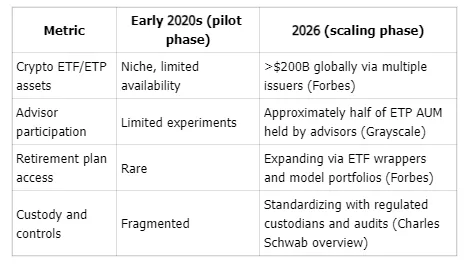
Broader education from mainstream firms—such as Schwab’s balanced take on crypto’s role and risks—underscores that institutional acceptance is growing, even as prudent risk controls remain paramount.
Tokenization and New Access to Traditional Assets
Tokenization is the process of converting traditional assets, such as stocks or bonds, into digital tokens on a blockchain, enabling fractional ownership, programmable features, and 24/7 trading. Regulatory plumbing is adapting: Forbes notes the SEC approved the DTCC to provide tokenization services, a milestone for bringing traditional finance workflows on‑chain. The World Economic Forum highlights that tokenization enables fractional, programmable, tradable representations of assets on blockchains, broadening access and improving operational efficiency.
Key benefits investors care about:
- Fractional access that lowers entry points and widens participation.
- Faster settlement and improved liquidity from always-on markets and on-chain rails.
- Programmatic rebalancing, composability with other assets, and transparent audit trails.
Use cases range from tokenized stocks and bonds to real-world assets like funds, real estate, and collectibles—expanding the investable universe beyond listed equities and Treasuries. At the same time, investors should understand tokenized-stock design and counterparty risks, which Bankrate has flagged as a distinct set of issues compared with owning underlying shares through traditional brokers.
Tokenization benefits versus traditional finance:
- Lower minimums vs. full-share constraints
- 24/7 trading vs. market-hour windows
- Real-time settlement vs. T+1/T+2 cycles
- On-chain transparency vs. fragmented back offices
Regulatory Landscape and Its Impact on Investment Strategies
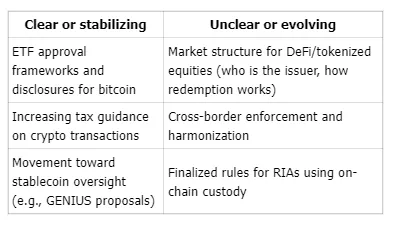
Regulatory clarity refers to the establishment of clear, consistent legal rules governing financial activities, which helps investors manage compliance uncertainty. Progress is real yet uneven in 2026. Money.com’s predictions highlight proposals like the GENIUS Act, which would define rules for issuing, reserves, and oversight of stablecoins, and anticipate additional IRS guidance providing greater clarity on crypto taxes. Fidelity’s investor education also emphasizes that taxes, reporting, and regulatory oversight remain essential considerations for crypto users.
Even with improvements, uncertainty still matters. Schwab cautions that evolving rules and market structure can affect access, liquidity, and product design, keeping some institutions cautious.
Practical takeaways:
- Prefer regulated ETFs/ETPs for core exposure while rulebooks mature.
- Stress-test allocations for sudden policy changes (listing venue restrictions, tax treatments, or custody rules).
- Monitor new rules for DeFi protocols and tokenized assets, including redemption mechanics and disclosures.
Checklist: What’s clear vs. still evolving in 2026
Correlation Dynamics and Portfolio Diversification Benefits
Correlation measures how closely the returns of two assets move in relation to each other. Low or negative correlation means the assets behave differently, which can improve diversification. Rolling 90‑day correlations show bitcoin’s correlation with the S&P 500 has rarely exceeded 0.50, according to Bitwise’s 2026 predictions, supporting the case for crypto as a diversifier. Bitwise also expects crypto-specific factors—like supply halving effects and on-chain flows—to further reduce correlation with equities in 2026.
How much crypto might help? Some large-bank strategists suggest that a modest 1–4% allocation can enhance diversification without dominating portfolio risk, as discussed in a 2026 market outlook video from Bank of America.
A simple way to evaluate diversification benefits:
- Estimate crypto’s expected volatility and correlation to your stock sleeve (use rolling correlations from reputable sources).
- Start with a small slice (1–2%) and model portfolio volatility and drawdowns.
- Stress-test for equity-down and crypto-down scenarios separately.
- If the risk/return improves, consider scaling toward 3–4% with periodic rebalancing.
- Prefer liquid, regulated vehicles to minimize implementation and custody frictions.
For a foundational comparison of crypto and stocks—including volatility, liquidity, and time horizon trade-offs—see Bankrate’s overview contrasting the two asset classes.
Risks of Crypto-to-US Stock Investing
Risk in investing refers to the potential for loss or the variability of investment returns, arising from factors such as market swings, regulatory changes, or technology failures.
Primary risks to weigh:
- Regulatory shock: Unexpected rules can trigger rapid repricing or access limits, especially for tokenized or on-chain instruments, as noted in 2026 outlooks from Money.com.
- Liquidity and custody: New token rails reduce settlement friction but introduce orchestration and redemption risks until standards mature; Bankrate’s analysis of tokenized stocks explains why structure and counterparties matter.
- Volatility: Bitcoin remains far more volatile than the S&P 500; 2026 reassessments still show a persistent volatility gap, per Investing.com research.
- Valuation concentration: Niche crypto equities and ETPs can concentrate exposure to a few winners, raising idiosyncratic risk; Bitwise’s predictions discuss dispersion risks in crypto markets.
- Consumer protection and scams: State regulators continue to warn about fraud and loss risks in crypto markets, per guidance from the DC Department of Insurance, Securities and Banking.
Comparing risk profiles
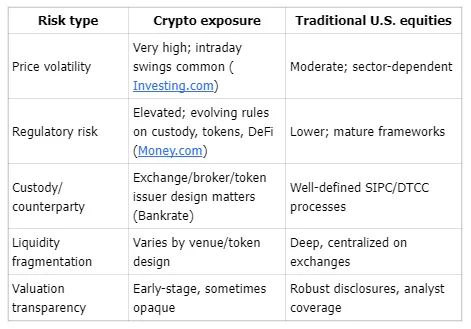
Consider stress-testing your portfolio for rule changes, liquidity squeezes, and high-volatility scenarios before adding or sizing crypto allocations.
Opportunities in Crypto-Backed US Stock Investments
Opportunities include new diversification levers, innovative token‑based products, and access to asset classes that were previously hard to reach. Crypto ETFs/ETPs and tokenized securities create lower-friction ways to gain exposure without handling private keys—useful for modest allocations inside diversified portfolios, as highlighted in Bitwise’s 2026 view. Money.com notes that many investors see 2026 dips as long‑term entry points. Adoption momentum is rising: about 30% of Americans owned cryptocurrency in 2026, and 61% planned to buy more, according to Security.org’s annual consumer report.
Where investors can benefit:
- Lower entry barriers via fractionalized stocks and funds.
- Potential sources of alpha from less-correlated digital assets.
- Tactical slices such as 1–4% crypto exposure to balance diversification and risk, echoing bank strategist guidelines.
Top opportunity areas for 2026:
- Regulated spot crypto ETFs inside retirement and advisory accounts
- Tokenized Treasurys and investment-grade credit for yield and liquidity
- Blue-chip crypto plus quality miners or infrastructure equities as satellite exposure
- Dollar-cost averaging into diversified crypto baskets to reduce timing risk
ToVest’s Strategic Guidance for Crypto and US Stock Allocations
Treat crypto exposure as a strategic, experimental sleeve: size allocations modestly, prefer regulated ETPs or tokenized instruments with clear redemption mechanics, and stress-test for regulatory, liquidity, and correlation shocks. ToVest’s philosophy is to balance innovation with simplicity and transparency.
Best practices:
- Keep total crypto exposure small relative to your equity sleeve (1–4%) and rebalance periodically.
- Prioritize high-quality assets and ETFs with transparent holdings, oversight, and robust liquidity.
- Use ToVest’s portfolio analysis to track rolling correlations, simulate drawdowns, and monitor regulatory headlines.
- Educate continuously; start with ToVest’s portfolio management guide and risk management primers for step-by-step frameworks.
A quick ToVest checklist for implementing a crypto-to-stock allocation:
- Define your objective: diversification, return enhancement, or liquidity.
- Choose vehicle(s): spot ETF/ETP for core, tokenized instruments only where redemption mechanics are clear.
- Set size and rules: begin at 1–2%, cap at 4%, and pre-commit to rebalancing bands.
- Run stress tests in ToVest for policy, liquidity, and volatility scenarios.
- Execute and monitor: track slippage, spreads, and correlation drift; revisit quarterly.
- Continue learning with ToVest’s market outlooks and educational modules.
Explore ToVest’s latest outlooks and portfolio how-tos to turn these steps into an actionable plan: see our market trends briefing, portfolio academy module, and risk analysis walkthrough.
Frequently asked questions
How volatile is Bitcoin compared to US stocks?
Bitcoin is still materially more volatile than broad U.S. equity benchmarks like the S&P 500, even if high-growth tech names occasionally show significant swings.
What is the expected correlation between crypto and US equities?
Historically low and variable; bitcoin’s rolling correlation with the S&P 500 has rarely exceeded 0.50, implying diversification potential.
How will regulatory changes affect crypto-to-stock investments in 2026?
ETF and tax clarity are improving access, but evolving rules for DeFi and tokenized assets mean investors should favor regulated vehicles and stay alert to policy updates.
What role do tokenized stocks play in modern portfolios?
They offer fractional access, programmability, and extended trading hours, but investors must understand issuer structure and redemption mechanics.
How can investors balance risk and opportunity in crypto and US stocks?
Use a modest crypto sleeve within a diversified stock portfolio, prefer regulated products, and rebalance and stress-test regularly.