How to Overcome High Fees When Buying US Stocks Abroad
14 มกราคม 2569
Buying US stocks from overseas doesn’t have to be expensive. The biggest cost drivers are rarely the headline commission; they’re the hidden frictions—currency conversion spreads, non-trading fees, routing charges, and poor execution. This guide shows you how to reduce those costs step by step: pick the right instrument for your goal, compare brokers on total cost (not just $0 commissions), optimize FX and funding, consolidate trades, and use hedging and tax-aware approaches where appropriate. Throughout, we highlight where ToVest’s fractional access, instant settlement, and low-latency execution can simplify investing for non‑US investors, while ensuring transparency remains a priority.

Choose the Most Cost-Effective Investment Instruments
The cheapest path depends on whether you want direct ownership of US shares or indirect exposure via instruments listed in your home market. A practical choice often reduces FX, custody, or fund fees. Industry broker guides detail how access and pricing vary by market and asset type, which is why starting with the access model is crucial (see the Best International Brokers guide from Stockbrokers.com for a comparative overview).
- ADRs (American Depositary Receipts): Dollar‑denominated receipts that represent foreign shares and trade on US exchanges. These simplify access to foreign companies for US markets but are technically not US companies. Example: AstraZeneca trades in the US as an ADR (AZN).
- Pros: US exchange liquidity; USD pricing; often robust disclosure.
- Cons: Depositary bank fees; not a tool to buy US companies; tax treatment can differ by ADR program.
- Cross-listed shares: The same company’s equity listed on more than one exchange, boosting access and liquidity. Example: Carnival has cross‑border listings that allow investors to trade the group on multiple venues.
- Pros: Trade in your local currency/venue; sometimes tighter local spreads; may reduce FX conversions.
- Cons: Price gaps vs. US line; local stamp duties or exchange fees may apply; liquidity can vary.
- International/global ETFs: Funds listed outside the US that hold US stocks (or track US indexes). Also includes global funds with US exposure.
- Pros: One trade for diversified US exposure; institutional FX and execution inside the fund; simple for regular contributions.
- Cons: Ongoing expense ratio; potential tracking error; currency share classes matter (unhedged vs. hedged); local taxes apply.
- Direct US stock purchases: Buying US-listed shares (and fractional ownership where available) through ToVest or an international broker or platform.
- Pros: Clean exposure; often $0 commissions on US exchanges; access to order types and depth; fractional ownership reduces ticket sizes.
- Cons: FX conversion costs; possible SEC/FINRA regulatory and routing fees; custody or withdrawal fees from some brokers.
Tip: If you regularly dollar-cost average, fractional US shares on a low‑FX platform such as ToVest can beat fund fees over time. If you want broad US exposure in one move, an international ETF may be cheaper once spreads and conversions are considered.
Compare Brokerage Platforms on Total Cost
Total cost of ownership matters more than any one fee line. Compare brokers on commissions, FX spread, non‑trading fees (inactivity, withdrawal), custody, and any per‑share routing or regulatory charges. The FX spread—the difference between buy and sell rates for currency conversion—often dominates overseas investing costs. Across brokers, it typically ranges from 0.1% to 1.4%, with an average around 0.6% for retail flows.
Create an apples-to-apples comparison before funding:
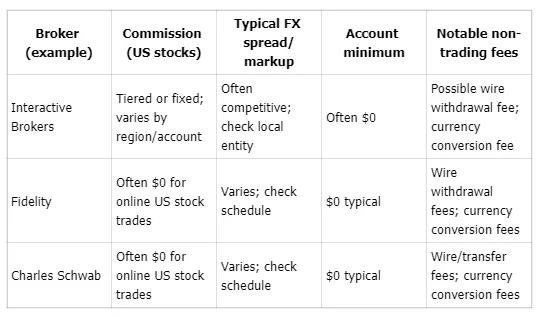
How to compare like a pro:
- Simulate small, medium, and large trades. Include per‑share costs and any routing or regulatory fees that scale with share count.
- Price the full “landed cost” of USD funding: your bank’s FX fees + broker’s FX spread/fee + any transfer charges.
- Check country-specific schedules; fee waivers in one region may not apply to non‑resident accounts.
- ToVest note: instant settlement and low‑latency execution can reduce slippage and opportunity cost—two “invisible” costs rarely listed on fee tables.
Optimize Currency Conversion and Funding Methods
FX drag is often the largest recurring cost for overseas investors. Small changes here pay off quickly.
- Use multi-currency accounts or USD funding: Holding USD avoids repeated conversions when buying and selling US stocks.
- Batch conversions: Convert larger amounts less frequently to reduce repeated spread costs. On average, retail FX conversions incur a 0.1%–1.4% spread, and some brokers add explicit ~1% per side; these erode small trades quickly.
- Choose efficient rails: Bank wires are predictable; where supported, USD‑pegged stablecoins can offer fast settlement and transparent on‑platform conversion. Always confirm your platform’s deposit/withdrawal and conversion fees.
- Know the terms: FX fees are any costs tied to converting your local currency into USD (or back), including spreads, commissions, and bank transfer charges.
ToVest tip: Funding in USD and deploying fractional orders can minimize repetitive FX and per‑ticket costs, especially for recurring contributions.
Consolidate and Time Trades to Minimize Fees
Execution tactics matter as much as pricing schedules.
- Consolidate tickets: Avoid frequent, tiny trades that trigger per‑ticket and per‑share charges. Exchange routing fees can scale with share count; routing 100,000 penny shares can cost roughly $300 in fees alone.
- Time FX and markets: Convert when FX rates are favorable or volatility is lower, and align orders with liquid US market hours to minimize spreads and slippage.
- Track “gotchas”: Account minimums, inactivity fees, and withdrawal fees vary by broker and region. Put renewal dates and fee changes on your calendar.
Quick checklist:
- Price your total FX cost (bank + broker).
- Bundle orders where sensible; use fractional shares instead of multiple micro‑tickets.
- Prefer liquid hours; use limit orders for control.
- Review non‑trading fees quarterly; switch providers if your profile changes.
Use Currency-Hedged Products and Understand Tax Implications
Currency swings can overwhelm stock returns over short horizons. Currency‑hedged ETFs aim to minimize the impact of FX fluctuations on your investment returns, helping stabilize overseas holdings—useful if currency volatility is high or your investment horizon is short. Unhedged share classes can be preferable for long‑term investors willing to accept currency risk for lower fees and potential diversification.
Taxes also affect your net return:
- Withholding tax: US dividends paid to non‑residents can be subject to withholding; rates depend on tax treaties and forms (e.g., W‑8BEN).
- Foreign tax credit: In many jurisdictions, you may claim a credit for taxes paid abroad to offset domestic tax liability, up to the local limit.
- Vehicle matters: ADRs can carry depositary fees; ETF domicile affects withholding rates; direct holdings may have different reporting.
For your situation, consult a qualified tax advisor. For practical context on cross‑border investing, see ToVest’s investor tax overview (https://tovest.com/en-US/blog/report/574333).
Regularly Monitor Fees and Adjust Strategies
Fees and FX conditions change. Stay proactive:
- Review fee tables and FX spreads quarterly; broker averages can move with market volatility and regulation.
- Monitor broker notices and industry news for changes to routing, platform, or tax policies.
- Use tools or set calendar reminders to reassess your funding method, order sizing, and product mix as your balance grows.
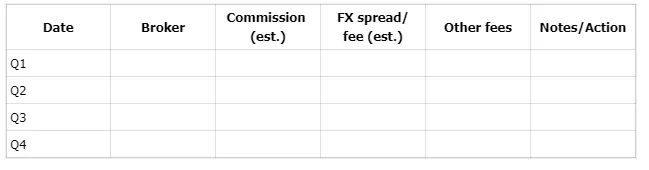
Sample tracking template:
Frequently Asked Questions
What are the main fee components when buying US stocks from abroad?
Trading commissions, currency conversion (FX) costs, regulatory or routing charges, and non‑trading fees such as inactivity, custody, and withdrawals.
How do foreign exchange fees impact investment costs?
They can dominate total cost because every deposit, trade, and sale that touches USD may incur a spread or markup that compounds over time.
What strategies can reduce currency conversion costs?
Use multi‑currency or USD accounts, convert in larger batches, and choose platforms with transparent, competitive FX rates.
What additional charges should investors consider?
Withdrawal and transfer fees, ADR depositary fees (if applicable), account minimums/inactivity charges, and exchange routing or regulatory fees.
How does tax treatment affect returns on US stock investments?
Withholding taxes on dividends, local capital gains rules, and available foreign tax credits can materially change your net return depending on residency and instrument.