Real‑World Asset Investment Trends 2025: What Every Investor Must Know
25 ธันวาคม 2568
Investing in tokenized real-world assets is moving from niche to mainstream in 2025. If you’re wondering how to invest in real-world assets through RWA platforms—or whether you can buy tokenized real estate—the answer is yes. Investors can open an account on a compliant RWA platform, complete KYC, fund with fiat, crypto, or stablecoins, and purchase fractional tokens that represent real assets. Institutional adoption and improved infrastructure are unlocking 24/7 trading, lower minimums, and global access. This guide explains what’s changing, which asset classes are leading, how blockchain and stablecoins power the market, and practical steps to participate—along with the risks you should weigh before you buy.
The Rise of Real-World Asset Tokenization
Tokenization is the process of converting real assets like real estate, private credit, or infrastructure into fractional digital tokens on a blockchain—making them tradable, accessible, and liquid for investors globally. Institutional leaders, including major asset managers and banks, are piloting and scaling tokenization, and the market is widely projected to surpass $50 billion by the end of 2025, signaling a decisive shift toward mainstream adoption, according to the RWA Market Outlook 2025 from industry analysts (RWA.io) RWA Market Outlook: Trends and Projections for 2025. By lowering minimums and enabling cross-border participation, tokenization democratizes access to historically gated assets such as real estate and art, expanding diversification options for both retail and professional investors Emerging Trends in Alternative Investments for 2025.
Benefits of tokenization at a glance:
- Fractional ownership of real assets
- Lower minimum investments and faster onboarding
- 24/7 secondary trading with near-instant settlement
- Global, cross-border access and programmable compliance
- Transparent audit trails and standardized reporting
Key Asset Classes Driving Growth in 2025
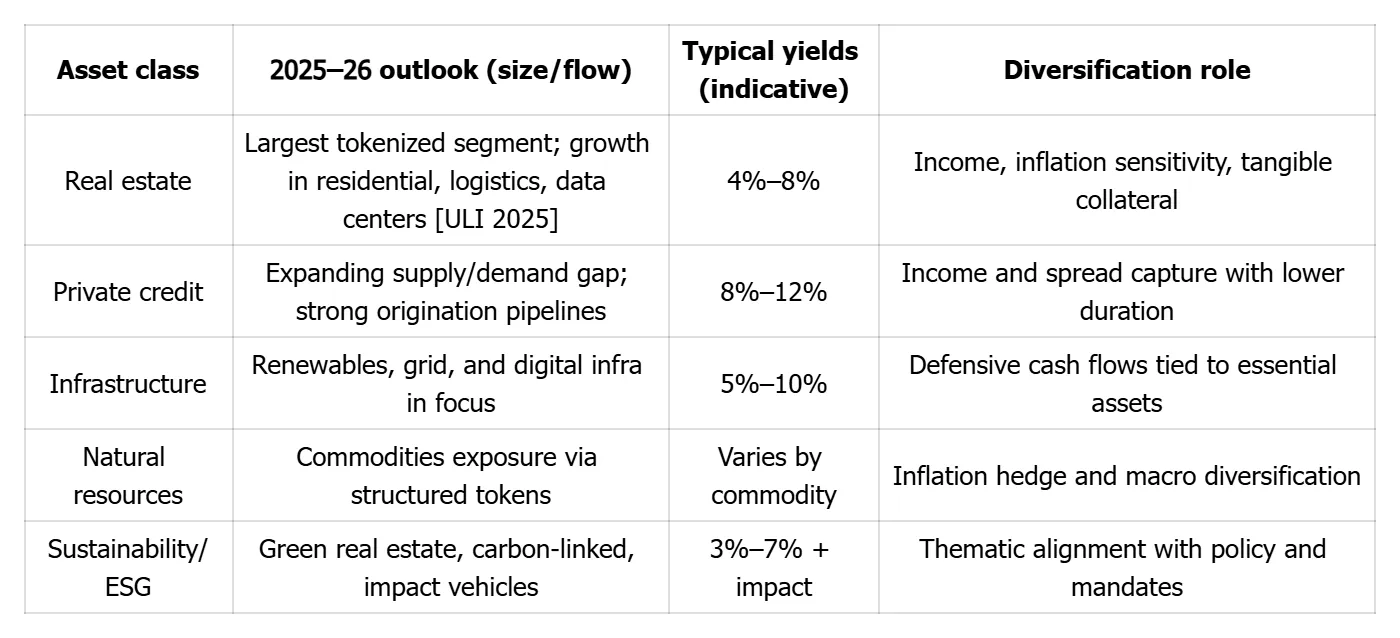
Real assets are seeing renewed demand as inflation hedges and diversifiers, with real estate expected to remain the largest segment and some forecasts projecting a market cap near $1.4 trillion by 2026 within tokenized structures, supported by broader alternative flows Emerging Trends in Alternative Investments for 2025. Sectorally, data centers and logistics (fueled by AI and e-commerce) and renewable infrastructure are leading performance trends in the built environment ULI Emerging Trends in Real Estate 2025.
Below is a comparative view of leading RWA categories in 2025 (illustrative ranges vary by strategy and risk):
How Blockchain and Stablecoins Transform RWA Markets
A blockchain is a secure, decentralized digital ledger that enables peer-to-peer trading and near-instant settlement—ideal for tokenized assets. Standardized on-chain tokens reduce operational friction, automate compliance, and compress settlement cycles toward T+0, lowering costs across issuance, trading, and servicing EY digital assets survey.
Stablecoins are cryptocurrencies pegged to fiat money, enabling seamless, stable-value transfers across borders and underpinning 24/7 transactions in RWA markets. Interest among investors is rising, with many exploring stablecoins for yield, FX efficiency, and transaction settlement EY digital assets survey.
A tokenized RWA trade in practice:
- Investor completes KYC/AML on an RWA platform and funds with fiat, crypto, or stablecoins.
- The platform allocates or matches a buy order; a smart contract records ownership on-chain.
- Stablecoins settle the transaction instantly; custody updates reflect new beneficial ownership.
- Corporate actions (rents, coupons) flow via on-chain distributions to token holders.
- Tokens can be listed for secondary trading with real-time price discovery.
Institutional Adoption and Its Impact on Liquidity
Institutional allocations to tokenized assets are accelerating, moving RWAs from an experiment to a mainstream opportunity and catalyzing product innovation across public, private, and semi-liquid formats RWA Market Outlook: Trends and Projections for 2025. As institutions enter, order books deepen, and secondary markets gain traction; private markets’ secondary transaction volumes recently reached record levels, supporting better exits and price discovery Alternative Investments in 2025: Themes to Watch. The “great convergence” of traditional and digital platforms is also merging public and private strategies into hybrid, semi-liquid products, broadening access while preserving exposure to alternative premia McKinsey Great Convergence.
Liquidity means how quickly and easily an asset can be bought or sold without significantly affecting its price.
Innovation in AI and Data-Driven Asset Management
AI integration automates underwriting, valuation, compliance, and risk analytics—improving speed, consistency, and scalability for RWA platforms. Industry outlooks suggest that combining blockchain with AI can make tokenized investing more efficient and secure, while also introducing new operational and model risks that must be governed RWA Market Outlook: Trends and Projections for 2025. By 2025, data and AI capabilities are expected to be a core differentiator for asset managers, shaping performance and client experience Asset Management Trends.
Common AI-driven features on digital RWA platforms:
- Instant property or collateral valuation using enriched data
- Automated KYC/AML screening and ongoing transaction monitoring
- Predictive analytics for pricing, defaults, and macro sensitivity
- Smart contract audits and anomaly detection for cyber-resilience
- Dynamic liquidity and order-routing algorithms across venues
Regulatory Landscape Shaping RWA Investment Opportunities
Regulatory clarity is both the top accelerant and a primary risk in digital assets—particularly around custody, tax treatment, disclosures, and stablecoins EY digital assets survey. As frameworks for stablecoins and cross‑border standards mature, international interoperability improves and distribution broadens RWA Market Outlook: Trends and Projections for 2025.
What investors should verify before allocating:
- AML/KYC procedures and jurisdictional registrations
- Asset custody model (qualified custodians, bankruptcy remoteness)
- Token standards and smart contract audit status
- Governance, disclosures, and rights (redemptions, voting, cash flows)
- Tax documentation and reporting processes
Selected regulatory themes in 2025 (high level):
- United States: Stablecoin legislation and clearer guidance on digital asset custody; implications for settlement and money movement.
- European Union: Comprehensive digital asset frameworks improving passporting and issuer obligations; implications for cross‑border distribution.
- APAC: Regulatory sandboxes and licensing regimes enabling controlled pilots and scale‑ups; implications for innovation and risk oversight.
Practical Considerations for Investing in Tokenized Real Estate
Tokenized real estate stands out for fractional ownership, lower minimums, and 24/7 market access—while retaining exposure to rents and appreciation. Many platforms now support multi-funding options (fiat, crypto, stablecoins) and real-time trading to enhance liquidity EY digital assets survey. On ToVest, investors can access fractionalized U.S. stocks and real estate with robust compliance and transparent risk disclosures ToVest platform overview.
How to buy tokenized real estate: step-by-step
- Choose a regulated RWA platform with audited smart contracts and clear legal structures.
- Create an account and complete KYC/AML verification.
- Fund your wallet with fiat, crypto, or stablecoins; confirm custody and settlement timelines.
- Review property documents (title, valuation, leases) and partner track records.
- Purchase fractional tokens; confirm on-chain ownership and distribution schedules.
- Monitor performance, distributions, and secondary market liquidity; rebalance as needed.
Practical tips
- Verify custody: who holds underlying assets and how investor rights are enforced.
- Check settlement: stablecoin rails, redemption windows, and any lockups.
- Confirm governance: disclosure cadence, audits, and contingency plans.
Risks and Challenges Facing Real-World Asset Investors
While 65% of investors cite diversification as a top benefit of digital assets, regulatory uncertainty and operational complexity remain key concerns EY digital assets survey. Principal risks include counterparty exposure, regulatory shifts, operational or cyber threats, liquidity constraints, and model risk from AI-driven decisioning. Counterparty risk is the possibility that a party to a transaction fails to fulfill obligations; liquidity risk is the potential difficulty or cost of selling assets quickly at fair prices.
Mitigation strategies
- Use regulated venues with independent audits and transparent governance.
- Prefer bankruptcy-remote structures and qualified custodians.
- Validate asset provenance, valuations, and service-level agreements.
- Diversify across issuers, asset classes, and maturities.
- Implement strong wallet security and ongoing monitoring.
The Future Outlook for RWA Technologies and Market Integration
Expect the tokenized RWA market to surpass $50 billion by 2025 and top $100 billion by 2026 as both institutional and retail participation deepen liquidity and product breadth RWA Market Outlook: Trends and Projections for 2025. The great convergence of traditional and digital investing is poised to unlock between $6 trillion and $10.5 trillion in new market volume by 2030, reshaping manufacturing, distribution, and investor experience McKinsey Great Convergence. Expect growth in semi-liquid vehicles, ESG-linked structures, and tighter integrations with DeFi and programmable money.
What this means for investors
- More accessible cross‑border products and lower minimums
- Faster settlement, better transparency, and improved price discovery
- Greater choice of semi-liquid and hybrid strategies
- Expanded role for stablecoins and on-chain cash management
- Increased emphasis on compliance, data, and AI governance
Frequently Asked Questions about Real-World Asset Investment Trends
What is real-world asset tokenization and why does it matter?
Real-world asset tokenization transforms assets like real estate and commodities into digital tokens on a blockchain, enabling fractional ownership, greater liquidity, and 24/7 global investing.
Can retail investors access tokenized real estate and other RWAs?
Yes, retail investors can buy fractional shares of tokenized real estate and other RWAs through platforms like ToVest, lowering entry minimums and expanding portfolio options.
What are the main risks associated with investing in RWAs?
Key risks include regulatory changes, counterparty or operational failures, and liquidity challenges, so careful due diligence and using secure platforms like ToVest are essential.
How do stablecoins support real-world asset trading?
Stablecoins facilitate real-world asset trading by providing fast, low-cost, and stable-value transactions, helping investors buy, sell, and settle globally around the clock.
What should investors look for in RWA platforms for safety and compliance?
Investors should check for transparent governance, regulated custody practices, clear legal structures, and independently audited technology when choosing an RWA platform, such as ToVest.