Regulatory Compliance in 2026: ToVest’s Updated Framework Explained
7 มกราคม 2569
ToVest ensures regulatory compliance by embedding controls into the heart of our real-time trading and tokenization workflows, not bolting them on after the fact. We operate a multi-layered model that blends automation, modular control libraries, and accountable governance to meet diverse global obligations across AML/KYC, market integrity, data privacy, and investor protection. Our teams use AI-enabled RegTech for continuous monitoring, dynamic rule updates, and predictive risk scoring—supported by rigorous oversight, independent audits, and transparent reporting. Put simply, the ToVest regulatory compliance framework for 2026 is proactive, measurable, and designed for fast-moving, cross-border markets where enforcement intensity and expectations are rising.

Strategic Overview
ToVest is a blockchain-powered fintech platform for global fractional ownership and tokenized assets. Our compliance program is engineered to scale with innovation and regulation alike. We integrate GRC tooling across product, engineering, and operations so that every new market, asset type, or feature ships with jurisdiction-aware controls, audit-ready evidence, and clear ownership.
Key elements include:
- Integrated, automated controls embedded in onboarding, listing, trading, and settlement pipelines, enabling compliance automation without slowing down execution.
- Regulatory change management that maps emerging rules to control updates across regions, with live status dashboards, evidence repositories, and board-level reporting.
- Third-party compliance across custodians, oracles, analytics providers, and payment rails—complete with continuous due diligence, contractual controls, and performance SLAs.
- Independent testing and issue remediation cycles, ensuring findings translate into durable fixes and measurable risk reduction.
Understanding Regulatory Compliance and Its Importance
“Regulatory compliance is the process by which organizations ensure their policies, operations, and systems align with laws, regulations, and industry standards designed to protect stakeholders and foster market trust.”
In financial services, compliance safeguards investor assets, market integrity, and the viability of business models. For fintech, blockchain, and tokenization platforms, 2026 regulatory requirements are broader and more prescriptive, with growing scrutiny of AI-driven processes, consumer protections, and cross-border data flows. Leading guidance emphasizes that robust compliance frameworks require ownership, documentation, and measurable outcomes, not just policies on paper, reflecting a shift from advisory oversight to active enforcement trends across jurisdictions, as summarized by Diligent’s overview of regulatory compliance and program governance and MetricStream’s guide to compliance frameworks and risk alignment. Practical steps such as control mapping, gap assessments, and continuous monitoring are now table stakes.
Key Trends Shaping Regulatory Compliance in 2026
AI governance refers to the frameworks and policies that ensure artificial intelligence is used safely, ethically, and in accordance with regulatory requirements. In 2026, compliance is increasingly defined by:
- AI governance and controls over automated decision-making (explainability, bias testing, model risk management).
- Cybersecurity, data privacy, and strict breach disclosure windows.
- Third-party and supply chain transparency with continuous monitoring.
- Agile compliance frameworks tailored for blockchain and tokenization, aligned with global compliance standards for 2026.
Enforcement has moved from presence to consequence, with regulators prioritizing measurable outcomes; new and impending rules concentrate on AI governance, cybersecurity, data privacy, and climate-related disclosure, according to cross-industry analyses from MetricStream and sector roundups.
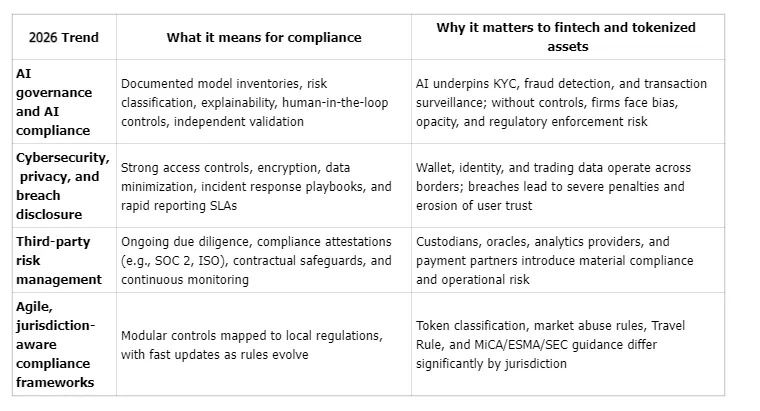
Additional practical guidance stresses automation, evidence capture, and vendor oversight as core enablers of scalable compliance.
ToVest’s Approach to Ensuring Compliance
ToVest moves beyond static checklists by embedding controls into core systems and operational routines, so every trade, update, and integration produces auditable evidence by design.
Our model rests on three pillars:
- Automation and integrated GRC platforms. “GRC stands for Governance, Risk, and Compliance—a unified approach to managing organizational governance, assessing risks, and ensuring regulatory compliance.” We centralize policies, risks, controls, tests, issues, and reporting, with automated control execution wherever feasible. This operationalizes compliance within engineering sprints and product releases.
- Accountability and transparency across all service and vendor relationships. We maintain clear RACI ownership, robust third-party compliance programs, and transparency through dashboards that track SLAs, incidents, and remediation—backed by periodic assessments and attestations.
- Modular, jurisdiction-aware controls. Our control library maps to region-specific obligations and emerging rules; templates allow fast localization while preserving global standards and consistent evidence. This aligns with regulator expectations for measurable, outcome-oriented compliance, not just policy intent.
Integration of AI and RegTech for Automated Controls
RegTech, or regulatory technology, comprises digital tools that automate compliance processes, risk monitoring, and regulatory reporting. ToVest deploys AI-driven RegTech to convert compliance from reactive to predictive:
- Automated monitoring. We surveil token issuance, listings, transfers, and trading behaviors for AML, market abuse, and sanctions risk—scoring events in real time and suppressing noise through model-driven thresholds.
- Real-time control updates. Regulatory change signals update rule engines and workflows, ensuring that new 2026 regulatory requirements are reflected without code-heavy releases.
- Predictive analytics. Models surface anomalies and weak signals before they escalate into incidents, enabling faster intervention and reporting.
Example flow for a suspicious activity alert:
1) Detection: The AI engine flags a cluster of high-velocity transfers linked to a risky jurisdiction.
2) Risk scoring: Contextual features (KYC profile, device signals, prior alerts) produce a high composite score.
3) Triage: A case auto-opens with evidence attached; tiered SLAs assign it to an investigator.
4) Investigation: The analyst reviews blockchain analytics, counterparties, and history; controls can pause settlement if thresholds are exceeded.
5) Reporting: If criteria are met, the system drafts an STR/SAR for compliance officer approval and submission.
6) Feedback: Case outcomes train models; control libraries and playbooks update to prevent recurrence.
By combining compliance automation, AI-driven governance, and rigorous third-party oversight, ToVest stays aligned with global compliance standards for 2026—without compromising the speed and transparency our investors and partners expect.