2026 Guide to the Risks and Rewards of Crypto-Powered US Stock Buying
15 มกราคม 2569
Buying US stocks with crypto is moving from a niche experiment to a real option for global investors. In 2026, tokenization and stablecoin rails make it possible to fund US equity exposure with digital assets, trade fractionally, and settle in near real time—often 24/7. The upside is speed, access, and flexibility; the downside is heightened market and operational risk, plus evolving regulation that varies by jurisdiction. This guide explains how crypto-powered stock investing works, the benefits you can expect, the risks you must manage, and the role platforms like ToVest play in providing secure, transparent, and global access to fractional US stocks.
Overview of Crypto-Powered US Stock Buying
Crypto-powered US stock buying means using cryptocurrencies or stablecoins to invest in US equities via blockchain infrastructure. Instead of wiring dollars to a traditional broker, investors fund accounts with digital assets and gain exposure to US stocks through tokenized shares, synthetic trackers, or crypto-funded brokerage channels on compliant platforms.
Tokenized US stocks are digital representations of equity interests issued and recorded on-chain, enabling fractional trading, programmable settlement, and global reach. Institutional attention and infrastructure have accelerated, yet tokenized assets remain early: they still account for roughly 0.01% of global equity and bond markets, underscoring large headroom for growth, according to a recent outlook from Forbes on 2026 crypto trends.
You’ll see terms like tokenized assets, blockchain infrastructure, crypto rails, and digital asset platform used to describe the building blocks that make crypto-funded equity access possible.
Benefits of Using Crypto for US Stock Investment
Crypto funding introduces several tangible advantages for investors accessing US equities:
- 24/7 market access: On-chain markets don’t close, enabling orders, hedges, and transfers whenever needed.
- Global reach: Borderless crypto rails reduce friction for non-US investors constrained by legacy banking or brokerage limits.
- Fractional ownership and lower minimums: Fractional ownership allows investors to buy portions of a stock, rather than whole shares, lowering the minimum capital required to invest.
- Faster, programmable settlement: Stablecoin settlement can compress T+2 into minutes or seconds.
- Improved capital efficiency: On-chain collateral and integrated wallets reduce idle balances and speed portfolio rebalancing, as highlighted in institutional research on 2026 crypto market structure.
Innovation is also expanding the toolkit. Equity-aligned perpetuals and prediction-market infrastructure have grown rapidly, indicating demand for crypto-funded equity products and hedges.
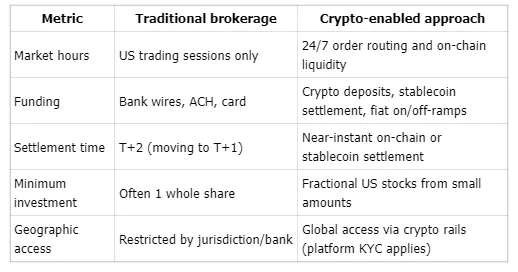
Traditional vs. crypto-enabled US stock investing
Key Risks in Crypto-Powered Stock Trading
Alongside new capabilities come real risks investors must price in:
- Regulatory uncertainty: Rules for tokenized equities and stablecoin settlement are evolving and jurisdiction-dependent.
- Market volatility: Crypto market swings can overwhelm risk budgets; in 2025, many altcoins saw drawdowns of 80%–99%, illustrating the potential severity of market moves (industry recap from KuCoin’s 2026 lessons).
- Operational vulnerabilities: Custody gaps, key mismanagement, and smart contract flaws can cause losses. Smart contract vulnerabilities refer to flaws or bugs in the automated code running on blockchains, which may be exploited.
- Counterparty exposures: Counterparty risk is the possibility that another party involved in a transaction may fail to fulfill their obligations.
Execution risks include stablecoin depegs, redemption delays, token listing/halting events, and legal uncertainties around whether a tokenized share constitutes a regulated security in your jurisdiction. These risks can surface even when underlying US stocks are relatively calm, creating basis and redemption risks that investors must monitor.
Regulatory Landscape and Its Impact on Tokenized US Stocks
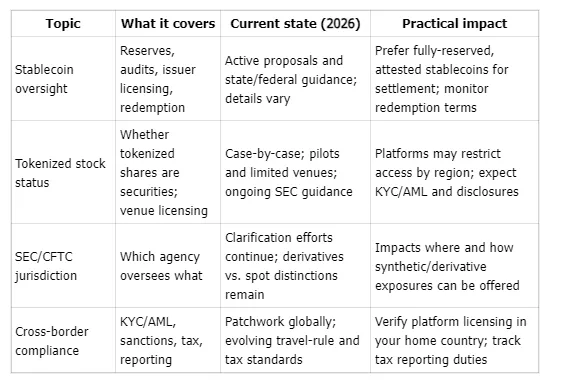
Regulation is catching up, but it is far from settled. In the US, lawmakers have debated stablecoin-specific rules—proposals like the GENIUS Act aim to clarify reserve, issuance, and redemption standards, reflecting broader policy momentum in 2026. At the market-structure level, educational briefings and draft bills continue to delineate SEC versus CFTC oversight and propose pathways for digital-asset market venues (Market-structure legislation explained). Industry pilots involving large market utilities have also explored tokenization and on-chain settlement models, with analysts noting the potential for DTCC-linked services in the tokenization stack, as discussed in Forbes’ 2026 outlook.
Key regulatory topics for investors
Operational Challenges: Custody, Settlement, and Security
Custody solutions are systems and processes for securing and managing investor assets, whether on-chain or off-chain. In crypto-funded equity access, several operational hurdles matter:
- Custody and counterparty risk: Who holds the assets? How are private keys secured? What happens if the issuer or platform fails?
- Cross-chain and fiat settlement complexity: Moving between chains and into bank money adds timing and reconciliation risk.
- Stablecoin redemption path: Minimizing counterparty exposure in digital USD redemptions is essential, especially during stress.
- Transparency and auditability: On-chain proofs, attestations, and clear asset–liability mapping build trust.
Evaluation checklist for custodial arrangements
- Regulated custodian with clear segregation of client assets
- Independent audit trail and public attestations
- On-chain proof of reserves or verifiable settlement records
- Documented, tested redemption guarantees and procedures
- Insurance options and incident response plans
- Hardware-security-module (HSM) or multi-signature key management
- Seamless wallet security and allow-listing controls
Real-time settlement and secure wallet integration reduce legacy friction, but only when paired with robust security, monitoring, and clear operational SLAs.
Market Dynamics and Volatility Considerations
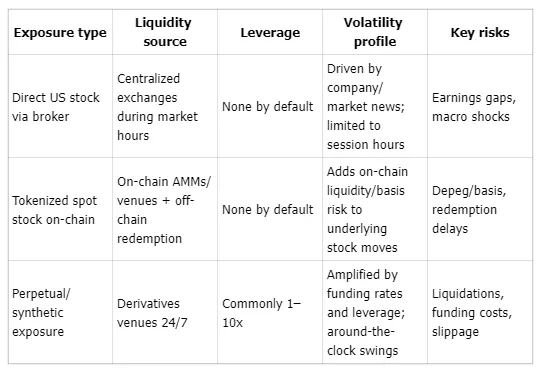
Crypto-powered equity access is shaped by 24/7 liquidity, derivatives, and increasingly institutional flows. Perpetual contracts trade around the clock and enable leveraged exposure; by 2025, perps activity reached roughly $340 billion in weekly volume, with record months near $1.3 trillion—evidence of deep but often volatile on-chain liquidity (KuCoin: 2026 trends and lessons). Institutional participation can improve depth, but leverage and continuous trading can still amplify intraday volatility and gap risks.
Volatility profiles across exposure types
ToVest’s Role in Crypto-Enabled Fractional US Stock Ownership
ToVest brings crypto wallet integration and on-chain custody to fractional US stock investing, combining instant trade execution with real-time analytics and support for both fiat and stablecoin funding. Our model focuses on transparent settlement flows, auditable asset backing, and global accessibility—designed for investors who want crypto-powered stock trading without sacrificing security.
Security architecture highlights
- On-chain custody with verifiable records and proof mechanisms
- Crypto wallet compatibility for seamless deposits and withdrawals
- Robust payment rails for stablecoin settlement and fiat on/off-ramps
- Compliance controls across KYC/AML, sanctions, and market integrity
First-time crypto-funded stock purchase on ToVest
- Connect a verified crypto wallet and complete KYC
- Deposit USDC/USDT or fiat via approved rails
- Choose a US stock and select a fractional amount
- Review fees, confirm on-chain settlement, and execute
- Track positions with real-time analytics and withdrawal-ready balances
Explore our primers on tokenized assets and custody best practices on the ToVest blog (Tokenization academy guide, Security and proof frameworks).
Practical Guidance for Investors Using Crypto to Buy US Stocks
A simple due-diligence checklist
- Verify platform regulatory status and where it is licensed to operate
- Assess counterparty and custody risk: who holds assets, how keys are secured, and failure procedures
- Confirm liquidity and redemption paths from token to fiat
- Understand tax obligations in your jurisdiction and required reporting (Forbes trend analysis)
- Stress-test scenarios: stablecoin depeg, venue downtime, or redemption queues
Best practices
- Diversify across assets and venues; avoid concentrated leverage
- Use hardware wallets and allow-listed withdrawals for funding accounts
- Monitor regulatory updates and platform attestations quarterly
- Document your redemption path and execute small test withdrawals periodically
Choosing your exposure route
- Direct tokenized stock: On-chain token mapped to underlying equity via a licensed intermediary; typically offers fractional investing and redemption rights.
- Synthetic/derivative exposure: Tracks price without conferring ownership; adds funding costs and liquidation risk but can provide 24/7 leverage.
- ETF/ETP-based access: Tokenized or crypto-funded wrappers around diversified baskets; simpler diversification with issuer risk considerations.
For deeper strategy notes and cross-border investing checklists, see our research feed (Investor due diligence checklist, Trend insights).
Frequently asked questions
What are tokenized stocks and how do they work?
Tokenized stocks represent traditional shares on a blockchain, enabling investors to buy, hold, and trade fractional interests using crypto or stablecoins, with settlement recorded on-chain.
How does stablecoin funding affect US stock purchases on crypto platforms?
Stablecoins such as USDC or USDT provide instant, borderless funding that can reduce settlement times and support 24/7 order execution.
What are the main regulatory concerns when buying US stocks with crypto?
Unsettled rules around tokenized securities and stablecoin oversight affect platform legality, investor protections, and access by jurisdiction.
How can investors manage risk in crypto-powered stock investments?
Investors should diversify, utilize secure custody, verify platform licensing and redemption mechanics, and adjust position sizes for crypto-level volatility.
What distinguishes direct token ownership from synthetic or derivative exposures?
Direct tokens confer a claim on the underlying asset via a custodian, while synthetics mirror price without legal ownership and add funding and liquidation risks.