Crypto for Beginners 2026: Where to Start, What to Avoid, and Why RWA Is the Smarter Entry Point
July 15, 2026
The Honest Truth About Getting Into Crypto in 2026
Every week, millions of people search for the same question: "Should I invest in crypto?"
The answer in 2026 is more nuanced than it was in 2017, 2020, or even 2021. Crypto is no longer just Bitcoin and Ethereum. The ecosystem has matured into multiple distinct categories — each with very different risk profiles, use cases, and return characteristics.
For a first-time investor, choosing the wrong type of crypto is far more dangerous than choosing the wrong stock. A bad stock pick loses you 30–50%. A bad altcoin can lose 90–99% in months.
This guide gives you the framework that most "crypto 101" articles skip: not just what crypto is, but which type is right for you — and why Real World Asset (RWA) tokens are increasingly the most sensible entry point for new investors in 2026.
What Is Crypto? A Clear Framework for Beginners
Cryptocurrency is a digital asset that exists on a blockchain — a decentralized, transparent ledger maintained by a network of computers globally. No single government, bank, or company controls it.
But "crypto" is not one thing. It is five very different categories:
The 5 Types of Crypto — What Every Beginner Must Know
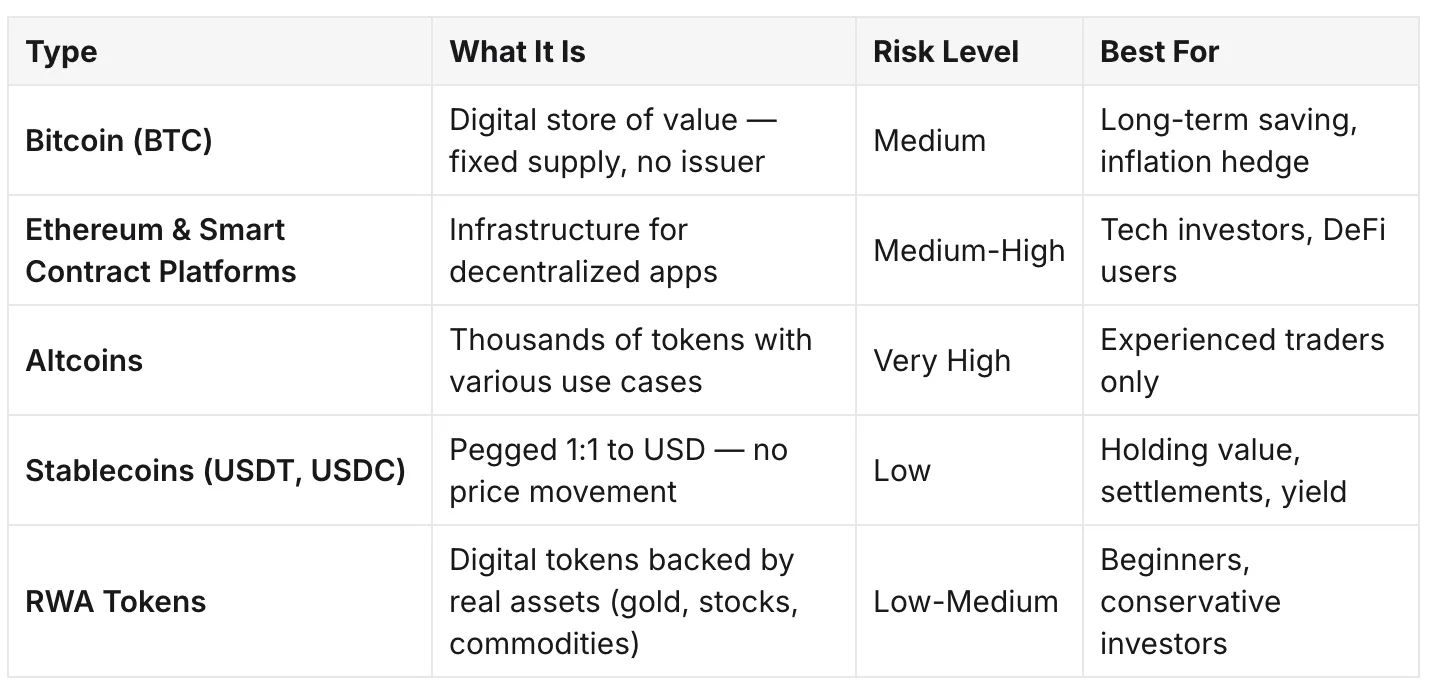
The critical insight most beginner guides miss: RWA tokens are technically "crypto" — they exist on a blockchain — but they behave like traditional investments. A gold RWA token tracks gold prices. A stock RWA token tracks Apple or NVIDIA prices. The blockchain is the delivery mechanism, not the source of risk.
Bitcoin vs Altcoins vs RWA: Which Is Right for You?
Bitcoin (BTC) — "Digital Gold"
Bitcoin was created in 2009 as a decentralized alternative to government-issued currency. Its key properties:
- Fixed supply: Only 21 million BTC will ever exist — built-in scarcity
- No central authority: No company, government, or individual controls Bitcoin
- Store of value: Most commonly used as a long-term savings vehicle
- Volatility: Still highly volatile (30–60% swings in a year are normal)
Who should own Bitcoin: Investors who believe in digital scarcity as a long-term value store and can tolerate multi-year holding periods with significant drawdowns along the way.
Who should not start with Bitcoin: Anyone who needs the money within 1–2 years, or who cannot emotionally handle watching a position drop 40% before recovering.
Altcoins — High Risk, High Reward (Mostly Risk)
Altcoins are every cryptocurrency other than Bitcoin. There are over 20,000 of them. The vast majority will eventually go to zero.
The brutal statistics:
- Of the top 100 altcoins from 2018, fewer than 20 are still in the top 100 today
- The average altcoin loses 85–95% of its value in a bear market
- Even "established" altcoins like Solana have dropped 95% in a single cycle
Who should own altcoins: Experienced traders with disposable capital, strong risk management, and deep knowledge of the specific project.
Who should not touch altcoins: Beginners, anyone investing money they need, or anyone who cannot do thorough due diligence on the team, technology, and tokenomics of a specific project.
RWA Tokens — The Bridge Between Crypto and Traditional Finance
RWA (Real World Asset) tokens are blockchain representations of real-world assets. When you buy a gold RWA token, you own a digital claim on physical gold held in a vault. When you buy a stock RWA token, you have exposure to the price of a real company's shares.
Why RWA tokens are different from speculative crypto:
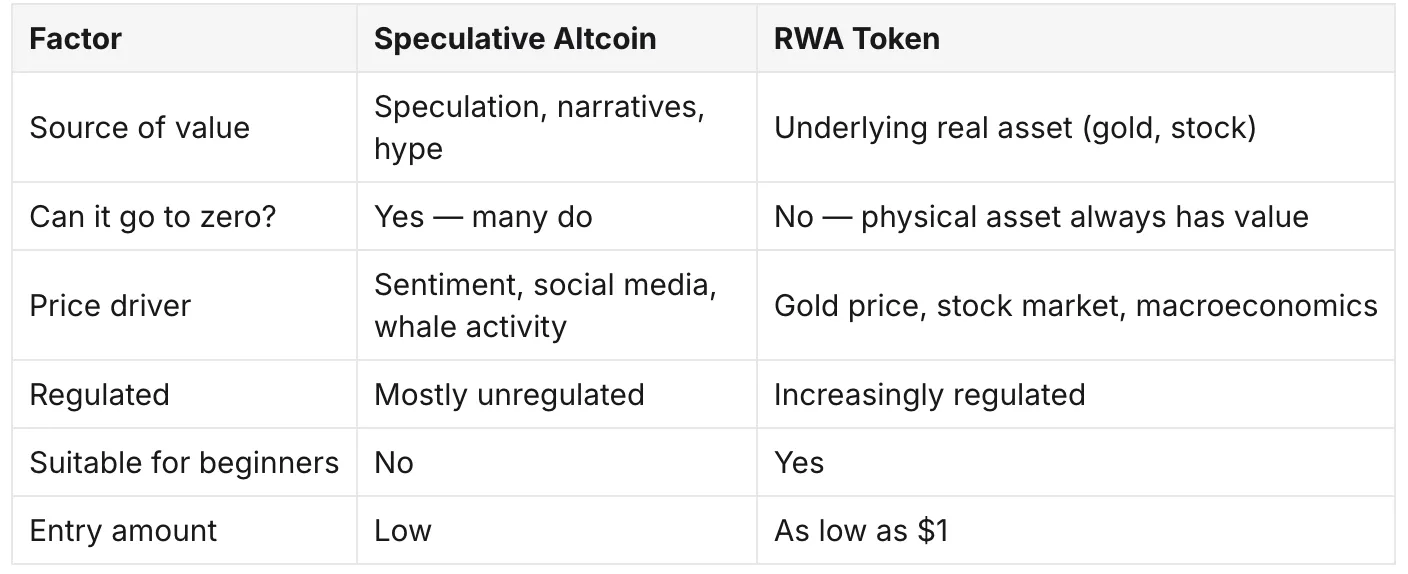
For a beginner in 2026: RWA tokens give you the benefits of crypto infrastructure (24/7 trading, USDT settlement, no bank required) with the risk profile of traditional assets (gold, stocks). This is why platforms like ToVest focus exclusively on RWA — it is crypto made accessible and safer for everyday investors.
How to Know If a Crypto Platform Is Trustworthy
This is arguably the most important section in this entire guide. More money has been lost to bad crypto platforms than to bad crypto investments.
The history of crypto is littered with platforms that appeared legitimate and then collapsed, taking user funds with them: FTX ($8B lost), Celsius ($4.7B lost), Voyager ($1.3B lost), and dozens more.
Here is the checklist every beginner must complete before depositing a single dollar:
The 7-Point Platform Safety Checklist
✅ 1. Proof of reserves / Asset backing
Can the platform demonstrate that user assets are actually held? For RWA platforms specifically: is there a third-party custodian holding the underlying gold or stocks? Are there regular audit reports?
Red flag: Platform claims to hold assets but provides no verifiable proof.
✅ 2. Regulatory compliance
Does the platform operate under a recognized regulatory framework? Does it require KYC (identity verification)? Legitimate platforms always require KYC — it is a sign of compliance, not a burden.
Red flag: "No KYC required" is not a feature — it is a warning sign that the platform operates outside regulatory oversight.
✅ 3. Withdrawal track record
Can users actually withdraw funds when they want? Search for the platform name + "withdrawal problems" before depositing. A pattern of delayed or refused withdrawals is the earliest warning sign of insolvency.
Red flag: Any withdrawal delays, withdrawal fees that seem unusual, or reports of frozen accounts.
✅ 4. Smart contract audits
For blockchain-based platforms: have the smart contracts been audited by a reputable third-party security firm (CertiK, Trail of Bits, OpenZeppelin)? Unaudited smart contracts are a significant security risk.
Red flag: No smart contract audit, or audit by an unknown firm.
✅ 5. Team transparency
Are the founders and key team members publicly identifiable? Legitimate platforms are run by people you can verify exist — LinkedIn profiles, public interviews, regulatory filings.
Red flag: Anonymous team, no public founding story, founders only known by pseudonyms.
✅ 6. Sustainable yield claims
If a platform promises extremely high yields (20%+, 50%+, or "guaranteed" returns), treat it with extreme skepticism. Legitimate yield sources are transparent and explainable. Unsustainable yield is almost always funded by new deposits — the definition of a Ponzi scheme.
Red flag: Guaranteed returns, yields that significantly exceed what legitimate DeFi or TradFi can explain.
✅ 7. Segregated custody
User funds should be held separately from the platform's operating capital. If a platform mixes user deposits with its own operational funds (as FTX did), a company financial problem directly endangers user assets.
Red flag: No mention of custody arrangements, or custody handled "in-house" with no third-party involvement.
How ToVest Scores on the Safety Checklist
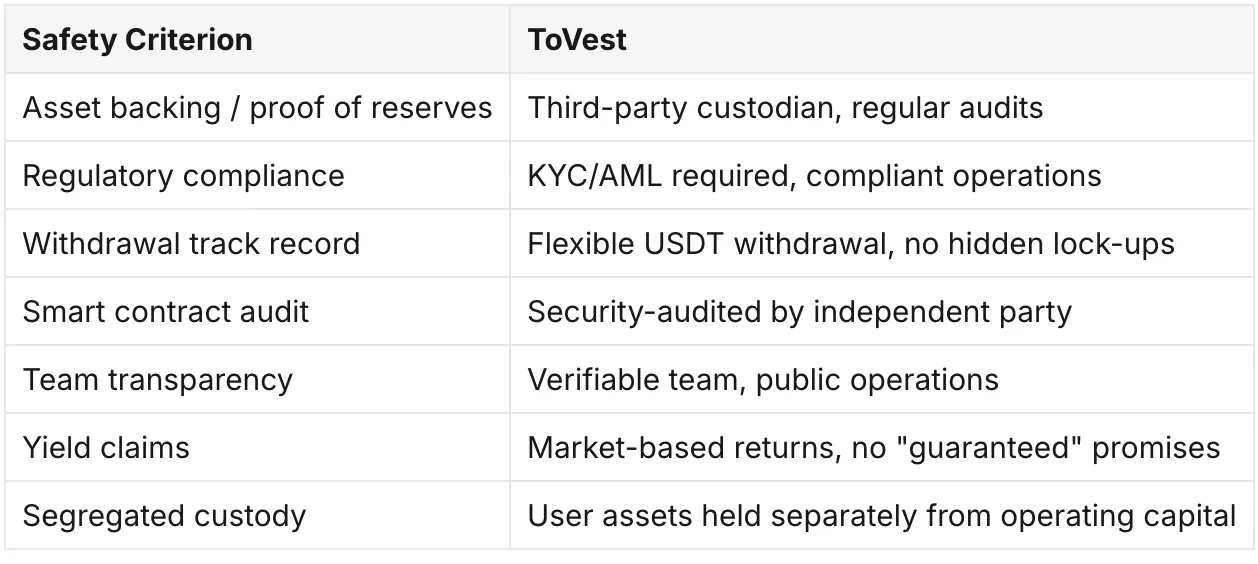
Why Are Major Financial Institutions Investing in RWA?
If you want to understand where crypto is actually going — not the speculative fringe, but the structural future — follow institutional money.
In 2026, the most significant capital flows in the entire crypto ecosystem are into Real World Asset tokenization. This is not retail speculation. These are trillion-dollar institutions making long-term infrastructure decisions.
Who Is Investing and What They Are Building
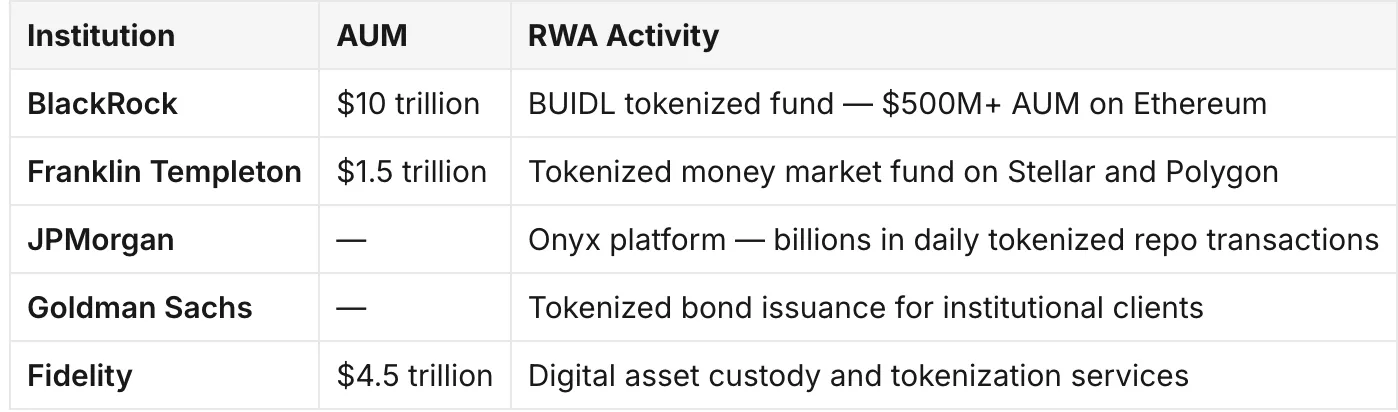
These are not experiments. These are live, revenue-generating products from the largest asset managers on earth.
The 5 Reasons Institutions Chose RWA Over Pure Crypto
1. Settlement in seconds, not days
Traditional financial markets settle on T+2 (2 business days after the trade). Blockchain settles in seconds. For a $10 billion institutional trade, the capital efficiency difference is enormous.
2. 24/7 market access
Bond markets close on weekends. Stock markets close at 4pm EST. Tokenized assets trade continuously — better liquidity, faster price discovery, no gap risk over weekends.
3. Fractionalization at any level
A $50 million commercial real estate asset can be tokenized and sold in $100 increments to thousands of investors. This unlocks liquidity in previously illiquid asset classes.
4. Programmable compliance
Smart contracts can embed regulatory requirements (accredited investor checks, transfer restrictions, tax reporting) directly into the asset — reducing compliance cost and human error.
5. Immutable audit trail
Every transaction is permanently recorded on the blockchain. For institutions that spend millions on audit and compliance, blockchain-native record-keeping is a structural cost reduction.
What this means for retail investors: When BlackRock and JPMorgan tokenize assets on blockchain, they are validating the infrastructure that platforms like ToVest use to provide retail investors with access to the same types of instruments. The technology is proven. The question is which platform gives retail investors the best access point.
The 3 Mistakes Every Crypto Beginner Makes (And How to Avoid Them)
Mistake 1: Starting With Altcoins Instead of Stable Assets
New investors often see altcoin gains of 500% or 1000% in news headlines and start there. What they don't see: the same coins losing 95% in the following year. Start with assets that have underlying value — Bitcoin for speculation, RWA tokens for stable exposure.
Mistake 2: Using Unverified Platforms for High Yield
The promise of 30–50% annual yield on platforms you've never heard of is almost always a sign of unsustainable economics. Stick to platforms with transparent custody, regulatory compliance, and verifiable operating history.
Mistake 3: Investing More Than You Can Afford to Lose in Volatile Assets
The crypto market can drop 50–80% in a bear cycle. Position sizing matters. Rule of thumb: Never put more than 5–10% of your total savings in high-volatility crypto (BTC, altcoins). RWA tokens tied to gold or stocks can represent a larger portion because their risk profile is closer to traditional investments.
Your First $100 in Crypto — A Practical Allocation Framework
If you are starting with a small amount and want sensible exposure to the crypto ecosystem without taking on excessive risk:
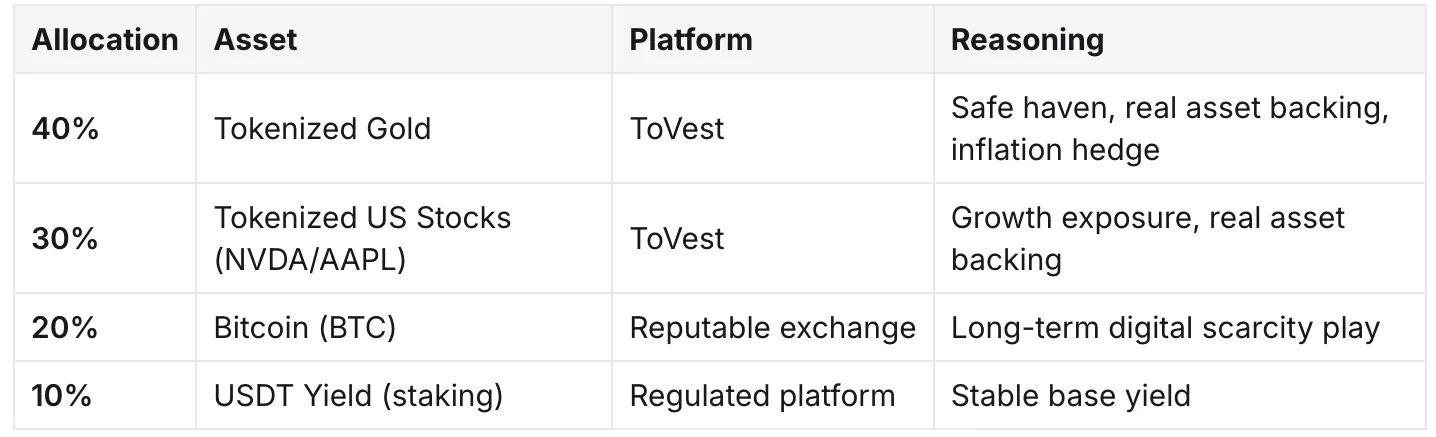
Why this allocation works for a beginner:
- 70% in RWA tokens = real asset backing, low risk of total loss
- 20% in Bitcoin = exposure to the core crypto value proposition
- 10% in stable yield = liquidity and income floor
- 0% in speculative altcoins = correct for a beginner
Frequently Asked Questions (FAQ)
Q: What is crypto and should I invest in 2026?A: Cryptocurrency is digital money on a blockchain. Whether to invest depends on which type: Bitcoin offers long-term store of value potential with high volatility. Altcoins are high-risk speculation. RWA tokens (backed by gold, stocks, commodities) offer crypto infrastructure with real-asset risk profiles — the most suitable entry point for most new investors in 2026.
Q: Is crypto safe for beginners?
A: Highly speculative crypto (altcoins) is not safe for beginners — the majority of altcoins eventually lose most or all of their value. However, RWA tokens — which are backed by real assets like gold and stocks — carry a fundamentally different risk profile and are much more suitable for new investors.
Q: How do I know if a crypto platform is trustworthy?
A: Check 7 criteria: (1) proof of asset reserves with third-party custody; (2) regulatory compliance and mandatory KYC; (3) clean withdrawal history with no frozen accounts; (4) independently audited smart contracts; (5) verifiable public team; (6) explainable yield claims — no "guaranteed" returns; (7) user assets segregated from company operating funds.
Q: What is the difference between Bitcoin and altcoins?
A: Bitcoin has a fixed supply of 21 million coins, is widely recognized as a store of value, and has survived multiple market cycles. Altcoins are thousands of other tokens with various use cases — most are much higher risk and the majority eventually fail. Bitcoin is where informed investors start; altcoins are where experienced traders speculate.
Q: Why are large financial institutions investing in RWA?
A: For five structural reasons: faster settlement (seconds vs T+2 days), 24/7 trading, ability to fractionalize previously illiquid assets, programmable compliance embedded in smart contracts, and immutable blockchain audit trails. BlackRock ($10T AUM), Franklin Templeton, JPMorgan, and Goldman Sachs all have active RWA programs.
Q: What is the minimum to start investing in crypto through ToVest?
A: From $1 (paid in USDT). ToVest focuses on RWA tokens — tokenized gold, stocks, and commodities — giving beginners real asset exposure with crypto's accessibility advantages (24/7, no brokerage needed, USDT settlement).
Q: Is RWA better than Bitcoin for a beginner?
A: They serve different purposes. RWA tokens (gold, stocks) are better for beginners because they are backed by real assets with established valuations — the risk of total loss is very low. Bitcoin is better for investors who specifically want exposure to the digital scarcity narrative and can tolerate high volatility over a multi-year horizon. Many investors hold both.
Q: How do I start investing in crypto safely?
A: Four steps: (1) Choose a compliant platform with verified custody and KYC (like ToVest for RWA); (2) start with real-asset-backed tokens (gold, stocks) before touching speculative coins; (3) invest only what you can afford to hold for 1–3 years; (4) never chase yields above 15–20% annually on platforms you cannot verify.
The Bottom Line: Crypto in 2026 Is Not One Thing
The biggest mistake a beginner can make is treating "crypto" as a single category. It is not.
- Bitcoin is a long-term bet on digital scarcity
- Altcoins are high-risk speculation for experienced traders
- Stablecoins (USDT) are the settlement layer — useful but not an investment
- RWA tokens are real assets on blockchain rails — the most accessible and logical entry point for new investors in 2026
The institutions pouring billions into RWA are not doing so because it is exciting or because there is hype. They are doing so because it is better infrastructure for the same assets that have generated wealth for centuries: gold, equity, real estate, and commodities.
For a retail investor in Vietnam or Southeast Asia in 2026, the best entry into the crypto ecosystem is through the same door the smartest institutional money is walking through — tokenized real assets on a compliant, transparent platform.
Start your crypto journey the right way — real assets, blockchain infrastructure, USDT settlement. Open your ToVest account from $1 at tovest.com