Top 10 Technology Stocks to Watch in 2026
July 6, 2026
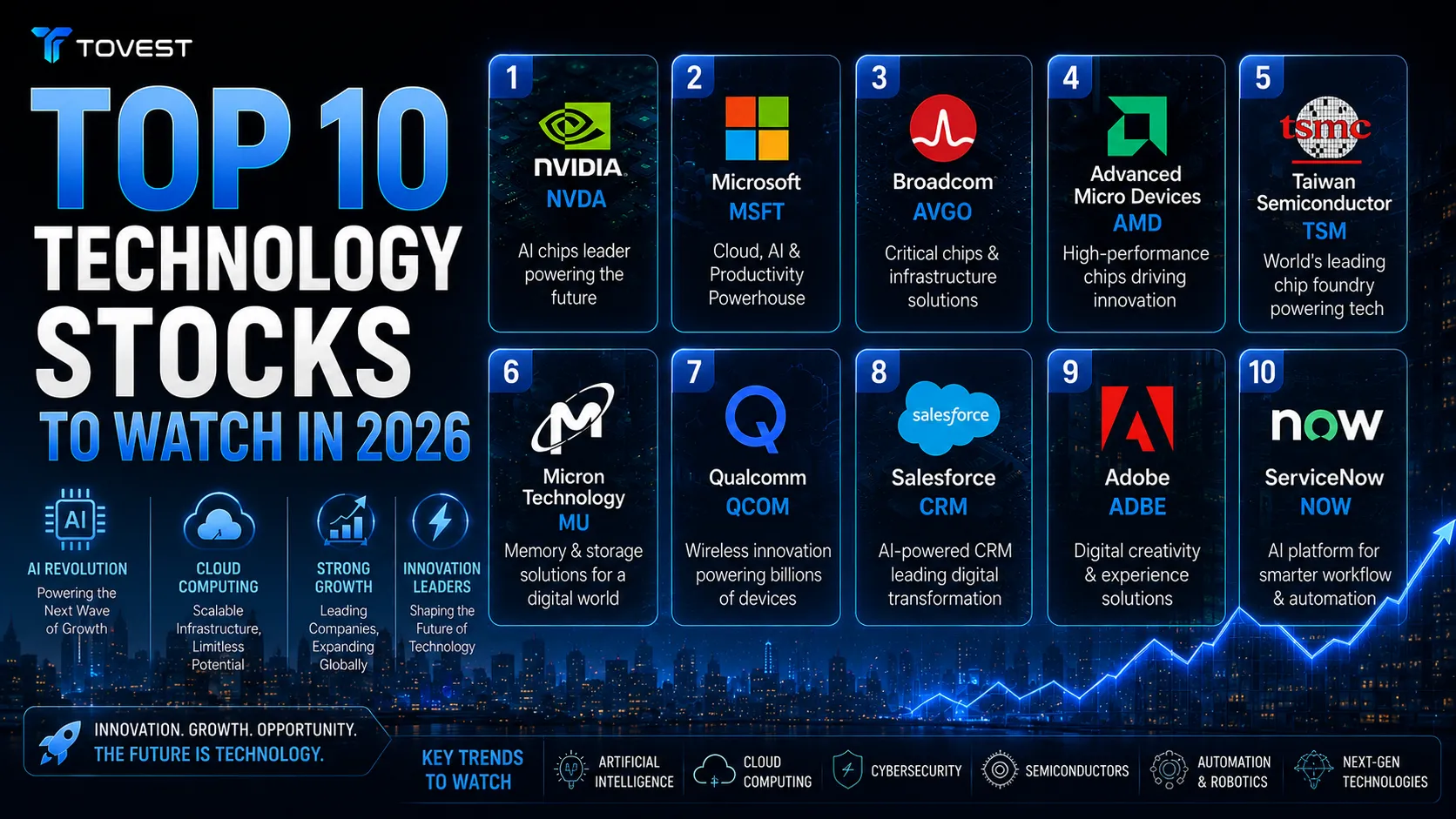
The technology sector continues to dominate global markets, capturing investor attention with innovation and scale rarely matched by other industries. As of May 2026, technology led all S&P 500 sectors with a 28.6% year-to-date total return—driven by explosive AI infrastructure spending, rising cloud adoption, and continued digitization across industries. Identifying the best 2026 tech stocks means focusing on companies with durable growth drivers, leadership in next-generation computing, and strategic AI exposure. Through ToVest’s blockchain-powered fractional platform, investors can access these opportunities globally, participating transparently in the innovation shaping tomorrow’s digital economy.
Nvidia (NVDA)
Nvidia remains the epicenter of AI investing. With a $5.1 trillion market cap and a forward P/E near 42.5x, its valuation reflects industry-leading strength in accelerated computing. The new Blackwell GPU architecture and entrenched CUDA developer ecosystem reinforce Nvidia’s competitive moat, sustaining its pricing power and ecosystem control. Ongoing AI data center buildouts and demand for generative compute support its trajectory, though investors must balance enthusiasm against rich valuations and concentration risk.
Microsoft (MSFT)
Microsoft continues to define enterprise technology strategy through its unified cloud and AI ecosystem. At a $3.25 trillion market cap and a modest 23.2x P/E, the company combines scale with consistent profitability. Azure’s rapid uptake and deep integration of generative AI into Office and Dynamics products position Microsoft as a leader in AI commercialization. While expansion may moderate as markets mature, its recurring cloud revenues and vast enterprise reach provide resilient portfolio exposure.
Broadcom (AVGO)
Broadcom has evolved into a critical semiconductor and infrastructure company, bridging traditional networking with AI-oriented systems. Its $1.83 trillion valuation reflects optimism fueled by a nearly 60% year-to-date gain and a durable high-margin model. With custom silicon and advanced networking products essential for hyperscaler demand, Broadcom benefits directly from AI-driven capital expenditure. Sustaining that momentum demands continued, disciplined execution to uphold premium pricing.
Advanced Micro Devices (AMD)
AMD is cementing itself as the agile challenger to Nvidia in AI and high-performance computing. With a P/E of roughly 34.2x and shares near $225, AMD’s growing data center footprint and efficient GPU roadmap attract investors seeking diversification beyond the AI leader. Success depends on execution—capturing developer mindshare and scaling performance effectively. For investors, AMD represents a calculated risk‑reward balance within the CPU–GPU convergence era.
Taiwan Semiconductor (TSM)
Taiwan Semiconductor Manufacturing Company underpins nearly every breakthrough in advanced chips. Reporting over $120 billion in revenue and an EPS above $10, TSM remains the premier foundry for leading-edge process nodes. As AI workloads drive demand for new packaging innovations, TSM’s engineering precision ensures sustained relevance and margin strength. Its pricing discipline and global importance offer stability even amid geopolitical tension—making TSM a foundational infrastructure play for 2026.
Micron Technology (MU)
Micron sits at the center of the AI memory revolution. With roughly $1 trillion in market value and moderate dividends, it offers leveraged exposure to high‑bandwidth memory (HBM) expansion tied to AI servers. The cyclical nature of memory markets amplifies both earnings and downside swings—an important consideration for risk‑tolerant investors. As AI‑capable systems proliferate, Micron could deliver strong upside if capacity and pricing trends align.
Qualcomm (QCOM)
Qualcomm’s focus is bringing AI to the edge. Its $232.7 billion valuation and steady dividends reflect leadership in mobile and IoT chipsets. As computing moves closer to end users—through smartphones, vehicles, and embedded devices—Qualcomm’s system‑on‑chip (SoC) innovation anchors growth potential. Although handset cycles remain volatile, deep AI integration across edge ecosystems strengthens its long‑term earnings potential.
Salesforce (CRM)
Salesforce is redefining enterprise automation through Agentic AI—autonomous digital assistants within its CRM suite. With a $264.5 billion market cap and stable subscription base, Salesforce illustrates SaaS durability in a competitive field. By automating knowledge work and personalizing customer engagement, it maintains a defensible niche in enterprise AI. Constant innovation, however, remains essential to protecting valuation leadership.
Adobe (ADBE)
Adobe remains the creative core of digital media and now generative design. Its $212.4 billion valuation reflects continuing dominance in creative suites and cloud‑based workflows. With proprietary AI tools like Firefly transforming content production, Adobe fuses design creativity with automation efficiency. Loyal user adoption and subscription stability enhance resilience, though evolving against open‑source AI competition stays critical.
ServiceNow (NOW)
ServiceNow exemplifies workflow automation enhanced by AI. Valued near $168 billion with a high P/E of 54.9x, its growth rests on sticky enterprise renewals and expanding automation across IT and HR functions. With AI embedded in more than one‑third of its workflows, ServiceNow captures additional value through efficiency gains and retention. The key challenge is to sustain innovation fast enough to justify its elevated multiple.
Key Catalysts Driving Technology Stocks in 2026
Several structural forces are propelling the technology sector:

Global AI investment is projected to reach around $1.5 trillion in 2025, while total IT spending could surpass $6 trillion in 2026—energizing hardware and software ecosystems across the board.
Risks Impacting Technology Stock Performance
Tech equities naturally exhibit volatility. Core risks include:
- Valuation crowding: elevated multiples (e.g., Nvidia) increase drawdown probability.
- Cyclical forces: memory market downturns can compress earnings.
- Geopolitical pressures: East Asian supply‑chain sensitivities stay material.
- Regulatory headwinds: antitrust scrutiny remains a recurring factor for major platforms.
- Rising competition: emerging AI entrants may apply margin pressure.

Strategies for Diversifying a Technology Stock Portfolio
A well‑balanced tech portfolio covers multiple layers of innovation:
- AI Compute Layer: Nvidia, AMD
- Chip Manufacturing: TSMC, Micron
- Enterprise SaaS: Salesforce, ServiceNow, Adobe
- Edge/Mobile: Qualcomm
- Cloud Core: Microsoft, Broadcom
Investors seeking diversified exposure can combine select equities with ETFs such as iShares Semiconductor ETF (SOXX) or Invesco QQQ. SOXX recorded over 112% cumulative gains in recent periods, while QQQ’s $480 billion in AUM signals scale and stability. Through ToVest’s fractional, tokenized ownership, investors can allocate efficiently across these subthemes with real‑time transparency and 24/7 access.
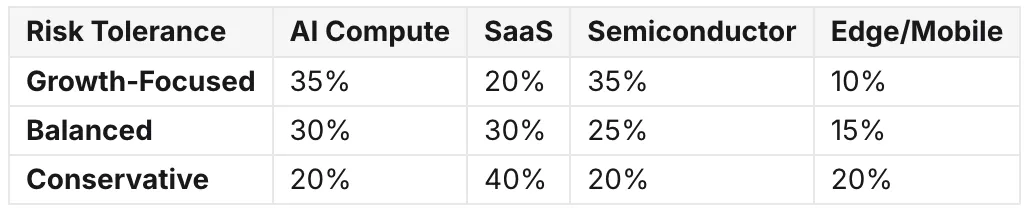
Example Allocation Framework
How to Monitor Market Signals and Capital Expenditure Trends
Tracking hyperscaler capex—spending by major cloud providers like Amazon, Microsoft, and Google—provides early indicators of semiconductor and AI infrastructure demand. Investors should:
- Review quarterly earnings reports from major chip and SaaS leaders.
- Monitor capex guidance from cloud hyperscalers.
- Analyze fund flow data for key tech ETFs to gauge sentiment.
- Use ToVest’s real‑time tracking and on‑chain verification to confirm portfolio exposure transparently.
Monitoring these data points helps anticipate sector pivots and adjust allocations with confidence.
Frequently Asked Questions
- Which technology stocks are expected to lead growth in 2026?
Nvidia and Microsoft lead AI and cloud growth, while Broadcom and TSM anchor AI infrastructure opportunities accessible through ToVest.
- How can I assess if a technology stock is overvalued in 2026?
Compare P/E and P/S ratios to historical and peer averages, using ToVest’s real‑time evaluation dashboards for context.
- What are the main technology themes influencing stock selection this year?
Artificial intelligence, advanced semiconductors, enterprise automation, and edge computing remain top 2026 catalysts.
- What risks should investors watch when buying tech stocks in 2026?
Watch for valuation compression, cyclical memory shifts, and policy or regulatory changes affecting leading platforms.
- Should I choose individual stocks or technology‑themed ETFs for my portfolio?
Both approaches work—ToVest enables fractional access to single equities and diversified baskets, depending on your strategy.
By integrating disciplined analysis, diversified positioning, and transparent on‑chain execution through ToVest, investors can participate confidently in the fast‑evolving world of 2026’s leading technology stocks.