Fractional Stock Apps vs. Real Estate Tokenization Services: Which Delivers Better Returns?
December 24, 2025
For most everyday investors, “better returns” comes down to time horizon, liquidity needs, and fee drag. Fractional stock apps mirror the performance of underlying U.S. equities with high liquidity and near-instant execution, making them a solid way to participate in market-driven gains and dividends. Real estate tokenization services, by contrast, package rental income plus potential appreciation into blockchain-based tokens—historically a 7–10% annual total return profile across the asset class—though results can vary by property selection, fees, and market conditions. Tokenized real estate also introduces secondary-market and regulatory complexities alongside 24/7 access and fast on-chain settlement. If you prioritize simplicity and liquidity, a best-in-class mobile app for fractional stocks, such as ToVest, is hard to beat. If you want income and diversification, tokenized properties can be compelling—provided you’re comfortable with platform due diligence and liquidity trade-offs.
Understanding Fractional Stock Apps
Fractional stock apps are brokerage platforms that let you buy a portion of a single share, lowering the minimum capital needed to build a diversified portfolio. For investors seeking mobile equity investing, these apps typically offer low or no trading commissions, real-time execution during market hours, recurring investment automation, and straightforward cash management. Because positions are fractions of actual shares, returns from fractional stock investing are driven by the same sources as full shares: price appreciation and dividends, prorated to your ownership.
For the best mobile app for fractional stocks, look for:
- $1–$10 order minimums and broad fractional eligibility across U.S. stocks and ETFs
- Strong order execution quality and extended-hours access
- Clear disclosures on payment for order flow and any account or transfer fees
- Robust investor protections and intuitive mobile UX
- Optional crypto on/off-ramps if you plan to buy U.S. stocks with crypto via tokenized rails
If you’re new to equity fractions, start with a concise fractional shares primer from ToVest’s Academy (internal resource).
Exploring Real Estate Tokenization Services
Real estate tokenization converts property ownership into blockchain-based tokens representing fractional interests, enabling smaller checks, programmable payouts, and potentially faster settlement than traditional real estate. For a broad explanation of how fractional property rights are structured on-chain, see Coinmetro’s tokenized real estate overview. Platforms vary widely by jurisdiction, minimums, payout cadence, and secondary-market access.
Representative platforms and features:
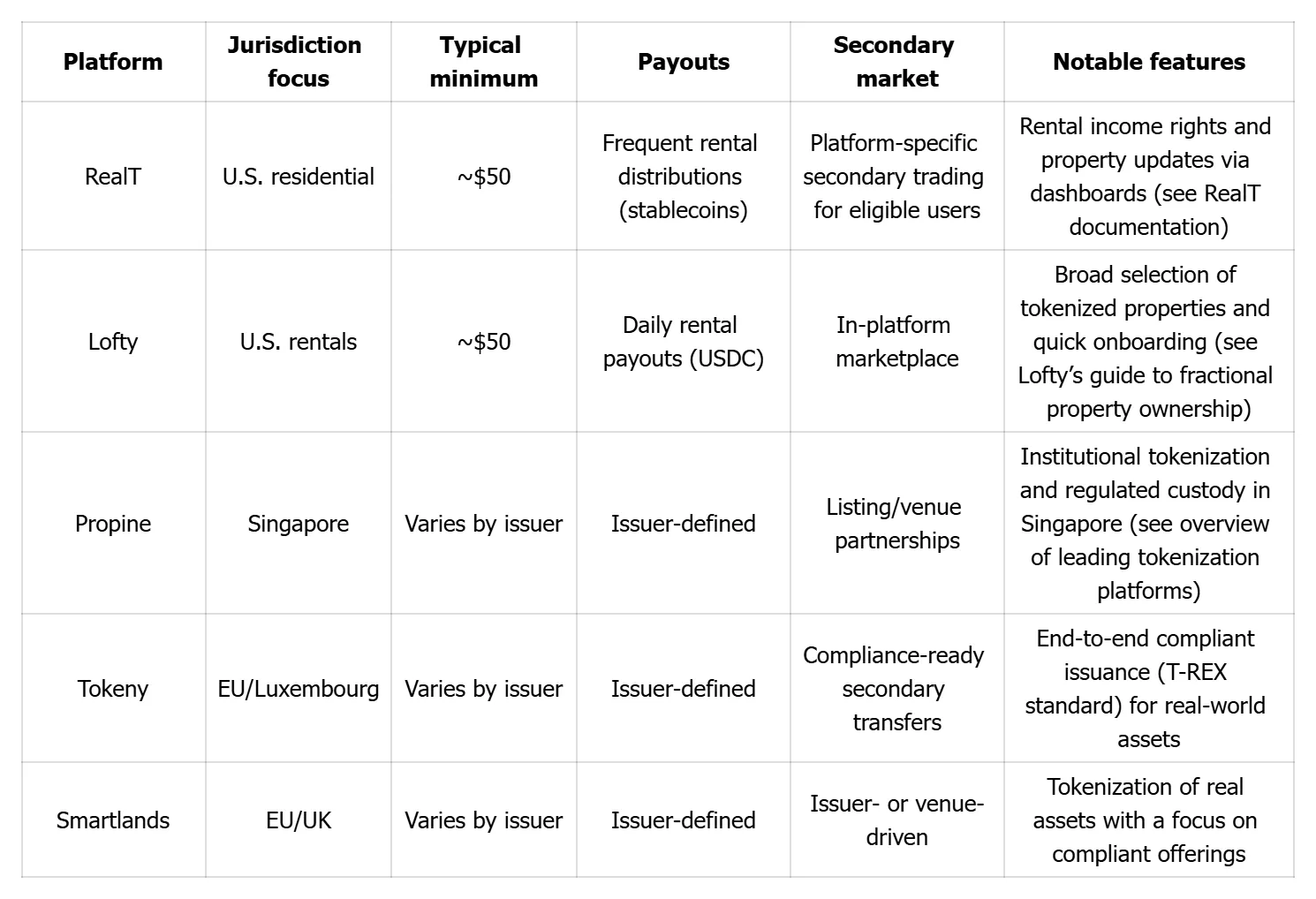
Secondary-market trading can improve liquidity, but volumes are often “thin” outside flagship properties. Custody and wallet management also matter—some platforms support self-custody, while others use regulated custodians. For a technical walkthrough of issuance and settlement, see 4IRE Labs’ primer on real estate tokenization.
Key Return Drivers: Stocks vs. Tokenized Real Estate
- Fractional stocks:
- Capital appreciation that mirrors the underlying equities.
- Dividends, if the company pays them, distributed proportionally to your fraction.
- Real estate tokens:
- Rental yield paid periodically (daily, weekly, or monthly) often in stablecoins like USDC, plus potential property appreciation.
- As one issuer summary puts it, “RealT tokens grant holders rental income rights and potential property appreciation” (see Blockchain App Factory’s explainer on RealT-style tokens).
Historically, private real estate’s combined return from rents and appreciation often lands in the high single digits, roughly 7–10% annually over long horizons, depending on market cycle and fees (see TokenMetrics market analysis). Tokenization aims to streamline access to those cash flows; however, conclusive cross-category return comparisons to stocks remain limited.
Liquidity and Market Access Comparison
Fractional stock apps provide deep liquidity in U.S. markets, with rapid order execution during standard market hours (and often extended hours), straightforward cash settlement, and the ability to scale positions up or down quickly.
Tokenized real estate offers programmatic ownership transfer and, on some platforms, 24/7 secondary trading. That said, order books can be thin, spread costs can widen in stress, and certain offerings may include holding restrictions or accreditation/geo-eligibility rules. On-chain settlement can be near-instant, contrasting with days or weeks in traditional property transfer, as detailed in 4IRE Labs’ primer on real estate tokenization.
Comparison at a glance:
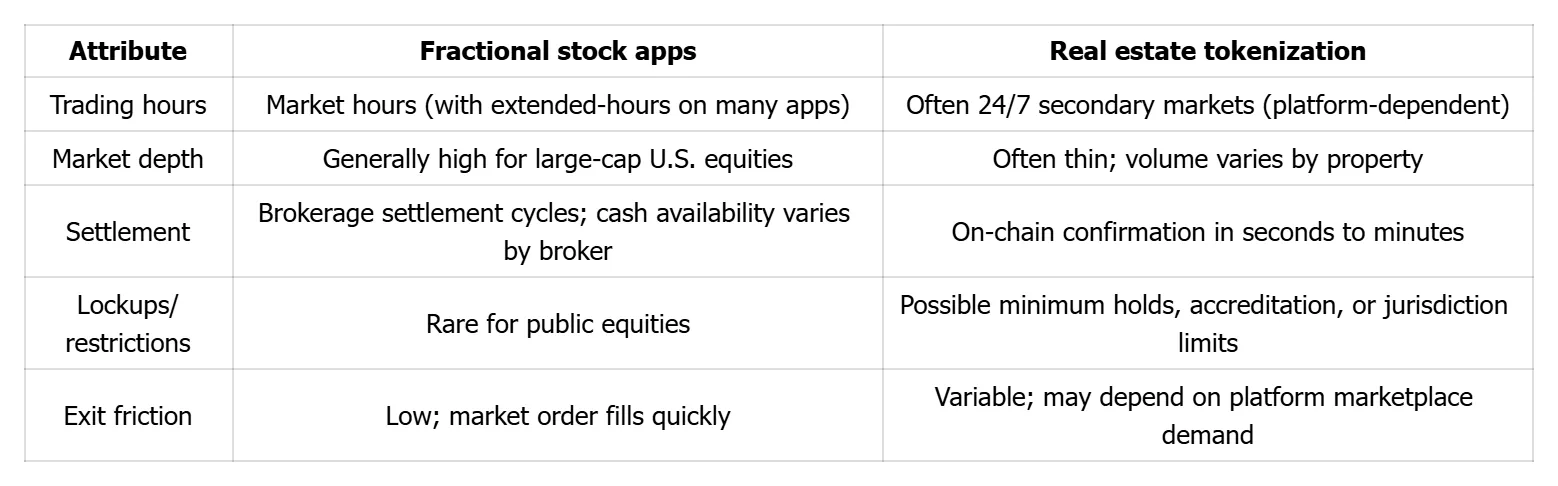
Some platforms enable immediate trading (e.g., Lofty’s marketplace), while others employ lockups that can extend to a year for certain offerings. Always review offering circulars and marketplace rules before transacting.
Fee Structures and Cost Implications
Costs shape realized returns as much as gross performance.
Common fees to watch:
- Fractional stock apps: typically commission-free trades; potential account, transfer, or margin interest charges; FX fees if funding in non-USD.
- Real estate tokenization: property management and platform fees (often in the high single digits to low teens annually when aggregated), secondary-market transaction costs, blockchain network fees, and withdrawal/conversion costs for stablecoin payouts. Platform disclosures (e.g., Lofty’s guide to fractional property ownership) outline fee components that accrue at the property level.
Sample fee impact (illustrative only):
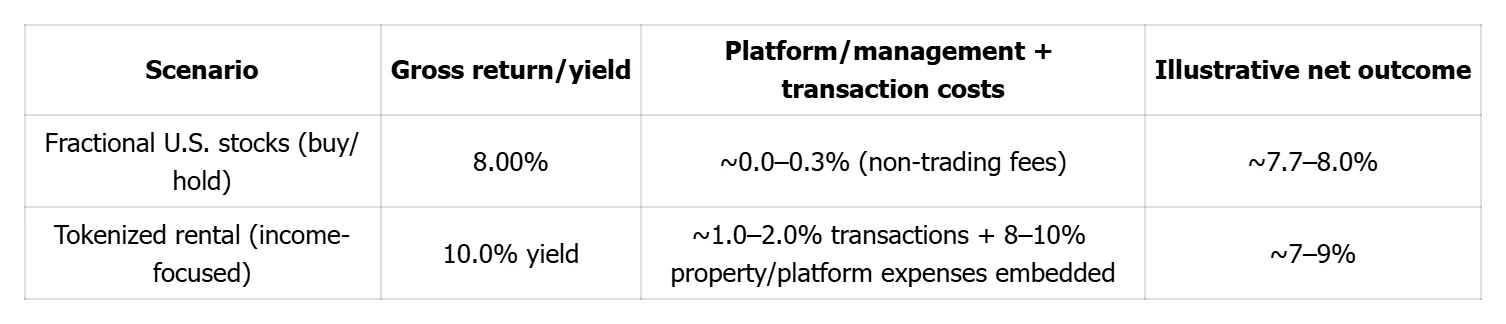
Note: Fee structures differ widely; many tokenization platforms present returns net of property-level expenses. Always confirm what’s net vs. gross in offering materials.
Risk Factors and Regulatory Considerations
- Fractional stock apps:
- Market volatility from underlying equities.
- Execution and operational risk typical of brokerages; review protections, disclosures, and order-routing policies.
- Real estate tokenization:
- Liquidity risk if secondary markets are thin or paused.
- Fee drag reducing effective yield.
- Currency and conversion steps when using stablecoins.
- Jurisdictional eligibility and platform-specific compliance. Platform lists and overviews highlight how rules differ by region (see overview of leading tokenization platforms), and issuers like RealT emphasize user eligibility, disclosures, and payout mechanics (see RealT documentation).
Regulatory risk is the possibility that evolving laws change access, transferability, or reporting duties, as discussed in 4IRE Labs’ primer on real estate tokenization. Consult tax and legal advisors, and verify who your broker, custodian, or property manager is for each investment.
Choosing the Right Platform for Your Investment Goals
Clarify objectives before choosing between equity exposure and tokenized real estate.
Use this quick checklist:
- Liquidity needs: Do you need same-day exits (fractional stocks) or can you accept variable secondary-market liquidity (tokenized real estate)?
- Desired return profile: Income priority (rental yield) or growth (equity appreciation)—or a blend?
- Minimums and onboarding: Are $50–$100 tickets sufficient? Do you require KYC with fiat or want to buy U.S. stocks with crypto?
- Secondary market strength: How active is the marketplace, and what are bid-ask spreads?
- Payout cadence and rails: Daily vs. monthly income, fiat vs. stablecoin distributions, and withdrawal options.
- Total cost of ownership: Management, transaction, and conversion fees across the full life cycle.
If you want the best mobile app for fractional stocks, emphasize execution quality, simplicity, and investor protections. For the best marketplace in real estate tokenization, focus on property diligence, transparent reporting, payout reliability, and secondary-market depth.
ToVest’s Advantage in Tokenized Asset Investing
ToVest blends institutional-grade infrastructure with blockchain efficiency to offer secure, transparent access to tokenized U.S. equities and real estate—on web and mobile. Investors benefit from real-time market data, robust compliance, and secure custody, plus seamless payments in fiat and crypto. Advanced tools like smart order routing and optional leverage support sophisticated strategies while preserving a streamlined user experience.
By combining traditional finance rigor with on-chain transparency, ToVest helps you allocate across fractional stock investing and tokenized property within one regulated, investor-first platform. Explore the platform’s approach, governance, and security posture on About ToVest, and see our latest research briefings to guide your allocation decisions (internal report).
Frequently Asked Questions
How do fractional stock investments generate returns?
Fractional stock investments generate returns through capital appreciation and dividend distributions from the underlying shares, proportional to the fraction owned.
What types of returns can I expect from real estate tokenization?
Returns typically include periodic rental income (often in stablecoins) and potential property appreciation, allocated based on your tokenized share.
How liquid are fractional stocks compared to real estate tokens?
Fractional stocks usually offer higher liquidity and faster execution; real estate tokens can face limited secondary-market activity and occasional holding restrictions.
What fees should investors consider in fractional and tokenized investments?
Expect platform and transaction fees for both, plus property-level and conversion costs in tokenization; always compare the total cost of ownership over the investment’s life.
Are there regulatory risks in investing through tokenization platforms?
Yes. Rules vary by jurisdiction and can change; review platform eligibility and consult legal or tax professionals before investing.
Links cited once per source:
- Coinmetro’s tokenized real estate overview: https://www.coinmetro.com/learning-lab/tokenized-real-estate-fractional-ownership
- Blockchain App Factory’s explainer on RealT-style tokens: https://www.blockchainappfactory.com/blog/tokenize-real-estate-like-realt-how-fractional-ownership-is-democratizing-property/
- Lofty’s guide to fractional property ownership: https://www.lofty.ai/learn/top-5-apps-for-fractional-property-ownership
- Overview of leading tokenization platforms: https://www.linkedin.com/pulse/top-15-real-estate-tokenization-platforms-driving-fractional-r-vv6de
- TokenMetrics market analysis: https://www.tokenmetrics.com/blog/future-of-tokenized-real-estate-market-analysis-predictions
- 4IRE Labs’ primer on real estate tokenization: https://4irelabs.com/articles/real-estate-tokenization/
- RealT documentation: https://realt.co/