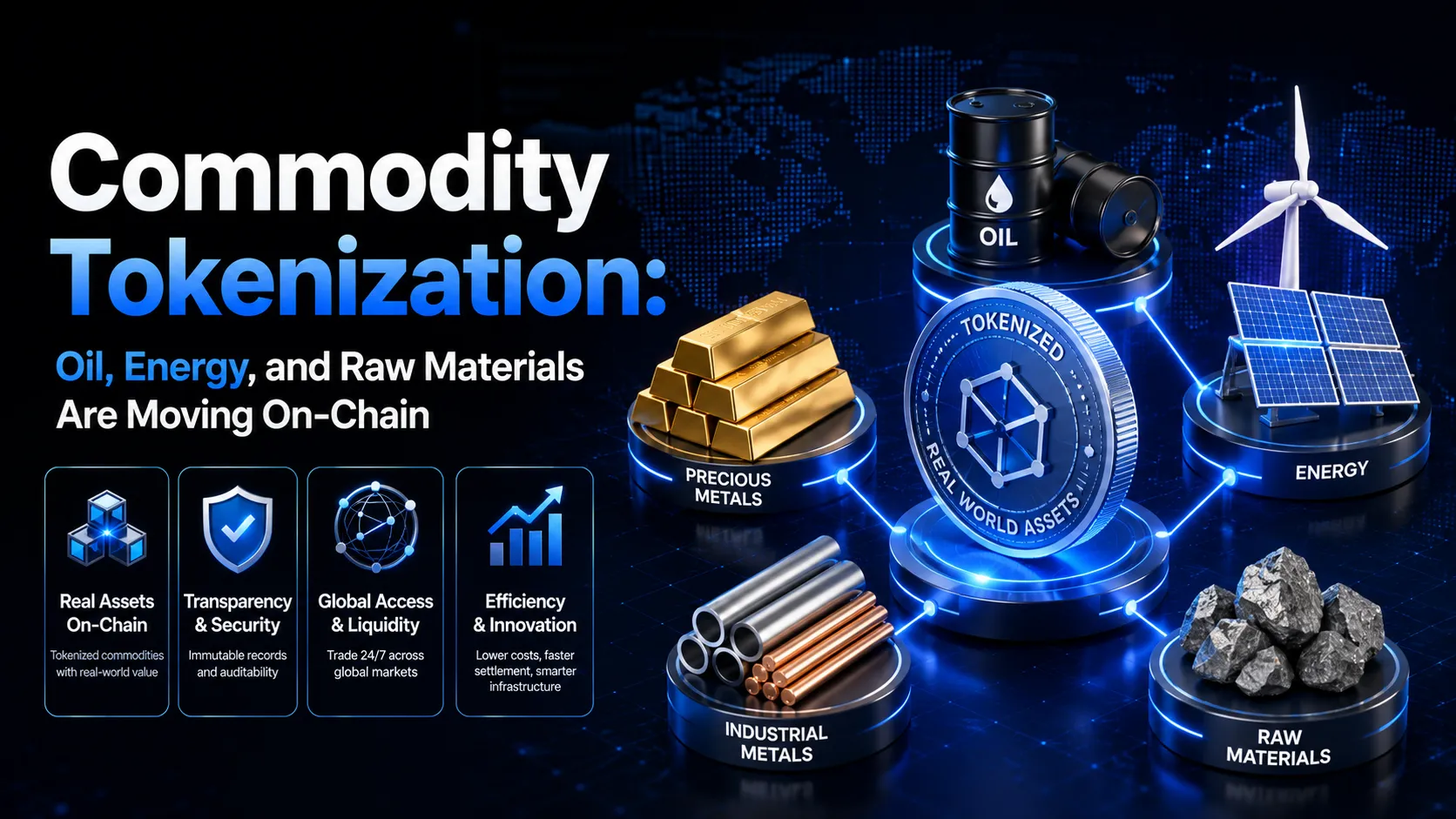
Commodity Tokenization: Oil, Energy, and Raw Materials Are Moving On-Chain
July 28, 2026
What Is Commodity Tokenization?
Commodity tokenization converts ownership rights in physical raw materials — crude oil, natural gas, lithium, copper, agricultural products — into blockchain-based digital tokens. Each token represents a fractional claim on a specific quantity of the underlying commodity, held in a regulated custodial facility or verified through an audited warehouse receipt system.
The process works as follows: a custodian or commodity trader holds the physical asset. A smart contract governs the issuance, transfer, and redemption of tokens representing that asset. Token holders have a legal claim on the underlying commodity, proportional to the number of tokens they hold.
This is structurally different from:
- Commodity futures — derivative contracts that expire and require rollover, with no direct ownership
- Commodity ETFs — fund structures that track commodity prices but keep the physical asset inaccessible to retail investors
- Commodity company stocks — equity in producers (e.g., ExxonMobil) rather than the commodity itself
Tokenized commodities give investors direct, allocated exposure to the underlying material — with blockchain-native liquidity, fractional access, and transparent custody.
Why Commodities Are Moving On-Chain in 2026
Four structural pressures are driving commodity tokenization from pilot programs into live infrastructure:
1. Fragmented global supply chains need settlement efficiency
Commodity trading — particularly oil and gas — runs on paper-intensive documentation: bills of lading, warehouse receipts, letters of credit. These documents take days to verify and transfer. Blockchain-based tokenization settles in minutes, with immutable records visible to all counterparties. Major commodity trading houses including Trafigura and Vitol have run blockchain settlement pilots since 2021 and expanded into production systems by 2024-2025.
2. Energy transition is creating new commodity demand curves
Lithium, cobalt, nickel, copper, and rare earth elements are critical inputs for electric vehicle batteries, solar panels, and grid storage. Demand projections from the International Energy Agency show lithium demand growing 40x by 2040 relative to 2020 levels. Tokenization creates retail investment pathways into commodities that were previously accessible only through mining company equity or specialized commodity funds.
3. Institutional demand for real-asset inflation hedges
In inflationary periods, institutional portfolios increase allocation to hard assets. Tokenized commodities allow institutions to hold fractional, liquid positions in oil, metals, and agricultural products without physical storage logistics or futures roll costs.
4. Regulatory frameworks for tokenized real assets are maturing
The EU's MiCA regulation, Singapore's MAS guidelines on digital asset securities, and UAE ADGM frameworks now provide legal clarity for tokenized commodity products. This has unlocked institutional issuance programs that require regulatory standing to operate.
Oil Tokenization: The Largest Commodity Market Moves On-Chain
Crude oil is the world's most traded commodity by value — approximately $3.5 trillion in annual trade as of 2025. The tokenization of oil is not a retail-first product; it began at the institutional and sovereign level.
Key developments:
- Abu Dhabi National Oil Company (ADNOC) tokenized physical oil cargoes in a 2023 pilot on the Polygon blockchain, settling transactions in under 24 hours versus the standard 5-10 day documentation cycle
- Trafigura and Shell participated in blockchain-based oil trading platforms that reduced trade financing costs by an estimated 15-20% per transaction
- Saudi Aramco has explored tokenized crude allocations as part of Vision 2030 digital infrastructure initiatives
- Crude oil tokens allow investors to hold exposure to WTI or Brent price movements backed by actual barrel allocations in named storage facilities — not paper contracts
What oil tokenization means for retail investors:
Previously, retail exposure to crude oil meant buying oil futures (complex, expensive to roll), oil ETFs (tracking error, management fees), or energy company stocks (corporate risk layered on top of commodity risk). Tokenized oil provides a cleaner signal: the price of a barrel, held in your digital wallet, without the operational complexity.
Energy Transition Commodities: The Metals Driving the Next Decade
The commodities with the highest demand growth projections in 2026 are not oil — they are the metals and minerals required to build the energy transition infrastructure.
Lithium
Lithium carbonate prices peaked above $80,000 per tonne in late 2022 before correcting to $10,000-$15,000 in 2024 as supply caught up. Analysts at Goldman Sachs and Wood Mackenzie project prices returning to $30,000-$50,000 as EV adoption scales through 2026-2030.
Tokenized lithium products allow investors to hold exposure to lithium prices without participating in futures markets or buying shares in specific mining companies. Several tokenized lithium products launched in 2024-2025 through partnerships between custodians in Australia and Chile (the two largest lithium-producing regions) and blockchain issuance platforms.
Copper
Copper is the metal most critical to the energy transition — used in electric motors, power cables, EV charging infrastructure, and wind turbines. The International Copper Study Group estimates global copper demand will exceed 30 million tonnes annually by 2030, against current production of approximately 22 million tonnes.
Tokenized copper products, backed by London Metal Exchange (LME)-registered warehouse receipts, began trading in 2024. LME-registered warrants — the standard document for copper ownership in commodity trading — are a natural fit for blockchain tokenization.
Natural Gas and LNG
Liquefied natural gas (LNG) has become a geopolitically critical commodity following the European energy crisis of 2022-2023. LNG tokenization projects have focused on fractionalizing large cargo positions — typically $50-100 million per cargo — into retail-accessible increments.
Several platforms in Singapore and the UAE are operating tokenized LNG products in 2026, targeting institutional and high-net-worth investors in energy-importing regions.
Agricultural Commodities: Food Supply Meets Blockchain
Beyond energy and metals, agricultural commodity tokenization addresses one of the oldest inefficiencies in global trade: the financing gap between farmers in producing regions and buyers in consuming regions.
Tokenized commodities in agriculture include:
- Soybeans and corn — Chicago Board of Trade (CBOT)-referenced tokens backed by grain elevator warehouse receipts
- Coffee and cocoa — tokenized positions backed by ICE Futures-registered certified warehouse stocks
- Rice — particularly relevant for Southeast Asian markets, where tokenization projects in Thailand and Vietnam are providing smallholder farmers with new financing pathways
For investors, agricultural tokens provide exposure to commodity price cycles that are historically uncorrelated with equity markets — a genuine diversification benefit.
How Retail Investors Access Tokenized Commodities on ToVest
The institutional infrastructure for commodity tokenization exists. The retail access layer is where ToVest operates.
ToVest provides tokenized commodity investment to retail investors in Vietnam and Southeast Asia with three structural improvements over traditional commodity access:
1. USDT-native entry
No commodity futures account required. No margin calls. No rollover complexity. Hold USDT and invest directly into tokenized commodity positions — oil, metals, or energy assets — at the size that fits your portfolio.
2. Fractional positions
A single crude oil futures contract on the CME represents 1,000 barrels — notional value of approximately $75,000-$80,000 at current prices. A tokenized oil position on ToVest starts at a fraction of that. $100 of oil exposure is a viable position.
3. Transparent pricing and custody
Each commodity token on ToVest is linked to a specific underlying asset with disclosed custody arrangements. You see what you own, where it is held, and how the price is determined — not a futures-tracking approximation.
Commodities available on ToVest include:
- Crude oil (WTI and Brent referenced)
- Gold and silver (see our tokenized gold guide)
- Copper and lithium (energy transition metals)
- Agricultural baskets
Explore tokenized commodity investments on ToVest →
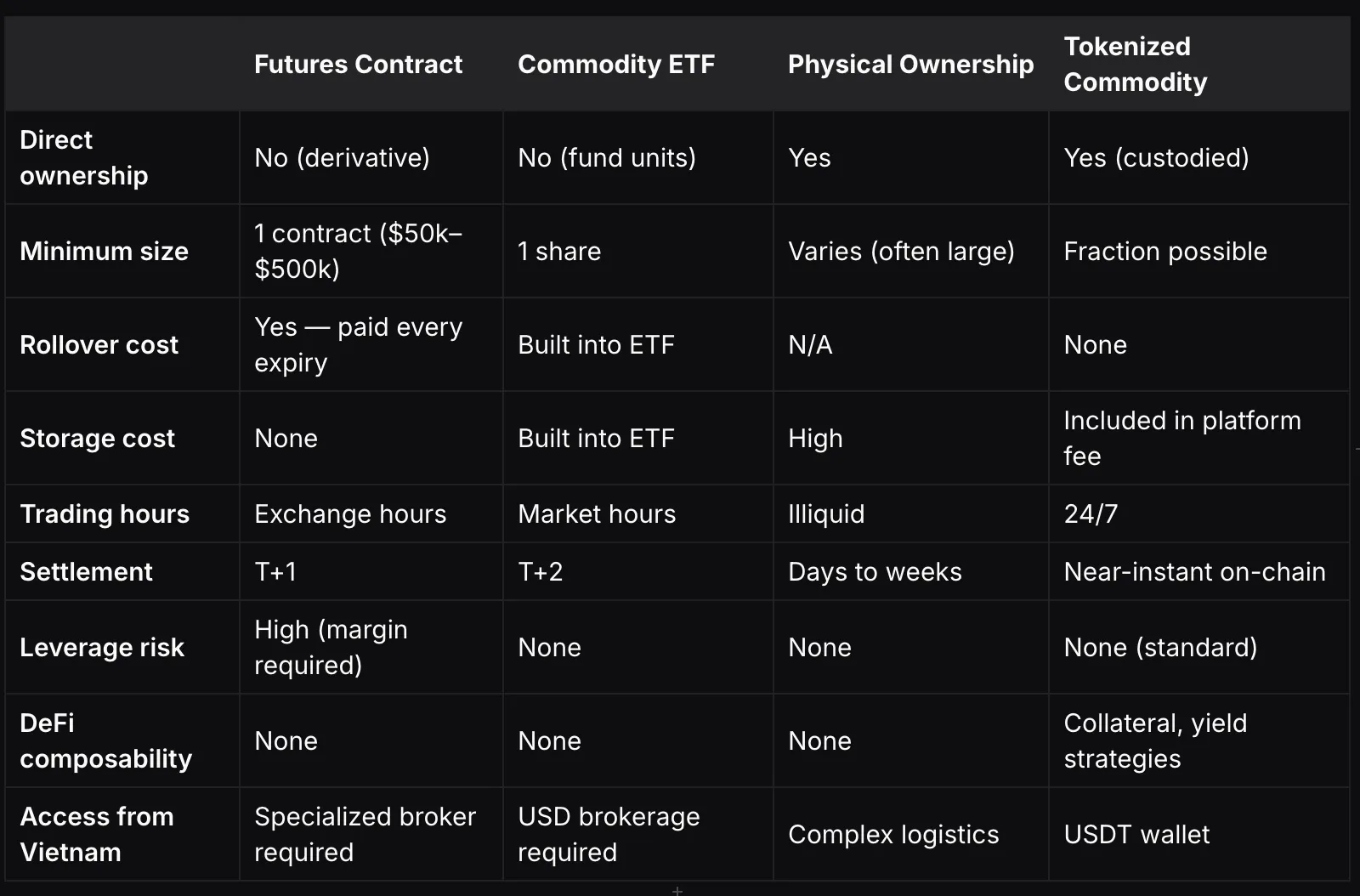
Commodity Tokenization vs. Traditional Commodity Investment
The Investment Case for Commodity Exposure in 2026
Commodities serve two roles in a portfolio that no other asset class replicates:
Inflation hedge. Commodity prices tend to rise when inflation rises — because commodities are inputs to the goods whose prices define inflation. A portfolio with commodity exposure has historically preserved purchasing power better than one composed only of equities and bonds during inflationary periods.
Diversification. Commodity price cycles are driven by supply-demand dynamics that are structurally different from corporate earnings cycles. Oil prices are influenced by OPEC production decisions, geopolitical disruptions, and weather events. Copper prices respond to Chinese industrial demand and mining labor disputes. These drivers are largely independent of interest rate decisions and equity valuations.
The practical challenge: commodity investment through traditional channels requires either derivatives expertise (futures), accepting tracking error and fees (ETFs), or logistics complexity (physical ownership). Tokenization removes that challenge without removing the investment case.
Risks to Understand
Commodity price risk: Commodity prices are volatile. Oil fell from $130 per barrel in 2022 to below $70 in late 2023. Lithium prices fell more than 80% from their 2022 peak. Tokenized commodity positions move with the underlying price — they do not insulate you from commodity market cycles.
Custody and issuer risk: The value of your token depends on the custodian holding the underlying commodity. Choose platforms with verified, audited custody. Unaudited or self-reported reserves are a red flag.
Liquidity risk: Tokenized commodity secondary markets are less liquid than futures exchanges or commodity ETFs. Large positions may be difficult to exit quickly without price impact.
Storage and insurance costs: Physical commodity custody involves storage and insurance costs. These are typically reflected in the token pricing or platform fees. Understand the total cost of holding before investing.
Regulatory risk: Commodity tokenization regulation varies by jurisdiction. Products legal in Singapore or UAE may face restrictions in other markets. Verify the regulatory status of any product before investing.
Concentration risk: Single-commodity exposure amplifies the impact of supply shocks, policy changes, or demand shifts specific to that material. A copper token falls when copper prices fall — regardless of what equity markets are doing.
The Long-Term Trajectory
The World Economic Forum estimated in 2023 that 10% of global GDP could be stored or transacted on blockchain by 2027. Commodities — as the foundational layer of the physical economy — represent a significant portion of that projection.
The move is not speculative. The infrastructure is being built now by the same companies that trade physical commodities at scale: Trafigura, ADNOC, Shell, Vitol, and LME participants. The question for retail investors is not whether commodity tokenization will reach scale — the institutional layer is already there. The question is whether retail investors have access to that layer.
ToVest is built to provide that access — in USDT, in fractional amounts, with disclosed custody and transparent pricing.