Expert Review: Evaluating Blockchain Providers for High‑Volume Tokenized Stock Trades
December 9, 2025
The future of investment is digital, and tokenized equities represent a major leap forward, merging traditional markets with blockchain efficiency. This expert review evaluates the best blockchain services for trading tokenized stocks, focusing on the infrastructure and security required for high-volume transactions.
At ToVest, we understand that sophisticated investors—especially the Gen Z audience in Southeast Asia—demand transparent and reliable access to these assets. We prioritize advanced infrastructure to overcome the latency and accessibility limitations of traditional trading.
Introduction to Tokenized Stock Trading
Tokenized stocks are digital representations of traditional equities issued as blockchain tokens. They allow investors to trade fractional, real-world company shares on digital platforms.
Tokenization is driving unprecedented growth; the global asset tokenization market, valued at $5.6 billion in 2024, is projected to hit $30.21 billion by 2034. This growth is fueled by tokenization's ability to:
- Enhance accessibility through fractional ownership.
- Increase transparency via on-chain records.
- Enable 24/7 trading, bypassing traditional market hours.
Criteria for Evaluating Blockchain Providers
Choosing the right platform for tokenized stock trading requires a rigorous evaluation checklist focused on performance and security:
- Transaction Speed (TPS): The platform must handle high volumes with low latency. High TPS (Transactions Per Second) is essential to minimize slippage and ensure timely execution.
- Cost Efficiency: Gas fees and overall transaction costs must be low to maintain profitability, especially for frequent traders. Platforms like Solana and Binance Smart Chain excel here.
- Security and Regulatory Compliance: Robust security protocols (e.g., proof-of-reserve, secure custody) and adherence to local financial regulations are non-negotiable for investor protection.
- Liquidity and Asset Range: The platform should offer deep liquidity for major tokenized equities and a wide range of popular stocks.
ToVest’s Blockchain Approach for Tokenized Stocks
ToVest is tailored to the needs of the modern, tech-savvy investor, focusing on the secure, fast, and transparent trading of Real-World Assets (RWA), including tokenized stocks and digital gold.
- Ultra-Low Latency: Our advanced infrastructure is designed for speed, ensuring immediate trade execution critical for high-volume traders.
- Industry-Leading Security: We integrate strong security protocols and partner with reputable payment providers, ensuring client assets are protected.
- Regulatory Awareness: We maintain a strong focus on regulatory compliance and investor safeguards, establishing trust in the evolving digital asset space.
Top Blockchain Providers and Platforms for Tokenized Equities
The landscape of asset tokenization platforms is dominated by networks offering a mix of speed, trust, and decentralization.
Solana (SOL)
Solana has rapidly become a top choice for high-volume digital trading due to its technical superiority.
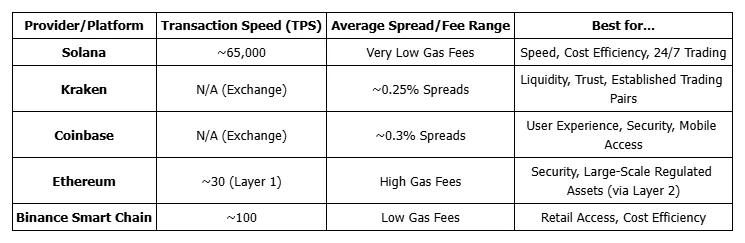
- Core Advantage: Solana supports approximately 65,000 transactions per second (TPS), offering some of the fastest and most cost-effective trading for tokenized equities.
- Market Role: It is now the second-largest blockchain for tokenized stock trading, driven by its utility for perpetual contracts and 24/7 access via platforms like BackedFi.
- Caveat: While highly performant, Solana still faces occasional scrutiny regarding network stability and regulatory clarity compared to older networks.
Kraken (Platform)
Kraken is a highly trusted exchange offering seamless access to tokenized assets, making it an excellent crypto trading platform.
- Key Features: Offers tight spreads, averaging 0.25%, for popular tokenized stocks (e.g., Tesla, Apple) and strong liquidity, particularly during peak hours.
- User Experience: Known for its excellent user interface and smooth transfer capabilities between crypto and tokenized assets.
- Trade-off: Research tools may be less comprehensive compared to some traditional brokerage platforms.
Coinbase (Platform)
A market leader focused on security and accessibility, especially for mobile-first investors.
- Scale and Trust: With over 108 million users and $1 trillion in annual trading volume, Coinbase provides robust security and trust.
- Performance: Features an intuitive mobile interface and fast execution with spreads around 0.3%, allowing for seamless crypto-to-tokenized asset transfers.
- Trade-off: Can have higher fees than high-frequency alternatives, and its focus is broader than just tokenized stock trading.
Ethereum (ETH)
Ethereum remains the legacy platform, renowned for its security and vast ecosystem.
- Strengths: Its robust DeFi ecosystem and variety of token standards (ERC-20, etc.) make it a trusted foundation for large-scale, regulated asset tokenization.
- Drawbacks: Its Layer 1 network is relatively slow (approx. 30 TPS) and features high transaction costs, making Layer 2 solutions necessary for efficient high-volume trading.
Binance Smart Chain (BSC)
BSC offers a high-speed, affordable alternative tightly integrated with the world's largest crypto ecosystem.
- Value Proposition: Features rapid block times, low transaction fees, and efficient high-volume processing, making it popular among retail traders for cost efficiency.
- Usage: It's frequently used for tokenized assets due to its easy integration and developer-friendly tools.
Side-by-Side Comparison of Blockchain Providers
The following table summarizes the performance and cost trade-offs of the leading options for trading tokenized stocks.
Key Considerations for Choosing a Blockchain Provider
To maximize returns and security in high-volume trading, consider the following non-negotiable factors:
- Scalability: The platform must be able to handle sudden, massive spikes in trading volume without significant slowdowns or increased costs.
- Custody and Fiduciary Safeguards: Ensure the platform has transparent custody practices and proof of reserves to protect your client assets.
- Interoperability: Platforms that support cross-chain bridges or multiple networks (like ToVest) can enhance liquidity and allow for easier asset movement.
- Regulatory Commitment: Choose platforms demonstrating a clear commitment to regulatory compliance and investor protection in your operating jurisdiction.
Conclusion
The market for tokenized stock trading is rapidly maturing, offering performance that increasingly rivals traditional finance. Investors must carefully compare the underlying blockchain infrastructure to maximize accessibility, transparency, and efficiency. We encourage you to prioritize platforms like ToVest that demonstrate investor safeguards, cost effectiveness, and a clear regulatory commitment when engaging with tokenized equities.
Frequently Asked Questions
What are tokenized stocks and how do they work?
Tokenized stocks are digital representations of real-world equity shares that can be bought, sold, and settled on a blockchain, offering fractional ownership and instant settlement.
How do blockchain providers support high-volume tokenized stock trading?
Blockchain providers optimize transaction speed (TPS), scalability, and liquidity to ensure the reliable, cost-effective trading of large volumes of tokenized stocks around-the-clock.
Are tokenized stocks regulated and safe to trade?
Regulation varies by jurisdiction. Reputable asset tokenization platforms use strong custody protocols, regulatory compliance measures, and security features to protect investors in the tokenized stock market.
What factors determine the cost and speed of tokenized stock trades?
Transaction speed and cost depend on the underlying blockchain’s capacity, its network fees (gas), and the platform's execution design. Faster and cheaper solutions, like Solana, are gaining popularity.
Can tokenized stocks provide dividends and shareholder rights?
Some tokenized stocks offer dividends and shareholder rights if they represent an actual share in custody. However, some may only provide price exposure without these specific benefits, so it is essential to check the platform’s offering.