2026 Guide to Trading Tokenized U.S. Stocks on Mobile Apps
January 12, 2026
The fastest way to buy tokenized U.S. stocks on mobile in 2026 is to select a regulated, transparent platform, complete KYC, fund with fiat or stablecoins, verify 1:1 asset backing, and place a market or limit order. Tokenized stocks are digital assets that mirror the price of real U.S. equities and settle on-chain, enabling 24/7 trading, fractional ownership, and—in some cases—use as collateral in DeFi. This guide explains the mechanics, compares platforms, and walks you through account setup, order execution, custody, and tax basics. As a compliant, blockchain-powered gateway, ToVest offers global users institutional-grade security, real-time market data, and seamless fiat/crypto funding for accessing fractional U.S. equities.

Understanding Tokenized U.S. Stocks
Tokenized U.S. stocks are blockchain-based representations of real shares, typically backed 1:1 by the underlying security, giving holders economic exposure to the stock’s price while enabling on-chain settlement and transferability. In short, they are digital assets that track U.S. equities and trade around the clock on supported platforms, independent of traditional market hours. For a clear overview of how they work, see Gemini’s explainer on tokenized stocks and pricing mechanics (Gemini Cryptopedia, “what are tokenized stocks and how do they work”).
Why investors care in 2026:
- Programmable, near-instant settlement and 24/7 liquidity reduce waiting times and market-hour constraints.
- Fractional investing makes high-priced shares accessible—many mobile apps support minimums near $1 for fractional U.S. stocks (see NerdWallet’s review of fractional-share brokers).
- Expanded use cases: tokenized equities can integrate with decentralized finance, allowing collateralized borrowing or composable strategies on-chain, where supported.
- Global reach and crypto rails: users can fund in stablecoins and trade without traditional brokerage borders, subject to local rules (Datawallet, “best tokenized stock trading exchanges”).
Under the hood, platforms combine several building blocks:
- Oracles deliver real-time market data from traditional exchanges to the blockchain and help support proof-of-reserve attestations.
- Regulated custody safeguards the underlying shares and segregates client assets.
- Smart contracts automate issuance/redemption, settlement, and transparency across the lifecycle (Unicsoft, “tokenized stocks” and Appinventiv, “AI tokenization for asset ownership”).
Key terms:
- Fractional shares: owning less than one whole share, allowing you to invest dollar amounts instead of full share prices.
- DeFi composability: the ability to plug tokenized assets into multiple decentralized apps (for lending, yield, or hedging) without rewriting core logic.
Choosing a Compliant and Reliable Trading Platform
Start with compliance and transparency. Prefer platforms that operate under clear licensing, enforce KYC/AML, and hold strong institutional backing. Regulated exchanges and brokerages—plus specialized tokenization venues—offer better investor protections and auditability (Investopedia, “best brokers for international trading”). Look for:
- Published compliance status (e.g., MSB registration in the U.S. or equivalent), KYC/AML controls, and clear terms.
- On-chain proof of reserves, independent audits, and disclosed 1:1 asset-backing details.
- Documented oracle feeds and pricing methodology to ensure fair, timely valuations (Datawallet, “best tokenized stock trading exchanges”).
Quick comparison of common options in 2026 (features vary by region):
PlatformRegulatory postureCoverageCustody modelMinimum
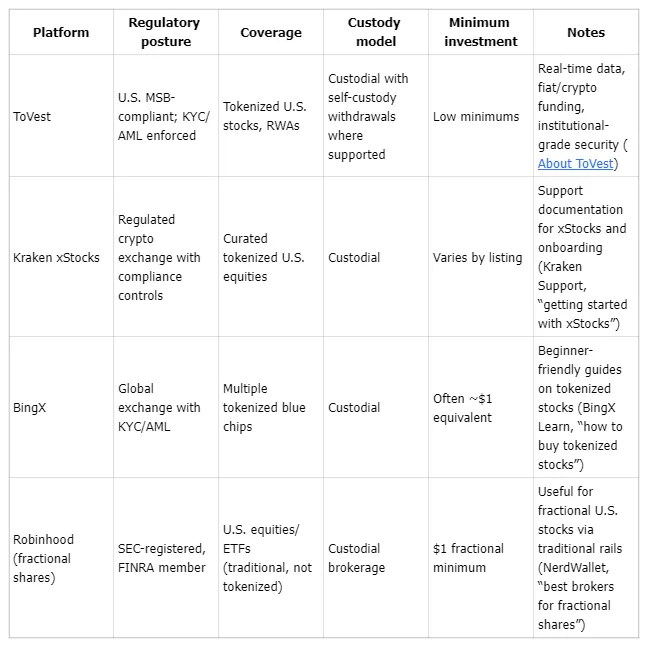
Tip: Favor platforms with MSB or equivalent credentials, audited reserves, and reputable custody partnerships to mitigate counterparty risk.
Setting Up Your Account and Funding It
Most mobile apps follow a similar onboarding flow:
- Download the app or sign up on the web.
- Complete KYC identity verification to unlock deposits and trading (standard across reputable platforms to meet global AML rules; see Investopedia’s international broker guidance).
- Link funding methods.
Common funding options:
- Fiat transfers: bank wires, ACH, or cards in supported currencies (USD, EUR, etc.).
- Stablecoins: USDT or USDC for fast, global funding.
- Major crypto: ETH or BTC where supported.
Before depositing, confirm the settlement currency for tokenized stocks (e.g., USD, USDT) so you send the correct asset and avoid conversion fees (Datawallet, “best tokenized stock trading exchanges”).
Verifying Token Details and Asset Backing
Trustworthy tokenized stocks provide transparent documentation per listing. Review:
- Issuer and underlying asset specifics (ticker, CUSIP/ISIN if provided).
- Custodian identity and regulatory oversight.
- Proof of 1:1 asset backing and frequency of third-party audits.
- Oracle sources and update cadence for price feeds.
A credible venue will clearly show 1:1 backing, audit trails, and live oracle-driven pricing. Many platforms also provide support articles on buying tokenized U.S. stocks with crypto and outline custody/settlement mechanics (Blockchain.com Support, “Can I buy Tokenized U.S. Stocks with crypto”). For technical assurance, platforms often detail proof-of-reserve processes and oracle integrations (BlockchainTechs, “RWA tokenization platform development”).
Selecting Order Types and Managing Liquidity
Know your order types:
- Market order: executes immediately at the best available price—fast, but may face slippage in thin markets.
- Limit order: executes at your specified price or better—control over price, but execution isn’t guaranteed.
- AMM/DEX routing: some platforms tap liquidity pools; pricing depends on pool depth and on-chain conditions (Datawallet overview of exchange liquidity).
Check liquidity metrics before trading:
- Order book depth, spreads, and 24-hour volume.
- Number of supported blue-chip tokens and trading pairs. Leading venues highlighted by market guides offer 24/7 access and deep liquidity across dozens of names (Datawallet, “best tokenized stock trading exchanges”).
Feature availability snapshot:
- Instant vs. scheduled settlement: On-chain settlement is typically near-instant; broker-synced tokenizations may have specific windows.
- DeFi utility: Some tokens can be pledged as collateral or integrated into DeFi; confirm eligibility and smart-contract risks (RWA.io, “RWA platforms for 2026”).
Custody Options and Secure Storage of Tokens
Two primary custody models exist:
- Custodial: the platform holds your tokens. Pros: convenience, integrated recovery, fewer operational steps. Cons: counterparty risk.
- Self-custody: you withdraw to a personal wallet (e.g., hardware wallet or MetaMask). Pros: control, DeFi access, portability. Cons: you’re responsible for key management and security hygiene.
Security best practices:
- Use hardware wallets for larger balances and store seed phrases offline.
- Enable 2FA and withdrawal allowlists.
- Regularly review app permissions and revoke unused approvals.
For a practical overview of exchange custody vs. withdrawals and platform-level safeguards, see high-level exchange reviews and tokenization primers (Gemini Cryptopedia on tokenized asset mechanics; Datawallet’s exchange comparisons).
Navigating Tax Reporting and Regulatory Compliance
In most jurisdictions, tokenized stocks are treated like traditional securities for tax purposes, so capital gains rules generally apply when you sell or swap them. Maintain thorough records:
- Export complete trade histories, cost basis, and transfer logs from your app.
- Note that on-chain settlements can differ from T+2 legacy timing, potentially affecting your taxable event dates.
Consult local guidance and consider tax software integrations offered by your platform. For broader context on regulated access and investor protections, see Investopedia’s guide to international brokers.
Starting to Trade Tokenized U.S. Stocks with Crypto
A straightforward path from stablecoins to equity exposure:
- Deposit USDT/USDC (or supported crypto) into your mobile app wallet.
- Browse the tokenized U.S. stock list and select your ticker.
- Choose market or limit order, input amount, and submit.
- Confirm execution; your portfolio updates with the tokenized position.
Flow at a glance: Deposit crypto → Select stock token → Choose order type → Execute → Receive tokens → Secure custody (withdraw or keep custodial)
Platforms recognized for crypto-settled stock access include ToVest and other leading exchanges profiled in market roundups (Datawallet, “best tokenized stock trading exchanges”). Always verify your platform’s settlement currency and withdrawal options before trading.
Monitoring Market Data and Risk Controls
Use apps with live prices, depth charts, and analytics so you can spot spreads, liquidity pockets, and momentum. Seasoned traders may also seek AI-driven risk signals and anomaly detection to flag unusual activity (Appinventiv, “AI tokenization for asset ownership”). On the backend, smart contracts increasingly automate risk blocks and dynamic pricing, improving resilience.
Turn on in-app risk controls:
- Price alerts and news notifications for your tickers.
- Stop-loss or take-profit tools where supported.
- Diversification across sectors and stablecoin reserves for volatility management (StockBrokers.com, “mobile trading guide”).
Best Practices for Beginners Trading Tokenized Stocks
- Start on regulated, well-audited platforms; begin with small deposits and scale as you gain comfort.
- Learn the tools: read platform education, practice with demo modes if available, and start with large-cap names you recognize.
- Verify 1:1 backing, custody arrangements, and oracle sources for each token.
- Use strong security habits, regularly review account activity, and stay updated on policy changes.
Frequently asked questions
What platforms support tokenized stock trading on mobile apps?
Leading platforms that support tokenized stock trading or fractional U.S. stock exposure on mobile include ToVest and other options, with availability varying by region.
How can I ensure the tokenized stocks are fully backed and audited?
Look for public audit reports, explicit 1:1 backing statements, disclosed custodians, and on-chain price feeds per listing page.
What are the main custody options for tokenized stocks and their risks?
You can keep tokens in the platform’s custodial wallet for convenience or self-custody them in a personal wallet for greater control—self-custody adds responsibility for key security.
How does tax reporting work for tokenized stock trades?
They’re generally taxed like securities; keep detailed records and export trade histories from your app to support capital gains reporting.
Can I trade tokenized U.S. stocks using stablecoins or cryptocurrencies?
Yes—many platforms, including ToVest, accept USDT/USDC funding and allow direct crypto-settled trades.