Tokenized Stocks vs Real Stocks: What's the Difference — and Which One Is Right for You?
June 18, 2026
Two Ways to Own the Same Asset
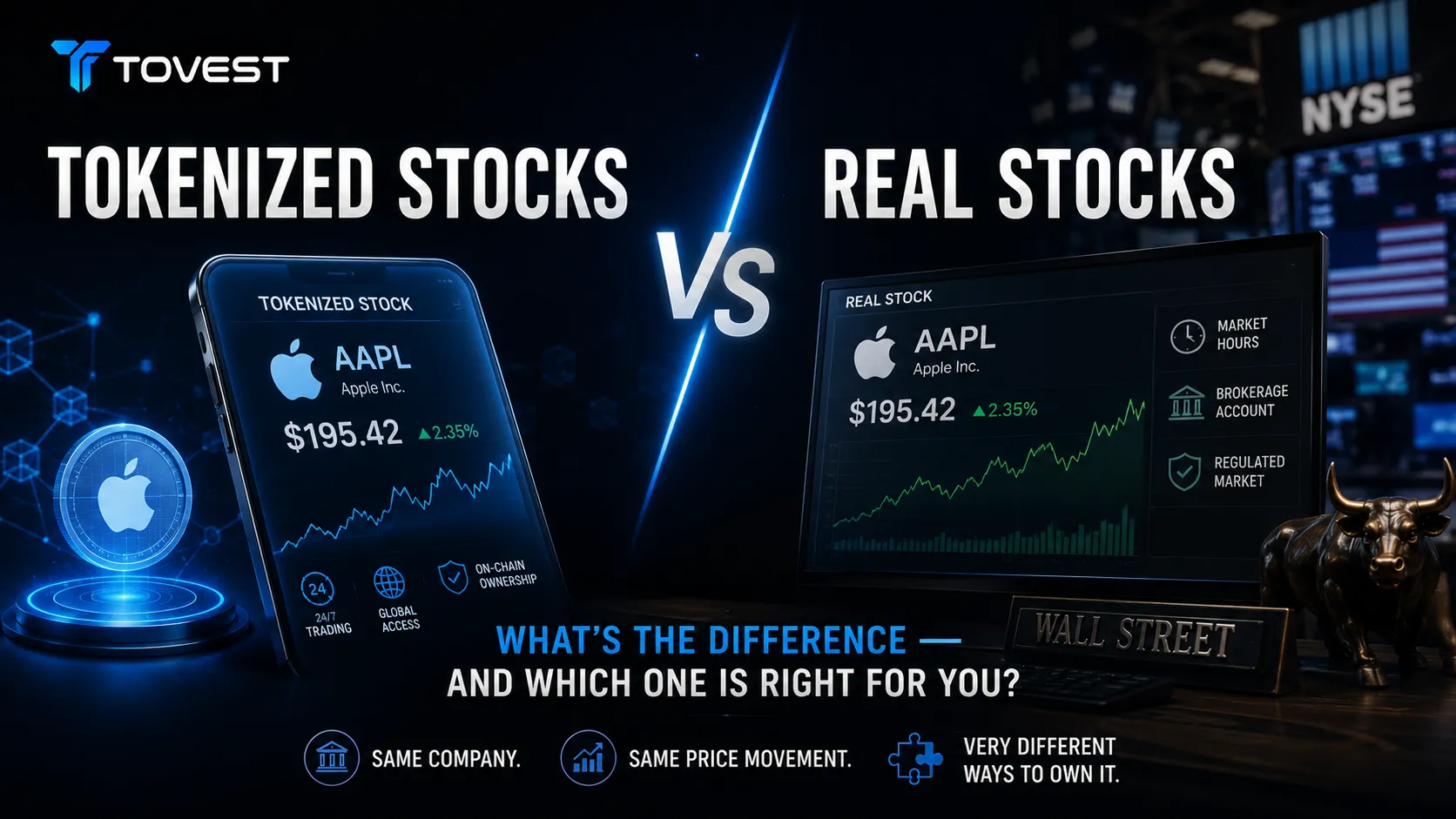
When Apple's stock goes up 5%, both Apple shareholders and holders of tokenized Apple shares benefit equally. The underlying price exposure is identical. But how you got there, what you actually own, and what you can do with it — that is where the two diverge significantly.
Understanding the difference is not just an academic exercise. It determines your access, your costs, your flexibility, and ultimately your strategy.
What Are Real Stocks?
A real stock — or traditional equity — represents direct legal ownership of a fractional share in a publicly listed company. When you buy Apple on Nasdaq through a broker, your name (or your broker's name on your behalf) is recorded in a regulated registry. You have shareholder rights: voting, dividends, legal recourse.
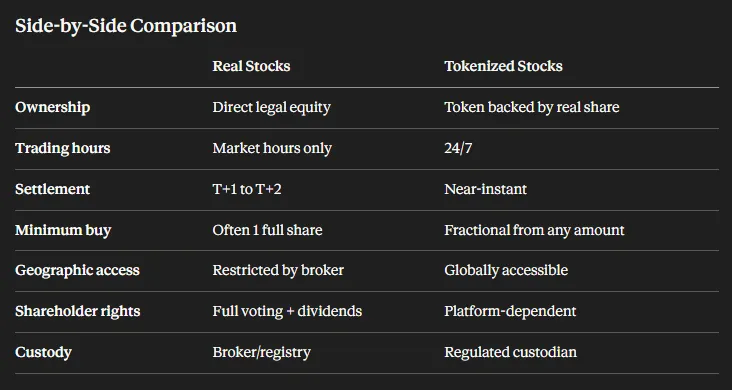
The infrastructure behind this is decades old. Settlement takes T+1 or T+2 business days. Trading hours are fixed — typically 9:30 AM to 4:00 PM Eastern Time for US markets. Access requires a brokerage account, often with country restrictions, minimum deposits, and currency conversion fees.
For investors in Southeast Asia, buying US-listed stocks through local brokers frequently involves additional friction: limited stock selection, higher commissions, slower execution, and currency risk on top of market risk.
What Are Tokenized Stocks?
A tokenized stock is a digital token issued on a blockchain that tracks the price of an underlying real stock. The token is typically backed 1:1 by the actual share — held in custody by a regulated entity — meaning the price moves in lockstep with the real market.
What changes is the delivery mechanism.
Tokenized stocks trade 24/7, not just during market hours. Settlement is near-instant rather than T+1 or T+2. Fractional ownership is built in by default — you can buy $10 worth of a $200 stock without any special arrangement. And because they exist on blockchain rails, they are accessible globally without the same country restrictions that limit traditional brokerage access.
The Trade-offs Worth Knowing
Tokenized stocks solve real problems — but they come with their own considerations.
Shareholder rights vary by platform. Some tokenized stock products pass through dividends. Voting rights are less commonly transferred. If governance matters to you, this is worth checking before you buy.
Regulatory status is still evolving across jurisdictions. Tokenized stocks are treated differently in different countries — some classify them as securities, others as derivatives, others have no framework yet. This affects your tax treatment and legal protections.
Liquidity on tokenized platforms is generally lower than on major exchanges for large orders — though for retail-sized positions this rarely matters in practice.
Counterparty risk exists with any custodial arrangement. The quality of the custodian holding the underlying shares matters, and it varies by platform.
Who Is Each One For?
Real stocks make more sense if:
- You want full legal shareholder rights
- You are already set up with a reliable brokerage with good US market access
- You are making large trades where liquidity and tight spreads matter
Tokenized stocks make more sense if:
- You are in a region where US brokerage access is limited or expensive
- You want to trade outside market hours — reacting to news that breaks on weekends or overnight
- You want fractional exposure to high-priced stocks without minimum share requirements
- You want to hold equity alongside crypto and RWA assets in a single portfolio
The Bottom Line
Tokenized stocks are not a replacement for real stocks — they are an alternative access layer to the same underlying assets. For investors in Southeast Asia navigating geographic restrictions, currency friction, and limited brokerage options, that alternative layer is often the more practical one.
The asset is the same. The difference is in who gets to own it, when, and how easily.
For informational and educational purposes only. This article does not constitute financial advice. All investments carry risk.