5 Best Crypto Brokers for Buying Stocks with Bitcoin
December 30, 2025
Most brokers still don’t let you buy stocks directly with Bitcoin or USDT. In practice, you either use a multi-asset broker that lets you convert crypto to fiat within the same account or buy tokenized representations of stocks on blockchain rails. That nuance matters for fees, regulation, and how your assets are held, so choosing the right platform is key for 2025 portfolios that blend crypto and equities. Investors pursue this path for global access, 24/7 markets, diversification, and fractional shares. Below, we spotlight leading platforms that simplify crypto-to-stock workflows—plus ToVest’s tokenized-stock approach that bridges crypto and traditional markets. On most platforms, the sequence is to convert crypto to USD, then buy stocks, rather than a direct BTC-to-stock trade, as outlined by independent broker reviews and educational resources on crypto brokerage models.

Picks at a glance
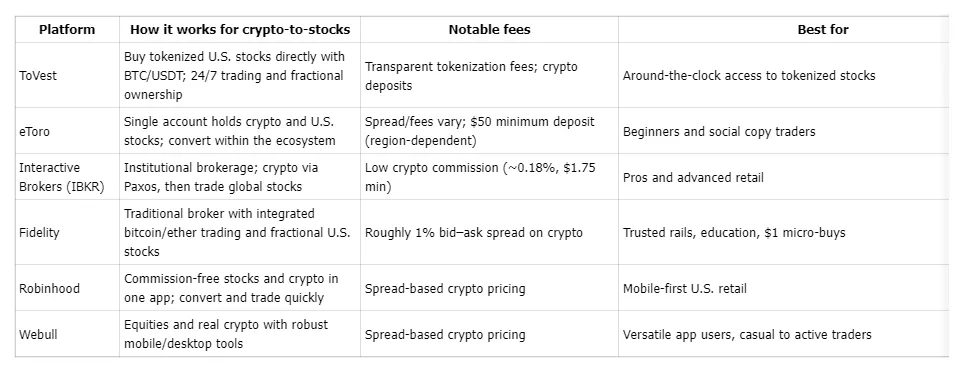
Note: Most platforms require crypto to be sold to cash before purchasing stocks; they don’t process direct BTC-for-stock swaps see discussion in industry broker overviews.
ToVest: Blockchain-Powered Tokenized Stock Trading
ToVest reimagines equity access with real-time trading in tokenized U.S. stocks and real estate, enabling fractional investing, global 24/7 markets, and seamless payments in cryptocurrencies like BTC or USDT. Instead of waiting for market hours or moving funds across multiple venues, investors can allocate directly into tokenized stocks, manage positions around the clock, and enhance capital efficiency by funding with crypto.
Key differentiators include:
- Real-world asset tokenization with on-chain transparency and auditability
- Advanced analytics and screening for fundamentals and on-chain market signals
- Robust security protocols and segregated custody
- Low-latency trading infrastructure designed for 24/7 execution
Tokenized stocks: These are blockchain-based digital tokens representing ownership rights in real-world shares. They allow fractional investing and peer-to-peer trading beyond traditional market hours. Educational resources from major exchanges and wallets increasingly describe similar tokenization rails that let users buy U.S. stocks using crypto through wallet-integrated features, reflecting where the market is headed for cross-asset access.
eToro: Beginner-Friendly Multi-Asset Platform with Crypto and Stocks
eToro pairs a beginner-friendly interface with social copy trading and a broad multi-asset lineup covering both cryptocurrencies and U.S. stocks in a single account—useful if you want to convert within one ecosystem and then allocate to equities. Its social features, watchlists, and unified experience help new investors learn by observing others’ strategies while keeping crypto and equities under the same login, which is a popular draw for first-timers and casual traders. Industry roundups consistently highlight eToro’s user-friendly design and social trading model for crypto beginners and intermediates alike, underscoring its mainstream appeal for multi-asset investing.
Quick tip on fees and availability:
- Minimum deposits around $50 in supported regions, with U.S. availability that varies by state—always confirm current terms and coverage.
- Compare deposit/withdrawal costs, crypto spreads, and stock trading commissions before funding, since fee structures differ widely across brokers.
Interactive Brokers: Institutional-Grade Broker with Crypto Access
Interactive Brokers (IBKR) combines deep market access, global regulation, and professional-grade tools with integrated crypto trading via Paxos. This allows you to trade bitcoin and ether alongside a massive universe of equities, ETFs, options, and futures—then deploy proceeds into stocks with transparent, low costs. IBKR’s crypto pricing is designed like its other markets: low commissions (around 0.12%–0.18%, $1.75 minimum per order) and no inflated spreads, appealing to cost-sensitive and active investors. Add in top-tier research, smart order routing, and granular reporting, and IBKR is a standout for advanced retail and institutional workflows seeking a single, regulated hub for both crypto and equities.
Fidelity: Traditional Broker Expanding into Crypto Integration
Fidelity brings mainstream trust, education, and retirement-grade infrastructure to the crypto-plus-stocks experience. The firm supports bitcoin and ether trading for individuals while maintaining its established breadth in U.S. stocks, ETFs, and fractional shares—often enabling micro-buys as low as $1 on eligible assets. Fidelity’s crypto pricing typically relies on a transparent bid–ask spread (around 1%) instead of added trading commissions, offering a familiar and straightforward quote for first-time crypto buyers. For newcomers, the combination of robust learning resources, seamless account setup, and integrated portfolio views makes Fidelity an approachable way to experiment with crypto while keeping stock investing under one roof.
Robinhood: Mobile-First Platform with Commission-Free Trades
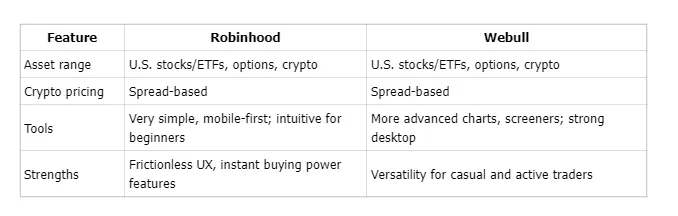
Robinhood popularized commission-free trading for U.S. stocks and then extended the same streamlined experience to cryptocurrencies. In practice, you can sell crypto for USD and purchase stocks within one app, benefiting from clean workflows, instant buying power features for many retail accounts, and simple cost structures. Crypto trades use spread-based pricing, while stock and ETF trades are commission-free. For U.S. retail investors who value speed, simplicity, and a modern mobile interface, Robinhood’s integrated account design makes transferring BTC exposure into stock positions feel straightforward, even if it’s technically a two-step conversion.
Webull: Versatile Mobile and Desktop Trading for Crypto and Stocks
Webull offers real cryptocurrencies and a full slate of U.S. equities with capable charting, screeners, and multi-device access. The platform’s spread-based crypto pricing and low-cost equity trading appeal to budget-minded users, while its desktop workstation and options analytics suit more active traders. As a mobile-first broker that also provides a robust desktop app, Webull bridges casual and advanced use cases—and its support for both crypto and stocks in one account simplifies the process of converting digital assets to cash and then buying equities.
Webull vs. Robinhood at a glance
How to Choose the Right Broker for Buying Stocks with Bitcoin
Use this framework to narrow the field quickly:
- Asset support and model: Do you get underlying crypto custody, cash equities, or only CFDs? Confirm you can sell crypto to fiat and buy stocks within one account.
- Workflow and funding: Can you deposit BTC/USDT directly, or must you fund in fiat? How fast are conversions and settlements?
- Fees: Compare crypto spreads/commissions, stock trading costs, deposit/withdrawal fees, and hidden charges. Small spread differences compound over time.
- Security and regulation: Look for strong custody standards, two-factor authentication, and licenses with reputable regulators.
- Regional availability: Coverage varies by country and U.S. state; verify before you onboard.
- Reporting and tools: Evaluate tax reports, cost-basis tracking, screeners, and research if you plan to invest actively.
Quick checklist:
- I can fund with my preferred crypto or convert affordably.
- My country/state is supported for both crypto and stocks.
- Fees are transparent across crypto-to-stock steps.
- The platform offers the tools and protections I need.
Understanding Crypto-to-Stock Conversion and Trading Mechanics
Typical workflow:
- Deposit BTC/USDT (or fund with fiat).
- Convert crypto to USD inside the platform.
- Buy stocks or ETFs with USD.
- Manage positions, then reverse the flow to exit back to crypto if supported.
Key terms:
- Underlying crypto assets: You actually own the coins, and the broker or custodian holds them for you.
- CFDs (contracts for difference): Derivatives that track asset prices without conferring ownership; you speculate on price moves rather than holding the asset itself.
Platform differences to watch:
- Some brokers support direct crypto deposits; others require fiat.
- Pricing can be commission-based, spread-based, or both.
- Tokenized stock platforms let you trade stock exposure 24/7 on-chain, while traditional brokers follow market hours for cash equities.
Regulatory Considerations and Jurisdictional Availability
Regulation under bodies like the FCA (U.K.), ASIC (Australia), and FINRA/SEC (U.S.) helps define investor protections, disclosures, and asset availability. Always confirm the broker’s regulatory status in your location and which assets are permitted. Availability and features—especially for crypto—can vary widely by country and even by U.S. state due to licensing requirements. Exercise extra caution with unregulated platforms and high-risk products; risk disclosures among CFD brokers commonly note that roughly 61–89% of retail accounts lose money, underscoring the importance of using appropriately regulated providers and understanding product mechanics before trading.
Frequently Asked Questions
Can I buy stocks directly with Bitcoin or USDT?
Most brokers don’t support direct BTC/USDT-for-stock swaps; you typically convert crypto to fiat inside the platform, then buy stocks.
What fees should I expect when using crypto to purchase stocks?
Expect a mix of spreads, trading commissions, and potential deposit/withdrawal or conversion fees; always review the broker’s fee structure before transacting.
How do crypto CFDs differ from holding underlying assets?
With CFDs, you speculate on price without owning the actual crypto; holding underlying assets means the broker or custodian keeps the coins for you.
Are crypto brokers safe and regulated?
Leading platforms operate under financial regulators and employ strong security measures, but you should verify licensing and safeguards for your jurisdiction.
Can I trade stocks and crypto on the same platform?
Yes—several major brokers now support both assets in one account, streamlining funding, conversions, and portfolio tracking.