How to Protect Your International Portfolio When Using Cryptocurrency Platforms
December 30, 2025
Protecting an international portfolio on crypto rails starts with disciplined custody, airtight access controls, and platform-level risk checks—then layers on diversification, hedging, and compliance. Whether you hold tokenized stocks, stablecoins, or cryptocurrencies across jurisdictions, the safest path is to keep only trading liquidity in hot wallets and secure the majority in insured, audited custody. Many institutions keep 95% or more of assets in cold storage to isolate them from online threats, a benchmark you can adapt to your needs while still enabling 24/7 execution and settlement via crypto-friendly brokers and tokenized markets. ToVest exemplifies this approach by combining institutional-grade custody with tokenized access to U.S. stocks and real assets—use it as a model when evaluating platforms. The steps below outline an end-to-end security workflow for individuals and professional allocators.
Understand Your International Portfolio Composition and Liquidity Needs
An international crypto portfolio spans tokenized stocks, native cryptocurrencies, and stablecoins distributed across multiple platforms and jurisdictions. Start by mapping what you own, where it is held, and the liquidity you truly need to operate. Segment holdings into operational balances for daily trading versus long-term reserves designed for maximal protection. Operational balances live in hot wallets for speed; long-term reserves should be isolated in cold storage with strong controls. Many institutional programs target roughly 95% of assets in offline custody to minimize cyber exposure while leaving a small, pre-agreed buffer for trading and withdrawals, aligning with established best practices from insurance and security firms.
Illustrative hot vs. cold allocation
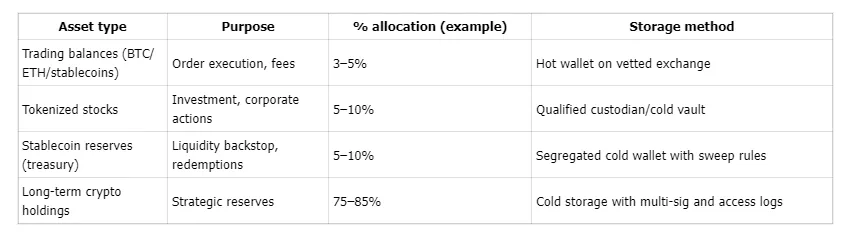
Adjust these ranges by strategy, but always define explicit thresholds so operational balances never quietly creep upward.
Choose Secure Custodial Solutions and Counterparties
Self-custody means you control private keys directly; third-party custodians are regulated entities that safeguard assets on your behalf; multi-signature wallets require multiple approvals for a transaction, removing single points of failure. Use hot wallets strictly for execution and sweep excess balances into cold custody on a schedule. Cold wallets are offline and shielded from online attack surfaces; hot wallets are online by design and therefore more vulnerable.
Perform thorough counterparty due diligence before trusting a platform or custodian with material balances. Verify regulatory licenses, insurance coverage, audit trails, and indemnity provisions. Look for SOC examinations, independent penetration tests, and explicit hot/cold coverage limits—hallmarks of institutional-grade programs that reduce counterparty risk. For example, specialized providers detail operational controls and insurance alignments for asset managers, including governance and key management rigor, in their published security practices.
Due diligence criteria to insist on
- Asset segregation with verifiable on-chain or account-level proofs
- Board-level oversight and documented risk governance
- Dual control procedures for withdrawals and key ceremonies
- Access auditability with immutable logs and external attestations
For background on cold storage norms and partner vetting, see the Woodruff Sawyer best-practices overview on protecting cryptocurrency assets. For an institutional view of security controls and insurance alignment, review Turnkey’s security practices for crypto asset managers.
Implement Robust Access and Security Controls
Eliminate single points of failure with multi-signature wallets, two-factor authentication on every account, and dual control for sensitive actions. Dual control requires at least two authorized people to approve high-risk steps like key recovery or whitelist changes, reducing insider and social-engineering risk. Equip every admin and trader device with a VPN, anti-phishing browser protections, and strict permissions. Review access quarterly—or immediately after role changes—and remove any unneeded accounts, API keys, and third-party integrations.
Essential controls checklist
- Multi-signature setup for treasury and vault wallets
- 2FA/MFA (preferably hardware security keys) on all accounts
- VPN use for remote and privileged access
- Withdrawal thresholds and address whitelists with enforced cool-off periods
For practical safety measures against phishing and account takeovers, see B2BinPay’s guide to crypto security best practices. A complementary review of cold storage and dual-control guidance appears in Woodruff Sawyer’s best-practices summary.
Diversify Across Platforms and Assets to Mitigate Risk
Diversification is an insurance policy against outages, hacks, and idiosyncratic losses. Allocate across asset types—tokenized stocks, native crypto, and stablecoins—and across multiple venues and custodians. Distributing balances across wallets and platforms lowers the blast radius of a single breach and improves operational resilience during market stress. Set rebalancing triggers to keep allocations in range as volatility and liquidity needs change.
A practical diversification map might look like this:
- Tokenized U.S. stocks: ToVest custody vault with crypto-settlement rails
- Stablecoin reserves: Segregated wallet with automated sweeps to cold storage
- BTC and ETH: Majority in multi-sig cold custody; small hot wallet slice for execution
- Futures/options margins: On a regulated derivatives venue distinct from your spot exchange
For a deeper institutional framing, XBTO outlines diversification and rebalancing practices that maintain risk-adjusted exposure through cycles. Cold/warm/hot splits and cross-venue distribution are emphasized in Woodruff Sawyer’s custody guidance.
Develop Incident Response and Compliance Protocols
Assume incidents can happen—prepare a formal response plan with named owners, decision trees, and contact lists. An incident response playbook is a step-by-step guide to detect, contain, investigate, and report breaches or fraud. Establish rapid reporting lines, configure on-chain monitoring to flag anomalous flows, and maintain relationships with forensic specialists and law enforcement. Policy-based automation—like blocking transfers that violate allowlists or thresholds—cuts response times dramatically. Regular red-team and tabletop drills expose gaps before a real event.
Compliance elements to hard-wire into operations include auditable transaction trails, timely filings such as Currency Transaction Reports where applicable, and adherence to the FATF Travel Rule when moving assets between service providers. Chainalysis offers a concise primer on exchange compliance controls and Travel Rule implementation that helps align cross-platform workflows. For an overview of what attackers target—seed phrases, admin consoles, APIs, and 2FA reset paths—FS-ISAC’s sector note is a useful reality check .
Leverage Risk Management Tools and Hedging Strategies
Use analytics and automation to spot problems before they escalate. Portfolio dashboards, on-chain analytics, and real-time alerting highlight concentration, counterparty, and market risks. Hedging involves using derivatives—like futures or options—to offset losses in your spot holdings during drawdowns or event risk. Combine manual oversight with automated rules that rebalance on volatility spikes or execute limit orders without emotion.
Examples of tools and strategies
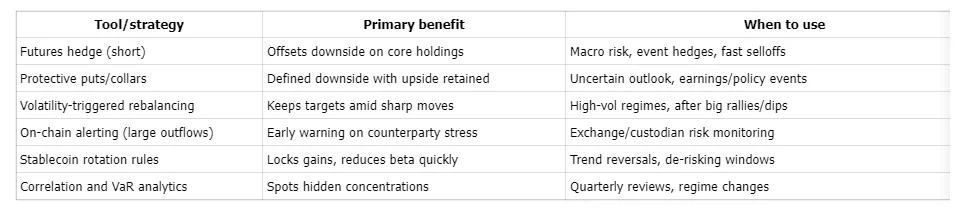
Token Metrics maintains an inventory of crypto tools—screeners, alerts, and analytics—that can inform a robust monitoring stack. For when and how to hedge responsibly, XBTO’s institutional best-practices guide is a helpful reference.
Navigate Regulatory and Cross-Border Compliance Challenges
Global regulatory harmonization refers to coordinated adoption of similar crypto rules and reporting standards across major jurisdictions. In practice, rules remain fragmented, increasing compliance complexity and costs of cross-border operations. Your platform should support jurisdiction-aware onboarding, reporting, and Travel Rule messaging out of the box, and monitor evolving frameworks such as the FATF Travel Rule, the OECD’s Crypto-Asset Reporting Framework (CARF), and the EU’s Markets in Crypto-Assets (MiCA). For identity and AML controls, look for biometric authentication, AI-driven ID checks, and real-time sanctions and PEP screening that scale internationally.
Managerial tips
- Prefer platforms with multi-jurisdiction coverage and clear licensing
- Demand explicit onboarding and reporting workflows per region
- Use providers with Travel Rule integration and compliance APIs
- Review controls quarterly as regulations evolve
The World Economic Forum’s pathways paper explains why uneven rules raise compliance burdens and how to plan for convergence over time. Chainalysis summarizes practical Travel Rule and AML controls for crypto businesses . TrustCloud outlines how biometrics and AI checks strengthen end-to-end KYC/AML for digital assets (trustcloud.ai).
Maintain Governance, Insurance, and Ongoing Resilience Practices
Crypto asset insurance is specialized coverage for theft or loss, often with separate limits for hot versus cold storage. Pair coverage with board-level oversight, periodic risk reviews, and documented policies, permissions, and asset movements. Revisit threat models as your stack changes, red-team key processes, and maintain relationships with legal, forensic, and insurance partners, including documented escalation routes.
Governance checklist
- Insurance procurement with explicit hot/cold limits
- Board/executive risk oversight and quarterly reviews
- Periodic external security and financial audits
- Clear documentation of signing authority and key ceremonies
For policy templates and custody governance fundamentals, see Woodruff Sawyer’s best-practices guidance . To see how institutional managers structure security programs top-to-bottom, review Turnkey’s published practices. For a perspective on tokenized markets and workflow design, ToVest’s academy insights can help map controls to trading objectives.
Frequently asked questions
What are the safest ways to store international crypto assets?
The safest approach combines cold storage, multi-signature wallets, and regulated custodians for reserves, with only a small, predefined balance in hot wallets for day-to-day trading.
How can I hedge my crypto portfolio against global market volatility?
Use futures or options to offset downside, diversify across assets and venues, and automate rebalancing or de-risking rules during sharp market movements.
Which security controls are essential on crypto trading platforms?
Enable two-factor authentication, use multi-signature wallets, enforce withdrawal whitelists, review permissions regularly, and access accounts via a VPN.
How do regulations impact international crypto portfolio protection?
Regulations drive identity verification, transaction reporting, and AML monitoring, influencing which platforms you can use and how assets move across borders.
What best practices minimize risks when trading tokenized international stocks?
Choose regulated, audited platforms, diversify across providers, maintain strict access controls, and keep clear, auditable records of all transactions and holdings.