Robinhood vs. Public vs. Stash: Which Fractional App Wins for US Stocks?
December 30, 2025
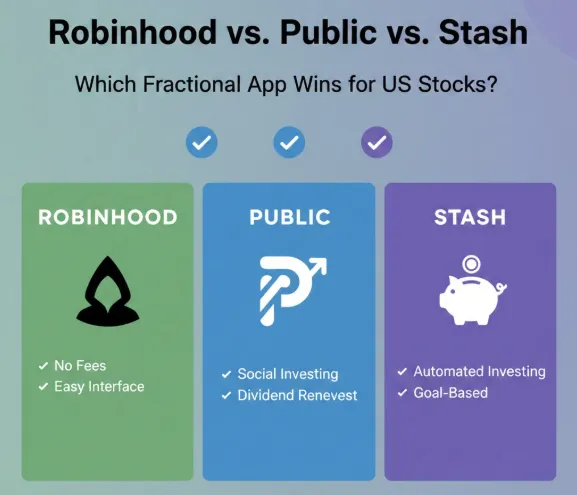
Fractional investing apps let you buy a slice of a US stock for just a few dollars, making blue-chip names accessible without saving for a full share. If your goal is simple, low-cost exposure to US stocks with fractional shares, Robinhood is the best fit for most beginners thanks to $0 trading commissions, $1 minimums, and easy recurring buys. Public serves as a strong alternative if you want a social, research-forward experience. Stash is designed for hands-off beginners who prefer automated portfolios and banking-style features, though its monthly subscription can outweigh benefits on small balances. Below, we compare the three apps on fees, minimums, usability, and who each is best for—so you can start with as little as $1 and build a diversified portfolio over time.
Overview of Fractional Investing Apps for US Stocks
Fractional shares allow you to purchase a portion of a stock or ETF by dollar amount rather than whole shares. This lowers the barrier to entry—many leading apps support minimums as low as $1, which aligns with findings in Bankrate’s guide to fractional-share brokers that highlight dollar-based investing and low starting amounts across top platforms. Fractional orders typically execute like market or recurring buys during market hours, and most brokers credit dividends proportionally on your holdings. Voting rights on fractional shares vary by broker and are often limited to whole-share ownership, a nuance covered in StockBrokers.com’s explainer on fractional-share brokers.
Below is a side-by-side look at Robinhood, Public, and Stash for US stock investing with fractional shares.
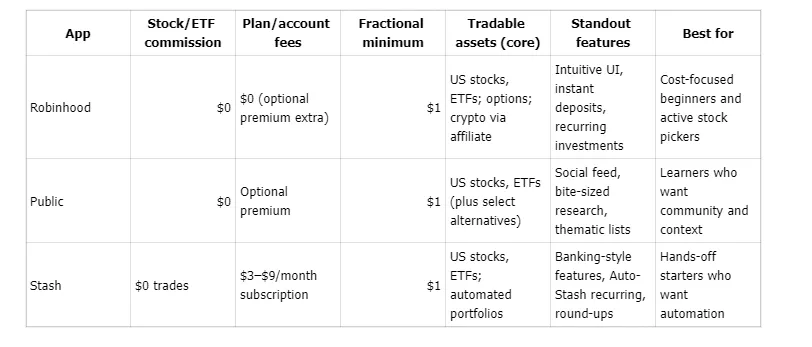
NerdWallet’s roundup of brokers with fractional shares corroborates that all three offer dollar-based investing in US stocks and ETFs alongside beginner-friendly tools. StockBrokers.com’s beginner investing guide also stresses education and ease of use—areas where simple interfaces, recurring buys, and bite-sized research help new investors stay engaged.
Our quick verdict:
- Best overall for fractional US stocks: Robinhood, for $0 commissions, low minimums, and seamless recurring investing.
- Best for research and community: Public, for social discovery and curated insights.
- Best for automation (but mind the fee): Stash, for set-and-forget portfolios with banking-style tools.
Robinhood at a glance
Robinhood made fractional shares mainstream by pairing $0 commissions with an interface that makes dollar-based buys and recurring investments easy. You can start with $1 per trade, build a US stock or ETF core, and add recurring schedules to automate contributions. For most cost-sensitive beginners, the lack of trading commissions and a clean onboarding flow stand out. If you plan to place frequent small orders, minimizing ongoing fees is critical—Robinhood’s pricing structure helps your returns compound without a monthly drag.
Public at a glance
Public layers fractional investing with a social feed, thematic collections, and light research to help beginners learn in context. You get $0 stock and ETF commissions and $1 minimums, plus optional premium features for deeper insights. If you value community, short-form commentary, and discovery tools that surface ideas, Public is compelling. The trade-off: optional add-ons can cost extra, so the best fit is investors who will actively use the research and community features.
Stash at a glance
Stash blends brokerage and banking-like tools—fractional shares, automated portfolios, recurring deposits, and round-up savings—behind a monthly subscription ($3–$9). The fee can be worthwhile if you rely on automation to save and invest consistently, but it poses a clear cost disadvantage for very small balances. If you prefer a guided, set-it-and-forget-it path with budgeting and saving tools under one roof, Stash is the most integrated of the three.
How much do you need to start?
You can begin investing in fractional US stocks with as little as $1 on Robinhood, Public, and Stash. That low threshold is a key reason fractional apps rank highly across expert lists that compare stock trading platforms for beginners.
Editorial methodology
Our comparison focuses on total cost to own (commissions plus ongoing plan fees), minimum investment thresholds, beginner usability (recurring buys, education, community), and breadth of US stock/ETF access. We cross-checked claims and best practices against independent editorial sources that research fractional-share brokers, including NerdWallet and Bankrate, and aligned functionality considerations with StockBrokers.com’s guidance for beginners.
Where ToVest fits in
If you’re exploring fractional ownership beyond traditional brokerages, ToVest brings blockchain technology to US equities and other real-world assets, enabling real-time execution windows, programmatic recurring buys, and diversified, tokenized portfolios. The goal is enhanced capital efficiency and global access while maintaining a familiar, dollar-based investing experience. For investors who want fractional US stocks today with a path to broader tokenized assets tomorrow, ToVest complements the options above.
Quick FAQs
How much can I start with?
Typically $1 per trade on these apps; start small and automate contributions.
Do fractional shares pay dividends?
Yes, dividends are credited proportionally to your fractional ownership.
Do I get voting rights on fractional shares?
Voting rights are often limited or not provided for fractional positions; whole shares generally carry voting privileges.
Are there monthly fees?
Robinhood and Public can be $0 for core trading, while Stash charges a $3–$9 monthly subscription.
Which app is best for beginners?
For pure US stock buying with minimal ongoing costs, Robinhood is ideal. If you want community and research, Public is a strong choice. For those who prefer automation and banking-style tools, Stash is suitable.
What’s the best fractional investing app for US stocks?
For most cost-focused beginners, Robinhood wins; Public is the runner-up for social discovery, and Stash suits hands-off investors who value automation despite the fee.