Is Tovest Legal? Solutions for Verifying Regulatory Compliance
June 11, 2026
Overview of the Legality of Tovest
"Legality" reflects the extent to which a financial institution or investment platform fully complies with regulations, licenses, and supervisory standards in the country where it operates. With the rapid development of blockchain technology, investment platforms like ToVest face growing pressure from regulators to ensure transparency, prevent money laundering, and protect investors.
The global securities and digital asset markets are entering a regulatory tightening phase in 2025, forcing businesses to adjust their operating models to meet new requirements. For individual investors, clearly determining whether a platform is legally compliant and transparent is a key factor in risk management and capital protection.
Key Factors Determining the Legality of a Blockchain Investment Platform
A blockchain platform is considered legal when it meets the following core factors:
- Clear legal classification of the investment product (security or commodity).
- Transparent Anti-Money Laundering (AML) and Know Your Customer (KYC) policies.
- Valid operating licenses from competent authorities.
- Periodic audits and independent attestations.
- Public and fair dispute resolution mechanisms.
AML (Anti-Money Laundering) and KYC (Know Your Customer) are the foundation of compliance controls, aimed at preventing money laundering, financing of terrorism, and ensuring customer identities are verified. Companies like ToVest regularly update policy frameworks and transaction monitoring technologies to keep pace with rapidly changing international standards.
Compliance Verification Solutions for Tovest
ToVest adopts a “compliance by design” model—embedding compliance into the product foundation and operational processes from the start. Rather than reacting after incidents occur, ToVest integrates compliance controls, legal reviews, technical audits, and customer protection as part of its core system.
This approach helps ToVest maintain a competitive global position by complying with local regulations while meeting the requirements of international financial institutions, all while upholding principles of transparency and security for every investor.
Legal Classification and Independent Token Assessment
Legal classification determines whether a token or investment product is considered a security, a commodity, or a digital asset under local regulations. This assessment is often supported by expert opinions—an objective conclusion based on analysis of the token’s functions and associated rights.
ToVest partners with independent advisory firms to assess tokens, ensuring all platform activities and products remain within clear legal boundaries and align with international compliance standards.
Registration, Licensing, and International Regulatory Oversight
A company being “registered” only confirms its legal existence, while “licensing” confers the right to provide financial services under the supervision of authorities.
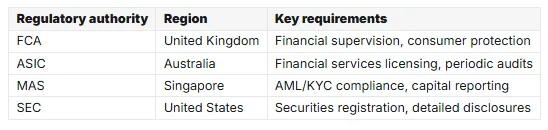
Major regulators such as the FCA (UK), ASIC (Australia), MAS (Singapore), and the SEC (US) require providers to demonstrate investor protection capabilities, fully disclose risks, and submit to periodic supervision.
AML/KYC Controls and Transaction Monitoring
ToVest's AML/KYC policies establish systems to prevent money laundering and ensure accurate customer identification. The platform applies risk-based due diligence by customer segment and product type, combined with monitoring technologies to detect unusual transactions.
Platforms that meet international standards must have mechanisms to report, handle, and freeze accounts when suspicious behavior is detected, while publicly disclosing procedures for users to follow. ToVest meets these requirements in a transparent and verifiable manner on its system.
Independent Technical and Financial Audits
Independent audits are objective assessments by third parties to verify a platform's security, solvency, and financial condition.
ToVest undergoes periodic audits covering both technology and finance, including verification of custodial assets and system security, providing users with high confidence in transparency and risk management capabilities.

Dispute Resolution Mechanisms and Transparent Governance
Dispute resolution mechanisms protect investors when conflicts arise, especially in cross-border contexts. ToVest implements a flexible mediation–arbitration model, allowing both parties to choose solutions appropriate to each situation.
Transparent governance—through clear disclosure of processes, terms, and responsibilities—builds trust, limits legal risks, and affirms the platform’s ethical operating standards.
Challenges and Regulatory Trends in the Digital Investment Market
The fintech and blockchain markets are seeing numerous lawsuits and expanded supervisory scope. In the United States, most disputes focus on the classification of tokens as securities and tort claims related to non-contractual damages.
At the same time, many countries are considering banning or strictly controlling hidden-fee models and requiring transparency regarding foreign ownership. This demands that platforms like ToVest not only maintain current compliance but also continuously upgrade processes to adapt to new legal frameworks.
Benefits of Tovest’s Proactive Regulatory Compliance
Proactive compliance delivers tangible benefits:
- Increase user trust and loyalty.
- Minimize legal risks and dispute-handling costs.
- Enhance international scalability and access to tightly regulated markets.
- Shorten processes for trading, settlement, and identity verification.
Thanks to independent audits, advanced authentication technologies, and transparent disclosures, ToVest asserts a clear competitive advantage. The platform regards proactive compliance not only as a risk management measure but also as a driver for expanding global presence.
Guide to Self-Assessing the Legality and Compliance Level of an Investment Platform
Investors can self-verify a platform’s legality using the following checklist:
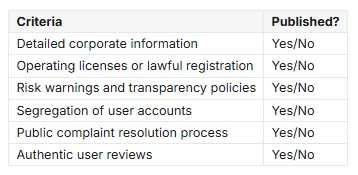
A few steps users can take themselves:
- Check the platform’s "About/Legal" page.
- Cross-check company information on the website of the relevant financial regulator.
- Carefully review risk policies and independent user feedback.
Be alert to red flags such as abnormally high guaranteed returns, pyramid schemes, or lack of transparency. ToVest encourages users to always assess risks before investing, adhering to the principle of "transparent and verifiable."
Frequently Asked Questions about the Legality and Regulatory Compliance of Tovest
Does Tovest hold an operating license in Vietnam?
ToVest has not currently disclosed a license issued by Vietnamese regulators, so users should carefully consider and verify the legal status before using the platform.
How does Tovest comply with AML/KYC policies?
ToVest implements strict AML/KYC policies, requiring user identity verification and transaction monitoring to prevent money laundering and fraud.
How are users’ funds protected when transacting on Tovest?
ToVest segregates user assets and applies modern security technologies to ensure capital safety and reduce incident risks.
How can I verify Tovest’s abnormal transaction monitoring mechanism?
Users can review the “Abnormal Trading Supervision & Disposal Policy” on ToVest to understand the mechanisms for detecting and handling suspicious transactions.
Does Tovest effectively support dispute and complaint resolution?
ToVest has transparent procedures for receiving and handling complaints, ensuring user rights in accordance with publicly disclosed policies that can be directly verified on the platform.