Fractional Ownership: The Investing Concept That's Opening Up Markets for Everyone
May 28, 2026
The Old Rule: You Need a Lot of Money to Make Money
For most of investing history, the best assets came with the highest entry tickets. A Manhattan apartment. A Picasso painting. Shares in a pre-IPO startup. A commercial property in Singapore's CBD.
These were not investments for ordinary people — not because ordinary people lacked the intelligence to evaluate them, but because they lacked the capital to access them. The floor was simply too high.
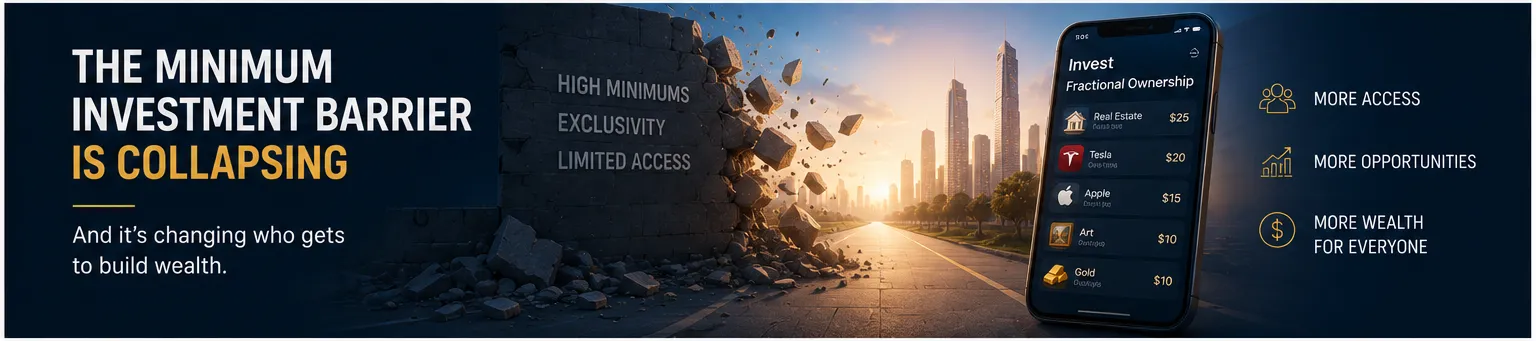
Fractional ownership is dismantling that floor. And the pace at which it is happening is faster than most people realize.
What Fractional Ownership Actually Means
The concept is straightforward. Instead of one investor buying an entire asset, ownership is divided into smaller units — fractions — that multiple investors can purchase independently.
You do not need $500,000 to invest in a property. You buy a fraction of it for $100. You do not need $50,000 to own a share of a high-growth private company. You buy a tokenized slice for the equivalent of a monthly dinner out.
The returns, the risks, and the rights attached to that fraction scale proportionally with your stake. What changes is the barrier to entry.
The Numbers Show This Is Already Mainstream
This is not a future concept. It is happening at scale right now.
The global fractional ownership market was valued at $8.2 billion in 2025 and is projected to reach $21.6 billion by 2034, expanding at a CAGR of 11.3%. The tokenized segment is growing even faster — blockchain-based fractional ownership is the fastest-growing model, at an estimated CAGR of 21.4%.
The demographic driving this shift is clear. By 2025, 60% of fractional investors are projected to be under the age of 40 — a generation that grew up with mobile-first finance and has no attachment to the old minimums.
Use of fractional shares is 30% higher among those earning under $50,000 annually — meaning this model is reaching precisely the investors traditional markets were never designed for.
What Can Actually Be Fractionally Owned Today
The asset classes available through fractional platforms have expanded well beyond stocks:
Stocks and ETFs — Robinhood popularized fractional shares for US equities. Owning a slice of Amazon or Tesla no longer requires a four-figure investment.
Real estate — Australian platform BrickX allows investors to purchase fractions of residential properties from as little as AUD 50, attracting hundreds of thousands of users. Similar platforms are expanding across SEA.
Art and collectibles — The global art and collectibles fractional ownership market was valued at $1.82 billion in 2025 and is projected to reach $5.98 billion by 2034. Platforms like Masterworks allow retail investors to own shares in blue-chip artworks that previously traded only among ultra-high-net-worth collectors.
Private company equity — Tokenized Pre-IPO shares are enabling retail investors to access high-growth companies before they list publicly, at fractions of the minimum that traditional private equity rounds require.

The Enabler: Tokenization
None of this scale would be possible without blockchain technology as the underlying infrastructure. Tokenization converts ownership rights into digital tokens that can be divided, transferred, and traded without the friction of traditional financial intermediaries.
Asia Pacific represented 21.3% of the global fractional ownership market in 2025 and is forecast to be the fastest-growing region through 2034, driven by expanding investor populations in Singapore, India, Australia, and beyond. Singapore has established itself as a leading hub for blockchain-based fractional ownership platforms, benefiting from MAS's progressive digital asset regulatory framework
For investors in SEA, the infrastructure is being built on their doorstep.
The Honest Caveat
Fractional ownership lowers the barrier to entry — but it does not eliminate risk. A fraction of a bad investment is still a loss. Liquidity on some platforms remains limited. Regulatory frameworks across different asset classes and jurisdictions are still evolving.
What fractional ownership changes is not the nature of investing. It changes who is allowed to participate in it.
For a generation of investors in Southeast Asia who have historically been priced out of premium assets — US equities, private equity, global real estate — that distinction matters enormously.
The minimum is no longer the reason to stay on the sidelines.
For informational and educational purposes only. All investments carry risk. This article does not constitute financial advice.