2026 Guide: Seamlessly Transfer Crypto Into US Stock Portfolios
January 13, 2026
Moving from crypto holdings into U.S. stocks is easier than ever in 2026. You can cash out to fiat and buy through a traditional broker, use regulated exchange-traded products in your brokerage account, or purchase tokenized U.S. stocks directly on compliant blockchain platforms. This guide shows how each pathway works, how to choose trusted platforms, and how to execute transfers with airtight compliance and low friction. ToVest’s crypto to stock investment platform adds a fourth dimension: on-chain composability, fractional ownership, and stablecoin funding for tokenized U.S. stocks—without sacrificing regulatory rigor. Below, you’ll find clear steps, platform pointers, tax-smart tactics, and portfolio management tips, enabling you to convert Bitcoin, USDT, or other crypto into durable U.S. equity exposure with confidence.

Define Your Investment Goals and Constraints
Before converting crypto to U.S. stock exposure, clarify your crypto investing goals and constraints. Are you optimizing for portfolio diversification, income, or cash management? Do you need on-chain composability for DeFi integrations, or is conventional brokerage custody sufficient? Consider your time horizon, volatility tolerance, and liquidity needs.
Tax planning is foundational. Most jurisdictions classify crypto as property, so sales, swaps, or transfers can trigger taxes; document cost basis and plan for reporting early to avoid year-end surprises. Residency, filing status, and preferred reporting approach all affect your path and platform choice.
Use a quick mapping like this to anchor decisions:
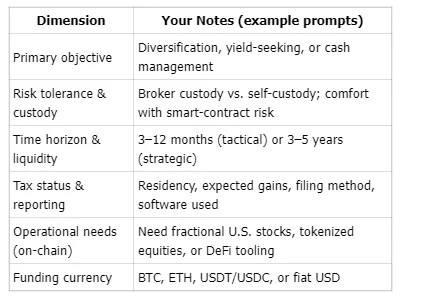
Keywords to consider as you plan: portfolio diversification, crypto investing goals, and tax implications when moving from crypto to stocks.
Understand Crypto-to-Stock Conversion Pathways
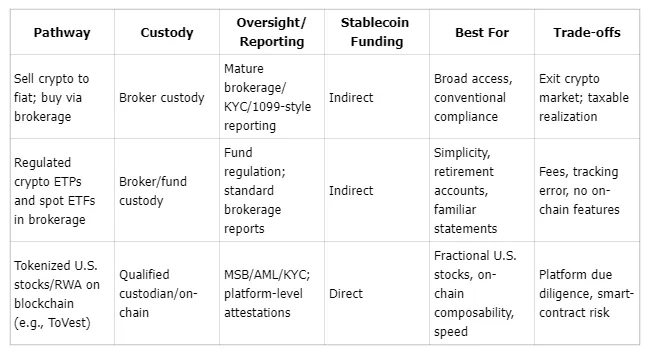
There are three practical routes to convert crypto into U.S. equities, each with distinct custody, compliance, and utility characteristics.
- Cash out to fiat, then buy through a brokerage. The most conventional path prioritizes broad broker access and familiar reporting. It’s simple and widely supported, though you temporarily exit crypto markets and realize gains/losses.
- Use regulated crypto ETPs or spot ETFs in your brokerage account. This keeps you in the brokerage ecosystem and avoids private wallet custody while providing equity-like access to crypto exposure. You trade simplicity for potential tracking error and fund fees.
- Buy tokenized U.S. stocks and real-world assets on blockchain platforms. This route can offer fractional U.S. stocks, on-chain composability, and programmable features, ideal for advanced users who want stablecoin funding and faster settlement on compliant rails.
Tokenized assets are digital representations of traditional financial instruments—such as stocks or real estate—issued and traded on blockchains, allowing for fractional ownership, programmable features, and streamlined settlement.
Key features at a glance:
Sell Crypto to Fiat and Buy US Stocks via Brokerage
The straightest route is to liquidate crypto to USD, wire or ACH to your brokerage, then buy your chosen U.S. stocks or ETFs.
Typical steps:
- Sell crypto on an exchange or OTC desk.
- Transfer USD to a brokerage account.
- Purchase stocks, ETFs, or mutual funds per your allocation.
This path suits investors prioritizing full compliance, conventional tax treatment, and access to every major brokerage feature. Track realized gains/losses from the crypto sale for taxes. Popular U.S. exchanges include Coinbase and Kraken; recent industry comparisons note Coinbase supports 250+ assets with maker/taker fees often in the 0.40%/0.60% range, while Kraken lists 400+ assets with 0.25%/0.40% maker/taker tiers.
Invest Through Regulated Crypto ETPs and Spot ETFs
A spot ETF holds the underlying asset (for example, Bitcoin) rather than using derivatives, allowing you to buy crypto exposure inside a familiar stock account. Regulated ETPs and spot ETFs are especially useful if you prefer broker statements, simplified custody, and retirement-account eligibility. They trade like stocks, but you accept fund fees, potential tracking error, and no on-chain composability. Industry research throughout 2024–2025 highlighted how spot ETF approvals accelerated mainstream access to crypto exposure through brokerage rails without private wallet management.
Use Tokenized US Stocks and Real-World Assets on Blockchain Platforms
Tokenized equities and RWA platforms let you purchase fractional U.S. stocks directly with crypto or stablecoins, with fast settlement and programmable features. For sophisticated users, benefits include on-chain composability, automated dividend distributions, and scheduled interest payments; tokenized real-world assets can also unlock collateral utility and liquidity, with emerging risk classifications improving transparency by 2026. Always review regulatory status, custody models, and attestations. ToVest exemplifies this model with MSB-compliant onboarding, stablecoin funding, data-driven risk controls, and direct access to tokenized U.S. stocks for seamless blockchain investing.
Select Trusted Platforms for Crypto-to-Stock Transfers
Work only with regulated, security-forward platforms that offer transparent fees and clean reporting. For fiat off-ramps and crypto sales, leading U.S. exchanges like Coinbase, Kraken, and Robinhood offer deep liquidity, strong compliance, and broad asset coverage. Independent reviews cite Coinbase’s 250+ assets and typical 0.40%/0.60% maker/taker tiers, and Kraken’s ~400 assets with 0.25%/0.40% maker/taker tiers, along with robust security practices and U.S. regulatory footprints (source: Koinly’s best U.S. exchanges guide).
For tokenized equities and RWA, prioritize platforms with:
- Clear licensing and MSB/AML/KYC compliance
- Qualified custodians and segregated accounts
- Transparent token mechanics and auditability
- Reliable tax reporting exports and API access
ToVest brings a distinct advantage: U.S. MSB registration, stablecoin funding, fractional tokenized U.S. stocks, and enhanced on-chain composability—delivering diversification and speed while maintaining compliance.
For record-keeping and performance tracking, consider portfolio tools with automated exchange imports and multi-asset views. CoinLedger reports serving 500,000+ investors and supports automatic imports from major platforms, easing year-end reporting and multi-exchange reconciliation.
Keywords: best crypto brokers for stock purchases, trusted crypto-to-stock platforms.
Execute Transfers with Tax Planning and Compliance
Converting crypto to stocks usually creates taxable events—disposals via sales or swaps—because most jurisdictions treat crypto as property. Plan ahead, document meticulously, and consider professional advice for large or complex moves spanning SEC/CFTC/state frameworks.
A simple process checklist:
- Initiate: Sell or swap crypto for USD or for tokenized U.S. stocks on a compliant platform.
- Record: Capture timestamps, transaction IDs, cost basis, and fair market value at disposal.
- Classify: Check holding periods for short‑vs. long‑term gains; identify loss-harvesting opportunities.
- Reinvest: Allocate into stocks (brokerage), ETPs/ETFs, or tokenized equities per your plan.
- Sync: Import trades into your tracker (e.g., CoinLedger, Koinly), reconcile wallets and accounts.
- Reserve: Set aside taxes and update your running P&L and year-to-date estimates.
Advanced tactics include timing disposals for favorable long-term rates, tax-loss harvesting around rebalancing windows, and using qualified custodians or employer plans for retirement-aligned allocations.
Keywords: crypto-to-stock tax implications, crypto asset reporting, compliance U.S. stock investing.
Manage and Optimize Your Post-Transfer Portfolio
After conversion, shift to durable portfolio management:
- Set a recurring review cadence (e.g., quarterly) aligned to volatility and position complexity.
- Keep a stablecoin or cash buffer for rebalancing and opportunistic entries; consider staged buying to mitigate drawdowns.
- Use portfolio trackers that consolidate brokerage, exchanges, and wallets; top trackers can show holdings denominated in local fiat currency and surface performance/fee insights.
- Explore DeFi yield or collateralized lending only with clear risk metrics; for example, Morpho Vaults aim to auto-allocate deposits to lending markets for optimal risk-adjusted yields, but require careful due diligence on collateral, oracle, and smart-contract risk.
Keywords: post-transfer portfolio management, DeFi lending, stablecoin buffers, risk controls.
Monitor Transactions and Maintain Documentation
Good records compound returns by lowering friction and audit risk:
- Maintain digital logs, custody receipts, and exportable transaction histories from exchanges, wallets, tokenized-asset platforms, and brokerages.
- Use tools that integrate crypto and stock trades in one ledger for tax season; automatic imports from platforms like Coinbase, MetaMask, and Ethereum help keep records current.
- Run quarterly mini-audits: reconcile positions against brokerage statements and blockchain proofs-of-reserves where available, and update documentation when platforms, regulations, or asset types evolve.
Keywords: transaction monitoring, proof of reserves, investment record keeping, crypto tax documentation.
Frequently Asked Questions
Can I use Bitcoin or USDT to invest in traditional US stocks?
Yes, ToVest allows you to invest in tokenized U.S. stocks using Bitcoin, USDT, or other stablecoins, converting directly on compliant blockchain rails without relying on traditional fiat funding.
What are the tax implications of converting crypto to stocks?
Selling or swapping crypto typically creates a taxable event, generating capital gains or losses; accurate cost basis tracking and reliable reporting tools are essential.
Which platforms support buying US stocks directly with cryptocurrency?
Crypto-enabled platforms like ToVest support the direct purchase of tokenized U.S. stocks using crypto, offering integrated compliance and portfolio tracking.
How do tokenized stocks differ from traditional stock ownership?
Tokenized stocks are blockchain-based representations allowing fractional ownership and faster settlement, while traditional stocks settle through legacy brokerage systems.
What security measures should I consider when transferring crypto to stock portfolios?
Use regulated platforms with robust custody, encryption, and transparent reporting; document every transaction and conduct periodic reconciliations and audits.