US Stock Token Investing Guide 2026: Platforms, Rules, and Best Practices
January 2, 2026
Investors can now buy fractional slices of U.S. equities on-chain and trade them around the clock, but the key is using a regulated, transparent platform. This guide explains how tokenized U.S. stocks work, what makes them different from traditional shares, how to choose a compliant venue, and how to get started safely. If you’re looking for where to trade legally, prioritize platforms that publish licensing, use regulated custody for the underlying shares, and embed on-chain compliance. We also outline ToVest’s compliance-first approach, including stablecoin funding, instant settlement, and institutional-grade custody—allowing you to begin with confidence and a clear checklist.

Understanding US Stock Tokens
Tokenized U.S. stocks bring real-world equity exposure to the blockchain. They matter because they combine the simplicity of a brokerage with the programmability of digital assets: 24/7 access, fractional ownership, and instant settlement, all under a security token framework. As real-world asset tokenization scales, analysts expect rapid growth toward the end of the decade, with expanding institutional participation and new distribution rails for compliant retail access, as highlighted in a 2026 market outlook for tokenized capital markets.
Security tokens are part of a broader trend in real-world asset tokenization that enhances interoperability between crypto and traditional capital markets via standardized compliance and identity layers .
What are tokenized US stocks?
“Tokenized US stocks are digital tokens on a blockchain that represent shares in U.S. listed companies, allowing fractional ownership, instant trading, and programmable compliance features.”
Unlike synthetic or derivative products, tokenized stocks are intended to be linked 1:1 to underlying shares held with regulated custodians and intermediaries, with rights and restrictions defined in legal documentation. For example, you could own 0.25 of a Tesla share in a compliant wallet and trade it 24/7, subject to transfer rules.
How do tokenized stocks differ from traditional stocks?
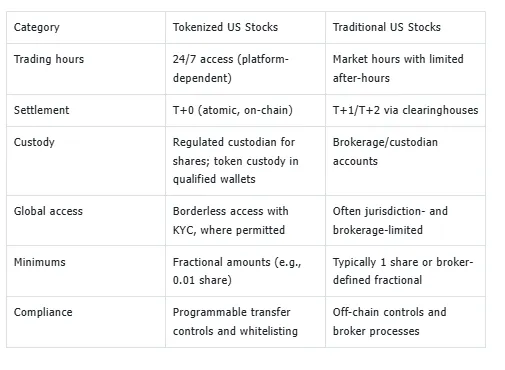
Round-the-clock access and instant settlement are live on several platforms bridging equities and crypto rails. On-chain compliance can embed transfer restrictions, identity checks, and suitability rules directly into tokens, supporting safer secondary trading.
Benefits of investing in tokenized US stocks
- Fractional ownership lowers barriers to high-priced names and enables precise portfolio sizing.
- 24/7 trading with T+0 settlement reduces delays and can improve liquidity compared to traditional post-trade cycles.
- On-chain transparency offers auditable trails and consolidated portfolio views across wallets and venues.
- Global investors can gain U.S. equity exposure without a traditional U.S. brokerage account, subject to KYC and local eligibility.
Choosing a Regulated Platform
Start with regulation and custody. A credible, regulated tokenized stock exchange or broker will publish licenses, identify its intermediaries, and describe custody segregation for both the underlying shares and the tokens. Look for security token standards that enforce whitelisting, identity, and transfer rules at the token level.
Key criteria for platform selection
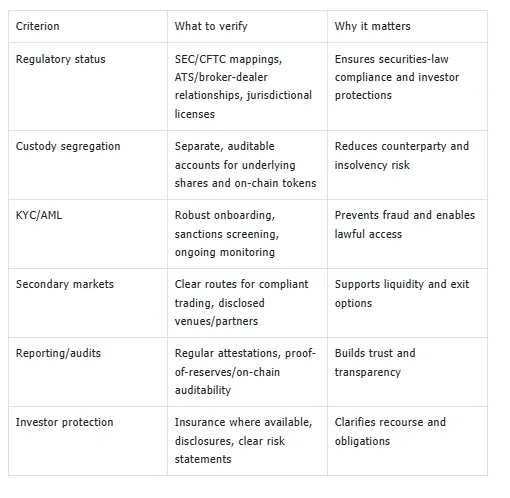
Leading RWA platforms emphasize built-in compliance, strong KYC/AML, and liquidity pathways from day one (see Blockchain App Factory’s review of leading RWA platforms).
ToVest platform overview and features
ToVest is designed for compliance-first tokenization across U.S. equities and real estate, combining advanced blockchain infrastructure with institutional-grade custody, 24/7 trading access, and instant settlement for eligible tokenized assets. Users can fund with major stablecoins (e.g., USDC, USDT), access granular portfolio analytics, and—where eligible—utilize margin and leverage with transparent risk controls. ToVest’s approach includes rigorous KYC/AML, asset segregation, and SEC-aligned custody practices, unifying traditional safeguards with on-chain efficiency.
Leading platforms for US stock token trading
Industry models span:
- Institutional tokenization platforms and transfer agents focused on compliant issuance and secondary trading (strong legal wrappers, higher minimums).
- Retail-focused platforms that streamline UX, fractional trading, and stablecoin rails, while embedding identity and transfer controls.
When comparing options, assess regulatory clarity, fractional support, underlying-custody design, audit transparency, and the availability of compliant secondary markets (see Blockchain App Factory’s review of leading RWA platforms).
Regulatory Compliance and Legal Considerations
In the U.S., tokenized stocks are treated as securities, meaning platforms and issuers must comply with securities law, maintain proper custody, and implement anti-fraud controls and reporting—just as with traditional equities . Many platforms rely on programmable compliance to ensure only eligible, whitelisted investors can hold or trade specific tokens.
US regulations governing tokenized stocks
Regulators treat tokenized stocks the same as traditional securities, mandating compliant custody, disclosures, and anti-fraud protections to safeguard investors. Primary offerings often utilize exemptions such as Regulation D (accredited investors) or Regulation S (non-U.S. persons), coupled with identity verification and suitability checks. The legal structure typically includes an issuer, licensed intermediaries, and contracts that bind on-chain tokens to underlying share rights. Regulatory momentum is visible in approvals for new distribution models, as noted in CoinDesk coverage of a FINRA-approved tokenized stocks rollout.
Custody and investor protection requirements
Custody segregation means holding underlying shares and on-chain tokens in distinct, auditable accounts to reduce insolvency and operational risk. Strong platforms pair regulated custodians, insurance where available, and transparent reporting to reinforce investor protections. ToVest adheres to these best practices across tokenized equities and real estate, emphasizing clear ownership records and reconciliations.
KYC, AML, and suitability checks
KYC verifies identity; AML checks source of funds and screens for sanctions/PEPs; suitability aligns products with an investor’s profile. These steps are mandatory for compliant access and may include accreditation verification for certain offerings . Many platforms increasingly use AI-driven compliance engines to streamline checks and continuous monitoring.
How to Get Started with US Stock Token Investing
- Choose a regulated platform and review published licenses, custody partners, and risk disclosures.
- Complete KYC/AML and, if required, accreditation checks.
- Fund your account—often with stablecoins—or connect a bank.
- Review each token’s legal docs (rights, transfer restrictions, dividend policies).
- Place small test trades, then scale based on liquidity, reporting quality, and your risk plan.
Verifying platform licensing and disclosures
- Confirm registrations or exemptions (e.g., broker-dealer/ATS relationships), plus jurisdictional licenses and risk warnings.
- Check custody structure for the underlying equities and token wallets.
- Review legal agreements, fee schedules, and secondary-market arrangements. Kraken’s xStocks support documentation is a good example of clear eligibility, onboarding, and product disclosures.
Completing KYC and accreditation processes
Expect to submit a government ID, proof of address, and basic financial profile; some offerings require accredited status based on income or net worth thresholds. These steps unlock appropriate access tiers and protect retail investors from unsuitable risks. Platforms like ToVest automate onboarding with guided flows and built-in checks.
Understanding token rights, dividends, and transfer restrictions
Token rights typically include economic rights (such as dividends) and defined transfer rights; governance rights depend on the legal structure. Transfer restrictions and whitelisting enforce compliance and ensure tokens move only between eligible wallets. Review each asset’s documentation and technical standard; some platforms use security token frameworks with embedded compliance and identity modules .
Assessing liquidity and secondary market options
- Evaluate supported trading venues, 24/7 access, and links to regulated exchanges or OTC routes.
- Check daily volumes, active trader counts, and order book depth.
- Confirm any lockups, transfer windows, or trading curbs that could affect exits. For secondary market design and liquidity practices, review Blockchain App Factory’s analysis of RWA platforms.
Starting with a small investment allocation
Begin with a modest allocation to validate funding, settlement, and reporting flows. Diversify across tickers and tokenized asset types (equities, real estate, fixed income) and keep organized records from your first trade to simplify tax filings.
Trading Mechanics and Portfolio Management
Trading tokenized equities feels like a brokerage account with crypto-native speed. You’ll see atomic settlement, real-time balances, and often stablecoin base pairs—plus portfolio analytics designed for multi-asset views.
Trading hours and settlement processes
Tokenized stocks typically trade 24/7 with atomic settlement, meaning trades finalize instantly without third-party clearing. In contrast, traditional equities generally settle T+1 or T+2.
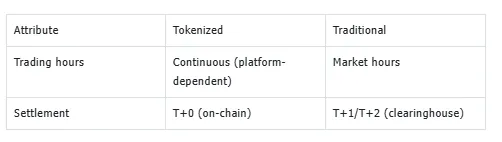
These tokenized mechanics are now live on several regulated offerings and are broadly supported across RWA infrastructure providers.
Using stablecoins and margin trading features
Stablecoins like USDC and USDT often serve as funding and trading currencies, enabling fast, global settlement without FX friction. Margin trading uses borrowed funds to increase position size; leverage expresses how much exposure you control relative to your collateral. ToVest supports stablecoin wallets and, for eligible users, margin and leverage with risk-based limits and transparent liquidation rules.
Monitoring compliance and audit transparency
Use compliance dashboards, attestations, and on-chain proofs to monitor platform health and your portfolio’s eligibility status. Top platforms employ real-time compliance engines to prevent unauthorized transfers and maintain auditable trails (see a 2026 architecture guide to tokenization compliance automation). Periodically review wallet histories and export reports for your records.
Tax considerations and reporting best practices
Gains, losses, and dividend income from tokenized U.S. stocks are generally taxable per your jurisdiction. Maintain detailed transaction logs, download annual statements, and use integrated tax tools when available. Consult a qualified tax advisor for jurisdiction-specific guidance.
Risks and Best Practices for Investors
Key risks include regulatory shifts, varying liquidity across secondary markets, custody or counterparty failures, and differences in how legal rights are structured and enforced. Marketing language can also be confusing; for instance, “stock tokens” in headlines don’t always reflect direct equity ownership structures.
Best practices:
- Diversify across assets, issuers, and platforms.
- Prefer regulated venues with segregated, insured custody where available.
- Verify compliance modules, reporting frequency, and auditor credentials.
- Start small, use limit orders in thin markets, and track tax lots meticulously.
Regulatory and jurisdictional risks
Rules differ by country, and the U.S. generally treats stock tokens as securities under SEC oversight. Laws are evolving; work with platforms that adapt quickly and keep you informed.
Custody and counterparty risk mitigation
Counterparty risk is the chance you lose access if a platform or custodian fails. Mitigate it by insisting on segregated custody for both shares and tokens, verifying audits, and confirming available insurance or legal recourse.
Managing liquidity and market volatility
Some security tokens trade with thinner books and wider spreads than listed equities. Use real-time order books, published volumes, and clear limit orders; avoid overconcentrating in less-liquid names (see Blockchain App Factory’s review of RWA platforms).
Diversifying tokenized asset holdings
Spread exposure across multiple tokenized stocks, real estate, and fixed-income tokens, and across more than one provider. Rebalance quarterly to keep concentration and liquidity risk in check.
Frequently Asked Questions
What platforms legally support US stock token trading?
Several regulated platforms support tokenized U.S. stocks if they comply with securities law and perform investor checks; always verify licensing, custody, and disclosures before trading.
Are tokenized stocks equivalent to owning traditional shares?
They mirror economic exposure and may pass through dividends and corporate actions, but ownership mechanics can differ based on each platform’s custody and legal wrapper.
What regulatory safeguards protect investors in tokenized stocks?
Compliant platforms employ KYC/AML controls, segregated custody, disclosures, and securities-law reporting to protect investors.
How do dividends and corporate actions affect token holders?
Eligible token holders generally receive dividends and applicable actions proportionally, subject to the token’s legal documentation and platform policies.
What are the key risks specific to tokenized stock investing?
Regulatory changes, liquidity differences, custody/counterparty risk, and the legal enforceability of token rights across jurisdictions are the main considerations.