2026 Guide to Maximizing Returns When Buying US Stocks With Crypto
January 5, 2026
Buying US stocks with cryptocurrency can compress costs, speed up settlement, and widen your access to markets—if you set up the right rails and manage risk. In 2026, investors have two clear paths: use crypto or stablecoins to fund traditional equity purchases through a compliant broker, or buy tokenized stocks that represent equity exposure on-chain. This guide shows you how to minimize friction at each step, from regulatory prep and platform selection to order execution and custody. Throughout, we emphasize ToVest’s strengths—global accessibility, ultra-low-latency execution, rigorous compliance, and advanced portfolio tools—enabling you to convert digital assets into durable equity exposure with confidence.

Understanding the Basics of Buying US Stocks With Crypto
Tokenized stocks are digital representations of real-world stocks issued as blockchain tokens, enabling fractional ownership and blockchain-based trading. The appeal is straightforward: tokenization can reduce administrative overhead and move settlement closer to real time, while broadening participation according to SVB’s 2026 Crypto Outlook. See SVB’s 2026 Crypto Outlook for a sector-wide view of tokenization’s momentum and settlement benefits.
Global investors increasingly use cryptocurrencies and, especially, fiat-backed stablecoins as a funding source for US equities. Institutional interest and infrastructure are deepening, with clearer policy direction and more compliant on-ramps expanding access worldwide .
There are two main routes:
- Use tokenized stocks that live on-chain and track the underlying equity via licensed custodians and market makers.
- Use crypto or stablecoins as a bridge to fund purchases of traditional US equities through a regulated broker.
Key advantages of using crypto to access US equities:
- Fractional ownership and, on some tokenized markets, extended trading hours beyond the conventional US session.
- Lower administrative costs and faster settlement potential via blockchain rails.
- Global accessibility and a new diversification sleeve across funding, custody, and execution models.
Assessing Risks and Benefits of Buying US Stocks With Crypto
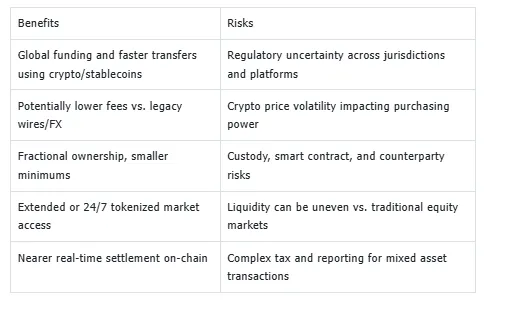
Done well, crypto to stock trading can improve market access, lower fees, add global transfer flexibility, and enable nearer real-time settlement. But investors must weigh regulatory risk, counterparty risk, and tokenization security.
- Regulatory risk: US rules remain stricter and fragmented across federal agencies and state regimes such as New York’s BitLicense, which affects listings, custody, and disclosures.
- Market risk: Crypto is volatile; keep allocations modest and sized for loss tolerance.
- Operational risk: Custody and cyber risk persist, including exchange hacks, wallet compromise, and smart contract vulnerabilities.
Concise definition: Fractionalized assets allow investors to purchase portions of a stock, increasing accessibility and enabling smaller portfolio allocations.
Benefits vs. risks at a glance:
Step 1: Evaluate Regulatory and Tax Considerations
Your jurisdiction and your platform’s licensing govern what’s allowed. In the US, oversight spans multiple regulators and state regimes, so both where you live and where your broker or exchange operates will shape what you can do and how you report it.
Check whether crypto-to-stock conversions, stablecoin transfers, and tokenized equity exposure are permitted by local rules and your platform’s terms. Policymakers are moving toward clearer stablecoin frameworks, which support compliant, low-cost settlement rails.
Create a pre-trade checklist:
- Tax treatment of disposing crypto to fund equities (capital gains/losses).
- Reporting requirements for digital asset transactions and foreign accounts.
- Broker or issuer documentation for tokenized products and custody.
- Whether your chosen stablecoin is permitted and fiat-backed with credible attestations.
Stablecoins are cryptocurrencies whose value is pegged to a reserve asset, like the US dollar, and are often used for faster, lower-cost settlement in digital asset transactions.
Step 2: Choose a Licensed Exchange and Custody Provider
Prioritize regulated platforms with proven security. Look for two-factor authentication, encrypted wallets, and cold storage; institutional options like wire support and custody APIs; and clear regulatory registrations, including oversight by state agencies such as the New York Department of Financial Services, where applicable (exchange security best practices).
Compare:
- Fees: Maker/taker and withdrawal fees vary widely and compound over time.
- Asset coverage: Which stablecoins and tokens are supported? Are tokenized stocks or on-chain wrappers listed?
- Liquidity and uptime: Low-latency execution and robust market depth are crucial for price quality.
Many investors blend centralized exchanges for execution with non-custodial wallets for long-term storage to balance convenience and control (exchange security best practices). ToVest’s infrastructure prioritizes low-latency order routing, fractional access, and compliance-forward custody to enhance execution quality and safety.
Step 3: Convert Crypto to Stablecoins or Use Tokenized Stock Rails
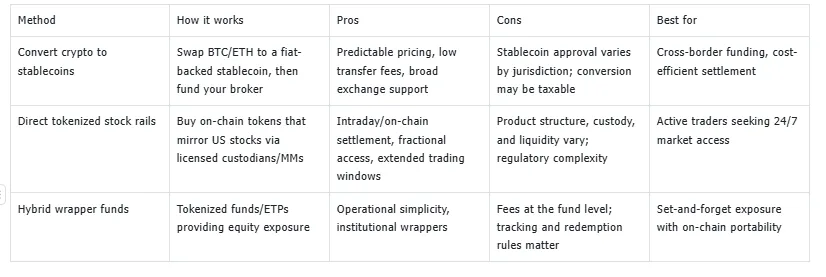
Converting volatile crypto into regulated, fiat-backed stablecoins can stabilize purchasing power and reduce transfer costs—where rules and platform policies permit it. Alternatively, tokenized stock rails or fund wrappers can let you move value directly on-chain and settle equity exposure intraday, avoiding legacy banking bottlenecks. Major asset managers and brokerages are piloting on-chain settlement and tokenized products, including WisdomTree, 21Shares, and Robinhood.
Comparison of funding methods:
Step 4: Place Market or Limit Orders to Buy Stocks
A market order buys immediately at the best available price. A limit order sets your desired price and only fills if the market reaches it. For tokenized stocks or stablecoin-funded equities, prefer limit orders to control slippage and avoid surprise fills in thinner books.
Tips for better execution:
- Check intraday liquidity and spreads; tokenized markets can trade differently than traditional exchanges.
- Use real-time data and low-latency routing. ToVest’s execution stack is engineered to minimize delay and enhance fill quality.
- Consider time-in-force settings to avoid partial or stale fills during volatile windows.
Step 5: Securely Store and Manage Purchased Assets
Match custody to your time horizon:
- Short-term traders: Platform custody may be acceptable for speed, provided the platform is regulated with strong security layers.
- Long-term holders: Prefer cold storage or regulated external custodians; secure private keys and diversify custody when feasible (exchange security best practices).
Baseline hygiene:
- Turn on multi-factor authentication and withdrawal whitelists.
- Use a hardware wallet for on-chain holdings; maintain strong, unique passwords in a reputable manager.
- Stick to platforms with transparent compliance and a strong security record.
Step 6: Monitor and Rebalance Your Crypto-Funded Stock Portfolio
Set a recurring review cadence—monthly or quarterly—to align risk with goals and capture tax opportunities. Rebalancing is the process of realigning the weightings of assets within a portfolio to maintain a desired allocation amidst market movements.
Keep the crypto sleeve sized appropriately: many investors treat crypto as a small, experimental allocation within a diversified plan. Maintain device and account security with 2FA, OS updates, and phishing awareness to protect both your equity and on-chain assets.
Best Practices for Risk Management and Security
- Combine centralized custodial solutions for execution with non-custodial storage for long-term holdings to balance speed and control (exchange security best practices).
- Use strong, unique passwords, hardware wallets, two-factor authentication, withdrawal whitelists, and rigorous device hygiene.
- Avoid excessive leverage; only risk capital you can afford to lose in speculative crypto-funded positions.
- Monitor spreads, slippage, and fee schedules—small inefficiencies erode net returns over time.
- Document every conversion and trade for accurate tax reporting and audit trails.
Frequently Asked Questions
What are the main risks when buying US stocks with crypto?
Regulatory uncertainty, crypto price volatility, custody/security vulnerabilities, and complex tax reporting across asset types are the biggest risks.
How can I reduce costs and settlement times using crypto?
Utilize fiat-backed stablecoins and compliant tokenized rails to lower transfer fees and enhance on-chain value movement for faster settlement than traditional banking.
What role does regulation play in crypto-funded stock investing?
Regulation dictates what instruments are allowed, how custody must be handled, and how transactions are taxed—varying by your and your platform’s jurisdiction.
How should I size my crypto allocation for stock purchases?
Keep your crypto allocation small relative to your overall portfolio and aligned with your loss tolerance and diversification goals.
What security measures protect my investments on tokenized trading platforms?
Look for two-factor authentication, cold storage for digital assets, audited smart contracts, and platforms with strong compliance and incident response.