2026 Guide: Why International Investors Need Tokenized Stock Platforms Now
January 5, 2026
Introduction to Tokenized Stock Platforms
Tokenized stocks are digital representations of ownership rights in real-world equities recorded on a blockchain. Instead of buying a whole share through a traditional broker, investors can hold blockchain-based tokens that mirror the economic rights of equities, enabling fractional ownership, automated actions, and global investor access.

In practice, tokenized stock platforms, such as ToVest, make real-world assets (such as U.S. equities) tradable as on-chain tokens, with pricing, custody, and compliance coordinated between regulated partners and smart contracts. Clear rules of the road and more robust market rails now make these platforms practical for cross-border investing in 2026, as infrastructure providers, issuers, and custodians have matured beyond early pilots into production-grade systems. For foundational mechanics and benefits, see CoinGecko’s explanation of what tokenized stocks are and how they function, including liquidity, transparency, and programmability in blockchain stocks trading.
Market Maturity Driving Tokenized Stock Adoption
In 2026, tokenized stocks are shifting from niche experiments to a mainstream option as market plumbing and institutional participation deepen. Coverage in 2025 already framed tokenized stocks as a fast-forming market with expanding venues, better liquidity, and tighter links to traditional finance. Meanwhile, the broader tokenization trend has moved beyond crypto-native startups: large asset managers, banks, and infrastructure providers are building and piloting offerings, bringing credibility, standardized processes, and deeper secondary markets. For international users, this institutional normalization reduces first-mover risk and improves access, execution quality, and post-trade support.
Key milestones in market maturity
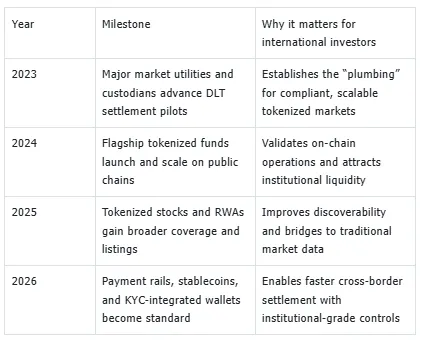
Payment rails, stablecoins, and KYC-integrated wallets become standard
Enables faster cross-border settlement with institutional-grade controls
Benefits of Tokenized Stocks for International Investors
Tokenized stock platforms offer practical, measurable advantages to non-U.S. investors seeking efficient exposure to U.S. equities and other assets:
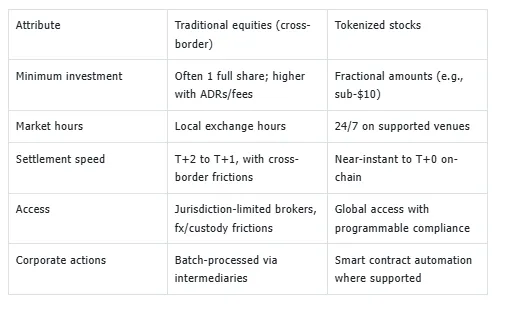
- Fractional ownership reduces minimums, allowing small-ticket participation in high-priced shares and baskets while preserving economic exposure.
- 24/7 markets and smart contracts compress settlement cycles from days to near real-time, with automated compliance, distributions, and corporate actions.
- Global reach comes from programmable compliance that enables cross-border access under jurisdiction-specific rulesets, broadening participation beyond local brokerages.
- Diversification extends beyond listed stocks into real-world asset tokenization such as private credit, infrastructure, and real estate, widening portfolio options.
Traditional vs. tokenized access (typical ranges)
Blockchain Infrastructure Supporting Tokenized Stock Trading
Blockchain infrastructure is the stack of distributed ledger networks and services that record ownership, enforce rules, route orders, settle trades, and manage lifecycle events for tokenized assets in a secure, tamper-evident, and transparent manner.
Leading execution and issuance ecosystems today include Ethereum, BNB Chain, and Solana, while services like Chainlink oracles, identity/compliance modules, and tokenization middleware connect on-chain assets to real-world data and regulations . Security and transparency are strengthened by on-chain records and auditability, which reduce reconciliation overhead and provide real-time traceability for positions and transfers.
ToVest’s stack is built for international users. It features ultra-low latency matching, real-time analytics, embedded risk controls, and seamless fiat and stablecoin rails. It supports direct wallet connectivity alongside custodial accounts, enabling flexible settlement workflows without compromising compliance. Learn how ToVest integrates performance and security across cross-border flows on our About page.
Regulatory Progress and Challenges in Cross-Border Tokenized Trading
Regulatory harmonization refers to aligning rules across jurisdictions to enable seamless issuance, trading, and settlement. Fragmentation describes inconsistent or conflicting requirements that create frictions in KYC/AML, investor protections, disclosures, and taxation. In practice, cross-border regulation remains a core challenge; investor protections, tax treatment, and licensing differ widely, demanding careful platform design and disclosures.
Despite challenges, long-run forecasts are significant: Boston Consulting Group has outlined a scenario where tokenized assets could reach into the tens of trillions by 2030, reflecting mainstream adoption across asset classes (American Century Investments). In the U.S., exemptions like Reg D, Reg A+, and Reg CF provide frameworks for compliant distribution to different investor segments, often paired with transfer restrictions encoded at the token level.
Checklist for international investors
- Look for programmable compliance supporting your jurisdiction and investor category.
- Prefer platforms with regulated custodians and clear segregation of client assets.
- Verify stablecoin and fiat on/off-ramp partners and settlement venues.
- Assess disclosures on price oracles, corporate actions, and redemption mechanics.
- Review incident response, audit practices, and transparency of on-chain records.
Payment Rails and Crypto Wallets in Tokenized Stock Trading
Payment rails are the systems and protocols that move funds between parties—bank transfers, card networks, instant payment schemes, and on-chain rails including stablecoins. For tokenized stocks, robust fiat on/off-ramps and high-quality stablecoins enable predictable liquidity, faster settlement, and lower counterparty risk, particularly across borders.
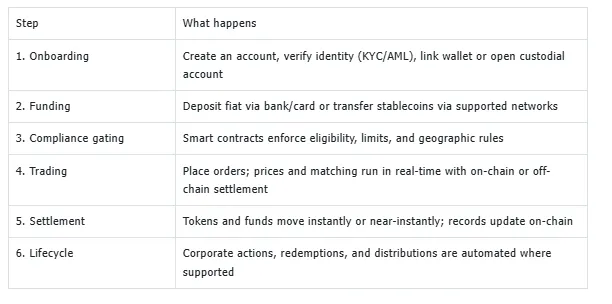
Many platforms support direct wallet trading, letting users fund with stablecoins or fiat, pass KYC/AML checks, and settle on-chain. Wallet compatibility, recovery options, and transaction signing policies are critical for security and compliance. ToVest integrates both self-custodial and custodial flows, with programmable settlement and safeguards tuned for international users.
Wallet-based tokenized stock trading: typical steps
Institutional Interest and Market Integration Trends
Institutional activity signals confidence and durable market structure. BlackRock’s tokenized fund initiatives and bank pilots in tokenized equities and treasuries demonstrate that blue-chip players are now building on public chains with institutional controls. Even with rapid growth, tokenized assets still represent a tiny fraction of global equity and bond markets, underscoring how early the adoption curve remains—yet the trajectory is steep as liquidity, risk management, and compliance capabilities improve.
Established infrastructure players are also bridging TradFi and blockchain through connectivity to clearing, custody, and compliance stacks, reducing operational risk and enabling standardized workflows across issuers, brokers, and market utilities. Retail and institutions are converging on the same rails, with institutions emphasizing controls, reporting, and counterparty quality—benefits that enhance the entire market.
Future Outlook fr International Investors Using Tokenized Stocks
Macro demand for 24/7, programmable markets, clearer regulatory frameworks, and expanding asset diversity will drive continued growth in tokenized stocks and broader real-world asset tokenization (a16z crypto). Expect deeper institutionalization, richer data feeds, and a wider variety of asset categories—private markets, infrastructure, cash yields—available globally through compliant, wallet-native interfaces (Grayscale Research).
Actionable next steps
- Choose platforms that prioritize transparent disclosures, programmable compliance, and regulated custody, like ToVest.
- Favor venues with robust fiat and stablecoin rails and clear wallet compatibility.
- Evaluate execution quality: latency, price discovery, and on-chain settlement guarantees.
- Diversify across tokenized equities and yield-bearing RWAs to balance growth and income.
- Track evolving guidance and market structure updates on ToVest’s trend hub (ToVest Trends).
Frequently Asked Questions
What are tokenized stocks and how do they work?
Tokenized stocks digitize ownership of real-world equities on a blockchain, enabling fractional shares, on-chain transferability, and automated corporate actions via smart contracts.
How do tokenized stock platforms benefit international investors?
They expand access to U.S. markets with lower minimums, 24/7 trading, and near-instant settlement while embedding cross-border compliance.
Can crypto wallets be used to trade tokenized stocks?
Yes. Many platforms support direct wallet funding and trading, but identity verification and jurisdictional checks still apply.
What are the regulatory considerations for tokenized stock trading?
Rules vary by country; investors should use platforms with clear disclosures, programmable compliance, and regulated custodians to remain within local laws.
How will tokenized stocks impact global market access and liquidity?
They lower barriers, broaden asset access, and improve liquidity and settlement speed through on-chain rails and automated processes.