The Authoritative Guide to Understanding ToVest’s Compliance Framework
January 13, 2026
ToVest brings regulated, fractional access to tokenized U.S. equities and other real-world assets to a global audience—backed by a compliance-by-design platform architecture. This guide explains how ToVest’s compliance framework works, why it matters, and how you can confidently buy tokenized stocks while staying within regulatory guardrails. You’ll learn the core components of our program, from governance and policy management to automation, monitoring, and audit readiness, as well as the practical steps we take to protect investors and meet legal obligations across jurisdictions. In short, ToVest integrates blockchain finance with institutional-grade controls so you can participate in tokenized stock trading on ToVest with clarity and trust.

What Is ToVest and Its Compliance Focus
ToVest is a blockchain-powered platform that enables fractional ownership and global trading of tokenized U.S. equities and other real-world assets, built for both retail and institutions with an emphasis on transparency and security. Compliance is integral to this model: platforms interfacing with regulated securities and cross-border asset flows must manage risk, protect investors, and satisfy legal requirements in every market they serve.
A compliance framework is the structured set of policies, procedures, and controls an organization uses to meet legal, regulatory, and industry standards—providing traceability from requirements to day-to-day operations. In tokenized markets, this means embedding controls for regulatory compliance across onboarding, trading, custody, and reporting so real-world asset trading is both accessible and lawful.
How To Buy Tokenized Stocks on ToVest
Tokenized stocks are digital representations of real company shares issued on a blockchain, which allow fractional ownership, global access, and faster settlement compared with traditional equities. A typical journey on ToVest looks like this:
- Create and verify your account
- Complete sign-up, agree to disclosures, and pass identity verification (KYC) and sanctions screening (AML) as required by your jurisdiction.
- Fund your account
- Deposit fiat or approved stablecoins via supported rails. Funding methods may vary by region and partner banks/payment providers.
- Choose your asset
- Browse tokenized U.S. stocks or other eligible real-world assets, review risk disclosures, and select the quantity or fraction you want to buy.
- Place your order
- Use market or limit orders. Execution, settlement, and token issuance/custody are handled within the platform’s regulated workflow.
- Post-trade confirmations
- Receive trade confirmations and view holdings in your portfolio. Statements and tax documents are generated as applicable.
- Ongoing compliance touchpoints
- Keep your profile current, respond to any enhanced due diligence requests, and review updates to terms, privacy notices, or risk disclosures..
Core Components of ToVest’s Compliance Framework
- Policies: Documented rules that express obligations (e.g., AML, KYC, GDPR, PCI DSS) and how ToVest meets them in blockchain finance.
- Procedures: Operational instructions that translate policies into consistent daily actions across onboarding, trading, and custody.
- Training: Role-based education to ensure employees understand their responsibilities and the risks they manage.
- Monitoring: Ongoing oversight (manual and automated) to detect control drift, emerging risks, or process gaps before they affect users.
- Reporting: Evidence-backed logs, dashboards, and audit artifacts that demonstrate compliance to regulators, auditors, and stakeholders.
Failure to comply can lead to fines, legal actions, and reputational damage, underscoring the need for a robust, traceable control environment.
Governance and Policy Management at ToVest
Strong compliance governance starts with clear ownership, standard templates, version control, and timed review cycles so policies remain current and auditable throughout their lifecycle—a widely recommended best practice. ToVest leverages policy management modules with customizable templates to keep pace with regulatory updates and business changes, enabling rapid edits, approvals, and communication to stakeholders. This policy lifecycle approach ensures alignment from board-level oversight to frontline procedures as rules evolve.
Risk Assessment and Control Mapping
Risk assessment identifies high-risk activities, data flows, and jurisdictions, then maps them to specific controls and measurable KPIs. At ToVest, the process is systematic:
- Identify obligations by jurisdiction and business model (e.g., GDPR for data privacy, PCI DSS for card data, KYC/AML for onboarding and transactions).
- Inventory data, systems, and vendors touching those obligations.
- Score inherent and residual risks and prioritize remediation.
- Map controls to requirements (preventive, detective, corrective) with owners and types of evidence.
- Define KPIs/KRIs (e.g., control coverage, drift rate, time to remediate).
- Validate with internal testing and readiness checks ahead of external audits.
To align with industry expectations, ToVest considers widely adopted frameworks such as SOC 2, ISO 27001, and the NIST Cybersecurity Framework during control selection and mapping.
Automation and Continuous Monitoring in Compliance
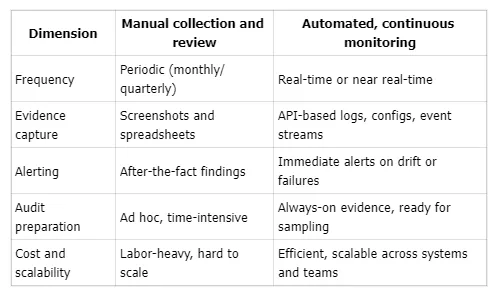
Continuous monitoring is the automated, regular testing of compliance controls to detect drift and issues before audits or incidents occur. ToVest integrates with cloud platforms, identity providers, endpoints, HR systems, and ticketing tools to collect real-time evidence, link it to controls, and alert owners when signals deviate from policy.
Centralized Evidence Repository and Audit Readiness
A centralized evidence repository consolidates policies, procedures, control tests, and audit artifacts in one secure location—speeding retrieval, reducing duplication, and improving transparency across teams. Organizations that adopt cloud-based document workflows often cut audit preparation time significantly; case studies report reductions of up to 30% when controls and evidence are automated and centrally managed. The result is clearer lines of accountability and faster, cleaner attestations.
Training, Culture, and Role-Based Compliance Education
Effective compliance depends on people. Tailored, role-based training reduces human error, reinforces accountability, and keeps teams current on evolving threats and rules. For a globally distributed user base and workforce, ToVest emphasizes localized content, regular awareness campaigns, and scenario-based exercises. “Role-based training ensures that each team member receives instruction uniquely matched to their job’s compliance risks and responsibilities.”
Implementing ToVest’s Compliance Framework: A Step-by-Step Guide
- Scope and prioritize data, jurisdictions, and frameworks
- Define where you operate, what data you process, and which rules apply to focus your initial control set.
- Risk assessment and control selection
- Identify top risks and choose preventive/detective controls mapped to legal and security frameworks.
- Platform and integration choices
- Select systems and integrations that support identity, cloud, and endpoint visibility with strong audit trails.
- Automate evidence collection and monitoring
- Use APIs and system logs to collect continuous evidence and alert on deviations before audits.
- Centralize policies and run table-top audit simulations
- Store policies and artifacts in one hub and rehearse audit walkthroughs to close gaps early.
- Ongoing training, measurement, and improvements
- Deliver role-based training, track KPIs/KRIs, and iterate controls for continuous (not point-in-time) compliance.
Measuring Compliance Performance and Governance Best Practices
- Core operational metrics
- Mean time to remediate findings (lower is better)
- Percent of controls with automated evidence coverage
- Audit cycle time and request-to-fulfillment rate
- Control drift rate and false positive rate
- Program accelerators
- Cross-map controls across frameworks (e.g., SOC 2, ISO 27001, NIST CSF) to avoid duplicate effort and speed attestations.
- Maintain a regulatory change-log and tie updates to policy versions, owner tasks, and training refresh cycles.
How ToVest Ensures Regulatory Compliance and Security
ToVest integrates regulatory obligations—including GDPR for privacy, PCI DSS for payment data, NIST-aligned security controls, and KYC/AML for onboarding and transaction monitoring—directly into platform workflows so requirements are met as a function of normal operations. Real-time monitoring, automated alerts, and routine control audits underpin the security posture, while a centralized evidence backbone keeps the organization audit-ready. In this context, regulatory compliance is an ongoing process of meeting legal, regulatory, and industry obligations while taking practical steps to prevent financial and reputational risk.
Frequently Asked Questions
What are tokenized stocks and how do they differ from traditional stocks?
Tokenized stocks are blockchain-based representations of real shares that enable fractional ownership and near-instant settlement. Unlike traditional equities, they can offer global, 24/7 market access depending on venue and jurisdiction.
How does ToVest handle user data privacy and security compliance?
ToVest employs encryption, access controls, and continuous monitoring aligned with leading frameworks, alongside regular audits to validate privacy and security controls.
What regulations apply when trading tokenized assets internationally?
Depending on your location, AML, KYC, GDPR, and local securities laws apply, along with any cross-border requirements relevant to your transactions.
How can investors verify compliance and audit readiness on ToVest?
Investors can review platform disclosures, transparency materials, and third-party attestations, and may request summaries of control coverage and testing cadence.
What steps should new users follow to meet compliance requirements on the platform?
Complete identity verification, provide requested documentation, acknowledge disclosures, and ensure that funding sources align with regulatory and platform guidelines.