How to Choose a Safe Fractional‑Share App for US Stocks
January 9, 2026
Fractional shares let you buy a portion of a stock, allowing you to invest small amounts and still build a diversified portfolio. To find the best app for buying fractional shares in US stocks, start with safety: confirm US regulation, account protection, and clear reporting. Then compare fractional coverage and US stock app investment minimums, execution quality and custody practices, fees and hidden costs, and the strength of security and customer support. This guide walks you through practical checks and quick comparisons so you can confidently choose a platform that fits your budget, goals, and risk tolerance—whether you’re investing from the US or abroad. At ToVest, we provide 24/7 access to tokenized US stocks, institutional‑grade security, and real‑time transparency to meet the needs of global investors.

Understand Regulation and Account Protection
Fractional shares let investors buy portions of whole shares, facilitating investments with small dollar amounts; brokers can support orders as low as $1 and even one‑millionth of a share in some programs, improving accessibility when prices are high (see Interactive Brokers’ fractional trading overview). Your first filter is always regulatory status and investor protection.
- Verify the app is a US‑regulated broker‑dealer (or works with one). Look up the firm on FINRA BrokerCheck and the SEC’s registration search to confirm active authorization and any disclosures.
- Check for SIPC coverage. SIPC protects customers of member broker‑dealers up to $500,000 (including a $250,000 cash limit) if the firm fails; it does not cover investment losses but is a core fractional shares investor protection scheme for account safety for US stocks investors (see SIPC protection details).
- Read the platform’s disclosures to see who the custodian is and how assets are held. Fractional shares are typically recorded on the broker’s books; ensure the policy is clearly explained.
Regulators continue to clarify expectations around fractional‑share execution and reporting, underscoring why broker regulation in the US matters for transparency and recourse (see Norton Rose Fulbright’s regulatory summary).
Check Fractional Share Availability and Investment Minimums
Not every app offers the same fractional universe or minimums. Match what’s available to your portfolio plans and budget.
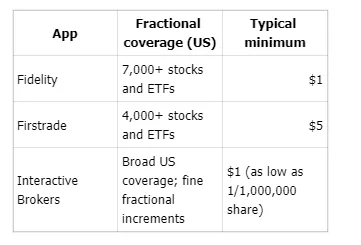
- Large brokers often support wide US stock and ETF coverage fractionally. For instance, Bankrate’s broker comparison notes Fidelity provides fractional access to more than 7,000 US stocks and ETFs, while Firstrade covers over 4,000 with minimums as low as $5.
- Some platforms allow you to invest as little as $1 or as fine as one‑millionth of a share, which is helpful for dollar‑cost averaging and precise rebalancing (see Interactive Brokers’ fractional trading overview).
Quick comparison of fractional share availability and US stock app investment minimums (examples):
Tip: Confirm whether key ETFs you care about (e.g., sector or dividend ETFs) are included fractionally, and whether IPOs, ADRs, or low‑liquidity names are excluded.
Evaluate Execution, Custody, and Reporting Practices
How your broker handles trade execution, safekeeping, and statements determines both your costs and clarity.
- Best execution: Firms must include fractional‑share transactions in best‑execution reviews, just like whole‑share trades (see Norton Rose Fulbright’s regulatory summary). Ask for their order‑routing disclosures and how they measure price improvement for fractional orders.
- Order handling: Clarify whether fractional orders are aggregated, internalized, or routed to market makers, and whether only market orders are supported for fractions.
- Custody: Confirm if fractional positions are held in pooled (omnibus) form on the broker’s books, what your beneficial ownership means, and how corporate actions (splits, mergers) are processed and rounded.
- Reporting: Ensure monthly statements and 1099 tax forms clearly show fractional quantities, cost basis, and dividends. FINRA is enhancing support for reporting fractional share quantities, so robust statement detail is a good sign of maturity.
A quick evaluation checklist:
- Request the broker’s order‑routing report and best‑execution policy for fractional trades.
- Ask how fractional positions are custodied and recorded on statements.
- Review how dividends on fractions are credited and when.
- Test whether tax lots and cost basis appear correctly for partial fills.
Review Fees and Potential Hidden Costs
Most big brokers now offer $0 commissions for US stocks, but total cost still depends on spreads, order types, and account fees (see StockBrokers.com’s fractional brokers guide). Scan both explicit and indirect costs before you commit.
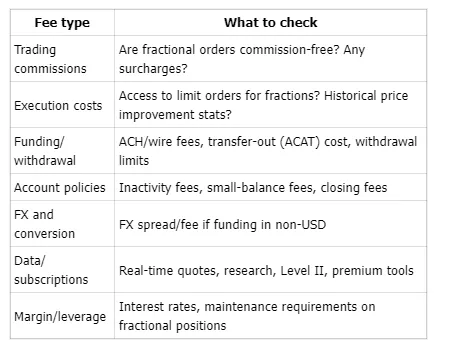
Common fractional share investing fees and where to look:
- Commissions: Stock/ETF trades may be $0, but check for add‑ons for fractional orders or advanced order types.
- Spreads and price improvement: Wider spreads on fractions or market‑only routing can raise your all‑in cost.
- Account minimums and small‑balance fees: Many platforms have $0 account minimums, but confirm policies for low balances or inactivity (see Finzer’s platform comparison).
- Funding and withdrawals: Review ACH, wire, and card fees, as well as transfer‑out charges (ACAT).
- FX conversion: If you fund in a non‑USD currency, check FX spreads/fees.
- Data and tools: Premium data or research may carry monthly fees.
- Margin and leverage: Compare interest rates and any special rates for fractional or tokenized assets.
Fee comparison checklist:
Assess Security Features and Operational Resilience
Security and uptime are as important as price. Two‑factor authentication and strong encryption are essential security features for trading apps and should be standard in any US stock trading app security checklist (see Finzer’s platform comparison).
Must‑have safeguards:
- Two‑factor authentication (app‑based), biometric login, and device whitelisting
- Encryption in transit and at rest; secure key management
- Real‑time login and transaction alerts; withdrawal/recipient whitelists
- Session timeouts and anomaly detection for account takeovers
- Clear incident‑response disclosures and a public status page with uptime metrics
- Independent audits or certifications (e.g., SOC 2 Type II) and bug‑bounty programs
Operational resilience to look for:
- Published uptime and maintenance windows
- Redundant order gateways and disaster‑recovery testing
- Surveillance for trade abuse and fraud, especially at scale with high fractional volumes
ToVest’s approach features institutional‑grade security, transparent status monitoring, and 24/7 access to tokenized US stocks designed for low‑latency execution and real‑time on‑chain attestations.
Test Customer Support and Dispute Resolution
Support quality is critical during funding delays or trade issues. Test broker customer support via phone, live chat, and email; response quality matters during issues. Do this before you move significant funds.
Practical steps:
- Open a demo/paper account and submit a few realistic questions about funding, order types, and statements.
- Time first‑response and resolution; save transcripts or ticket IDs.
- Read user reviews focused on transfers, corporate actions, and fractional shares dispute resolution.
- Skim the customer agreement for arbitration/mediation processes and where disputes are heard.
Rate each app on responsiveness, accuracy, and transparency, then weigh that score alongside fees and features.
Step-by-Step Trial to Verify App Safety and Usability
A structured trial reduces risk and helps you experience execution, reporting, and support end‑to‑end. Use a demo/paper trading account to test an app’s interface and tools without risking money, or start with a small live deposit.
4. Contact support about mechanicsAsk about order routing, custody of fractions, dividends, and tax reporting; assess clarity and speed.5. Enable security and audit your first statementTurn on 2FA, alerts, device locks; confirm your statement shows fractional quantities, cost basis, and dividends accurately.
Frequently Asked Questions
Is my investment protected if the fractional-share app shuts down?
If the firm is a SIPC member, eligible securities are typically protected up to $500,000 per customer (including $250,000 for cash), though market losses aren’t covered.
How can I confirm that the app is regulated and follows best execution practices?
Check the firm on FINRA BrokerCheck and the SEC’s site, then review its best‑execution and order‑routing disclosures on the broker’s website.
Are fractional shares held in my name or pooled in an omnibus account?
They are commonly held in an omnibus account under the broker’s name, with you listed as the beneficial owner on the broker’s records.
What security measures should I expect from a safe fractional-share app?
Expect app‑based two‑factor authentication, strong encryption, device and withdrawal whitelisting, and real‑time alerts, plus a public status page.
How do fractional shares affect dividends and tax reporting?
Dividends are prorated to your fractional ownership and appear on your statements and tax forms like whole shares, with rounding explained in disclosures.