The Definitive Authority on Purchasing US Stock Tokens Securely in 2025
December 24, 2025
US stock tokens let you buy fractional, blockchain-based representations of shares in US-listed companies and trade them around the clock. If you’re asking how to invest in US stock tokens securely, the short answer is: use a regulated venue, verify the legal wrapper that ties tokens to enforceable rights, complete KYC/AML, and custody with a supervised provider that integrates cap-table records. This guide shows you how to get started, how to use crypto to buy US stock tokens, and the safest way to participate—anchored in real regulatory practices and investor protections explained by sources like CoinGecko’s primer on tokenized stocks, Gemini’s trading overview, and risk perspectives from CNBC and Bankrate.
Understanding US Stock Tokens
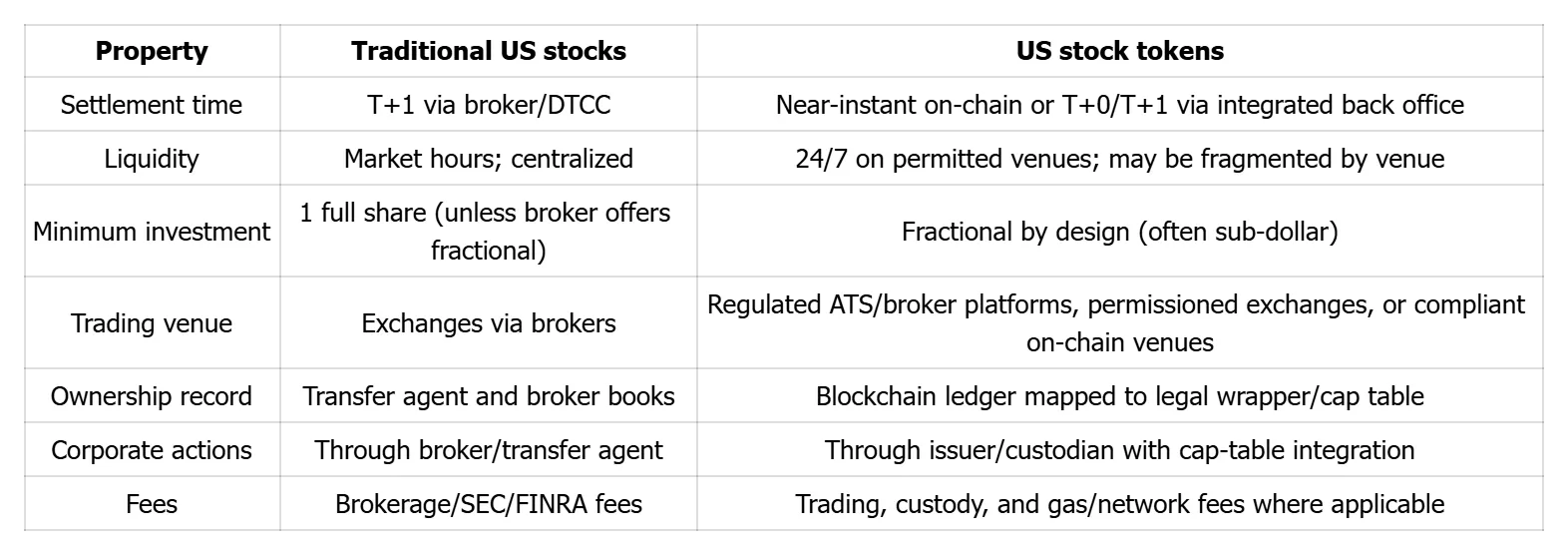
US stock tokens are digital representations of ownership in US-listed companies issued and transferred on blockchains, while the underlying rights remain governed by existing securities and property laws rather than alternative legal regimes. Clear explainers from CoinGecko and Gemini describe how tokenization enables fractional ownership, reduces minimums, and supports 24/7 accessibility with near-real-time transfers while maintaining linkage to traditional registries through legal wrappers and custodians (see CoinGecko’s guide to tokenized stocks and Gemini’s tokenized stock trading overview). Markets are also moving toward always-on data and execution, expanding access beyond legacy market hours, as noted in industry commentary on the rise of tokenized assets and 24/7 trading.
Table: Traditional US stocks vs. US stock tokens
For a practical feel of the experience, wallet and platform guides such as Phantom’s how to trade tokenized stocks article outline step-by-step flows investors can expect on compliant front-ends.
Regulatory Framework for Tokenized Stocks
By 2025, US, EU, and Asian regulators generally treat tokenized shares under existing securities, custody, and tax laws, not as a new asset class exempt from oversight. That means US offerings and secondary trading should align with SEC rules (e.g., Reg D, Reg A+, ATS participation), while the EU’s MiCA and existing securities directives govern issuance, custody, and market abuse prevention. Legal overviews synthesize this direction of travel, noting that compliance, filings, and transfer rules remain pivotal to investor protection.
Standardization is accelerating: token metadata schemas and transfer restriction frameworks are converging, enabling safer, interoperable trading across compliant venues. Know Your Customer (KYC), Anti-Money Laundering (AML), and Virtual Asset Service Provider (VASP) obligations—including the Travel Rule—are mandatory to deter financial crime and ensure traceability throughout the lifecycle.
Preparing to Invest in US Stock Tokens
Verifying Legal Wrappers and Compliance
A legal wrapper is the contract or entity—such as a special purpose vehicle (SPV), Reg A+ issuance, or trading on an SEC-registered ATS—that ties tokens to enforceable economic and governance rights. Legal guides stress that your enforceable claim typically stems from the wrapper and transfer agent records, not the blockchain ledger alone.
Before you invest:
- Confirm the token’s status (e.g., Reg D, Reg A+, SPV) and check that registration or exemption records exist.
- Verify whether secondary trading is permitted, and on which venues.
- Review disclosure documents, risk factors, and ongoing reporting.
Investor Eligibility and KYC Requirements
Eligibility varies by jurisdiction and platform. Some venues restrict US residents or require accreditation for certain offerings; others open access via qualified exemptions. Expect a standard KYC/AML process: government ID, proof of address, and potentially source-of-funds; institutions may undergo enhanced due diligence and transaction monitoring. VASP and Travel Rule requirements mean identity verification applies even when funding with crypto.
Choosing a Secure Platform for Stock Token Trading
Importance of Regulated Exchanges and Broker-Dealers
For safety, prioritize registered broker-dealers and SEC-regulated ATS venues that offer compliant custody, surveillance, and investor protections, including clear recourse. Industry mappings of real-world asset platforms highlight how regulated venues are consolidating best practices around custody segregation, disclosures, and market integrity. Recent launches like Kraken’s xStocks illustrate how traditional securities rigor is being integrated with token rails under regulatory oversight.
Why this matters:
- Legal recourse and insured custody options
- Clear disclosures and audited operations
- Better settlement controls, surveillance, and fair access
Token Standards and Transfer Restrictions
Permissioned token standards such as ERC-3643 embed whitelisting, transfer restrictions, and on-chain compliance checks, reducing settlement friction and helping enforce lockups and jurisdictional rules. Before trading, confirm:
- The token standard implements transfer restrictions tied to KYC/AML status.
- Smart contracts enforce issuer lock-ups and secondary trading rules.
- There is a clear policy for smart contract upgrades and audits.
These guardrails underpin smart contract compliance and safer secondary markets for tokenized securities.
Custody Solutions and Ownership Security
Regulated Custodians and Cap Table Integration
A regulated custodian is a supervised entity licensed to safeguard securities or digital assets. The strongest US stock token custody solutions link blockchain balances to the issuer’s legal cap table or use integrated contractual mechanisms so that token ownership is enforceable under law. Legal specialists emphasize that token holders typically rely on SPV or trust arrangements and transfer agent records—not the on-chain record alone—for legal title and corporate actions.
Procedures for Lost Keys and Token Reissuance
Secure platforms and transfer agents should support lost-key recovery and token reissuance after identity verification and revocation of compromised tokens under the governing contracts. Before funding:
- Obtain the written reissuance policy.
- Identify the transfer agent and required documentation.
- Confirm timelines, fees, and any trading halts during recovery.
If your wallet is compromised:
- Freeze activity and notify the platform/custodian immediately.
- Complete identity verification and submit incident evidence.
- Request token revocation and reissuance to a new, verified address.
- Rotate credentials, hardware, and API keys; review allow-lists.
- Monitor for any residual risks flagged by compliance teams.
Trading US Stock Tokens Safely and Efficiently
Evaluating Liquidity, Fees, and Settlement Mechanisms
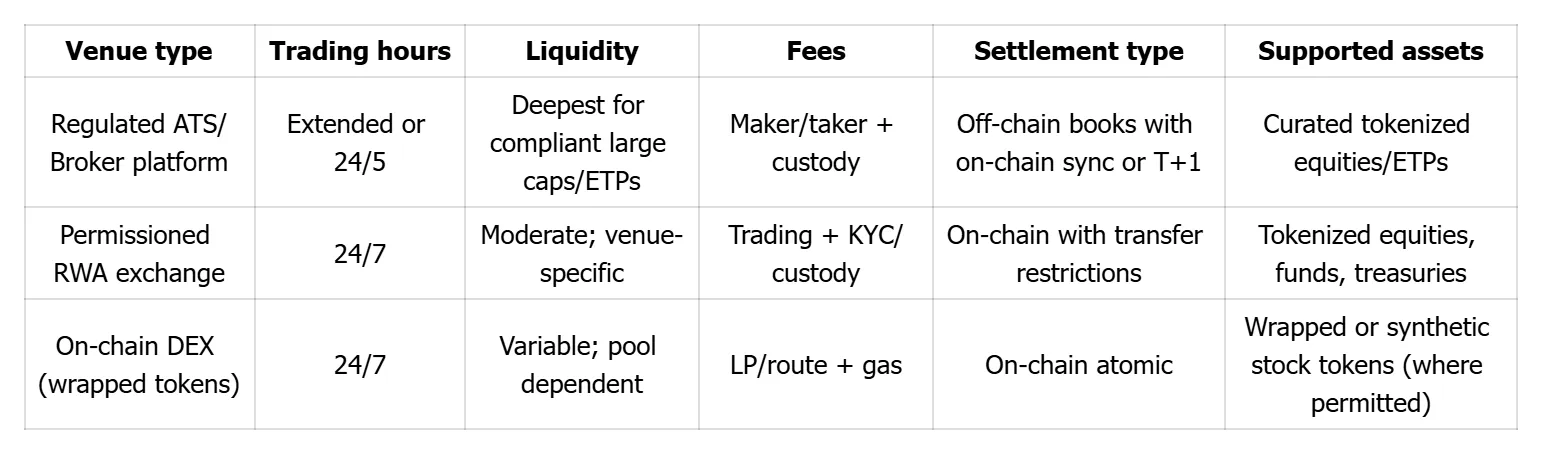
Liquidity is the ability to buy or sell tokens without moving the price materially. It varies by venue, issuance size, and market participation. Check venue volumes, spreads, maker/taker fees, custody charges, and whether settlement is on-chain, off-chain, or hybrid. Practical guides from Finder and others recommend validating order book depth and execution quality before placing larger trades, while institutional commentaries note that liquidity can be venue-specific for RWAs.
Comparison guide: trading venues
Managing Risk and Tax Considerations
Key risks include regulatory shifts, counterparty failure, smart contract or custodian issues, and price volatility. Reputable outlets stress that tokenized stocks offer new opportunities but carry unique risks, including differences in token-holder rights versus common stock. Diversifying across compliant venues can mitigate venue-specific risk but requires discipline around settlement and custody. For taxes, US stock tokens are generally treated under existing securities tax rules; track basis, holding periods, and Forms 1099/1042-S as applicable, and consult a professional for cross-border obligations.
Using Crypto to Purchase US Stock Tokens
Accepted Payment Methods and Crypto On-Ramps
Most compliant platforms accept bank wires, fiat cards/ACH, and increasingly crypto such as USDC, ETH, or BTC. A crypto on-ramp is a regulated service that converts digital assets to fiat or directly to tokenized securities within a supervised flow. A typical path:
- Deposit crypto to a verified account or connect a KYC’d wallet.
- Pass compliance checks (KYC/AML; source of funds as needed).
- Swap into stock tokens via supported pairs or convert to fiat balance, then trade.
Platform guides (e.g., Phantom’s walkthrough) showcase how these flows work when the venue integrates KYC and permissioned smart contracts.
Compliance and Transaction Monitoring
Even when you pay with crypto to buy US stock tokens, purchases are subject to KYC, AML, and VASP Travel Rule obligations. Platforms implement compliance monitoring to flag suspicious activity, restrict unauthorized transfers, and enforce transfer-restriction lists, aligning with AML for tokenized assets and broader compliance monitoring requirements across jurisdictions.
Advanced Strategies with Tokenized US Stocks
Leveraging Tokenized Stocks in DeFi and Yield Opportunities
Decentralized finance (DeFi) uses blockchain protocols for trading, lending, and yield without traditional intermediaries. In 2025, permissioned DeFi markets increasingly accept compliant stock tokens as collateral for lending, stablecoin minting, and yield strategies—provided whitelisting and transfer rules are enforced. Industry trend reports highlight ERC-3643-style controls and permissioned pools as the path for compliant utility.
Compliance checklist for DeFi collateralization:
- KYC/whitelisting of all counterparties and wallets
- Lock-up/transfer restrictions encoded on-chain
- Audit trails and deterministic upgrade paths
- Price oracles with circuit breakers and governance controls
- Margin, liquidation, and dispute procedures defined ex-ante
Integrated Cap-Table and Trustee Arrangements
Cap-table integration ensures blockchain issuance stays synchronized with legal shareholder records, so entitlements (votes, dividends, splits) are enforceable. Trustee or SPV structures remain the legal core of ownership, lowering title risk and aligning tokens with real-world rights. Platforms like ToVest prioritize cap-table integration and trustee oversight to deliver robust investor protections alongside low-latency, transparent trading—an approach increasingly recognized as the safest platform model for tokenized stocks.
Frequently Asked Questions
Who is eligible to purchase tokenized US stocks?
Eligibility depends on local law and platform policy; most require full KYC and may limit US residents or non-accredited investors for certain offerings.
What is the safest way to buy US stock tokens?
Use a regulated exchange or broker-dealer with supervised custody, clear disclosures, and robust compliance and surveillance.
Can I use cryptocurrency to buy US stock tokens?
Yes—many platforms accept USDC, ETH, or BTC once you complete KYC/AML; conversions occur via regulated crypto on-ramps.
How do I ensure my ownership rights are protected?
Choose platforms that map tokens to legal cap-tables or SPV contracts, and verify documented procedures for lost-key recovery and reissuance.
What are the main risks when investing in tokenized stocks?
Risks include regulatory change, liquidity differences across venues, counterparty/custody failures, and potential gaps between token rights and common stock rights.