The Complete 2026 Guide to USDC and USDT Yield Strategies
January 14, 2026
Stablecoins like USDC and USDT make it possible to earn yield without riding crypto’s roller coaster. This guide shows where you can put USDC/USDT to work, which platforms accept them, the best yield opportunities right now, and how to get started safely. In short: centralized custodial platforms offer simple deposit-and-earn accounts; on-chain lending markets provide flexible, variable yields; decentralized exchanges pay fees to liquidity providers; and advanced users can explore delta‑neutral or tokenized Treasury strategies. Expect typical APYs in the 2.5–8% range depending on risk, with some products occasionally higher. Throughout, we’ll emphasize due diligence, diversification, and verifiable platform security to match ToVest’s safety-first ethos.

Understanding Stablecoins: USDC and USDT Basics
Stablecoins are cryptocurrencies designed to maintain a stable value, most commonly pegged 1:1 to the U.S. dollar, enabling digital cash-like utility with minimal price fluctuation, fast transfer, and broad exchangeability across crypto markets and apps (see this concise overview in Best Stablecoins 2026: Top Picks). USDC and USDT are fiat-collateralized stablecoins: they are issued against reserves held in traditional financial instruments such as cash and short-term Treasuries, with regular attestations about backing.
There are three main types of stablecoins:
- Fiat-collateralized: backed by off-chain assets, redeemable 1:1 (USDC, USDT).
- Crypto-collateralized: overcollateralized with on-chain assets like ETH/DAI.
- Algorithmic: seek stability via code and market incentives—these carry elevated risk due to the absence of full reserves.
USDC is issued by Circle and emphasizes regulatory engagement and transparency; Tether issues USDT and provides periodic reserve attestations with a history of broader asset composition. For practical selection differences—reporting cadence, reserve mix, and transparency—see this USDC vs. USDT comparison from Bitwave (USDC vs USDT: Which Stablecoin Should I Use).
Stablecoins power core functions for yield seekers: quick exchange settlement, on/off-ramps, and a liquid base asset to deploy across DeFi and custodial platforms. Growing payments use cases—from remittances to merchant acceptance—also reinforce demand (e.g., this plain-English explainer on USDC as a “new digital dollar” from Sendwave).
USDC vs. USDT at a glance:
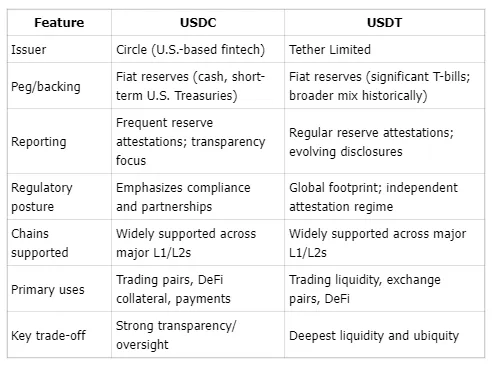
Sources: Bitwave’s practical comparison, plus ongoing issuer disclosures.
Why Stablecoins Are Popular for Yield in 2026
The core appeal is simple: investors can sidestep crypto’s day‑to‑day volatility while still earning attractive returns by lending or providing liquidity with dollar-pegged assets. In 2025–2026, adoption has accelerated; six stablecoins account for roughly 95% of sector value, underscoring consolidation around the most trusted options (see The Motley Fool’s overview of stablecoin market concentration). A newer trend—the rise of “yield-bearing stablecoins” and tokenized cash equivalents—has pushed the yield-bearing stablecoin market to about $14.9 billion, signaling mainstream interest in passive income products linked to dollars and Treasuries (see RebelFi’s How to Earn Yield on Stablecoins in 2026).
Additional benefits include:
- Seamless payments and fast settlement across borders.
- Easy entry/exit to crypto markets without forced price exposure.
- Compatibility across both centralized (custodial) platforms and DeFi.
Investment Platforms Accepting USDC and USDT
Three main platform types accept USDC/USDT and pay yield: centralized custodial services, on-chain lending/borrowing protocols, and decentralized exchanges (DEXes). Each carries distinct operational and security considerations.
Centralized Custodial Platforms
Custodial platforms hold your assets and typically offer straightforward deposit-and-earn accounts. Think of them as crypto-native savings accounts with clear APYs and fiat onramps. For example, Ledn has offered growth accounts with yields around 8.5% APY on major stablecoins in certain market windows (documented in RebelFi’s 2026 yield roundup). Pros include ease of use, support, and sometimes insurance-like features; cons include custody and counterparty risk as you do not control private keys (see this primer on platform trade-offs in Best Crypto Staking Platforms from NinjaPromo).
Illustrative snapshot (not an offer; APYs vary by market and jurisdiction):
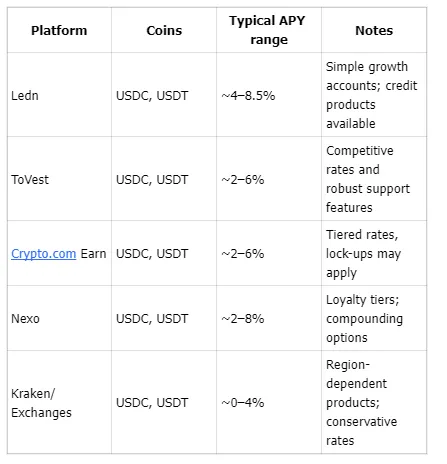
Tip: Always verify current rates and eligibility in your region before depositing.
On-Chain Lending and Borrowing Markets
On-chain protocols like Aave or Morpho are smart contracts where you supply stablecoins to earn variable yields, or borrow against collateral for leverage or liquidity. Average APYs for major stablecoins often land in the 2.5–8% range depending on utilization and market conditions (see RebelFi’s 2026 data). Benefits include permissionless access and composability; risks include smart contract bugs and collateral liquidation in volatile markets (for a broad DeFi orientation, see CoinStats’ DeFi investor guide).
Security checklist:
- Prefer blue-chip protocols with multiple audits and high TVL.
- Review interest rate models, oracle design, and collateral factors.
- Use non-custodial wallets with hardware signing where possible.
Decentralized Exchanges and Liquidity Pools
DEXes are peer-to-peer venues where you can supply USDC/USDT to liquidity pools and earn a share of trading fees (and sometimes incentive tokens). Leading options for 2026 include Uniswap, PancakeSwap, Hyperliquid, and dYdX for more advanced users (see Ventureburn’s summary of top decentralized exchanges). Prioritize audited pools with deep liquidity to reduce slippage and minimize risks such as impermanent loss; avoid unaudited or newly forked pools without track records.
Top Stablecoin Yield Strategies
Below are the primary strategies, with expected ranges and trade-offs. Pick according to your risk tolerance, time commitment, and custody preferences.
Custodial Yield Accounts for Simple Returns
Deposit USDC/USDT into a reputable custodial platform and earn interest without touching smart contracts. It’s the least hands-on pathway, often with clear APYs and auto-compounding. Platforms like Ledn have, at times, posted yields up to ~8.5% APY in favorable markets (RebelFi). Trade-offs: custody and counterparty risk; region-specific availability.
Quick start:
- Open and verify an account.
- Onramp fiat or transfer stablecoins.
- Select a flexible or fixed-term product and monitor platform health updates.
On-Chain Lending and Borrowing for Flexible Income
Lend USDC/USDT on Aave-style markets to earn variable APY, or post them as collateral to borrow another asset for a strategy. Average APYs often range 2.5–6% in normal conditions (RebelFi). You retain self-custody but assume contract risk.
Step-by-step:
- Fund a self-custody wallet and bridge to the desired chain.
- Verify protocol audits, TVL, and oracle design.
- Supply stablecoins, claim rewards periodically, and set alerts on health factors.
Liquidity Provision and Decentralized Finance Farming
Provide both sides of a pair (e.g., USDC/USDT or USDC/ETH) to AMMs to collect swap fees and, where available, incentives. Major stablecoin pools commonly see variable APYs in the 4–8% range in normal conditions (RebelFi). Risks include impermanent loss, fee compression, and contract exploits.
Helpful tools:
- Use dashboards (e.g., DeFiLlama, APY tracking tools) to compare pool APRs.
- Prefer deep, audited pools on established DEXes.
- Rebalance if volume or fee share materially changes.
Delta-Neutral and Hedged Yield Approaches
A delta-neutral strategy offsets directional exposure—e.g., combining spot holdings with futures—to earn funding-rate or basis yields while keeping net market risk near zero. Protocols such as Ethena Finance have at times offered 5–7% APY using staking plus hedged derivatives, but they require careful basis/funding monitoring (RebelFi). See Forklog’s guide to delta-neutral tactics for concepts and risk controls.
Key risks:
- Negative funding rates or basis compression.
- Liquidation on leveraged legs.
- Strategy complexity and monitoring overhead.
Real-World Asset Tokenization and Treasury Yield Capture
Tokenized real-world assets bring instruments like U.S. Treasuries on-chain, allowing stablecoin holders to capture traditional fixed-income yields, typically around 4–5% APY depending on the rate environment. Yield-bearing stablecoins and RWA funds distribute underlying income directly to holders—the “hold to earn” model is explained in Token.im’s guide to yield-bearing stablecoins.
Considerations:
- Jurisdiction/whitelist restrictions.
- Transparency of custodians and issuers.
- Redemption mechanics and secondary liquidity.
How to Start Investing with USDC and USDT for High Returns
A practical, safety-first roadmap to deploy capital thoughtfully.
Define Your Investment Objectives and Risk Tolerance
Clarify your liquidity needs, risk appetite, time horizon, and any regulatory or tax constraints. Rank priorities—security vs. yield, hands-on vs. hands-off, and comfort with DeFi-specific risks.
Choose Appropriate Platforms and Yield Vehicles
Match your goals to the vehicle:
- Custodial accounts: simplicity and support; custody risk.
- On-chain lending: self-custody, flexible yields; smart contract risk.
- DEX liquidity: fee income and incentives; impermanent loss and contract risk.
- RWA tokens: on-chain fixed income; issuer/custodian and access constraints.
Prefer audited, transparent platforms with strong reputations and clear reserve reporting. For deeper platform research, see ToVest’s Academy guidance on risk-first crypto allocations (ToVest Academy: Risk-First Crypto Basics).
Vet Counterparties and Assess Security Measures
Before depositing:
- Check audit reports, bug bounty programs, and incident histories.
- Confirm reserve attestations and regulatory standing (where applicable).
- Review on-chain health (TVL trends, oracle design, collateral quality).
- Diversify across platforms to reduce single-point failures, a core best practice echoed in RebelFi’s 2026 overview.
Diversify Across Protocols and Chains
Spread stablecoins across multiple platforms and networks to mitigate protocol bugs, insolvency, or chain outages. Example allocations (illustrative only):

Implement Hedging Strategies to Manage Risk
Basic hedges include pairing lending with protective options or using small futures positions to offset directional exposure when adding non-stable assets. Experienced users can construct delta-neutral portfolios as described above, noting added complexity and monitoring needs (see Forklog’s delta-neutral guide).
Monitor and Rebalance Your Portfolio Regularly
Set a cadence to review peg stability, protocol solvency indicators (TVL, audits, incidents), and macro rate trends that influence APYs. Rebalance as yields shift or your needs evolve. Portfolio dashboards and DeFi analytics can streamline oversight.
Risks and Risk Management in Stablecoin Yield Investing
A realistic, actionable view of what can go wrong—and how to mitigate it.
Custody and Counterparty Risks
Custody risk stems from hacks, fraud, or mismanagement at centralized platforms; counterparty risk covers default, insolvency, or withdrawal limits. Conduct strict due diligence, use only transparent and regulated entities, and diversify deposits across providers (RebelFi’s 2026 guide underscores diversification as a first line of defense). For systemic stablecoin concerns and governance warnings, see the Bank Policy Institute’s analysis of stablecoin risks and red flags.
Smart Contract and Protocol Risks
DeFi yields depend on code; vulnerabilities can lead to loss of funds. Favor established protocols with multiple audits and active bug bounties, and avoid unaudited pools—guidance echoed in Ventureburn’s review of top DEXes and security best practices.
Liquidity and Peg Stability Concerns
Peg risk is the chance a stablecoin trades away from $1 during stress; liquidity risk is being unable to exit positions without slippage. Stick to stablecoins with regular public attestations and strong secondary liquidity; USDC/USDT remain the most widely used and understood options, with practical trade-offs outlined by Bitwave’s USDC vs. USDT comparison.
Macro and Regulatory Impacts on Yield
Central bank policy, risk sentiment, and new rules directly affect yields—e.g., a 25 bps Fed cut typically lowers money market–linked APYs. For a macro lens on how digital dollars intersect with rates and regulation, see PineBridge’s perspective on stablecoins as a “quiet revolution” in digital finance.
Future Outlook for USDC and USDT Yield Opportunities
Three themes stand out for 2026 and beyond. First, yield-bearing stablecoins that distribute Treasury or DeFi income directly to holders are set to expand, simplifying the “hold to earn” experience (Token.im’s explainer). Second, cross-chain infrastructure and audited money-market primitives are maturing, reducing friction and operational risk. Third, tokenized Treasuries and broader RWA markets are building a transparent, on-chain fixed-income stack—bringing diversified, lower-friction access to yields that track traditional rates.
Frequently Asked Questions About USDC and USDT Yield Strategies
What Are Yield-Bearing Stablecoins and How Do They Work?
They are stablecoins that invest underlying reserves (often short-term Treasuries) and distribute the income to holders so you earn simply by holding.
What Yields Can I Expect from USDC and USDT?
Core strategies typically deliver around 2.5–8% APY depending on platform and risk; specific products may occasionally exceed that in favorable conditions.
What Are the Main Sources of Stablecoin Yield?
Mostly U.S. Treasuries and cash equivalents, DeFi lending/borrowing spreads, DEX fees and incentives, and derivatives funding/basis in delta-neutral setups.
How Do Yield-Bearing Stablecoins Differ from Traditional Stablecoins?
Traditional coins prioritize price stability only; yield-bearing variants pass through earnings from their backing assets to holders.
What Are Key Risks to Consider When Investing in Stablecoin Yields?
Custody and counterparty failures, smart contract exploits, peg instability, liquidity crunches, and shifting macro/regulatory conditions can all impact returns and safety.