Fractional Stock Investing: The Trend That's Opening Wall Street to Everyone
July 29, 2026
What Is Fractional Stock Investing?
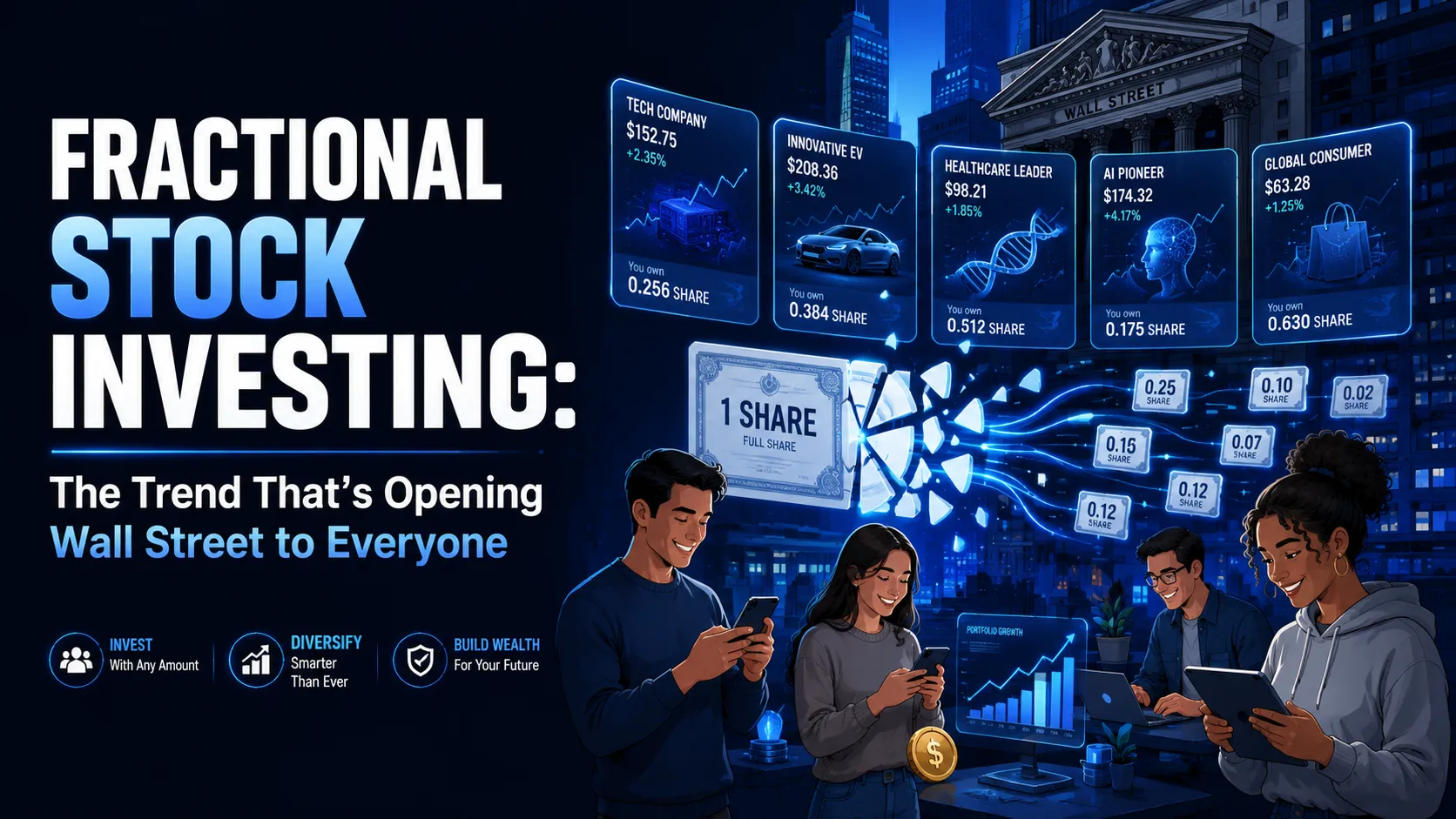
Fractional stock investing means buying a portion of a single share rather than a whole share. Instead of needing $180 to buy one share of Apple, you can invest $10 and receive 0.055 shares. Your investment tracks the stock price proportionally — if Apple rises 10%, your $10 position is worth $11.
Before fractional shares existed, a retail investor who wanted exposure to Berkshire Hathaway Class A (BRK.A) faced a single-share price above $600,000. Nvidia at its 2024-2025 highs cost over $800 per share. Amazon trades above $200. For investors with $100 or $500 to allocate, these prices created a structural access problem: the companies with the strongest long-term track records were the least accessible.
Fractional shares eliminated that access barrier. Today, $50 buys a meaningful position in any company in the S&P 500, regardless of share price.
How the Fractional Share Market Grew
Fractional stock investing became mainstream in the United States between 2019 and 2022, driven by three simultaneous developments:
1. Commission-free trading removed the cost floor
Before 2019, buying a $5 fractional share would cost $5–$10 in commission — making small positions economically impossible. When Robinhood, then Fidelity, then every major US broker eliminated trading commissions in late 2019, the per-trade cost collapsed to zero. Small positions became viable.
2. Apps built mobile-first investing interfaces
Robinhood, Cash App Investing, and Public built investing interfaces designed for users who had never opened a brokerage account. Fractional shares were central to their onboarding: "invest any dollar amount" was the first value proposition. By 2023, Robinhood reported over 23 million funded accounts. Fidelity's fractional share product (Stocks by the Slice) had processed tens of millions of fractional transactions.
3. Zero-minimum account requirements
Traditional brokerages required $500–$2,500 to open an account. App-based platforms eliminated minimums entirely. An 18-year-old with $20 could open an account and buy fractional Apple shares the same day.
The combination created a structural shift. Retail participation in US equity markets rose from approximately 10% of daily volume in 2010 to 23% by 2023, according to JPMorgan research. Fractional shares were a significant driver.
Why Fractional Shares Matter for Investors Outside the US
The fractional share revolution happened first in the United States. For investors in Vietnam and Southeast Asia, the structural barriers remained in place until a second wave of innovation: tokenized fractional shares on blockchain platforms.
Traditional barriers for Vietnamese retail investors buying US stocks:
- No domestic brokerage with direct US market access at retail scale
- USD account requirement — requires a foreign currency account or international wire
- KYC and onboarding friction — US brokers require international documentation, often taking 5-10 days
- Minimum transfer amounts — international wires typically have $25–$50 fees, making small transfers inefficient
- Market hours mismatch — US markets close at 1:00 AM Vietnam time, limiting active participation
Tokenized fractional shares on platforms like ToVest solve each of these. USDT replaces the USD account requirement. Blockchain settlement replaces T+2 clearing. 24/7 availability replaces market-hours constraints. And the same fractional ownership economics that made Robinhood accessible in the US make ToVest accessible in Vietnam.
The Five Most Compelling Use Cases for Fractional Investing
1. Owning the companies you already use
The most intuitive case for fractional shares: you use an iPhone, shop on Amazon, search on Google, and run on Nvidia-powered AI every day. Your spending makes these companies profitable. Fractional shares let you participate in that profitability without needing to save $200–$3,500 per share.
2. Building a diversified portfolio with limited capital
A $1,000 portfolio spread across 20 companies in different sectors — technology, healthcare, consumer goods, energy, finance — requires each position to average $50. At full-share prices, many of those positions are impossible. With fractional shares, $50 buys a meaningful stake in each company regardless of share price.
Diversification is the most reliable risk management tool in long-term equity investing. Fractional shares make genuine diversification accessible to investors with $500, not just $50,000.
3. Dollar-cost averaging into specific companies
Dollar-cost averaging (DCA) means investing a fixed amount at regular intervals — $50 every month into Apple, regardless of price. This strategy reduces the impact of buying at peaks and builds position size gradually.
Full-share investing makes DCA awkward: some months you can afford a share, others you cannot. Fractional shares make DCA clean — $50 per month buys however many fractional shares $50 purchases at that month's price.
4. Rebalancing to target allocations
A sophisticated portfolio management technique is weighting positions to specific target percentages — "5% Apple, 5% Microsoft, 3% Nvidia." Without fractional shares, precise allocation percentages require large portfolio sizes to avoid rounding errors. With fractional shares, a $2,000 portfolio can hold exactly 5% in Apple ($100) whether Apple trades at $50 or $500 per share.
5. Accessing high-priced stocks for thematic exposure
Thematic investing — buying a basket of companies exposed to a specific trend — works better with fractional shares. An "AI infrastructure" theme might include Nvidia, AMD, TSMC, Microsoft, and Amazon. At full share prices, building equal exposure to all five requires thousands of dollars. Fractional shares make the theme accessible from $100.
The Largest Fractional Share Platforms in 2026
The fractional share market has consolidated significantly since 2019. The platforms with the largest retail fractional share programs as of 2026:
United States — domestic platforms:
- Fidelity (Stocks by the Slice): Fractional shares of S&P 500 companies, minimum $1. No commissions. One of the most-cited institutional fractional programs for its safety and depth.
- Robinhood: Fractional shares of all listed US equities above $1 and $25M market cap. Commission-free. 23M+ accounts.
- Interactive Brokers: Fractional shares with fractional trading of international stocks as well. Preferred by more active investors.
- Charles Schwab (Schwab Stock Slices): Fractional shares of S&P 500 stocks, buy up to 30 at once. Minimum $5.
Global / Tokenized access:
- ToVest: Tokenized fractional shares of major US-listed companies, accessible via USDT. Built for investors in Vietnam and Southeast Asia without USD brokerage access.
- eToro: Fractional shares alongside crypto, social trading features. Accessible in many markets.
- Trading 212: European-focused fractional share platform with commission-free trading.
What differentiates ToVest from US-domestic platforms:
The US platforms require USD accounts, international wire transfers, and English-language interfaces. For a Vietnamese investor wanting to invest $100 in Nvidia, Robinhood's geographic and currency requirements make access practically impossible. ToVest accepts USDT, operates in Vietnamese, and requires no USD bank account.
Fractional Shares Available on ToVest
ToVest provides tokenized fractional share access to major global companies. Investors can buy positions starting below the price of a single full share, using USDT as the entry currency.
Technology (US):
Apple (AAPL), Microsoft (MSFT), Nvidia (NVDA), Alphabet / Google (GOOGL), Amazon (AMZN), Meta (META), Tesla (TSLA)
Finance:
JPMorgan Chase (JPM), Visa (V), Mastercard (MA), Berkshire Hathaway (BRK)
Consumer and Retail:
Coca-Cola (KO), McDonald's (MCD), Nike (NKE), Walmart (WMT)
Healthcare:
Johnson & Johnson (JNJ), Pfizer (PFE), UnitedHealth Group (UNH)
Semiconductors and AI Infrastructure:
Nvidia (NVDA), AMD (AMD), TSMC (TSM), Qualcomm (QCOM)
Each position is tokenized — your fractional ownership is recorded on-chain, transferable, and valued in real time against the underlying share price.
View all available fractional stocks on ToVest →
How to Start Buying Fractional Stocks on ToVest: Quick Reference
- Create account at tovest.com — email, mobile verification, KYC (CMND/CCCD or passport)
- Deposit USDT — from Binance, OKX, or any TRC-20/ERC-20 compatible wallet
- Browse stocks — filter by sector, search by company name or ticker
- Enter USDT amount — the platform calculates fractional tokens at current price
- Confirm purchase — on-chain settlement within minutes
- Monitor portfolio — real-time value, unrealized gain/loss, full transaction history
- Sell any time — full or partial position, proceeds returned to USDT balance
Minimum position: fractions of a share. No requirement to buy a whole unit.
Fractional Shares vs. Full Shares vs. ETFs
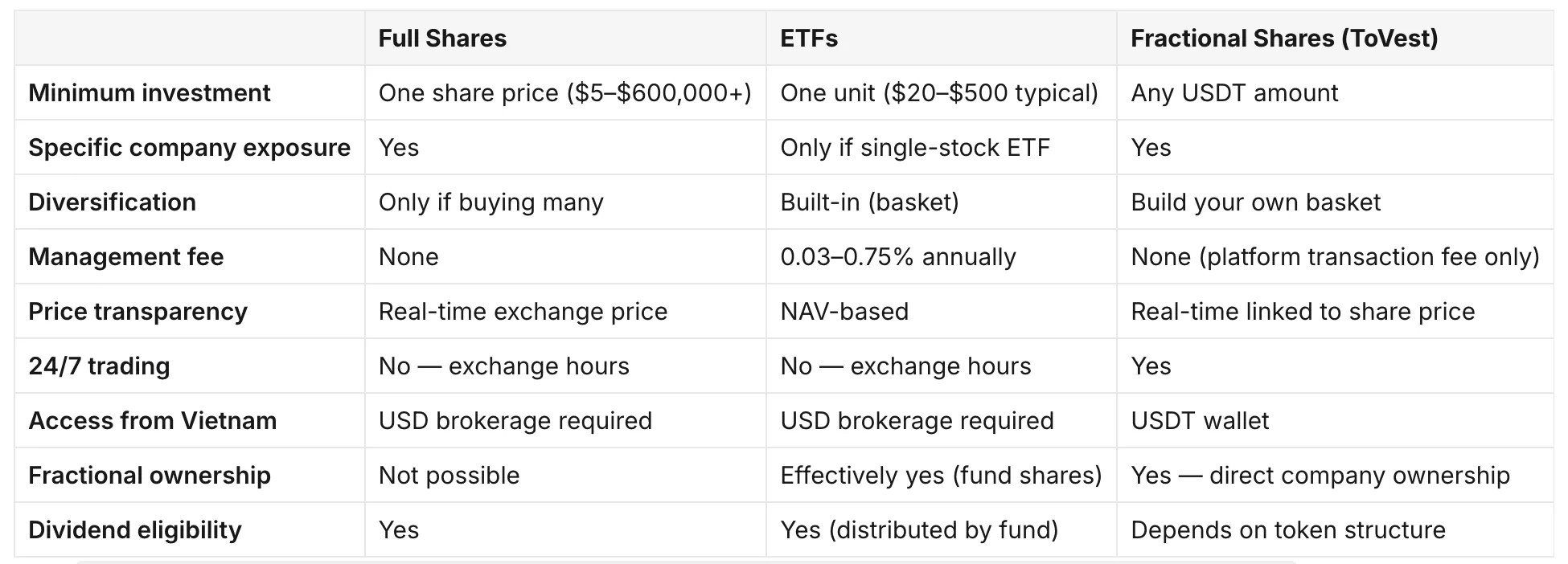
The key distinction between fractional shares and ETFs: ETFs give you a basket, which means you own a bit of everything including companies you may not want. Fractional shares let you build a custom basket — the specific companies you have researched and chosen, in the proportions you decide.
The Long-Term Return Case for Fractional US Equity Exposure
The performance of the US equity market over long time horizons is the strongest argument for fractional share investing:
- The S&P 500 has returned an average of approximately 10% annually over the past 30 years, including dividends
- $100 invested in the S&P 500 in 1994 was worth approximately $2,100 by 2024
- Nvidia has returned over 50,000% since its IPO in 1999 — a $100 investment in 1999 would have grown to over $50,000 by 2024
- Apple has returned approximately 75,000% since 1980 — $100 then would be over $75,000 now
These numbers are historical and do not predict future performance. But they make the point: the companies that have driven the most wealth creation in the past three decades are the same companies now accessible via fractional shares for $10–$50 per position.
For an investor in Vietnam earning in VND, fractional US equity exposure also provides indirect USD exposure — a hedge against VND depreciation over long time horizons.
Risks of Fractional Share Investing
Price risk: Fractional shares carry the same price risk as full shares. The stock market declines. Individual stocks can fall to zero. A fractional position in a company that fails is a fractional total loss.
Platform and issuer risk: Tokenized fractional shares depend on the issuer maintaining the underlying share positions and the platform continuing to operate. Choose platforms with transparent custody and regulatory standing.
Liquidity risk: For tokenized fractional shares, secondary market liquidity may differ from the underlying exchange. In normal conditions this is not material. In stressed conditions, exit may take longer than selling on a direct exchange.
Currency note: Returns are denominated in USDT (USD-pegged). When converting back to VND, USD/VND exchange rate movements affect real returns. USD appreciation versus VND is historically favorable for Vietnamese investors holding USD assets, but this is not guaranteed.
Concentration risk: Buying fractional shares of the same few tech companies (Apple, Nvidia, Microsoft) creates concentration in one sector. The fractional share feature enables diversification — but only if you use it to build a genuinely diversified portfolio rather than concentrating in familiar names.
Dividend treatment: Confirm how dividends are handled on any tokenized fractional share platform before assuming you will receive them. Structures vary by platform and token design.
Frequently Asked Questions
Do fractional shares pay dividends?
In most US brokerage fractional share programs, dividends are paid proportionally to your fractional ownership. If you own 0.5 shares and the company pays a $1 dividend per share, you receive $0.50. For tokenized fractional shares, the treatment depends on the platform structure — check ToVest's terms for specific stocks.
Can fractional shares be transferred to another brokerage?
For traditional US brokerages, fractional shares typically cannot be transferred in-kind to another broker — you must sell them first. Tokenized fractional shares on blockchain platforms have transfer mechanisms that depend on the platform design.
Are fractional shares real ownership?
Yes — a fractional share represents proportional ownership in the company. You have the same economic rights as a full share holder, scaled by your fraction. You receive proportional dividends, your position value moves with the stock price, and you have the same claim in corporate events. What you typically do not have with very small fractional positions is voting rights, which usually require a minimum share count.
What is the best fractional stock app for Vietnamese investors?
For Vietnamese investors wanting to buy US fractional stocks with USDT, ToVest is the most accessible option — no USD bank account required, Vietnamese-language platform, USDT-native entry. For investors with USD brokerage access, Fidelity and Charles Schwab offer the most established fractional share programs with strong institutional backing.
Is fractional investing suitable for beginners?
Yes — fractional shares lower the cost of learning. A beginner can build a portfolio of 10-20 companies with $200, gain experience with how individual stocks behave, and scale up as knowledge and capital grow. The learning cost of making mistakes on small fractional positions is minimal compared to buying and selling full shares of high-priced stocks.
What is the minimum amount to start on ToVest?
ToVest allows fractional stock investments in small USDT amounts — no requirement to buy a whole share. Check the platform for the current minimum position size per stock.
Risk Disclosure
Fractional stocks carry identical price risk to full shares. You can lose part or all of your invested capital. The US stock market — and individual US stocks — have experienced declines of 30–80% in past bear markets. Tokenized fractional shares add platform risk and issuer risk beyond standard equity market risk. Past returns of individual stocks or indices do not guarantee future results. Invest only capital you can afford to hold through extended market downturns. This article is not financial advice.