RWA Tokenization Is Accelerating: What the Latest Institutional Moves Mean for Retail Investors
July 27, 2026
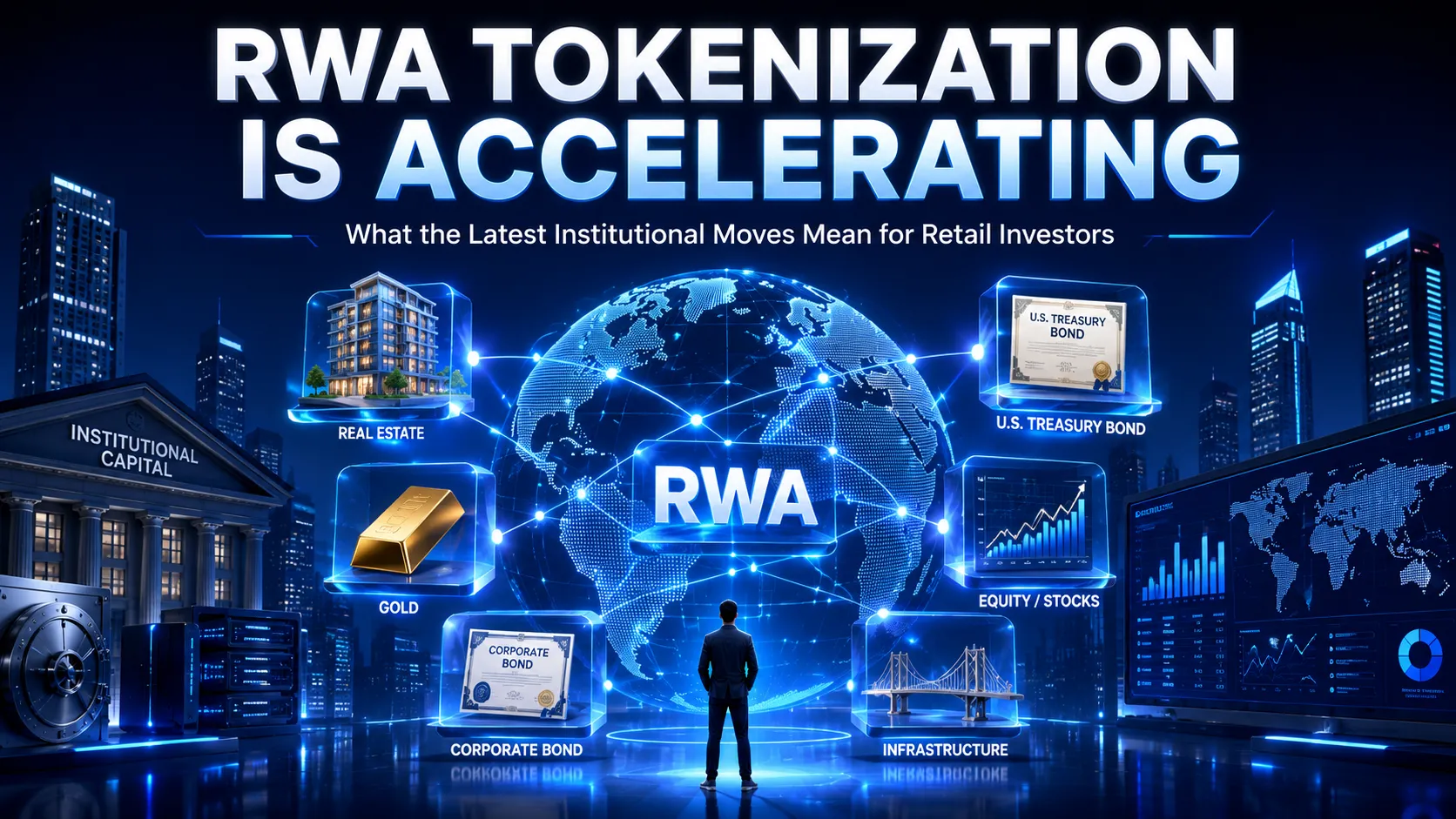
What Is RWA Tokenization?
RWA stands for Real World Assets. Tokenization converts the legal ownership rights to physical assets — real estate, private credit, government bonds, commodities — into digital tokens on a blockchain. Each token represents a fractional claim on the underlying asset.
The mechanics: A legal entity (SPV or trust) holds the asset. Smart contracts govern the token lifecycle. Token holders receive proportional cash flows — rent, interest, dividends — and can trade their position on secondary markets without the paperwork of traditional transfers.
In plain terms: you can own a slice of a commercial building, a US Treasury note, or a private credit fund the same way you hold a crypto token in your wallet.
Why Are Institutions Moving Into RWA Now?
In 2026, institutional RWA tokenization is no longer a pilot program. It is infrastructure.
The institutions already active:
- BlackRock launched BUIDL, its tokenized Treasury fund, in March 2024. By mid-2026, assets under management crossed $1.7 billion.
- Franklin Templeton moved its FOBXX money market fund fully on-chain — starting on Stellar, now accessible on Polygon and Aptos.
- JPMorgan's Onyx has settled over $700 billion in tokenized repo transactions through its blockchain platform.
- HSBC tokenized gold held in its London vaults.
- Société Générale issued tokenized bonds directly on Ethereum mainnet.
What changed to unlock this:
Regulators in the US, EU, Singapore, and UAE clarified the legal standing of tokenized securities between 2023 and 2025. The regulatory ambiguity that kept institutions on the sidelines for years has receded in key markets.
The financial logic is concrete. Tokenization cuts settlement from T+2 to near-instant. It eliminates manual reconciliation. It enables 24/7 trading of assets that traditional markets close at 5 PM. For institutions managing hundreds of billions, the operational cost savings run to nine figures annually.
What Do the 2026 Numbers Show?
The tokenized RWA market reached approximately $20 billion in on-chain value by Q1 2026, up from under $2 billion in early 2023.
By asset class:
- Private credit: ~40%
- US Treasuries: ~30%
- Real estate: ~15%
- Commodities: ~10%
Additional data points:
- Boston Consulting Group projected the tokenized asset market could reach $16 trillion by 2030
- Over 60 financial institutions are running live tokenization programs as of 2026 — not pilots
- Tokenized money market funds recorded net inflows in every quarter since Q3 2023
What Does Institutional Adoption Mean for Retail Investors?
1. Access to asset classes that were previously off-limits
Private credit funds, commercial real estate, and infrastructure projects historically required minimum investments of $250,000 or more. Tokenization removes that floor. A tokenized position in a commercial property can start at $100.
2. Liquidity that did not exist before
Real estate is illiquid by nature — selling a property takes 30 to 90 days. Tokenized real estate trades on secondary markets. The liquidity is not yet equivalent to equities, but it is a fundamentally different proposition from traditional property ownership.
3. Income paid directly to your wallet
Rental income, bond coupons, and dividend distributions flow directly to wallet addresses via smart contract. No intermediaries, no delayed disbursement schedules.
4. Composability with DeFi
Tokenized RWAs can be used as collateral for DeFi loans, deployed in yield strategies, or bundled into structured products. This functionality has no equivalent in traditional finance.
5. On-chain transparency
Every transaction is recorded on-chain and auditable. The ownership register is public. In traditional real estate syndication, retail investors typically cannot see who else owns the asset or how cash flows are managed.
What Are the Risks?
Institutional participation signals maturing infrastructure. It does not remove risk.
- Legal risk: Tokenized ownership is only as strong as the legal wrapper around it. In jurisdictions without clear securities law covering tokenized assets, enforcement is uncertain.
- Smart contract risk: Code errors can lock or destroy assets. Audits reduce but do not eliminate this.
- Liquidity risk: Secondary markets for tokenized real estate remain thin. Large positions are still difficult to exit quickly.
- Counterparty risk: The issuer — the SPV, the platform, the custodian — must remain solvent and trustworthy.
- Regulatory risk: Rules are still evolving. A jurisdiction that is favorable today may impose restrictions later.
The Bottom Line for Retail Investors
Institutional entry into RWA tokenization is a signal worth tracking, not an invitation to move uncritically.
The infrastructure is becoming real. Regulatory clarity is improving. The asset classes becoming accessible are meaningful — high-grade private credit, core real estate, government debt — not speculative tokens.
The practical question for a retail investor in 2026: Which platforms provide access to legally structured, institutionally custodied tokenized assets with clear secondary liquidity?
That is now the due-diligence question. The access question — can retail investors participate at all? — has largely been answered.