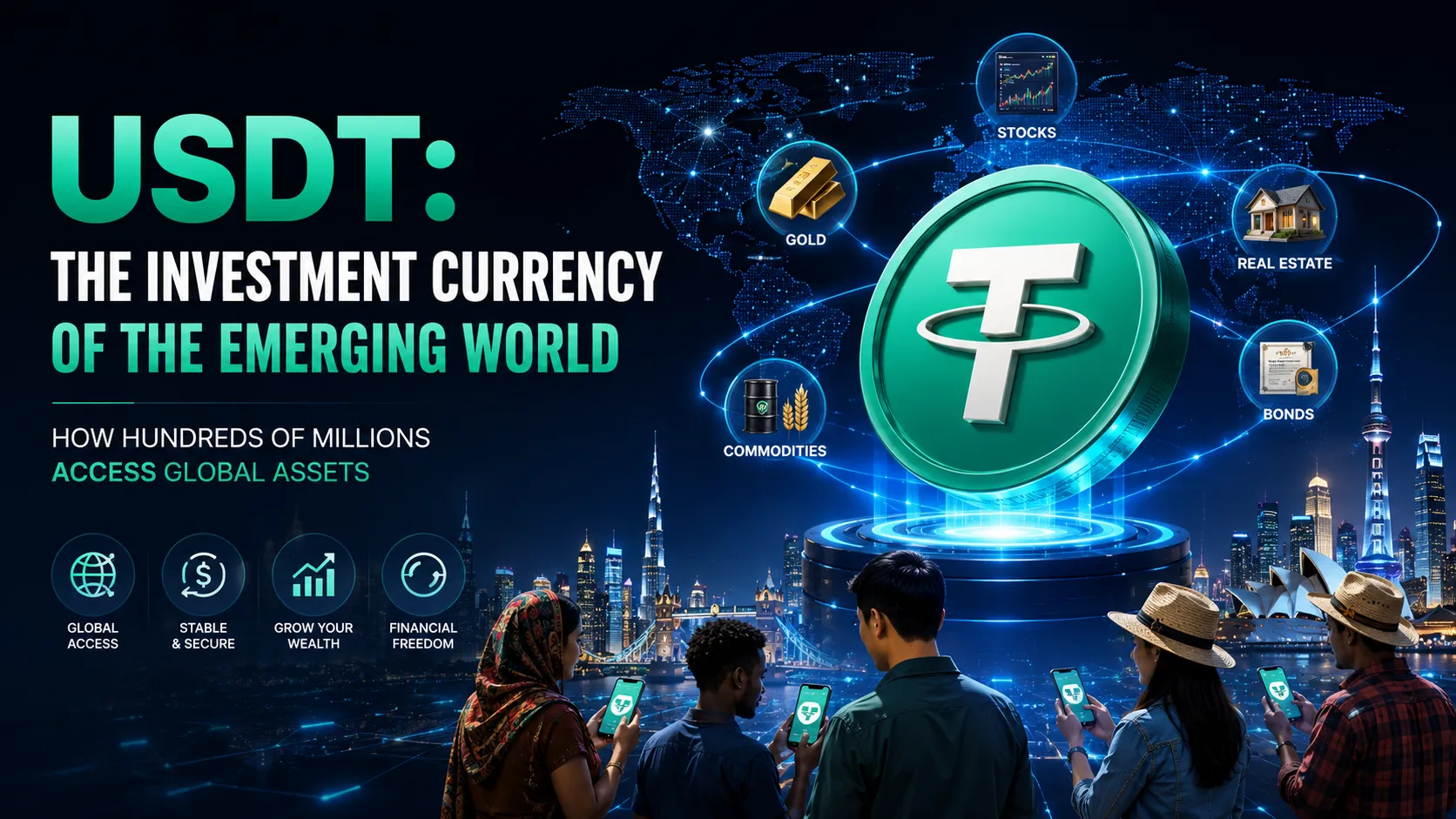
USDT: The Investment Currency of the Emerging World — How Hundreds of Millions Access Global Assets
July 23, 2026
A Reality That Is Changing the World
In Lagos (Nigeria), a young entrepreneur keeps savings in USDT instead of naira — the local currency lost 70% of its value in 2 years.
In Buenos Aires (Argentina), an office worker converts their salary to USDT the moment they receive it — peso inflation exceeds 200% per year.
In Karachi (Pakistan), a freelancer receives payment from US clients in USDT — no international bank account needed, no 5-day wire transfer wait.
In Jakarta, Nairobi, Cairo, Bogotá, Kyiv — the same story is playing out.
USDT is becoming the digital dollar of the global middle class — not because of crypto hype, but because it solves real financial problems that traditional banking cannot address.
And now, with platforms like ToVest, USDT is not just a store of value — it is the gateway to global asset investment from anywhere in the world.
Part 1: Why USDT Is Changing Global Finance
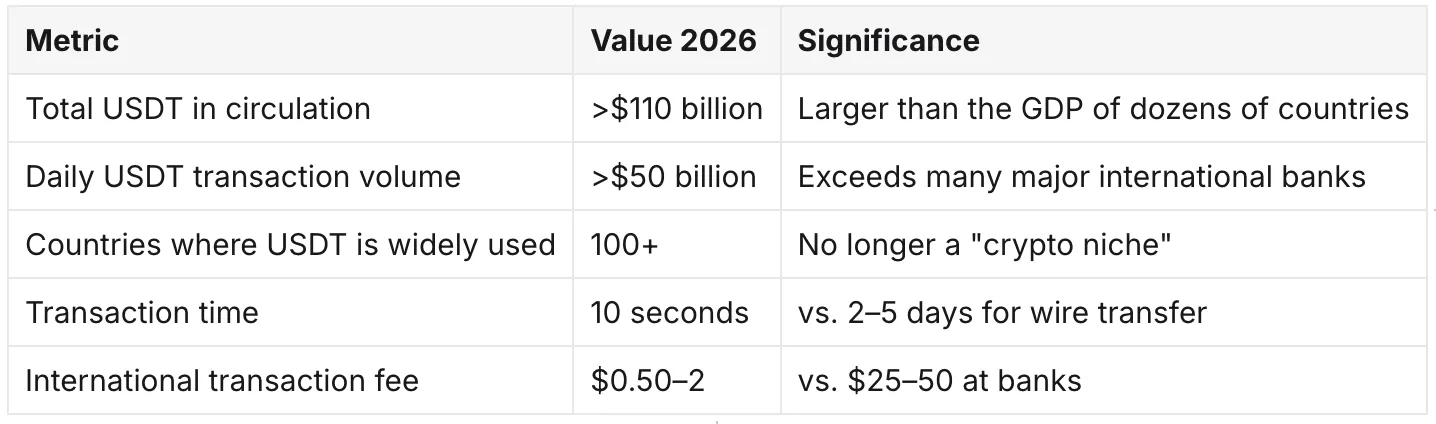
The Numbers Tell the Story
Why Traditional Banking Has Failed 1.4 Billion People
According to the World Bank, 1.4 billion adults globally have no bank account — not because they do not want one, but because the banking system does not serve them: address verification requirements, high minimum balances, maintenance fees, no rural branches, complex documentation.
USDT + smartphone = global bank account without a bank.
Part 2: How USDT Is Used Across Different Regions of the World
Southeast Asia — Bridge Between Crypto and Traditional Investing
Philippines: Overseas workers receive remittances via USDT — saving 5–8% in fees vs. Western Union. After receiving, many convert USDT into gold tokens to preserve value.
Indonesia: P2P USDT lending market growing. USDT used to trade tokenized stocks — a way to access US markets that local brokerage accounts do not offer.
Thailand: USDT merchant payments increasingly common in tourist areas. Users hold USDT as "digital USD" to avoid baht fluctuation.
Middle East & North Africa — De-Dollarization From Below
UAE/Dubai: Largest crypto hub in the region. USDT used in real estate, international trade, and cross-border RWA investing.
Turkey: With inflation oscillating between 50–80% annually, Turkish citizens hold USDT as a "shield" against lira depreciation. Estimated millions of Turkish people hold more USDT than domestic bank savings.
Egypt, Iran, Lebanon: Strict capital controls make USDT one of the only remaining channels to preserve and transfer international assets.
Latin America — Fighting Inflation With USDT
Argentina: Peso inflation exceeding 200% per year. USDT is the real "parallel dollar" — many Argentines hold assets in USDT and only convert back to peso when immediate spending is needed.
Brazil, Colombia, Mexico: USDT widely used in the freelance economy — receiving payments from international clients, avoiding currency conversion fees.
Venezuela, Bolivia: With historic hyperinflation, USDT is not a choice but financial survival.
Africa — Leapfrogging Banking Infrastructure
Nigeria: Largest P2P crypto market in Africa and among the top globally. USDT used for cross-border African business — no SWIFT needed.
Kenya, Ghana, South Africa: Mobile money (M-Pesa) proved Africans are ready for digital finance. USDT is the next step — "mobile money but global."
Eastern Europe — USDT in Geopolitical Instability
Ukraine: During war, USDT became the payment and asset preservation vehicle when the banking system was disrupted. The Ukrainian government even received aid in crypto.
Russia: After being cut off from the international financial system (SWIFT), USDT remains one of the few still-functioning channels.
Part 3: From Value Storage to Investment — The Natural Evolution
Stage 1: USDT as "Shelter"
Users in emerging markets initially used USDT solely to preserve value — avoiding local currency depreciation.
Stage 2: USDT as "Transaction Gateway"
After having USDT, users began using it for cross-border payments — freelance, commerce, remittances.
Stage 3: USDT as "Investment Tool"
This is what is happening in 2026 — users with USDT realize it should not just sit idle. They want USDT to work — investing into assets with real value.
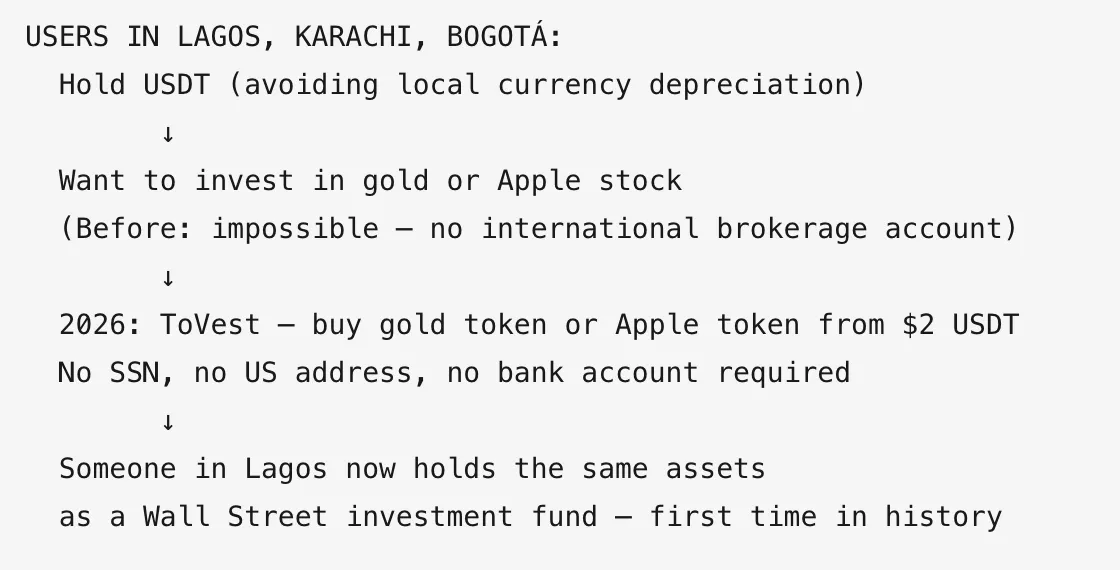
This is what BlackRock calls "democratization of finance" — and ToVest is delivering it to every user from $2.
Part 4: Why RWA Tokens Are the Right Choice for Global Investors
The Problem With Traditional Investment Markets for Global Users
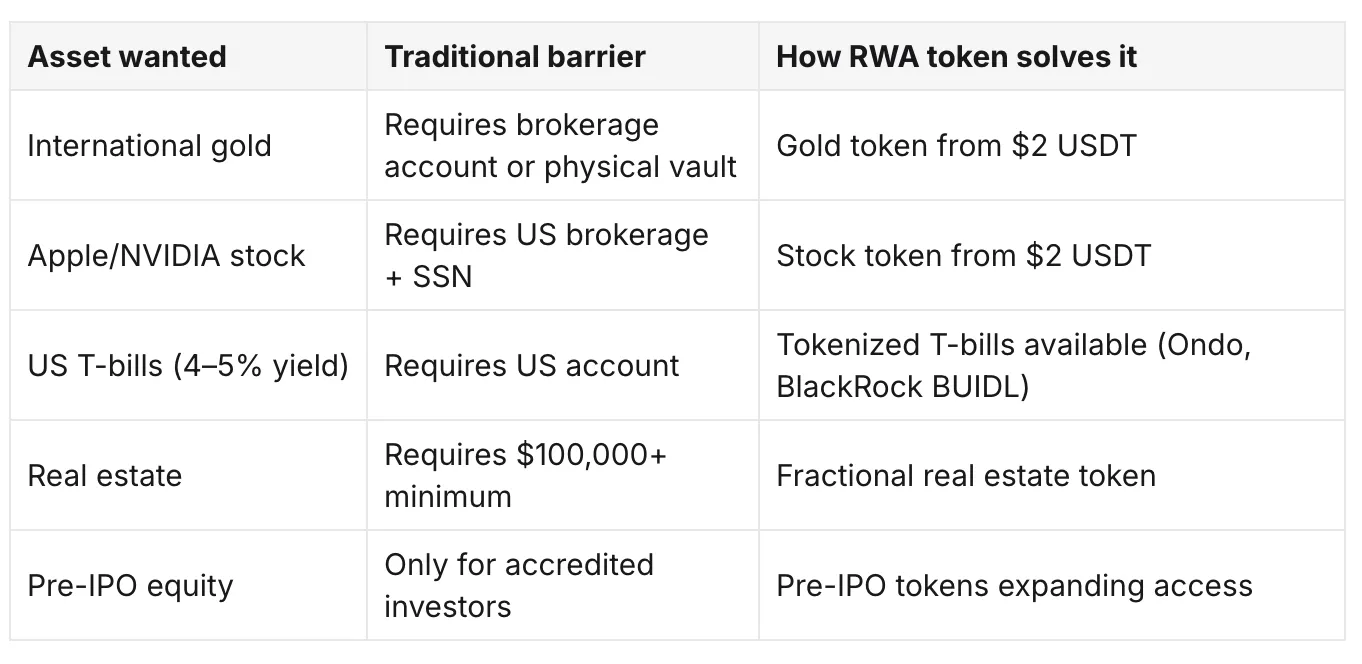
5 Reasons RWA Tokens Are Especially Suitable for Global Investors
Reason 1: No Geographic Barriers
RWA tokens do not know where you are. A user in Nairobi and a user in New York have identical access to gold tokens on ToVest — impossible with Schwab or Fidelity accounts.
Reason 2: No Need for Local Banking System
Users without bank accounts or with unreliable banking can still invest — just need a USDT wallet and a smartphone.
Reason 3: 24/7 Liquidity — No Time Zone Disadvantage
NYSE closes at 4pm EST. Users in Dubai (UTC+4) would trade at midnight. Users in Tokyo wake up early. RWA tokens trade 24/7 — no unfavorable time zones.
Reason 4: Protection Against Local Currency Inflation
For users in Argentina, Turkey, Nigeria — gold tokens or US stock tokens are not just "investments" but asset protection tools against local currency depreciation.
Reason 5: Full Fractionalization — No "Need Enough Capital"
In many parts of the world, $100 is a significant savings amount. Gold tokens from $2 USDT allow even those with very small capital to start building meaningful assets.
Part 5: Global USDT Strategies — By Regional Context
Strategy A: "Inflation Shield" — For High-Inflation Market Users
Best for: Argentina, Turkey, Nigeria, Pakistan, Lebanon, and other high-inflation markets.
Strategy:

Result: Assets protected from local inflation and can still grow with gold and US stocks.
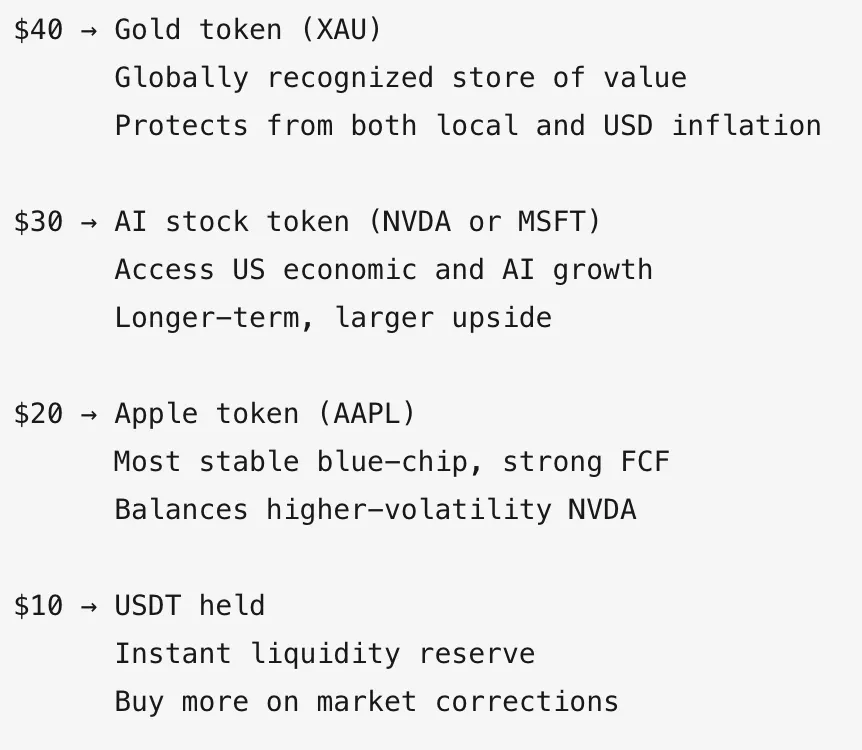
Strategy B: "Global Wealth Builder" — For Emerging Market Investors
Best for: Freelancers, digital nomads, remittance recipients, global SME entrepreneurs.
Monthly DCA allocation ($100 USDT/month):
Strategy C: "Remittance + Investment" — For Overseas Workers
Best for: Workers abroad sending money home (Philippines, Bangladesh, Mexico, India...).
New strategy with USDT:

Real savings: Worker sending $500/month home saves $25–50 in fees vs. Western Union — $300–600/year.
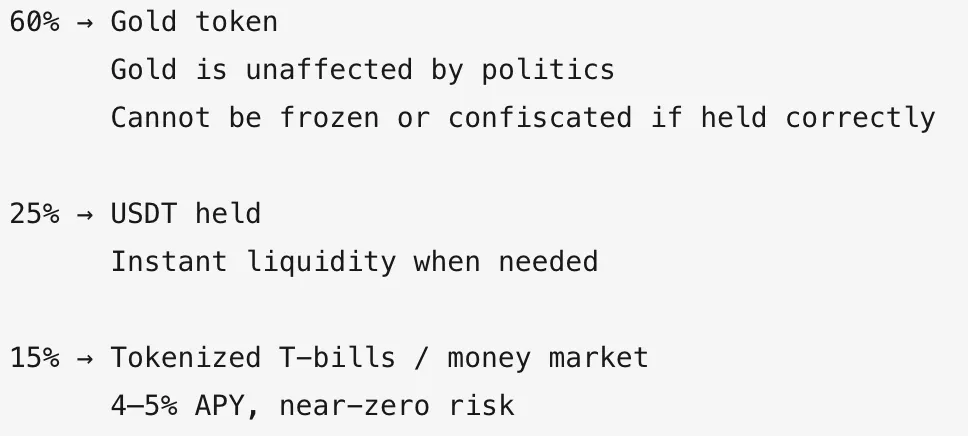
Strategy D: "Safe Haven Portfolio" — For Geopolitically Unstable Environments
Best for: Users in regions with high geopolitical risk (Ukraine, Middle East, Eastern Europe, Venezuela).
Priority: Capital preservation is paramount — upside is secondary.
Allocation:
Part 6: The Best Platform for Global USDT Investors
Why ToVest Fits Global Investors
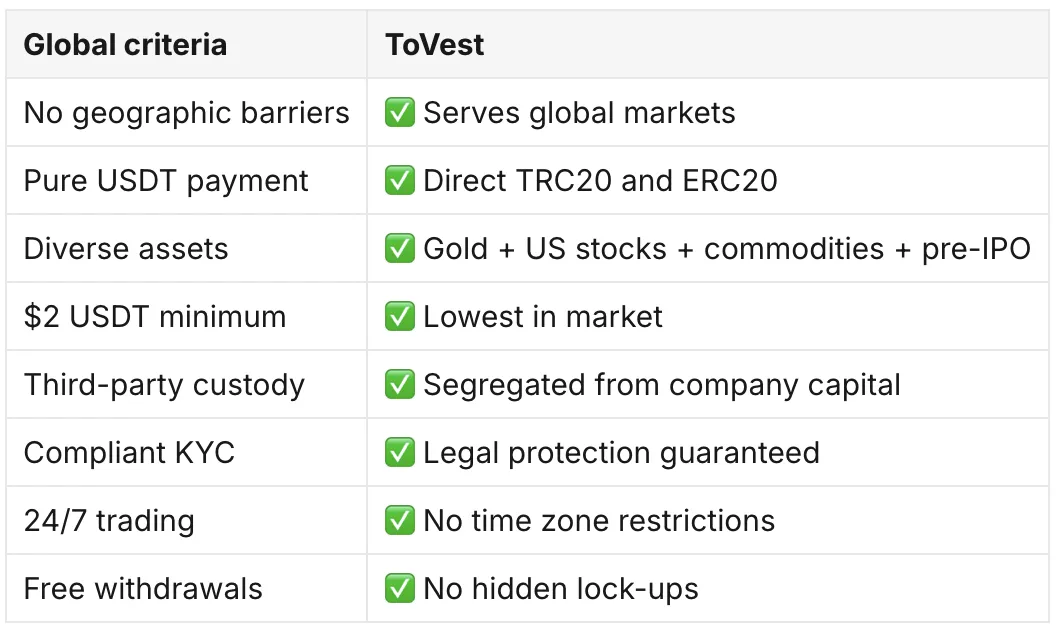
Part 7: How to Start — Guide for Investors Anywhere
Step 1: Get USDT
If you are in a market with P2P crypto:
Buy USDT with local currency via P2P exchange (Binance P2P, OKX P2P). Choose high-rated sellers, transact within exchange escrow.
If you are a freelancer/remote worker:
Ask clients to pay in USDT instead of wire transfer — instant receipt, no fees.
If you receive remittances:
Ask senders to use USDT instead of Western Union — receive in 10 seconds with $1–2 fee.
Blockchain network note:
- TRC20 (Tron): Fee ~$1, fast confirmation — most popular globally for small transactions
- ERC20 (Ethereum): Fee $2–20 depending on network congestion — use for larger transactions
Step 2: Security First
Use a non-custodial wallet for larger amounts:
MetaMask, Trust Wallet — you control the private key. Nobody can access your USDT except someone with your private key.
Non-negotiable security rules:
- Never share your seed phrase (12/24 words) with anyone
- Never enter your seed phrase on any website
- Use a hardware wallet (Ledger/Trezor) for amounts >$1,000
- Enable 2FA on all accounts
Step 3: Choose Platform and Start
On ToVest:
- Register at tovest.com
- Complete KYC (mandatory on legitimate platforms)
- Deposit minimum $2 USDT (TRC20 or ERC20)
- Select assets per your strategy
- DCA consistently — do not try to time the market
Step 4: Monitor Monthly, Not Daily
Check portfolio monthly — not hourly. Long-term investing does not need daily monitoring. Rebalance every 3 months back to your target allocation.
Frequently Asked Questions (FAQ)
How do I start investing with USDT for beginners with low risk from anywhere in the world?
Four global steps: (1) Get USDT via local P2P, freelance clients, or family remittances; (2) Choose a platform meeting 5 criteria: no geographic barriers, pure USDT payment, diverse assets, low minimum, independent custody; (3) Start with $2–$10 in gold tokens — the most stable real asset with 5,000 years of history; (4) DCA consistently weekly/monthly — no market timing needed.
What is the best and safest platform to invest USDT globally?
Evaluate using 5 global criteria: no geographic access barriers, accepts USDT directly without international banking, diverse RWA assets in one place, low minimum (from $2), independent third-party asset custody with regular audits. ToVest meets all 5 and is specifically designed for investors in emerging markets — no international bank account, no US address, no SSN required.
What USDT strategy generates stable income globally?
Depends on your context: (1) High-inflation environment → 60% gold token + 20% compliant USDT staking + 20% stable stock token; (2) Growth investor → 40% gold + 35% AI stocks + 15% BTC + 10% USDT; (3) Remittance + investment → 70% RWA investment + 30% USDT send home via blockchain. Realistic income: gold token with gold +10%/year = ~$10 return per $100 USDT invested.
How do I choose an official, safe USDT investment app globally?
Five non-negotiable criteria: (1) Mandatory KYC — proves legal framework operation; (2) Independent third-party asset custody with public audit reports; (3) Free withdrawals to personal wallet any time without hidden conditions; (4) Smart contracts audited by independent security firm; (5) Publicly verifiable team identity. Universal warning sign: no legitimate platform anywhere in the world promises "guaranteed" returns.
Where can I stake USDT at good yield but stay safe?
Three safest global options: (1) Gold tokens on ToVest — not fixed yield but gold rose 25% in 2024, exceeding any "safe staking" product; (2) Tokenized T-bills (Ondo, BlackRock BUIDL) — 4–5% APY, near-zero risk but usually higher minimum; (3) Compliant CeFi USDT staking with KYC and audits — 5–8% APY. Avoid any platform promising 15%+ APY "guaranteed" — this does not exist sustainably anywhere in the world.
Is USDT safe to hold long-term?
USDT has maintained its 1:1 USD peg consistently since 2014. The real risk is not USDT losing its peg — it is the platform you deposit USDT into collapsing (like FTX). Solution: hold USDT in your own non-custodial wallet (MetaMask, Trust Wallet) or only deposit on platforms with independent custody. For larger amounts, a hardware wallet (Ledger) is the safest option.
Why should people in high-inflation countries use USDT + RWA rather than just holding USDT?
Holding only USDT protects against local currency inflation — but does not protect against USD inflation (typically 3–8%/year) and provides no growth. USDT + gold token: protected from both local and USD inflation, plus growth tracking gold prices. USDT + AI stock tokens: access to US economic growth from anywhere. This is why smart users in Argentina, Turkey, and Nigeria do not just hold USDT — they invest USDT into real assets.
Conclusion: USDT Is the Most Equal Currency in History
For the first time in financial history, someone in Lagos has the same access to global assets as someone in London.
For the first time, a freelancer in Karachi can invest in NVIDIA stock without a US visa, without an SSN, without a US bank account.
For the first time, a worker in Manila can send money home in 10 seconds for $1 — and simultaneously build a global asset portfolio.
This is not "crypto hype." This is a structural change in how global finance operates — and USDT + RWA tokens are the infrastructure of that change.
Those who understand and leverage this from 2026 onward will look back and see they stood on the right side of financial history.
Start from $2 USDT. From anywhere in the world.
Join the global RWA investment platform at tovest.com — international gold, US stocks, commodities from $2 USDT. No international bank required. 24/7 trading. Every country.