Invest in Real‑World Assets Today – Top RWA Platforms for 2026
January 5, 2026
Real‑world assets (RWAs) are tangible or financial assets—such as real estate, bonds, commodities, and even U.S. equities—converted into digital tokens recorded on a blockchain. Tokenization makes ownership and transfer simpler, cheaper, and more liquid, opening markets that were once hard to access. In 2026, the RWA market is accelerating as regulations clarify, compliance tooling matures, and institutions deepen participation—broadening retail access worldwide, according to industry outlooks for the year ahead (see Blockchain App Factory’s 2026 perspective). These shifts make it an opportune time to assess the best platforms for secure, diversified RWA investing and to understand how blockchain infrastructure is transforming market efficiency and access.

ToVest: Leading Blockchain-Powered RWA Investment Platform
ToVest is built to remove historical barriers to premium U.S. assets by offering compliant access to tokenized U.S. stocks and real estate through a streamlined blockchain investment platform. Investors can buy fractional stakes, employ advanced trading tools like margin and leverage, and manage portfolios with transparent, real‑time reporting. We combine round‑the‑clock trading and institutional‑grade security with user‑friendly onboarding for individuals and institutions alike—delivering fractional investing and deep liquidity without compromising regulatory rigor. Explore how we approach regulated, global access to tokenized markets on the ToVest Academy.
Securitize
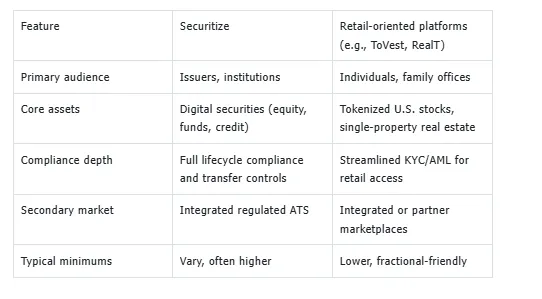
Securitize stands out as a compliance‑first market leader in tokenized securities with end‑to‑end issuance, investor onboarding, and secondary trading. Independent research highlights its adoption: more than $1B tokenized, a 1.2M‑strong investor base, and 3,000+ clients—a scale that sets the benchmark for 2026 (Suffescom’s review of top tokenization companies). Its strengths include regulated workflows (KYC/AML and transfer restrictions), a vertically integrated secondary venue, and robust infrastructure tailored for institutions.
Comparison snapshot:
Ondo Finance
Ondo Finance packages traditional fixed‑income into on‑chain products, making it easier for professional and institutional investors to hold diversified credit and bond exposure with blockchain‑native settlement. A tokenized bond is a digital representation of a fixed‑income instrument whose ownership, transfer, and coupon distributions occur on‑chain, enabling faster settlement and programmable compliance. Use cases span asset managers seeking operational efficiency, corporate treasuries aiming to optimize yield with liquidity, and DeFi participants who want safer base yields (CoinEdition’s 2026 tokenization roundup).
Centrifuge
Centrifuge channels DeFi liquidity into real‑world cash flows by tokenizing invoices, receivables, and SME loans—an approach that expands financing for businesses while giving investors diversified yield exposure to tangible, short‑duration assets. This is SME asset tokenization at work: turning real business obligations into investable on‑chain pools with transparent performance metrics (RWA.io’s platform overview).
How users engage:
- Sign up and complete KYC/AML.
- Review pools backed by real‑world assets (e.g., invoices, receivables).
- Select allocations aligned to risk/tenor preferences.
- Monitor performance and claim yield on‑chain.
RealT
RealT is a retail‑friendly entry point to U.S. real estate, offering property‑specific tokens that pay rental income on‑chain—simple onboarding and low minimums make it accessible to everyday investors (Bitcoin Chaser’s RWA platform guide). Fractional ownership means splitting a single property into many tradable shares, so investors can buy small portions and receive proportional rental distributions.
Maple Finance
Maple Finance operates an on‑chain private credit marketplace, connecting vetted borrowers with lenders via transparent pools backed by real‑world collateral. Lenders can choose among risk profiles, review programmatic terms, and monitor ongoing performance. Maple’s core benefits for institutions include auditable loan data, diversified pool offerings, and compliance layers aligned with enterprise requirements (Security Tokenizer’s 2026 platform analysis).
Polymath / Polymesh
Polymath pioneered security token tooling on Ethereum (notably ERC‑1400) and now powers Polymesh, a layer‑1 blockchain purpose‑built for regulated digital assets and capital markets operations. A security token is a blockchain‑based representation of a regulated financial instrument (equity, debt, fund interests), and KYC/AML automation applies identity and jurisdictional checks programmatically to enable compliant transfers. Their strengths: jurisdiction‑aware compliance, enforced transfer restrictions, and workflow automation that can streamline legal processes for issuers (Tokeny’s ecosystem mapping of RWA/tokenization infrastructure).
Tokeny
Tokeny provides compliance‑centric SaaS for institutions and enterprises to issue, manage, and transfer regulated tokens with automated checks, granular permissions, and clear audit trails. Their transfer modules emphasize real‑time visibility and control—capabilities increasingly sought in 2026 as investors demand transparent books and compliant distribution logic (Webisoft’s RWA tokenization guide). For enterprises prioritizing governance and reporting fidelity, Tokeny’s framework is a strong fit versus purely retail offerings.
YieldBricks / Realio
YieldBricks and Realio are next‑gen platforms marrying property tokenization with programmable yields and enhanced secondary liquidity. YieldBricks focuses on global real estate, often layering DeFi‑style yield mechanics on top of asset income, while Realio prioritizes compliant secondary market access for real estate and income fund tokens. Unique features can include automated rebalancing across portfolios and programmable distributions that align payouts with cash‑flow timing (OpenRWA’s ecosystem listings).
Safeheron / Antier Solutions
Safeheron and Antier Solutions sit in the infrastructure layer, helping issuers and platforms deploy multi‑asset tokenization infrastructure with enterprise‑grade custody, security, and flexible issuance models. Multi‑asset tokenization infrastructure refers to the end‑to‑end stack—issuance, identity, custody, transfer, and reporting—abstracted to support many asset types under unified policy controls. Expect capabilities like real‑time auditability of reserves and customizable security frameworks demanded by institutions (Changelly’s explainer on the RWA stack and custody considerations).
Swarm Markets / TrueFi
Swarm Markets and TrueFi represent regulated DeFi venues for on‑chain trading and lending of tokenized securities and credit. Swarm focuses on compliant tokenization and secondary trading of regulated assets; TrueFi offers infrastructure for tokenized credit with permissioned liquidity pools and transparent borrower performance. As RWAs mature, regulated venues that fuse DeFi mechanics with compliance will be essential to scaling institutional participation (Lightspark’s overview of why RWAs matter).
How to Choose the Best RWA Platform for Your Investment Goals
Key decision checklist:
- Regulatory posture: licensing, KYC/AML, and transfer restrictions.
- Custody and security: MPC, audits, proofs of reserves, and insurance.
- Secondary market access: liquidity venues, settlement times, and spreads.
- Fees: issuance, trading, custody, and redemption costs.
- Interoperability: bridges and standards to reduce vendor lock‑in.
- Asset expertise: track record with the asset class you want (equities, real estate, credit).
- Data transparency: real‑time reporting, attestations, and on‑chain auditability.
Cross‑chain interoperability means tokens can move or be recognized across different blockchains with consistent identity and compliance states—now a practical priority as institutions evaluate portability and vendor risk (Huma’s analysis of the RWA stack’s evolution).
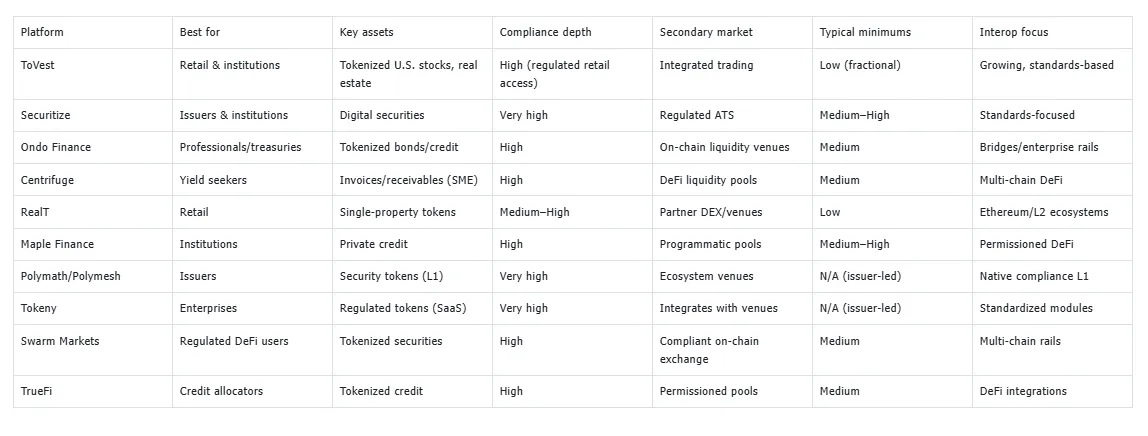
Quick comparison by investor fit:
Benefits of Investing in Real-World Assets Through Tokenization
- Accessibility: Fractional investing lowers minimums and broadens participation in high‑value assets.
- Liquidity: Secondary trading enables faster exits and more frequent price discovery.
- Transparency: On‑chain records support real‑time auditability and standardized reporting.
- Yield from tangible activity: Investors can access income streams tied to real economic output (Blockchain App Factory’s 2026 outlook).
“Tokenization enables programmable dividends and automated rebalancing via smart contracts,” a defining advantage as issuers bring traditional income strategies on‑chain (LinkedIn’s 2026 RWA trends brief). To get started with a streamlined experience across tokenized U.S. stocks and real estate, consider ToVest Academy’s practical overview.
Key Considerations and Risks When Investing in RWAs
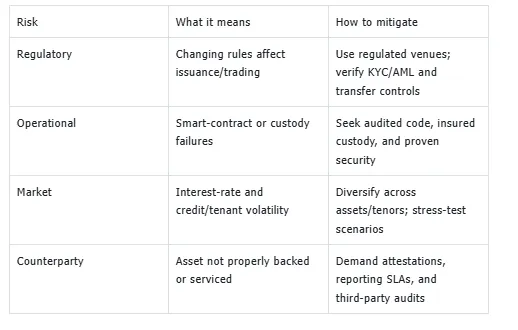
Understand these risks before allocating:
- Legal and regulatory: Rules vary by jurisdiction and are evolving; strong legal frameworks are becoming competitive advantages rather than barriers (Investax’s primer on RWA tokenization).
- Operational/platform: Smart‑contract bugs, custody lapses, or governance failures can impair access or value.
- Market/valuation: Interest‑rate moves, tenant risk, or credit events can affect prices and yields.
- Counterparty: Ensure assets are properly originated, serviced, and verifiably backed.
Risk quick guide:
Frequently Asked Questions About Real-World Asset Investments
What are real-world assets and why invest in them?
Real‑world assets are traditional assets represented as tokens on a blockchain, offering greater access, transparency, and potential yield linked to physical or financial cash flows.
How does tokenization enable fractional ownership?
Tokenization divides an asset into many small, tradable units, allowing investors to purchase fractions instead of the whole asset.
What types of real-world assets can be tokenized?
U.S. stocks, real estate, bonds, commodities, intellectual property, revenue streams, and private credit can all be tokenized.
What are the main risks involved in RWA investing?
Key risks include regulatory changes, platform or custody failures, market volatility, and ensuring assets are genuinely and verifiably backed.
How can investors start investing in tokenized real-world assets?
Open an account with a regulated RWA platform like ToVest, complete KYC, and allocate to tokenized assets that match your goals and risk tolerance.