Problem‑Solved: Buying US Equities with Crypto Without High Fees
December 29, 2025
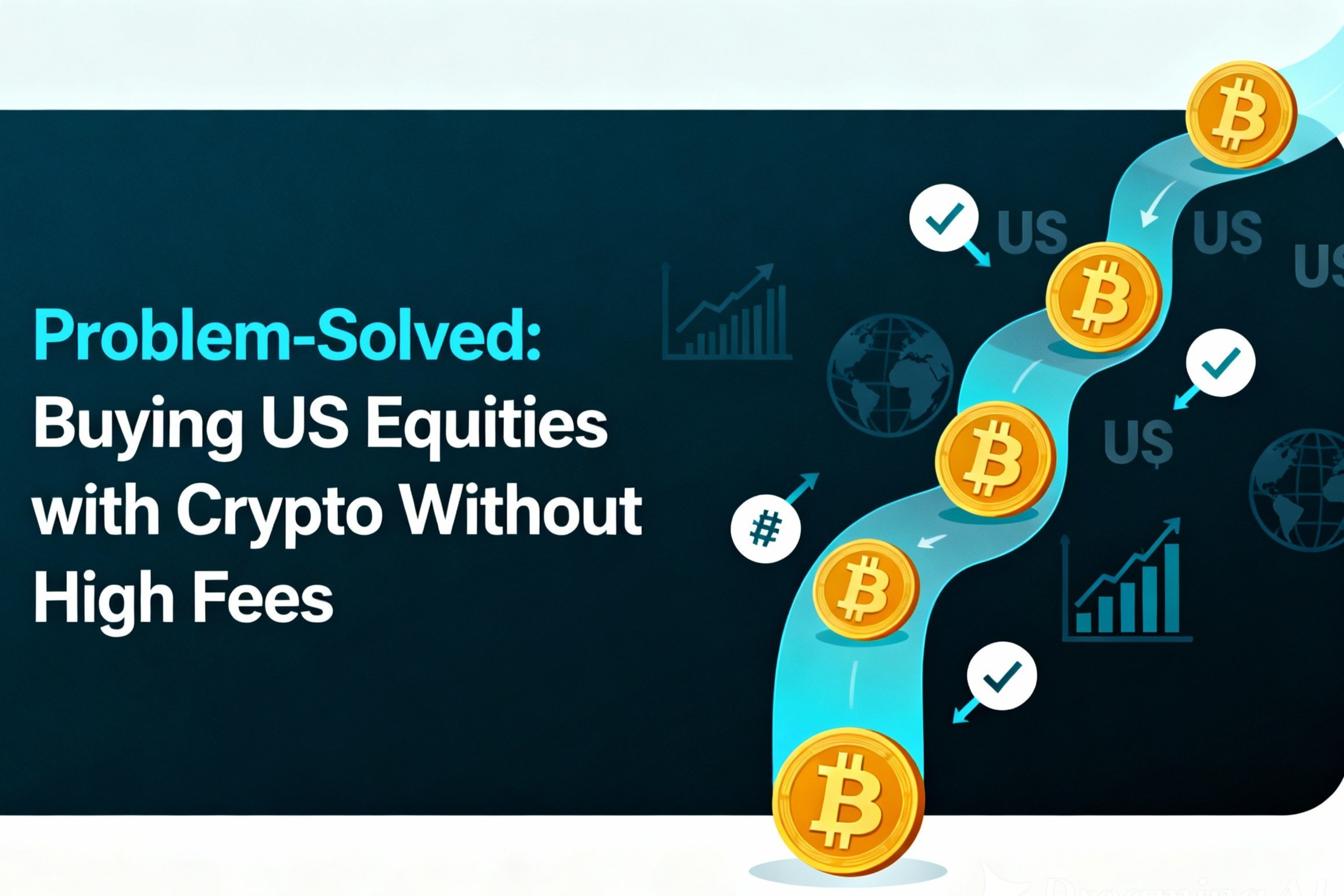
Buying U.S. stocks with cryptocurrency is absolutely doable—and you don’t have to overpay to do it. The fastest, lowest-cost route typically involves converting crypto to USD on a low-fee exchange, moving dollars via ACH to a broker, and placing limit orders for the stocks you want. If your platform supports tokenized U.S. equities, you can often skip the middle steps and buy directly with crypto while retaining fractional, on-chain ownership. This guide shows you how to choose smart rails, minimize fees at each step, and avoid unnecessary slippage or network costs. Whether you’re investing $500 a month or allocating $250,000 in one go, the steps below help you optimize the path—and your total cost—to buy US stocks with cryptocurrency.
Understanding the Basics of Buying US Stocks with Cryptocurrency
Blockchain-powered platforms now let you route from crypto to U.S. equities with fewer intermediaries, lower minimums, and transparent settlement. ToVest’s approach centers on fractional, secure, tokenized ownership and data-rich risk controls that make crypto-to-stock investing accessible without sacrificing rigor.
Tokenized stocks are digital representations of real-world equity shares that are recorded on a blockchain, enabling fractional ownership, instant settlement, and borderless trading. In practice, investors use three main pathways:
- Convert crypto to fiat and send USD to a traditional broker.
- Use platforms with native crypto-to-stock rails or tokenized equities for direct purchase.
- Leverage OTC or institutional providers for large trades where price impact matters.
Across most exchanges, retail taker fees typically range from 0.22% to 0.40% depending on volume, while maker fees fall with higher activity, especially at top tiers, per independent low-fee exchange analysis low-fee exchange data.
Step 1: Define Your Investment Size and Frequency
Your order size and cadence determine the most cost-effective route. Smaller, recurring buys usually benefit from low-fee retail exchanges and ACH transfers; larger, one-off allocations often warrant OTC execution to avoid market impact. As a heuristic, consider moving to OTC at $50,000+ where customized pricing and settlement can outweigh retail venue costs.
Example fee math:
- $1,000 order at a 0.40% taker fee costs $4.
- $50,000 order at a 0.24% taker fee costs $120—lower rate, but higher absolute dollars.
Quick routing guide:
- Small purchase (~$1,000): Retail exchange → ACH to broker → Stock limit order.
- Medium allocation ($5,000–$25,000): Maker/limit orders to cut fees → ACH → Broker.
- Large order ($50,000+): OTC desk for pricing and slippage control → Settle → Fund brokerage.
Step 2: Choose the Right Platform for Crypto-to-Stock Conversion
Compare total transaction costs, not just headline trading fees: trading fee + spread + deposit/withdrawal charges + network fees. Use research tools like CoinGecko and TradingView, and consult exchange fee schedules to benchmark liquidity and costs crypto tools roundup.
ACH (Automated Clearing House) is a U.S. banking network for electronic funds transfers with zero or minimal deposit fees, ideal for funding brokerage accounts efficiently. Favor platforms with:
- Low or $0 ACH deposit fees (e.g., Binance.US promotes $0 bank ACH deposits) Binance.US.
- Native crypto rails for easy funding (e.g., Robinhood supports crypto with no deposit fees; network fees still apply) Robinhood Crypto.
- Direct crypto-to-stock capabilities or tokenized equities for fractional access and streamlined settlement (ToVest’s tokenized rails are designed for this model) ToVest Academy overview.
- Transparent spreads and robust liquidity; verify via independent reviews independent exchange comparisons.
Step 3: Transfer Crypto Efficiently to Your Chosen Exchange
Keep network and withdrawal fees low by planning your transfers:
- Check on-chain network fees; batching or making fewer, larger transfers reduces fixed costs.
- Double-check destination network and wallet address before sending.
- Avoid multiple small transfers during congestion windows; schedule when networks are less busy.
Network fees, sometimes called miner or gas fees, are payments required to process transactions on a blockchain; they fluctuate based on demand.
Step 4: Convert Cryptocurrency to US Dollars Cost-Effectively
To reduce costs at conversion:
- Place limit (maker) orders to add liquidity and often pay lower fees; market (taker) orders remove liquidity and usually cost more.
- Maker fee tier at $0+ is commonly around 0.25% and taker around 0.40%, with high-volume tiers dropping as low as 0.12%–0.22% in aggregate on leading venues exchange fee benchmarks.
- Use limit prices to control slippage and execution quality.
Cost impact by order type (illustrative):
- $1,000 notional: maker 0.25% = $2.50; taker 0.40% = $4.00
- $100,000 notional: maker 0.12% (high-volume) = $120; taker 0.22% (high-volume) = $220
Step 5: Fund Your Brokerage Account and Place Stock Orders
Once converted, move USD to your brokerage via ACH to minimize fees; many platforms offer $0 ACH deposits, reducing friction between crypto and equities accounts Binance.US. If your broker supports native crypto rails or tokenized U.S. equities, settlement can be even more streamlined.
Tokenized equities are blockchain-based digital representations of real U.S. stocks, enabling fractional and instantaneous ownership. On platforms like ToVest, this can mean direct purchase of tokenized stock assets with crypto alongside transparent on-chain records ToVest Academy overview. When buying stocks, prefer limit orders to reduce spread costs and control execution.
Step 6: Use OTC Desks for Large Orders to Minimize Market Impact
Over-the-counter (OTC) trading occurs directly between parties rather than via public order books, enabling private price negotiation and lower slippage for size. Institutional liquidity firms such as ToVest, Cumberland, Galaxy, and GSR provide deep liquidity, customized settlement, and APIs—well-suited for $50,000+ tickets where execution quality outweighs retail venue simplicity institutional liquidity landscape.
Typical OTC flow:
- Engage OTC desk and share size/timing
- Receive streaming quotes and negotiate price
- Settle via agreed rails (crypto or fiat)
- Transfer USD to brokerage and place stock orders
Step 7: Reconcile Your Portfolio and Maintain Compliance
Treat crypto-to-stock moves like any other investment workflow: keep records, reconcile positions, and file taxes accurately. Tools such as CoinTracker, CryptoTrader.Tax, and portfolio dashboards can streamline accounting, reporting, and cost-basis tracking crypto tools roundup. For businesses, monitor policies on digital asset accounting and fair-value measurement; large firms increasingly apply rigorous controls and disclosures to crypto holdings Deloitte guidance.
Mark-to-market tax treatment values assets at fair market price at year-end, recognizing unrealized gains or losses for certain digital asset traders—consult a tax professional to determine applicability.
Practical Tips to Reduce Costs When Buying US Stocks with Crypto
- Prefer ACH over wires for funding; target platforms and brokers with zero or low deposit fees.
- Use maker (limit) orders to save on taker fees; avoid market orders unless speed is worth the premium.
- Batch transfers to minimize per-withdrawal network costs and avoid congestion windows.
- Choose venues with narrow crypto-to-USD spreads and strong, insured custody for value and safety low-fee platform findings.
- Switching to lower-fee venues can save roughly $750–$2,750 per $100k transacted annually, depending on your cadence and fee tier low-fee platform findings.
- Use CoinGecko and TradingView to spot liquidity pockets and time entries; consolidate transfers to cut fixed costs.
The Future of Crypto-to-Stock Investing and Emerging Opportunities
Real-World Assets (RWAs) are traditional financial assets (like stocks) issued as blockchain tokens to enable fractional, borderless, and programmable ownership RWA outlook. Expect continued growth in tokenized equities, tighter broker–exchange integrations, and clearer custody frameworks. As new rails roll out, model total cost of ownership—fees, spreads, funding, and taxes—before switching platforms. For early movers, tokenized rails can compress settlement times and unlock fractional access without the legacy overhead.
Frequently Asked Questions
Can I buy US stocks directly with cryptocurrency?
Some platforms enable direct purchase of tokenized U.S. stocks using cryptocurrencies, but most traditional brokers require converting crypto to USD first.
How can I avoid high fees when converting crypto to dollars for stock buying?
Use exchanges with low maker/taker fees, favor ACH transfers, and consolidate transactions to reduce network and withdrawal fees.
Are stablecoins a better option to reduce volatility when purchasing US equities?
Stablecoins can reduce volatility during transfers and holding periods before you convert to USD and buy stocks.
What are the main costs involved in buying US equities using crypto?
Expect network fees for transfers, exchange trading/conversion fees, withdrawal fees, and potential brokerage fees or spreads when you buy stocks.
How do regulatory and tax considerations affect crypto-funded stock investments?
Selling crypto to fund stock purchases may trigger taxable events, and regulated platforms require identity verification to comply with U.S. laws.