US CPI Drops to 3.5%: What the Inflation Surprise Means for Gold, Stocks, and Crypto Investors
July 15, 2026
The Numbers That Are Moving Markets Right Now
The latest US Consumer Price Index (CPI) report has delivered a decisive surprise to the downside — and for investors across every asset class, the implications are immediate and significant.
CPI Snapshot — This Release
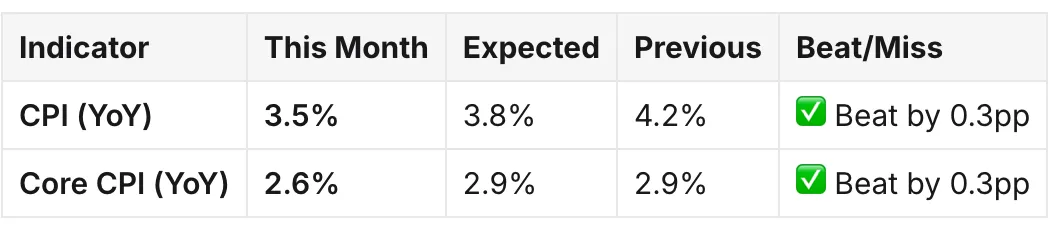
This is not a marginal beat. CPI came in 0.3 percentage points below expectations and 0.7 percentage points below the prior month. Core CPI — which strips out food and energy and is the Fed's preferred gauge — dropped from 2.9% to 2.6%, also 0.3 points below forecast.
Both numbers moving in the same direction, both beating simultaneously — this is a strong, clean inflation print.
Why This CPI Report Is Unusually Important
Most monthly CPI releases produce noise. This one is different for three reasons:
1. The Magnitude of the Drop Is Larger Than Expected
Going from 4.2% to 3.5% in a single month is a significant move. The market consensus of 3.8% already assumed meaningful progress — the actual print showed even faster disinflation than the most optimistic forecasters projected.
2. Core CPI Is Now Below 3% for the First Time in Years
Core CPI at 2.6% puts it within striking distance of the Fed's 2% target. When Core CPI drops below 3%, the conversation shifts — not "if" the Fed cuts rates, but "when" and "by how much."
3. The Fed's Path Has Changed
The Federal Reserve has been in a holding pattern, reluctant to cut rates while inflation remained stubbornly above 3%. A print of 3.5% headline and 2.6% core materially changes that calculus. Markets will now reprice rate cut expectations forward — and that repricing moves every major asset class.
The Transmission Chain: From CPI to Your Portfolio
Understanding how a CPI beat flows through to asset prices is the difference between reacting to headlines and positioning ahead of them.
Impact on Each Asset Class — What Happens Next
Gold: The Clearest Beneficiary
Gold and real interest rates move in opposite directions — this is one of the most reliable relationships in financial markets. When real rates fall (because inflation falls faster than nominal rates adjust), gold benefits.
Why this CPI print is gold-bullish:
- Core CPI at 2.6% raises the probability of Fed rate cuts
- Rate cuts → lower real yields → gold becomes relatively more attractive
- USD weakens on rate cut expectations → gold (priced in USD) rises
- Geopolitical risk premium remains intact — gold was already elevated
Historical precedent: Every Fed rate-cut cycle in recent history has been accompanied by a gold bull run. The 2019 rate cut cycle sent gold from $1,270 to $1,550. The 2020 cut cycle sent it from $1,600 to $2,075. The current setup — with gold already above $2,800 — could see a test of $3,500+ as rate cuts materialize.
For ToVest investors: Tokenized gold captures this upside in real time, 24/7, with USDT settlement. No storage cost, no broker delay — the moment gold moves, your position moves with it.
US Stocks: Lower Rates = Higher Valuations
Stocks and interest rates have a mathematical relationship: every dollar of future corporate earnings is worth more today when discounted at a lower rate. A rate cut environment mechanically re-rates equities higher.
Sectors that benefit most from lower inflation/rate cuts:
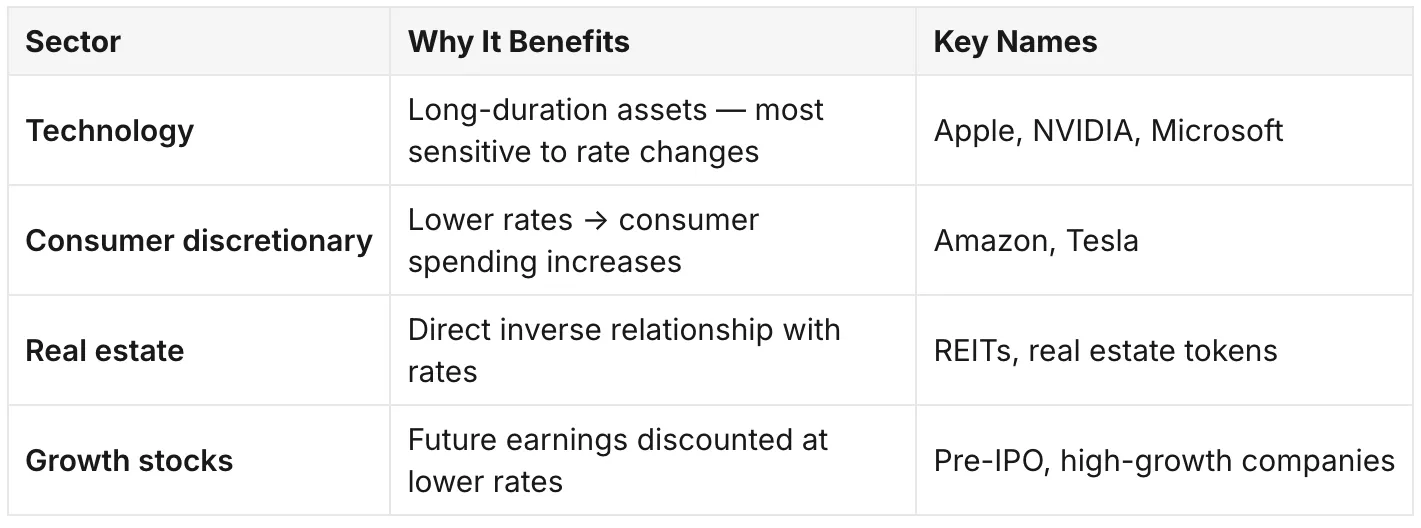
NVIDIA context: NVIDIA has been the defining stock of the AI era. Lower rates extend its valuation runway — the same AI earnings, discounted at a lower rate, justify a higher stock price. This CPI print is structurally positive for AI-heavy tech portfolios.
For ToVest investors: Tokenized US stocks (AAPL, NVDA, TSLA) on the platform directly benefit from this macro shift. A 0.25% rate cut reprices the entire stock market — you're positioned before the cut happens.
Crypto: Risk-On + Dollar Weakness = Bullish Setup
Crypto markets are highly sensitive to two factors that this CPI print moves simultaneously:
1. Risk sentiment: A CPI beat reduces recession risk, improves growth outlook, and encourages investors to take on more risk. Crypto is the highest-beta risk asset available.
2. Dollar weakness: Lower rate expectations weaken the USD. Bitcoin and crypto assets are priced against USD — dollar weakness translates directly to crypto appreciation.
Bitcoin specific: BTC has historically outperformed in the 3–6 months following the first Fed rate cut of a cycle. If this CPI print accelerates rate cut timing, Bitcoin's bull case strengthens.
RWA tokens specific: Tokenized assets like gold tokens and stock tokens benefit doubly — from the underlying asset appreciation AND from the favorable macro environment.
USDT Strategy: Hold or Rotate?
For investors holding USDT, this CPI print changes the calculus:
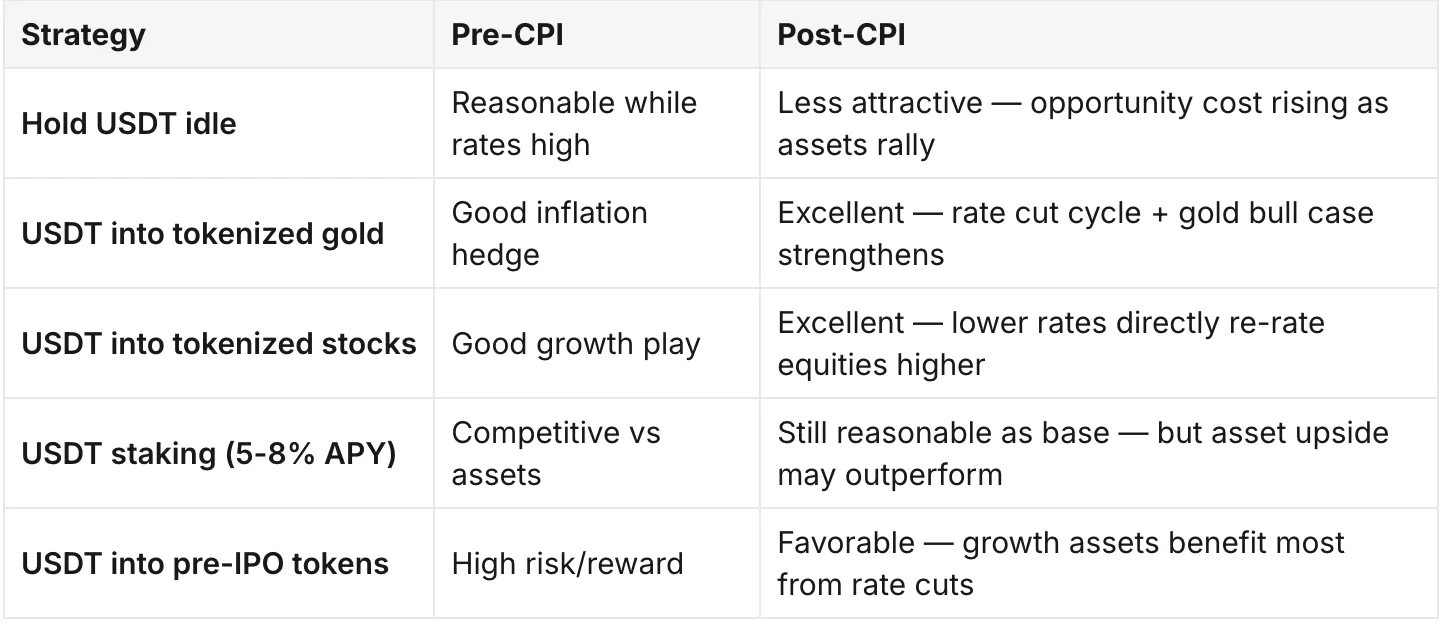
Bottom line for USDT holders: This CPI print is a signal to reduce idle USDT and increase allocation to real assets. The macro wind has shifted — holding stablecoins when gold, stocks, and crypto are positioned to rally is an opportunity cost.
What the Fed Does Next — 3 Scenarios
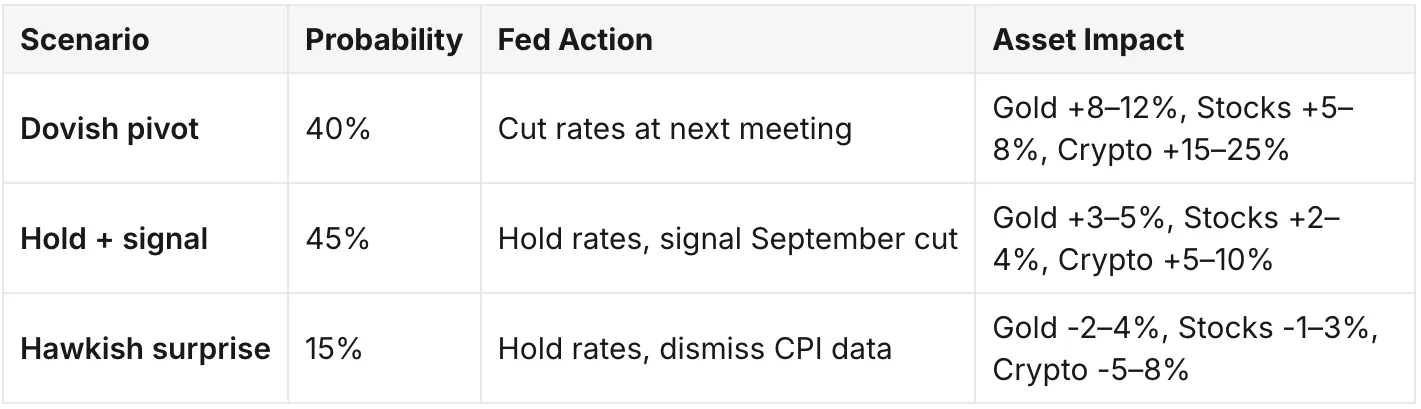
The base case (45%) is a hold at the next meeting with a clear signal for a September cut. The dovish pivot (40%) becomes more likely if the next employment report also shows softening. Either scenario is net positive for real assets.
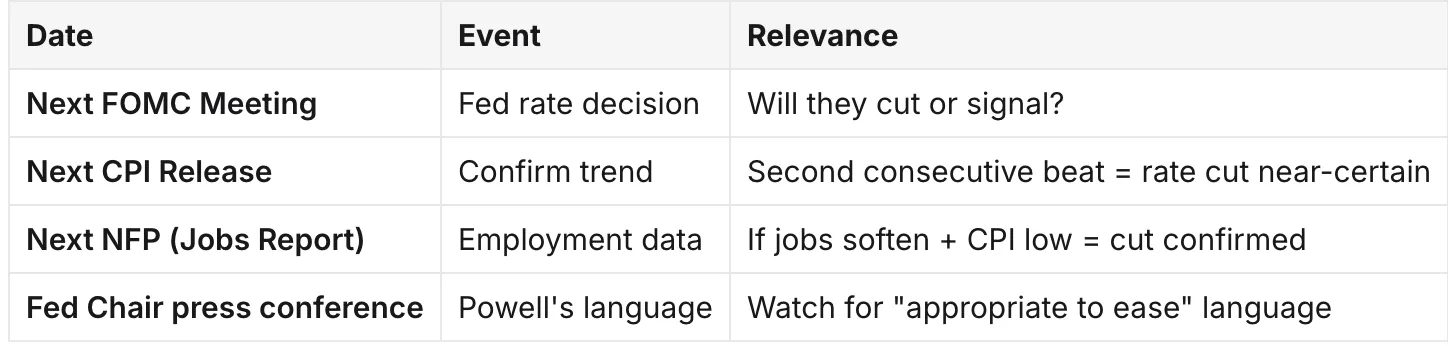
Key Dates to Watch
Frequently Asked Questions (FAQ)
Q: What does CPI 3.5% mean for investors?
A: A CPI of 3.5% — below the 3.8% expectation and down from 4.2% last month — signals that inflation is falling faster than anticipated. This increases the probability of Federal Reserve interest rate cuts, which is generally positive for gold, stocks, and crypto, and negative for the US dollar.
Q: Why did gold react positively to the CPI data?
A: Gold has an inverse relationship with real interest rates. When inflation falls faster than nominal rates adjust, real rates decline. Lower real rates reduce the "opportunity cost" of holding gold (which pays no yield), making gold more attractive relative to bonds and cash.
Q: Will the Fed cut rates after this CPI data?
A: This CPI print significantly increases the probability of a Fed rate cut, particularly for the September meeting. Core CPI at 2.6% puts inflation close to the Fed's 2% target. The next employment report and CPI release will be the deciding data points.
Q: How does low CPI affect tokenized stocks on ToVest?
A: Lower inflation expectations lead to lower interest rates, which mechanically increases the present value of future corporate earnings. This benefits growth stocks (tech, AI) the most — NVIDIA, Apple, and Microsoft tokenized on ToVest all benefit from this repricing.
Q: Is this a good time to convert USDT to gold tokens?
A: The macro setup — falling inflation, rising rate cut probability, dollar weakness expectations — is structurally favorable for gold. Tokenized gold on ToVest gives USDT holders direct exposure to gold price appreciation without storage costs or conversion friction.
Q: What is Core CPI and why does it matter more than regular CPI?
A: Core CPI excludes food and energy prices, which are highly volatile. Because food and energy prices can spike or fall due to temporary supply shocks (weather, oil wars), the Federal Reserve focuses on Core CPI as a cleaner signal of underlying inflation trends. Core CPI at 2.6% — the lowest in years — is a more significant signal than headline CPI alone.
Q: What happens to crypto when the Fed cuts rates?
A: Rate cuts typically weaken the USD and increase risk appetite, both of which are positive for crypto. Bitcoin has historically outperformed in the 3–6 months following the first Fed rate cut of a cycle, with gains of 30–100%+ in past cycles.
The Investor Takeaway
This CPI report is not just a data point — it is a macro regime shift signal. Inflation falling faster than expected while Core CPI breaks below 3% changes the Fed's calculus, changes market pricing, and changes the risk/reward of every major asset class.
For investors on ToVest:
- Tokenized gold is well-positioned for the rate cut cycle
- Tokenized US stocks (especially tech/AI) benefit from lower discount rates
- USDT holders should evaluate rotating into real assets before rate cuts fully reprice the market
- Pre-IPO positions become more attractive in a lower-rate growth environment
The window between a CPI beat and the first Fed rate cut is historically one of the best entry points for real asset positioning. That window is open right now.
Position ahead of the Fed's next move — invest in tokenized gold, stocks, and real assets on ToVest. USDT settlement, from $1, 24/7.