How to Leverage Blockchain for Secure International Stock Transactions
January 30, 2026
International investors want faster access to global equities without the friction of cross-border delays, fragmented intermediaries, and opaque reconciliations. Blockchain addresses these pain points by creating a shared, tamper-resistant ledger for issuance, trading, and settlement—enabling near-instant transfers, transparent ownership, and programmable compliance. In practice, you can leverage tokenized stocks, permissioned blockchain networks, and smart contracts to automate onboarding, trade matching, and delivery-versus-payment across jurisdictions. ToVest’s approach combines regulated brokerage rails with blockchain’s always-on infrastructure—stablecoin funding, fractional ownership, institutional-grade custody, zero commissions, and T+0 settlement—thereby enabling international investors to access U.S. equities securely and efficiently. Below is a concise, practical guide to understand the technology, choose the right architecture, design compliant tokens, integrate with legacy finance, and pilot at scale.

Understanding Blockchain Technology for Stock Trading
Blockchain is a decentralized, distributed ledger secured by cryptography. In regulated markets, its value lies in time-stamped, immutable transactions that create verifiable, tamper-resistant trade histories across multiple parties, reducing reconciliation and fraud risks, as summarized in a comprehensive WTO report on blockchain and trade (WTO report on blockchain and trade).
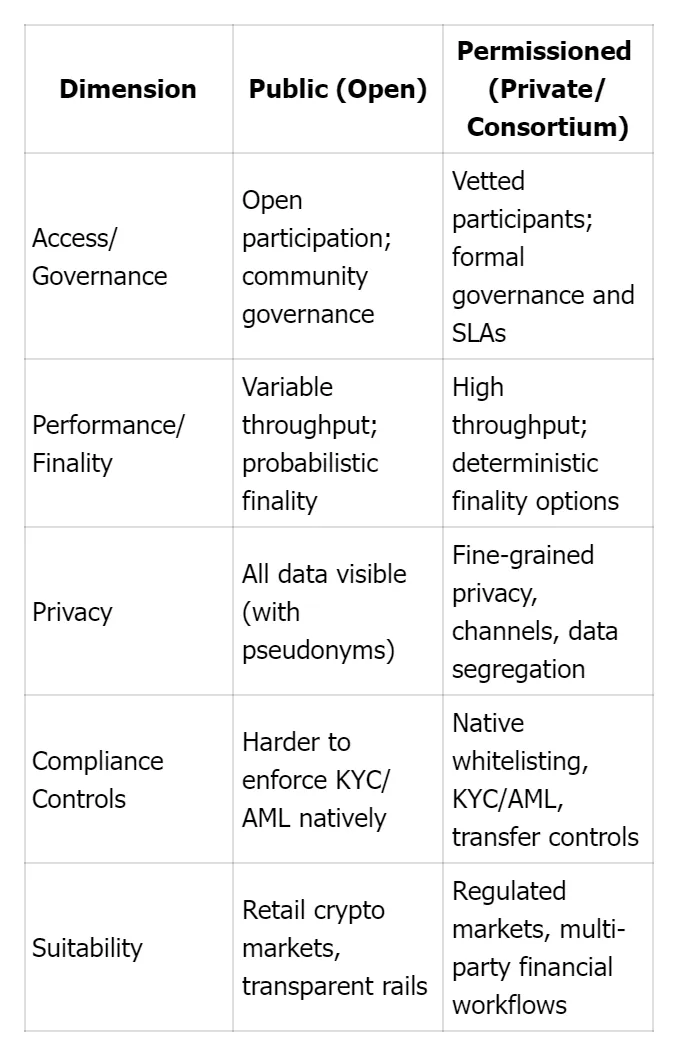
Public versus permissioned blockchains. Public (open) networks maximize transparency and censorship resistance, but regulated environments often prefer permissioned models for privacy, performance, and governance. Hyperledger Fabric is a permissioned blockchain framework designed for enterprises—well-suited to financial market workflows and access controls.
Key differences for compliant stock trading:
Benefits of Blockchain in International Stock Transactions
Near-real-time settlement, lower risk. Blockchain can cut cross-border processing times via near-real-time settlement and automation, reducing counterparty exposure and idle capital (Trade Council analysis of blockchain in trade).
Tokenization unlocks access. Tokenized securities enable fractional ownership and faster transfers of real-world assets, delivering 24/7 market access and global reach—especially valuable for international investors navigating time zones and capital controls (research on tokenized securities benefits).
Additional advantages for international users:
- Digital identity verification and on-chain KYC for faster onboarding.
- Instant settlement (T+0) and atomic delivery-versus-payment.
- Reduced fees via fewer intermediaries and automated workflows.
- Transparent ownership records and audit trails end-to-end.
Illustrative comparison:
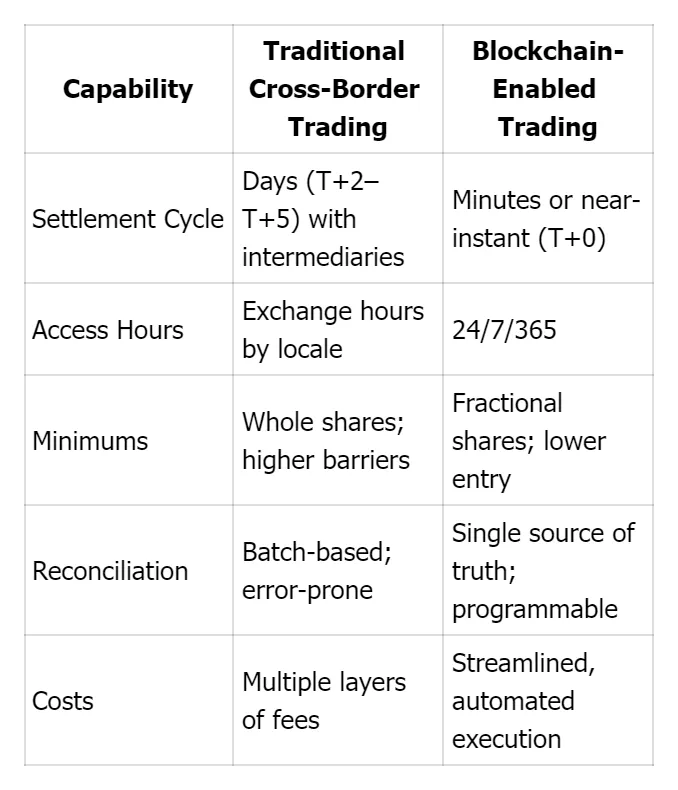
ToVest operationalizes these benefits with stablecoin funding, fractional U.S. stock access, zero commissions, and institutional-grade custody—facilitating T+0 settlement and global accessibility for compliance-first investors.
Setting Up for Blockchain-Based International Stock Trading
Defining Instruments and Market Participants
Start with scope definition. Define scope and actors: determine which instruments, markets, and participants will join the ledger. Map assets to stakeholders and compliance needs:
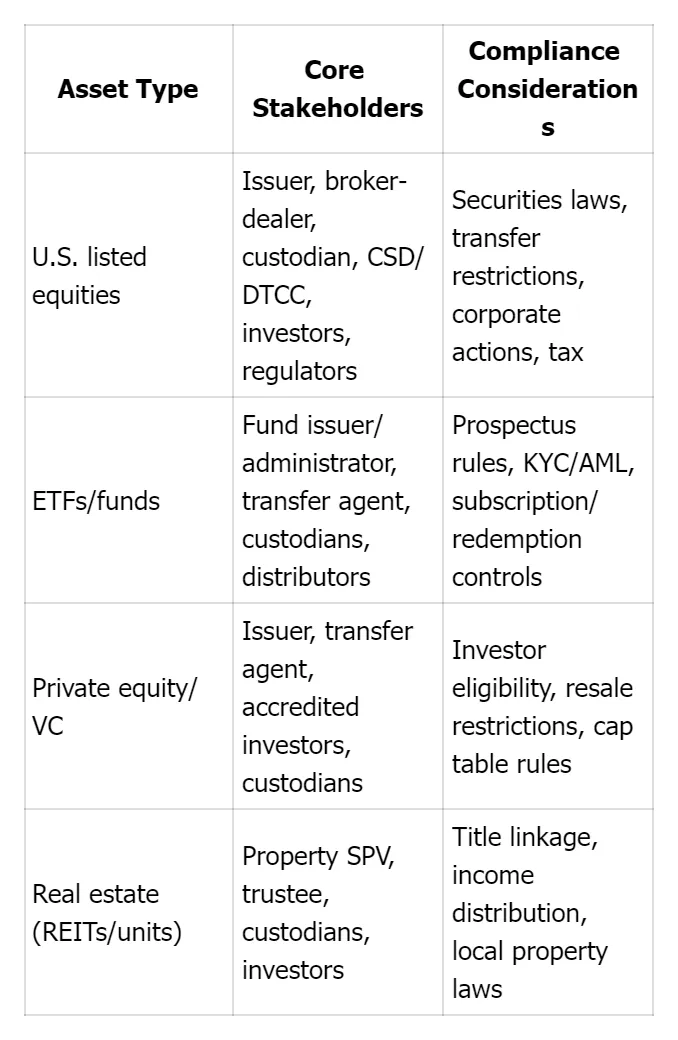
Digital identity and on-chain KYC streamline onboarding and oversight. Blockchain enables digital identity verification integrated into smart contracts, improving compliance checks while reducing repeat documentation.
Choosing the Right Blockchain Architecture
Architecture options:
- Public: Open participation; maximum transparency; limited privacy.
- Private: Single organization controls access; high privacy and performance.
- Consortium: Multiple institutions share governance; permissioned privacy.
Private and consortium blockchains are typically permissioned to preserve privacy and enforce compliance in regulated markets, with frameworks like Hyperledger Fabric frequently favored.
Privacy tooling. Zero-knowledge proofs allow one party to prove possession of specific information without revealing the information itself—helpful for confidential KYC or trade details while maintaining verifiability.
Decision criteria to weigh:
- Throughput/finality needed for peak volumes.
- Privacy/confidentiality for orders and identities.
- Regulator audit access and reporting needs.
- Interoperability with existing market infrastructure.
- Operational model (single-operator vs. multi-party consortium).
Designing Token Models and Legal Compliance
Tokenization of securities is the process of representing real-world stocks or assets as blockchain-based tokens, enabling programmable ownership and transfer. To ensure investor protection and market integrity:
- Create legal wrappers mapping tokens to legal entitlements (ownership, voting, dividends), with programmable transfer restrictions and whitelist rules.
- Align issuance, custody, and transfer mechanics with securities law in each jurisdiction.
- Design for corporate actions (splits, dividends, proxy voting), compliance reporting, and auditability from day one, as stressed by a recent Nature study on stock tokenization and trading.
Implementing Blockchain Solutions for Secure Trading
Integrating Legacy Systems and On-Chain Protocols
Real-world blockchain securities systems must interoperate with SWIFT, DTCC, and CSDs for settlement finality and reporting. Effective integration patterns:
- Gateways/API adapters that translate on-chain events into ISO 20022 and FIX messages for back-office systems.
- Oracles to bring reference data, prices, and corporate actions on-chain using secure networks such as Chainlink's education on tokenized stocks.
- Event-driven microservices to sync order, custody, and compliance states across layers.
Think of the flow as: Order entry (client) → KYC/eligibility check → Trade match → Atomic DvP settlement → Custody update → Regulatory reporting, with adapters bridging each step to legacy systems.
Automating Compliance and Settlement with Smart Contracts
Smart contracts are self-executing agreements coded on a blockchain. In securities trading, they can:
- Enforce KYC/AML, investor eligibility, and jurisdictional rules at the point of trade.
- Automate trade matching, margin checks, and transfer restrictions.
- Execute atomic delivery-versus-payment settlement, including privacy-preserving approaches using zk-SNARKs where appropriate.
- Generate regulator-friendly logs and real-time reporting.
Net result: fewer manual touchpoints, fewer errors, faster settlement, and a continuous audit trail for supervisors.
Piloting and Scaling Blockchain Stock Trading Platforms
Adopt a phased approach: Pilot with limited participants and assets, measure latency/throughput, error rates, and audit outcomes, then iterate toward consortium governance and broader market coverage.
KPIs to track:
- Median/95th-percentile settlement time (T+0 success rate).
- Transactions per second at peak; block finality time.
- Reconciliation exceptions and operational error rates.
- Regulatory report timeliness and audit pass rates.
- Custody accuracy and asset-servicing timeliness.
Global momentum includes exchange pilots and infrastructure trials; industry surveys and case studies reflect growing adoption across equities, post-trade, and collateral.
Overcoming Challenges in Blockchain Stock Trading
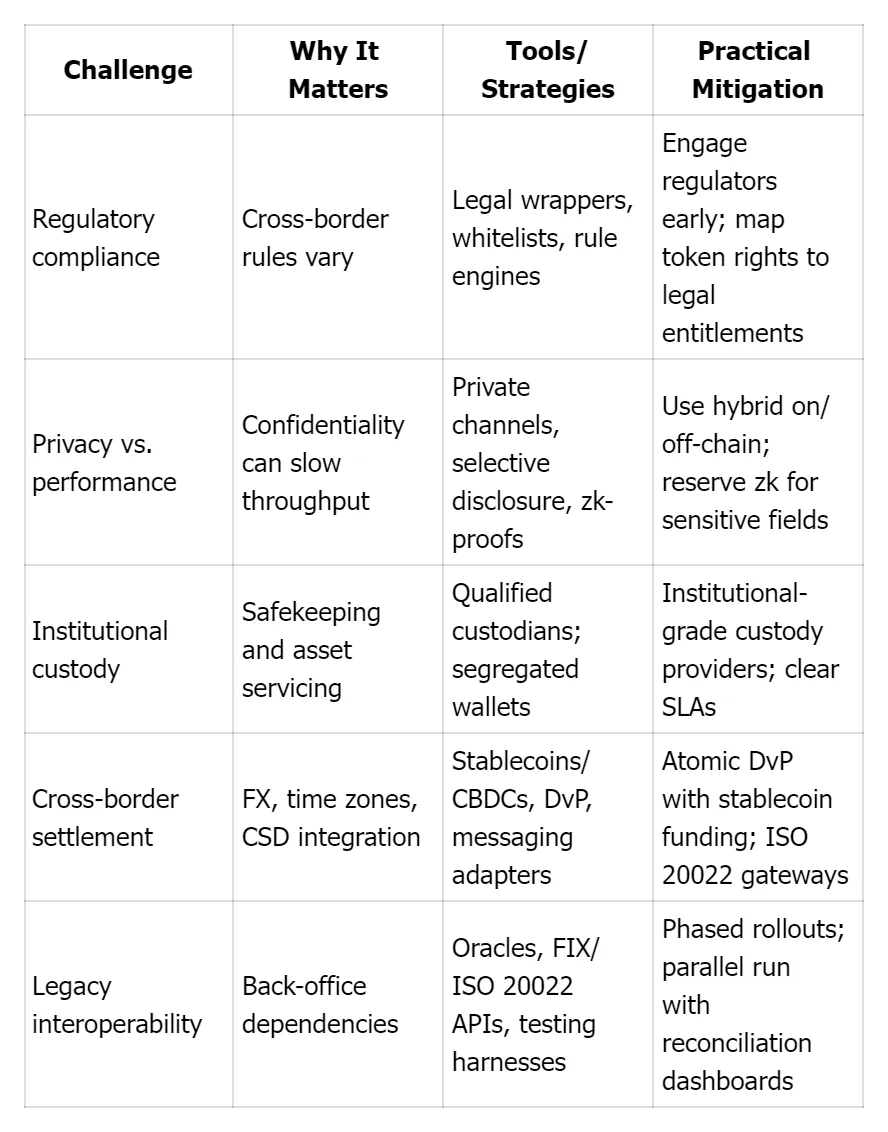
Anticipate trade-offs and plan mitigations early:
- Privacy vs. performance: Zero-knowledge proofs and private channels can add computational overhead and latency.
- Evolving legal frameworks: Cross-border rules, custody, and investor protections continue to mature; proactive legal mapping is essential.
- Interoperability with legacy systems: Rigid interfaces and standards require robust adapters and testing.
Summary of common issues and responses:
Frequently asked questions about blockchain in international stock transactions
How does blockchain enable instant settlement for international stock trades, reducing counterparty risk?
By recording trades on a shared, immutable ledger and automating DvP, many transactions can settle T+0, compressing exposure windows and minimizing counterparty risk.
What security features make blockchain suitable for secure international stock transactions?
Consensus validation, cryptographic signatures, and tamper-evident audit trails make records difficult to alter and facilitate post-trade oversight.
Can blockchain support fractional shares and 24/7 trading for international investors?
Yes—tokenized equities support fractional ownership and continuous markets, widening access across time zones and capital sizes.
How does blockchain lower costs and improve efficiency in cross-border stock transactions?
It streamlines or eliminates intermediaries and automates reconciliation and settlement, which reduces operational overhead and accelerates execution.
What are the regulatory and adoption challenges for blockchain in international stock trading?
Key hurdles include jurisdictional approvals, consistent liquidity, and integration with legacy systems, though pilots and standards are advancing.
How do tokenized stocks bridge traditional finance and blockchain for global access?
They represent real shares on-chain while preserving legal rights and compliance, facilitating rapid settlement and expanding global reach without sacrificing investor protections.