How to Overcome Low Returns: Secure Passive Income with Stablecoins
January 28, 2026
Stablecoins can turn today’s low-yield landscape into steady, programmatic income. You earn by lending coins on regulated platforms, supplying liquidity in DeFi, or using automated vaults—often with yields meaningfully above traditional bank savings. The quick path: start with reputable fiat-backed stablecoins (e.g., USDC, USDT), split funds across two to four issuers, and use simple lending or audited DeFi protocols for 3–8% APY, then graduate to liquidity pools or vaults if you understand the risks. As ToVest users, you can diversify across tokenized assets with multi-currency funding and compliant, transparent settlement—bringing a brokerage-grade approach to on-chain yield. Below, we explain what to buy, where yields come from, how to choose platforms, and the controls that keep your passive income both stable and secure.
Understanding Stablecoins and Passive Income
Stablecoins are cryptocurrencies designed to maintain a stable value by being pegged to assets like the US dollar or short-term government securities. Leading examples include USDC, USDT, and newer on-chain tokens backed by Treasuries or other real-world assets. Because price swings are muted versus typical crypto, stablecoins are a practical base for earning yield that often ranges from about 3% to the mid-teens depending on the method and market demand, according to the Cobo 2026 stablecoin guide (Cobo 2026 stablecoin guide).
Scale and relevance are hard to ignore. Stablecoin issuance has roughly doubled in recent years, and adjusted on-chain volume reached an estimated $18.4 trillion in 2024, per the IMF’s analysis of digital money usage (IMF 2025 digital money report (USEA)). Some asset managers see the rails expanding dramatically, with total stablecoin settlement potentially approaching $100 trillion within five years if adoption continues (PineBridge insight on stablecoin adoption).
Types of stablecoins and key risks:
- Centralized (fiat-collateralized): Issued by companies that hold cash and T-bills against each token; examples include USDC and USDT. Risks: issuer and banking partner exposure; policy or regulatory actions.
- Decentralized (crypto-backed): Overcollateralized by on-chain assets and, increasingly, tokenized T-bills; example: DAI. Risks: smart-contract and collateral volatility.
- Algorithmic: Maintain a peg via supply algorithms; some have failed catastrophically (e.g., UST). Risks: design fragility and bank-run dynamics.
Choosing the Right Stablecoins for Investment
Diversification means spreading your investments across multiple assets or issuers to reduce exposure to any single point of failure. For stablecoins, that typically means holding two to four well-adopted coins so no single de-peg, reserve freeze, or technical issue can sink your yield stream (Cobo 2026 stablecoin guide).
Prioritize fiat-collateralized, regulated issuers that publish regular reserve attestations and follow KYC/AML. Coins like USDC and USDT are claims on reserves—cash and U.S. T-bills—held by custodians and attested periodically. Still, de-peg risk is real; even top issuers have briefly traded below $1 during stress events, while purely algorithmic designs have suffered permanent failures. Diversification, transparency, and audit trails matter more than brand recognition alone.
Indicative comparison of popular stablecoins:
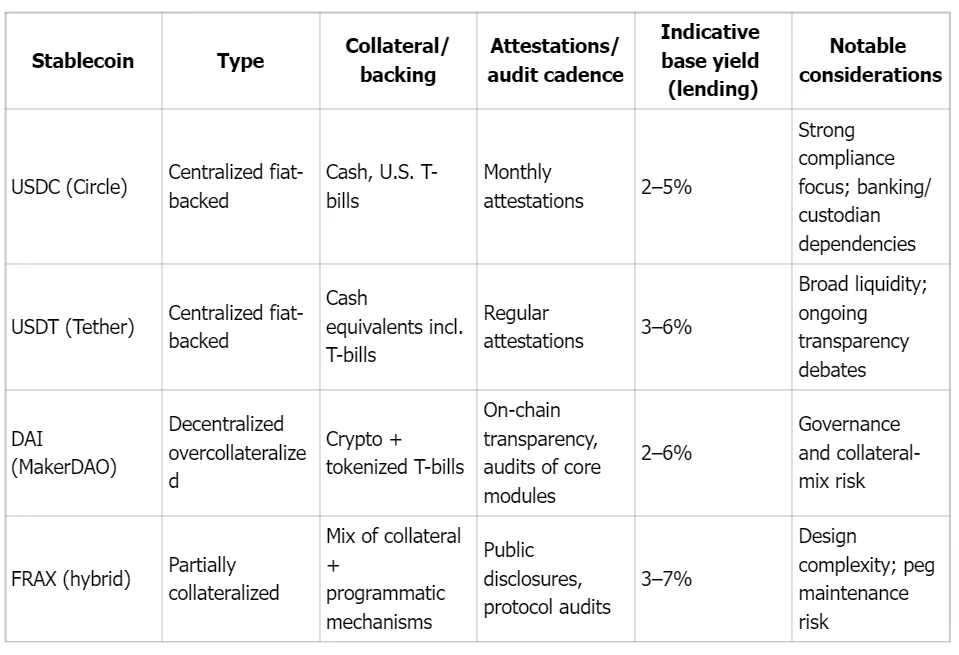
Note: Yields are indicative and change with platform, demand, and market conditions.
Selecting a Stablecoin Earning Strategy by Risk Level
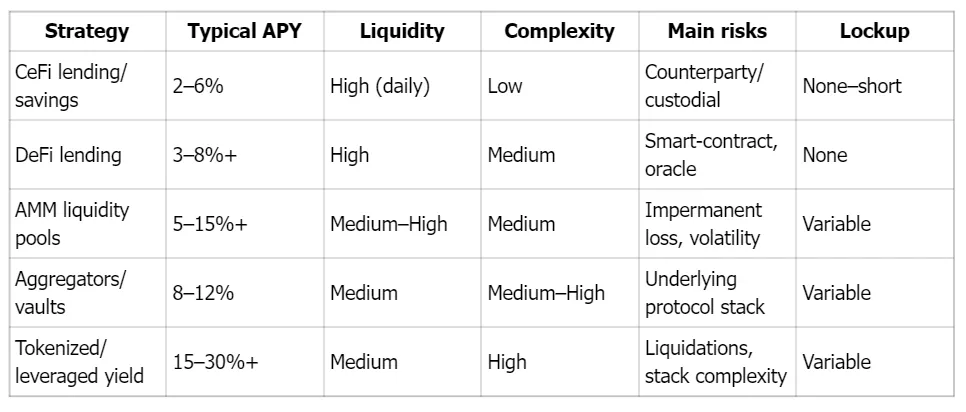
Common strategies, from conservative to advanced:
- CeFi lending/savings: Simple earn accounts or term lending at roughly 2–6% APY; you take custodial and counterparty risk (CoinTracker’s passive income overview).
- DeFi lending (e.g., Aave, Compound): Self-custody with smart-contract risk; APY varies with utilization and collateral tiers. Rates can spike during market stress.
- AMM liquidity pools: Earn trading fees (and sometimes incentives) that may hit double digits, but expect price volatility around the peg, slippage, and occasional impermanent loss.
- Yield aggregators/vaults: Automated strategies (e.g., Yearn-style) targeting 8–12% APY in normal conditions; returns depend on underlying protocols and their risks.
- Yield tokenization/advanced strategies: Tools like Pendle separate principal from yield; leverage loops can push returns to 20–30%+ but can materially increase liquidation and cascade risk (Galaxy Digital’s State of Onchain Yield).
Strategy comparison at a glance:
Getting started step-by-step:
- Define your liquidity needs and timeline (emergency cash, near-term expenses, investment horizon).
- Begin with low-risk options (CeFi or top-tier DeFi lending) and small allocations.
- Only add liquidity pools, vaults, or leverage once you fully understand peg risk, impermanent loss, and liquidation mechanics.
Evaluating Platforms for Yield Opportunities
Before depositing funds, vet platforms with a simple checklist:
- TVL and adoption: Total value locked is the sum of user funds in a protocol, a rough signal of traction and trust. Favor platforms with consistent, multi-cycle TVL.
- Security: Look for reputable audits, ongoing bug bounties, multisig controls, and transparent incident history.
- Yield quality: Compare 7-day/30-day average APY and understand the sources (trading fees, borrow demand, incentives). Avoid opaque, black-box models.
- Operations: Withdrawal and settlement times, on/off-ramp quality, fees, and supported chains.
- Governance and disclosures: Public team, jurisdiction, licensing, and reserve attestations for custodial venues.
- Safeguards: Institutional-grade custody, segregation of client assets, and meaningful insurance.
For a concise due-diligence framework, see ToVest Academy on crypto due diligence (ToVest Academy on crypto due diligence). Community write-ups on seasonal strategies can also help you calibrate expectations (winter 2025 stablecoin strategies).
Implementing Risk Controls and Safeguards
Practical defenses that preserve your principal and your yield:
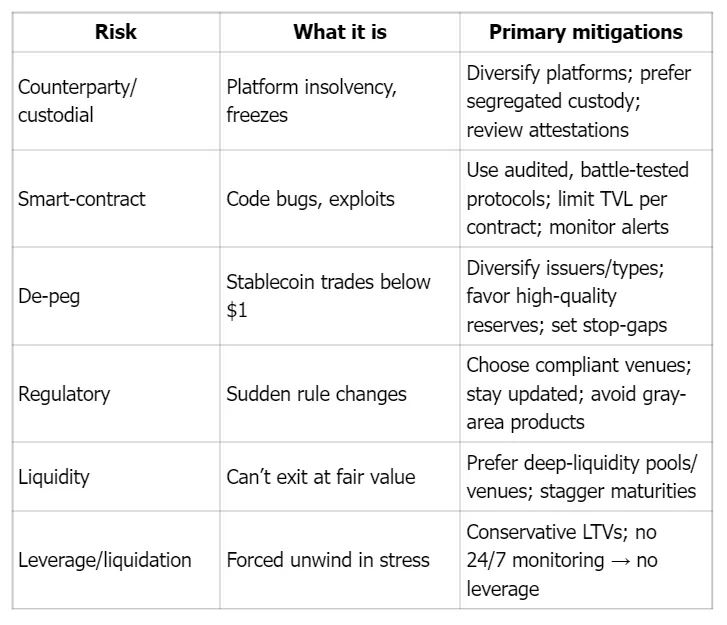
- Position sizing: Cap exposure per issuer and per platform; maintain a liquid cash reserve.
- Segregation and custody: Prefer self-custody for DeFi; for larger amounts, use institutional custody with hardware security and role-based access.
- Protocol standards: Require recent audits, active bug bounties, and transparent governance before allocating.
- Leverage discipline: Set strict LTV and liquidation buffers; avoid recursive loops unless you can monitor continuously (Galaxy Digital’s State of Onchain Yield).
- Process hygiene: Rebalance periodically, track regulatory updates (e.g., EU’s MiCA and U.S. proposals for reserve-backed stablecoins), and document everything (Cobo 2026 stablecoin guide).
Key risks and how to mitigate them:
Monitoring and Rebalancing Your Stablecoin Portfolio
Treat passive income like a living system:
- Track yields, utilization, TVL shifts, incentive schedules, and any audit or governance updates. Dashboards and aggregator tools make this manageable (XBTO beginner’s guide to crypto yield).
- Rebalance on a schedule: Review allocations across coins and platforms, reinvest matured yields, and prune underperformers or strategies with rising risk.
- Keep clean records for tax and compliance, including transaction hashes, cost basis, and annual summaries (ToVest report on digital asset recordkeeping).
- Stay flexible—product design, yields, and regulations evolve quickly; your mix should adapt with them.
Frequently Asked Questions
What are stablecoins, and why use them for passive income?
Stablecoins are cryptocurrencies pegged to stable assets like the US dollar, allowing you to earn steady yield without the price swings of typical crypto.
What are the main ways to earn passive income with stablecoins?
You can lend on centralized or decentralized platforms, provide liquidity to trading pools, use automated yield vaults, or hold yield-bearing RWA-backed stablecoins.
What yields can I realistically expect in 2025–2026?
Expect roughly 3–5% in quiet markets and up to 10–25% when demand spikes, with many diversified strategies averaging around 8–12%.
What are the risks, and how do I mitigate low returns?
Major risks include platform failure, smart-contract exploits, de-pegs, and regulatory changes; diversify across issuers and venues, use audited protocols, and start small.
How do I get started securely?
Set up a secure wallet, choose a reputable platform like ToVest, deposit stablecoins, and begin with simple lending or an audited vault—prioritizing security features and clear disclosures.