How to Turn Your Crypto into U.S. Stocks Without Complex Exchanges
January 28, 2026
You don’t need a bank wire, a legacy brokerage account, or a maze of order types to get U.S. stock exposure with crypto. The most direct path is to use a tokenized stock platform that accepts stablecoins. Convert your BTC or ETH into USDC/USDT, connect a compatible wallet, and buy tokenized U.S. stocks or ETFs with near‑instant settlement—often 24/7. Tokenized stocks are blockchain-based representations of shares or their price exposure, giving global investors fractional ownership, transparent on-chain records, and flexible custody options.
At ToVest, we enable compliance-first, fractional investing in tokenized U.S. stocks funded by stablecoins, with a strong focus on speed, security, and self-custody. Below, we map the process end-to-end—and highlight key decisions, risks, and tax considerations along the way.
Choose a Tokenized Stock Platform That Supports Your Crypto
Tokenized stocks are blockchain tokens that mirror the economic value of a public company’s shares. Depending on the issuer, they may be backed by actual shares with legal rights (redeemable) or offer synthetic, derivative-style price exposure. The draw for investors is simple: global access, 24/7 trading, and fast settlement powered by blockchains rather than legacy market rails, as outlined in the CoinGecko explainer on tokenized stocks and other resources on market structure.
Platform types and access:
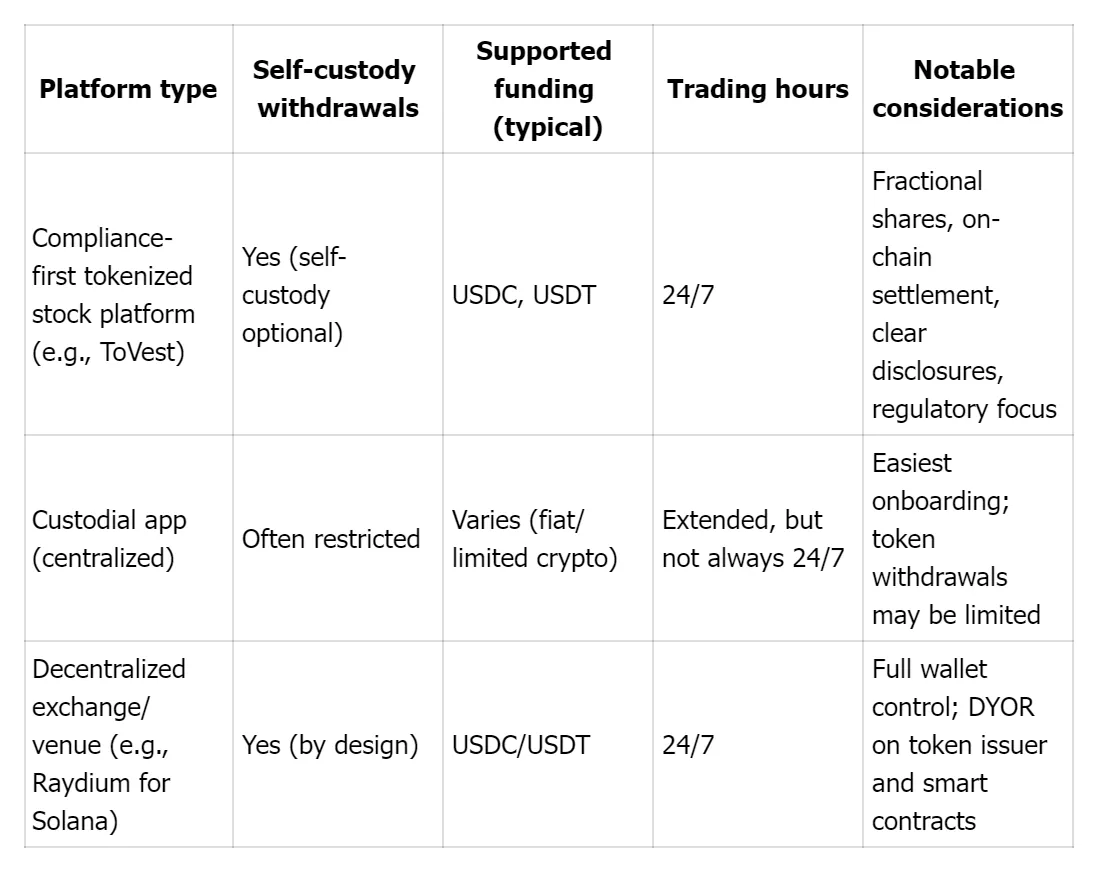
- Custodial platforms: Onboarding is simpler, but withdrawals can be limited (some centralized apps restrict moving assets on-chain or only allow certain networks; see Robinhood crypto transfer policies for a flavor of these constraints). This model is easy for newcomers but may lock you into one app’s custody and fee schedule.
- Withdrawal-enabled venues: Platforms and DEXs that let you withdraw tokens to your own wallet enable self-custody and DeFi uses (e.g., Solana DEXs like Raydium). Large exchanges such as Kraken are known for robust withdrawal support for crypto in general—look for a similar policy for any tokenized stock product you use.
- Backed vs. synthetic:
- Backed tokens are anchored to underlying shares and can offer clearer legal rights and redemption paths.
- Synthetic tokens deliver price exposure via derivatives and carry higher counterparty risk. TD Securities’ analysis distinguishes these models and how settlement and rights differ.
- What to verify before you pick a platform:
- Supported funding: Which cryptocurrencies are accepted for deposits? Are USDC/USDT supported natively?
- Asset coverage: Does it list the U.S. stocks/ETFs you want, with fractional sizes?
- Withdrawals: Can you withdraw tokenized stocks to a self-custody wallet?
- Disclosures: Review risk, custody, and redemption documentation.
Definition — Tokenized stocks: Digital tokens on a blockchain that represent ownership or price exposure to real-world shares. They may be backed by actual stock (with legal rights) or be synthetic derivatives and are tradable 24/7 with near-instant settlement.
Table: Quick comparison of platform features
Set Up a Compatible Crypto Wallet for Tokenized Stock Trading
Your wallet is your account on the blockchain. It’s how you hold stablecoins, receive tokenized stocks, and connect to platforms.
- Compatible wallet options:
- Solana-based tokens: Phantom or Solflare tend to be the most user-friendly choices for xStocks and other Solana assets.
- Ethereum and Layer-2 tokens: MetaMask and other EVM-compatible wallets are widely supported for ERC-20 assets.
Step-by-step: install and fund a wallet securely
- Download from official sources (browser extension or mobile) and verify URLs.
- Create a new wallet and record the seed phrase offline. Never share it.
- Enable app-level security (PIN/biometrics) and multi-factor authentication where available.
- Fund the wallet with a small test transfer first; then add USDC/USDT for trading.
- Consider a hardware wallet for larger balances.
Security best practices—avoid sharing private keys/seed phrases, store backups offline, and use MFA—are emphasized in this security best practices overview.
Definition — Crypto wallet: A digital tool to store, send, and receive crypto. It secures the private keys that sign blockchain transactions. Wallets can be software-based or hardware devices with different security–convenience trade-offs.
Convert Your Crypto into Stablecoins to Facilitate Purchase
Most tokenized stock platforms quote prices and settle trades in major stablecoins like USDT and USDC to minimize volatility and simplify accounting. This is common across tokenized asset markets that target fast, predictable settlement.
How to swap into stablecoins
- Send your BTC/ETH to a compatible exchange or venue with good liquidity.
- Swap to USDC or USDT, watching the spread and fees; place limit orders when possible.
- Withdraw stablecoins to your self-custody wallet or deposit them directly to the tokenized stock platform.
A practical overview of converting and moving funds across crypto–fiat rails is outlined in the eToro guide to converting crypto.
Tips to keep costs down
- Avoid unnecessary hops: choose a platform that supports direct USDC/USDT deposits on your target chain.
- Check network fees and pick cost-effective chains (e.g., Solana vs. L1 Ethereum for small transfers).
- Batch transfers where possible.
Definition — Stablecoin: A cryptocurrency designed to maintain a steady value, typically pegged 1:1 to a reserve asset like the U.S. dollar. USDT (Tether) and USDC (USD Coin) are the most used for tokenized stock purchases.
Buy Tokenized U.S. Stocks Using Stablecoins on the Platform
Once your wallet holds stablecoins and your platform account is ready, placing your first order is straightforward.
Step-by-step: execute your first trade
- Connect your wallet: Approve the connection to the platform or its custody module.
- Choose the asset: Search the U.S. stock or ETF ticker; review the token page.
- Review the token model: Is it backed (redeemable for shares/cash) or synthetic (derivative exposure only)? Backed models typically offer stronger legal protections; synthetic models introduce counterparty risk, as explained in TD Securities’ analysis.
- Place a buy order with USDC/USDT: Enter amount or fractional size; confirm slippage and fees.
- Settlement: Tokenized trades typically settle instantly or near-instantly on-chain and are available 24/7, a core benefit highlighted in the CoinGecko explainer.
- Verify receipt: Confirm tokens in your wallet or platform account.
Unlocking DeFi utility
- Withdrawal-enabled tokenized stocks can be used as collateral in lending pools or integrated into on-chain strategies, per the XBTO overview of tokenization use cases. Always weigh smart contract and issuer risks.
Manage Your Tokenized Stock Holdings and Custody Options
After purchase, decide how you want to hold and secure your tokens.
- Platform custody: Easiest for beginners; the platform secures keys and manages backups. Trade-off: possible withdrawal limits and reliance on a single custodian.
- Self-custody: You hold your own keys and can deploy assets across DeFi. Trade-off: you assume full security responsibility (key storage, backups, transaction hygiene).
Security essentials
- Use cold storage (hardware wallets) for meaningful balances.
- Enable MFA and strong device security; keep offline backups of recovery phrases.
- Regularly test small transactions before moving size.
Important: Tokenized markets and many crypto venues do not provide broker-dealer protections such as SIPC insurance; understand custodial and counterparty risks as noted by FINRA on crypto assets.
Definition — Self-custody: Holding your own private keys and assets rather than relying on a third-party platform. It offers maximum control with higher security responsibility.
To see how ToVest approaches on-chain custody and disclosures, start with our academy primer on fractional tokenized investing.
Track Transactions and Understand Tax Implications When Converting Crypto
Every swap, transfer, and trade leaves a paper trail—and you’ll want it neatly organized.
- Record-keeping: Export histories from exchanges and wallets (CSV/JSON), and keep a running spreadsheet of dates, amounts, fees, and transaction IDs. Save platform receipts for buys/sells.
- Tax basics: Selling or exchanging crypto (including swapping BTC/ETH to USDC/USDT as a step toward buying tokenized stocks) may trigger a taxable event under many jurisdictions’ capital gains rules. In the U.S., gains/losses are generally reported on Form 8949 and summarized on Form 1040; consult a qualified tax professional for local guidance and complex cases.
- Best practices: Maintain cost-basis notes for each asset, tag transfers between your own wallets to avoid double-counting, and back up records securely.
Definition — Capital gains tax: A tax on the profit realized when selling or exchanging an asset for more than its purchase price. Crypto disposals typically require reporting gains or losses.
For a deeper dive into 24/7 markets and infrastructure considerations, see our latest ToVest report on on-chain settlement and market access.
Frequently Asked Questions
Can I buy U.S. stocks directly with cryptocurrency without converting to fiat?
Most tokenized stock platforms accept stablecoins, so you typically swap into USDC/USDT and purchase—no bank transfer required.
What are tokenized stocks and how do they differ from traditional shares?
They are blockchain-based tokens that represent ownership or price exposure to a stock and trade 24/7, unlike traditional shares limited to exchange hours.
What fees or risks should I consider when converting crypto to U.S. stocks?
Watch trading spreads and network fees, review issuer and custody risks, and note that many venues lack protections like SIPC insurance.
How can I securely manage my tokenized stock assets on blockchain platforms?
Use reputable wallets, enable MFA, store recovery phrases offline, and consider a hardware wallet for larger balances.
Are there tax consequences when converting cryptocurrency into U.S. stocks?
Yes—swapping or selling crypto is usually taxable; track your cost basis and consult a local tax advisor on reporting.