How to Invest Securely in Tokenized Assets Without Liquidity Risks
January 6, 2026
Investing in tokenized assets can expand your portfolio with fractional access to stocks, real estate, Treasuries, and more—but it requires disciplined safeguards to avoid security lapses and liquidity traps. The shortest path: use regulated platforms with transparent custody, verified legal rights to the underlying assets, robust secondary markets (or on-demand redemption), audited smart contracts, and clear exit options before you buy. At ToVest, we provide regulated access to fractionalized, tokenized U.S. equities with 24/7 trading, transparent custody, and risk controls designed to protect both retail and professional investors. Below is a practical, step-by-step framework to evaluate platforms and instruments so you can allocate confidently—and exit predictably—without compromising security.

Understand What Tokenized Assets Are
Tokenized assets are digital representations of real-world value—such as equities, real estate, or commodities—issued and traded on blockchains, which enables fractional ownership, global access, and near-instant settlement. Asset‑backed tokens are explicitly tethered to tangible assets like gold or property, with rights and processes defined in the token’s documentation and legal agreements, as outlined in Algorand’s guide on RWA tokenization (Algorand’s Real World Asset Tokenization: A Comprehensive Guide).
Smart contracts power the rules for issuance, transfers, and corporate actions, automating ownership updates when predetermined financial conditions are met and reducing manual reconciliation risk (see Tokenizing Real-World Assets: Secure Smart Contracts & Scalable Markets by Calibraint).
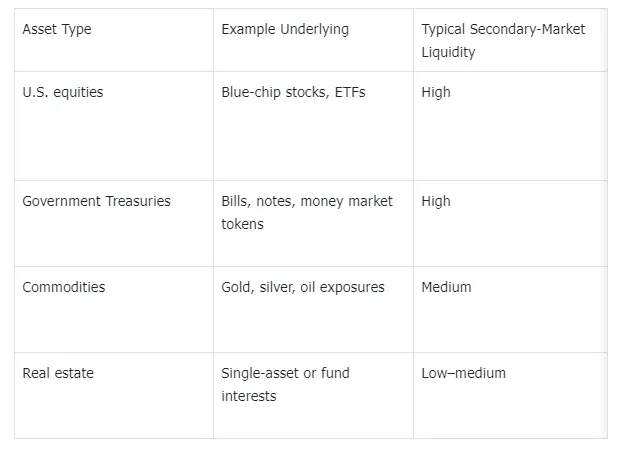
Typical liquidity and minimums vary by asset:
Verify Legal Rights and Asset Structure
Start by confirming how your token links to the underlying asset. Common structures include direct title, a claim on an SPV (Special Purpose Vehicle), or a purely contractual right—each with different implications for insolvency, governance, and enforcement (see Legal Guide to Real-World Assets (RWA) Tokenization from Buzko Legal). A Special Purpose Vehicle is a legally separate entity created to hold assets and issue tokens, designed to isolate assets and protect investors if the issuer experiences financial difficulty.
Insist on clear jurisdictional disclosures, KYC/AML onboarding, and enforceable investor rights. For practical liquidity protection, verify whether the offering includes on-demand redemption or primary buyback clauses, as well as the operational steps and timelines to exercise those rights (Wyoming Legislature: Tokenization of Real-World Assets).
Evaluate Market Liquidity and Trading Venues
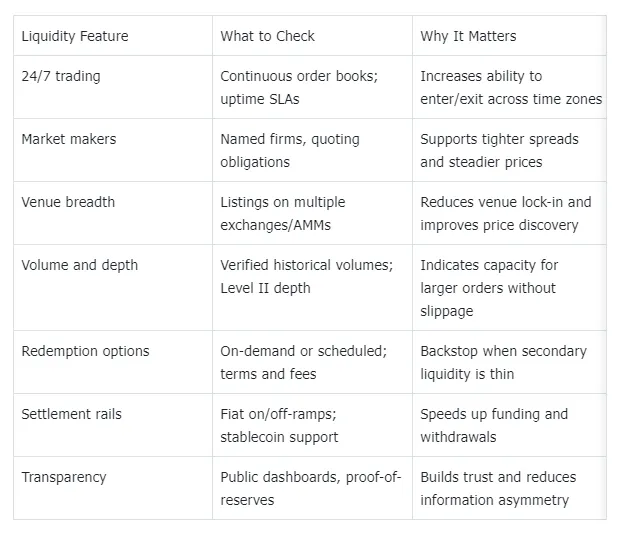
Liquidity measures how quickly and easily you can buy or sell tokens without materially moving the price. Don’t rely on marketing claims—evaluate the trading rails:
- Signals of strong liquidity
- Consistent historical trading volume and tight spreads
- Multiple secondary venues or integrations (centralized and on-chain)
- Active market makers and 24/7 trading support
- Clear redemption pathways for cash-equivalent and money market token products (McKinsey analysis of asset tokenization)
- Be cautious with thin markets
- Single-asset real estate and niche commodities can have bespoke or limited secondary exits and longer settlement timelines (XBTO on applying tokenization across asset classes)
Liquidity features to compare across platforms:
Assess Security and Custody Measures
Custody refers to the safekeeping and administration of the cryptographic keys that control digital tokens—either by you or by a regulated custodian. Look for institutional-grade controls: multi-signature wallets, hardware-based key storage or HSMs, MFA, strict access controls, and regular penetration testing. Code risks matter as much as key risks: choose platforms that use independently audited smart contracts, maintain bug bounties, and publish material findings. Insurance coverage, SOC/ISO-aligned processes, and periodic operational audits are additional layers that help limit single points of failure (see Halborn’s guidance for institutional security).
Conduct Counterparty and Platform Due Diligence
Your risk is only as low as the weakest service provider. Verify the issuer’s reputation and legal standing, confirm regulatory compliance (licensing, KYC/AML), and review third-party reports where available (Webisoft’s RWA Tokenization Guide). Scrutinize:
- Corporate disclosures: ownership, governance, and regulatory permissions
- Audit artifacts: smart contract audits, financial statements, proof-of-reserves
- Custody setup: regulated third-party custody vs. self-custody; escrow terms for fiat and underlying assets
- Data integrity: price oracles and reference data design; incident response processes
- On-chain transparency: viewable holdings, mint/burn policies, and redemption logs
This platform due diligence reduces counterparty risk and supports more reliable liquidity.
Plan Position Sizing and Exit Strategies
Guard against concentration risk by capping exposure per issuer and asset type, and diversify across several tokens and platforms. Bake in exits ahead of time: prefer tokens with on-demand redemption, active secondary listings, or standing OTC/buyback programs, and verify the operational steps and timing before investing (as highlighted in McKinsey’s industry analysis).
A simple process:
- Set maximum portfolio allocation per tokenized asset (e.g., 1–5% depending on risk).
- Confirm average daily/monthly trading volumes and any redemption windows and fees.
- Document your exit sequence (secondary sale, redemption, or OTC) and test with a small trade.
Implement Ongoing Monitoring and Risk Management
Tokenized markets evolve quickly. Reassess smart contract audits after major upgrades, track regulatory developments (e.g., EU MiCA, Dubai VARA, ADGM), and monitor custody, order-book health, and on-chain asset-linkage signals. Use dashboards and alerts for venue uptime, market depth, and redemption backlogs. ToVest regularly publishes best practices, risk updates, and product transparency to help investors stay ahead of change; learn more on our About page (ToVest Company Overview).
Frequently Asked Questions
What steps ensure secure investment in tokenized assets?
Use regulated platforms with KYC/AML, audited smart contracts, and transparent, enforceable links between tokens and the underlying assets, along with institutional-grade custody.
How can investors mitigate liquidity risks effectively?
Choose assets and platforms with active secondary markets, robust trading volumes, and clear redemption or buyback options—favoring highly liquid instruments like U.S. equities or Treasuries.
What are the key security features to look for in tokenized asset platforms?
Look for multi-signature and hardware-based custody, audited smart contracts, strong authentication controls, regular security audits, and comprehensive insurance coverage.
Which types of tokenized assets generally offer better liquidity?
U.S. stocks, ETFs, and government Treasuries typically trade with deeper liquidity, while real estate and niche commodities often have thinner or episodic secondary markets.
Are there geographic or regulatory restrictions to consider?
Yes—eligibility varies by jurisdiction, platform policy, and investor status; always confirm local compliance and complete KYC/AML before investing.