How to Overcome Low Liquidity When Investing Through Crypto Wallets
January 6, 2026
Investing through crypto wallets can be fast and accessible—but thin order books, fragmented venues, and opaque token mechanics can make seemingly simple trades costly. The most effective way to overcome low liquidity is to prepare before you trade (contract checks, volume validation, pool depth), execute smartly (limit and split orders, OTC for size), and route across multiple liquidity rails and aggregators. Where possible, choose regulated tokenized-asset platforms with deep pools, fractional markets, and 24/7 trading—areas where ToVest’s real-time data, low-latency execution, and robust controls help to reduce spreads and slippage. Below is a concise playbook that explains where liquidity is, how to access it with wallets, and how to safeguard your capital along the way.

Understanding Low Liquidity in Crypto Investing
Low liquidity in crypto markets means there is insufficient trading volume or too few buyers and sellers, making it hard to enter or exit positions without significant price impact or slippage, as defined in Liquidity in crypto markets by Crypto.com . In practice, this manifests as wide bid–ask spreads, order rejections, and deeper-than-expected price moves during execution.
Low trading volumes from poor market adoption keep many real-world asset (RWA) and security token (STO) markets illiquid, amplifying volatility and execution delays. For example:
- A thinly traded tokenized real estate pool can quote a narrow mid-price but slip 3–5% on a modest buy due to shallow depth.
- Small-cap tokens on DEXs may show chart activity but post large spreads, causing market orders to fill far from expected prices or fail entirely.
Recognizing these symptoms early is essential to avoid being trapped in positions or incurring hidden “taxes” through slippage.
Preparing Before You Trade
Preparation is your first defense against liquidity traps—especially for retail investors without institutional execution tools. You can dramatically reduce risk by validating contract safety, confirming genuine trading activity, and measuring pool depth before committing capital. Build a simple pre-trade checklist and use it every time.
Checking Contract Safety and Taxes
Before you buy:
- Paste the contract address into tools like Token Sniffer and Honeypot.is to detect sell restrictions or hidden taxes; these scanners flag honeypots and asymmetric tax logic that can impede exits.
- Understand a honeypot: a contract that allows deposits but blocks withdrawals or sales, trapping funds.
- Watch for asymmetric or mutable taxes (e.g., 1% buy, 20% sell), which are a significant red flag.
- Verify liquidity lock status via the DEX or third-party dashboards, and check whether the contract owner can alter fees, trading limits, or blacklist addresses.
Verifying Genuine Trading Volume
Not all volume is real. Use DEX scanners like DEXTools or DexScreener for real-time price and transaction feeds and manually inspect the tape ). Red flags include:
- High reported volume with very few unique transactions or wallets
- Repetitive buy/sell sizes at tight intervals (bot loops)
- Volume spikes without corresponding price discovery (wash trading)
- Sudden “turn on” of activity around promotions only
Assessing Liquidity Pool Depth and Slippage
Slippage is the difference between your expected price and executed price due to insufficient liquidity at your order size. Use pool explorers and order book visualizers to simulate price impact at various sizes, then size your order accordingly .
Remember that entry and exit friction shrink net gains; for instance, a 7% buy plus 7% sell may require roughly a 39% gross rise to net a 20% gain. Illustrative math:
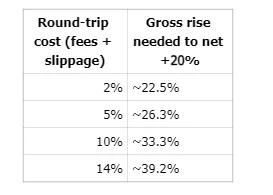
Tip: If the pool can’t handle your desired size with <1–2% price impact, consider splitting orders or using alternative venues.
Smart Execution Strategies
Execution discipline is more important than trade ideas in thin markets. Know your order types and how they behave when depth is limited.
Using Limit and Split Orders
- Use limit orders and reduced position sizes to protect against slippage in low-liquidity markets.
- Split orders: break a large trade into smaller slices over time to minimize price impact and reduce the chance of front-running.
- Avoid market orders in thin markets; they can fill at undesirable prices due to slippage.
Quick comparison:
- Market order: fastest, but highest slippage risk.
- Limit order: price control, but may not fill fully.
- Split limit orders: best blend of control and completion in thin books, at the cost of time.
Exploring Over-the-Counter Trading Options
Over-the-counter (OTC) trading refers to direct, broker-facilitated trades executed off public order books—ideal for larger tickets where you want to avoid moving the market. OTC desks help to reduce price impact and slippage compared to placing bulk orders in low-liquidity markets . To access:
- Identify a reputable, regulated OTC provider
- Complete KYC/AML onboarding
- Agree on terms (size, price bands, settlement assets), then settle on-chain or via custodian
Leveraging Liquidity Rails and Aggregation
Liquidity rails are the integrations and routing pathways that let you scan multiple DEXs and venues for the best executable price; liquidity can vary widely across venues. Use DEX aggregators and consider routing via stablecoins (USDT/USDC) to confirm exit paths and lower friction.
Common tools and advantages:
- 1inch, Matcha/0x, ParaSwap, CoW Swap, and ToVest: multi-venue routing, gas-optimized paths, and MEV protection
- Stablecoin routing: improves fill probability, clarifies exit liquidity
- Cross-chain bridges with safeguards: broaden venue reach, but verify security and fees
Providing Liquidity to Improve Market Access
AMMs and liquidity pools match trades against pooled assets rather than traditional order books, enabling continuous pricing even when counterparties are scarce. Liquidity mining and yield farming programs often reward users for supplying depth to pools, improving fills for everyone.
Participating as a Liquidity Provider
If you’re comfortable with the risks:
- Select a pool with healthy, organic volume and clear token mechanics
- Deposit token pairs to earn trading fees (and potential incentives), thereby enhancing ecosystem liquidity
- Confirm platform requirements: wallet connection, pair composition, reward cadence, and withdrawal terms
- For tokenized RWAs, prioritize platforms with transparent oracles, proof-of-reserves, and compliance workflows
Managing Risks of Impermanent Loss
Impermanent loss occurs when relative price changes between deposited assets reduce your position value versus simply holding. To mitigate:
- Favor stable or high-volume pairs
- Set strict allocation caps (e.g., small single-pool limits)
- Monitor pool metrics and smart contract audits regularly
Ongoing Risk Management and Position Sizing
Strong risk management and monitoring are key to counter low-liquidity vulnerabilities—tight sizing, staged entries/exits, and predefined exit rules reduce avoidable losses.
Setting Conservative Position Limits
Adopt conservative caps that reflect liquidity, volatility, and correlation. Practical guidance: allocate no more than 2–5% of your portfolio to a single low-liquidity asset, and use portfolio-level stress tests. Consider hedging or market-neutral overlays when appropriate.
Planning Trades During High Liquidity Periods
Liquidity varies by time and region; U.S. trading hours often show higher on-chain and off-chain participation, potentially improving fills . Check:
- DEX scanner heatmaps for intraday volumes
- Exchange depth metrics and spread trackers
- News calendars and macro data windows that attract flow
Platforms Offering the Best Liquidity for Tokenized Assets
Tokenized assets are blockchain-based representations of real-world assets—like stocks, T-bills, or property—that trade in fractional units with programmable settlement. When comparing platforms, assess market depth, spreads, trading hours, regulatory status, global accessibility, and data transparency.
ToVest’s Liquidity Advantages
ToVest is designed for efficient access to tokenized RWAs:
- Fractional ownership with 24/7 trading, real-time market data, and fast settlement to minimize entry/exit friction
- Seamless fiat and stablecoin funding, low-latency matching, and smart routing to enhance effective liquidity
- Institutional-grade controls: 2FA, cold storage, segregation, and regulatory oversight
- Global accessibility supported by robust risk tooling and transparent reporting
Learn more about our approach to liquid tokenized markets in our Academy overview and latest market report .
Additional Leading Tokenized Asset Platforms
Independent reviews highlight enterprise-grade tokenization platforms and regulated venues as consistent liquidity leaders due to stronger compliance, custody, and institutional participation. Notable trends:
- Tokenized U.S. Treasury bills have become a flagship RWA use case with growing secondary liquidity
- Exchanges have piloted exchange-issued stock tokens to compress settlement and expand access
- Well-designed tokenized real estate offerings can sell out quickly; one luxury villa sale reportedly closed in under five minutes, illustrating demand when UX and compliance are aligned
- Wallet-integrated tokenized asset access continues to broaden retail reach
- Robust oracle frameworks and proof-of-reserves remain core infrastructure for trustworthy RWA pricing and redemption
Tip: Favor platforms with audited contracts, transparent pricing sources, clear redemption policies, and multi-venue routing.
Using Crypto Wallets to Invest in Tokenized Assets
Crypto wallets are software or hardware tools for storing, sending, and receiving cryptocurrencies or tokenized assets; modern wallets increasingly connect to DEXs, bridges, and RWA platforms to streamline trading . Common options like MetaMask support custom networks and tokens and offer guidance on secure usage. For optimal liquidity, select wallets that integrate directly with exchanges or aggregators and support both fiat and stablecoin rails.
Wallet Features That Enhance Liquidity
Look for:
- Direct exchange integrations and smart order routing across venues
- Built-in DEX aggregation (1inch/0x/ParaSwap) with MEV protection
- Stablecoin support (USDT/USDC) and quick network switching
- Advanced order types (limit, TWAP), custom slippage settings, and price alerts
- Integrated bridges and on/off-ramps with transparent fees
- Security: hardware-signing support, 2FA, spending limits, and address whitelists
Funding Options and Security Measures
To minimize friction:
- Use platforms that accept both fiat and stablecoins for deposits/withdrawals to avoid bottlenecks when moving between venues
- Keep hot balances lean and store long-term holdings in cold custody
- Enable 2FA, set withdrawal allowlists, and verify every contract you approve
Illustrative flow:
- On-ramp fiat to stablecoin via a regulated provider
- Transfer to your wallet, then route via an aggregator to the target tokenized asset
- Set conservative slippage and use limit or split orders
- When exiting, route back to a liquid stablecoin, then off-ramp if needed
For a deeper dive into liquidity tactics and execution timing, see our market trend brief.
Frequently Asked Questions
What causes low liquidity in crypto wallets and how does it affect my trades?
Low liquidity arises from low trading volumes, fragmented pools, or locked supply, leading to high slippage, delays, and poor fills.
How can I use crypto lending to access liquidity without selling assets?
Borrowing against your holdings on lending platforms allows you to access cash or stablecoins while retaining exposure to the underlying assets.
What are liquidity pools and how do they help with low liquidity?
Liquidity pools aggregate tokens in smart contracts, enabling trades to execute against pooled depth, which reduces slippage compared to thin order books.
Which crypto wallets provide the best liquidity and trading access?
Wallets integrated with exchanges and DEX aggregators offer superior access, enabling multi-venue routing, fast transfers, and improved fills.
How can diversification reduce liquidity risk in my portfolio?
Diversifying across various assets and venues mitigates dependence on any one thin market and smooths overall execution and drawdown risk