Invest in Real‑World Assets on RWA Platforms in 2025: A Complete Guide
December 23, 2025
Investors increasingly want yield and diversification without leaving the digital rails. Real‑world asset (RWA) platforms allow you to buy on‑chain claims to assets like real estate, treasuries, and commodities, often in small, tradable fractions. To invest, you typically complete KYC on a compliant platform, review the asset’s legal and financial documents, purchase tokens representing a share of the asset, and receive payouts (rent, interest, fees) on‑chain. You can buy tokenized real estate in many jurisdictions; fractional investment is a core feature of modern RWA platforms. This guide explains what RWAs are, how tokenization works, why these assets belong in a portfolio, and the practical steps to start—backed by industry sources and ToVest’s infrastructure‑led approach to secure, transparent trading.
Understanding Real‑World Assets and Tokenization
Real‑world assets (RWAs) are tangible or financial assets—such as real estate, government bonds, private credit, and commodities—represented digitally on a blockchain. Tokenization converts the ownership rights in these assets into programmable blockchain tokens, allowing divisible, transferable fractions with embedded compliance and transparent settlement. Clear legal structures and custodial arrangements connect tokens to the off‑chain asset so that on‑chain transfers map to real‑world ownership claims, as summarized in the Webisoft RWA tokenization guide (Webisoft RWA tokenization guide).
What makes tokenization compelling:
- Broader access: Lower minimums and fractional investing open large, formerly illiquid markets to more investors.
- Liquidity: Secondary trading windows and automated market makers can improve exit options compared with traditional private markets.
- Transparency and automation: On‑chain ledgers, oracles, and programmable controls streamline reporting, distributions, and transfer restrictions.
- Global, always‑on rails: 24/7 settlement and interoperable standards widen participation and reduce operational friction.
- Embedded compliance: Whitelisting and regulated issuance frameworks integrate KYC/AML and securities rules into the token lifecycle (Tokeny RWA ecosystem map).
What Are Real‑World Assets and How Does Tokenization Work?
Tokenization is the digital representation of real‑world assets on a blockchain, making traditionally illiquid assets tradable and divisible.
Typical lifecycle from asset to token:
- Asset selection and due diligence: Identify a property, credit pool, bond, or commodity and validate title, valuation, and cash‑flow sources.
- Legal structuring: Form a special purpose vehicle (SPV) or trust, draft offering documents, and define investor rights and transfer restrictions.
- Token creation: Issue tokens (often on standards that support compliance features) that represent shares or claims on the SPV.
- Qualified custody and data: Safeguard the underlying asset and establish attestations, oracles, and reporting for proof‑of‑reserve and cash‑flow tracking.
- Primary offering: KYC/AML investors, allocate tokens, and settle on‑chain.
- Secondary trading and lifecycle events: Enable compliant transfers, distributions (e.g., rent, interest), redemptions, and governance on‑chain.
Examples in practice include tokenized income‑producing real estate and on‑chain treasuries, which offer global investor access with smaller tickets and faster settlement compared with traditional processes (BinaryX overview; RWA.io on real estate liquidity).
Types of Tokenized Assets Available on RWA Platforms
Below are common categories you can access on RWA platforms today:
- Real estate: Residential, commercial, logistics, and redevelopment projects with on‑chain rent or revenue distributions (RWA.io on real estate liquidity).
- Government and corporate bonds: Tokenized treasuries and short‑duration credit offering transparent yields and periodic redemptions.
- Private credit and structured debt: SME lending pools, invoice factoring, and revenue‑sharing notes with tranche options.
- Commodities: Tokenized gold, diamonds, and carbon credits with audit trails and redemption or offset mechanisms.
- Equities, funds, and ETFs: Wrapped interests in funds or SPVs that mirror portfolio exposures with on‑chain transfer controls.
- Niche/ESG assets: Energy infrastructure, sustainable projects, and environmental markets increasingly accessible via DeFi integrations (Webisoft RWA tokenization guide).
Yes—you can invest in tokenized real estate on compliant platforms, often down to small fractions, with programmatic distribution of rental income and improved secondary liquidity (RWA.io on real estate liquidity). Ecosystem directories illustrate the breadth of providers and rails across issuance, compliance, and markets (Tokeny RWA ecosystem map; OpenRWA directory).
Why Invest in Real‑World Assets Through RWA Platforms
RWA platforms fuse real‑world yield with digital efficiency. Key benefits include:
- Fractional investing and lower minimums: Own small slices of large assets, broadening access to strategies once reserved for institutions (RWA.io on fractional ownership).
- Liquidity: Periodic or continuous secondary markets can compress exit times versus traditional private placements.
- Global access and 24/7 settlement: Trade and settle across time zones with round‑the‑clock infrastructure (RWA.io on RWA crowdfunding in 2025).
- Transparent operations: On‑chain records simplify performance tracking, audits, and distributions.
- Tokenized securities with embedded controls: Whitelisting and transfer restrictions align with securities rules while preserving user experience (Tokeny RWA ecosystem map).
Market momentum is significant: industry analyses project tokenized assets to reach into the trillions by 2030, reflecting strong institutional and fintech adoption (4IRE Labs market outlook).
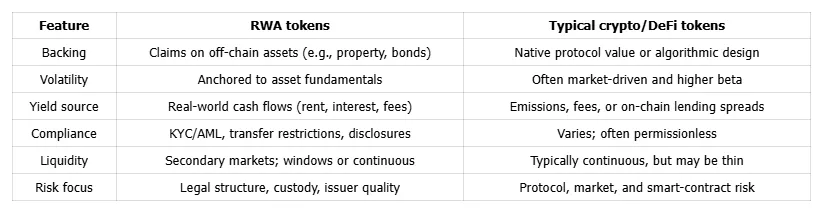
Quick comparison
How to Invest in Real‑World Assets Through RWA Platforms (in Five Steps)
- Choose a compliant platform: Assess licensing, custody model, and asset coverage; directories and reviews can help (BitcoinChaser RWA platforms; OpenRWA directory).
- Complete onboarding: Submit KYC/AML, verify eligibility (e.g., accreditation if required), and fund your account (IVIRSE getting started with RWAs).
- Diligence the asset: Read offering documents, SPV terms, fees, valuation, distribution schedule, and risks.
- Buy and custody: Purchase tokens, verify they are whitelisted to your wallet, and confirm how income is paid.
- Monitor and exit: Track on‑chain performance, tax documents, and secondary market windows for liquidity.
On ToVest, investors benefit from institutional‑grade security (segregated custody, attestations), ultra‑low latency matching, and 24/7 markets across a broad RWA universe—paired with transparent documentation and programmable compliance to simplify each step.
Compliance Checklist Before You Invest
- Identity verification and sanctions screening (KYC/AML)
- Jurisdiction and investor‑type eligibility (accredited or retail status)
- Offering documents and legal link between token and asset (SPV/trust)
- Transfer restrictions and whitelisting policies
- Custody and proof‑of‑reserve or audit attestations
- Fees, distributions, tax reporting, and redemption terms
Benefits of Fractional Ownership and Increased Liquidity
Fractional ownership means you hold a portion of an asset via digital tokens, enabling small tickets and diversified baskets. For example, buying $100 of a $500,000 property represents 0.02% exposure, with pro‑rata rent distributions and tradable exit options subject to platform rules. Fractionalization lowers barriers, improves portfolio construction, and broadens participation in assets like prime real estate, treasuries, or private credit (RWA.io on fractional ownership; BinaryX overview).
Liquidity improves as tokens trade in regulated secondary markets or during defined windows, reducing the time to exit versus traditional private placements. Tokenized real estate has shown notably better liquidity profiles than direct holdings, thanks to programmatic transfers and standardized disclosures (RWA.io on real estate liquidity). Many platforms explicitly support fractional investment; ecosystem maps and directories highlight where these features are available and compliant across regions (Tokeny RWA ecosystem map; OpenRWA directory).