7 Ways Crypto Wallets Enable Tokenized Asset Investing
December 23, 2025
Crypto wallets are quickly becoming the front door to investing in tokenized assets—digital tokens that represent ownership or rights to real-world assets like real estate, Treasuries, or equities on a blockchain. With a wallet, you can manage token custody, transfer assets across markets, and access decentralized finance. As real-world asset tokenization scales and brings fractional access, faster settlement, and transparent ownership records into portfolios, wallet technology acts as the practical layer that empowers day-to-day usability. From multi-asset support and Web3 connectivity to security and cross-platform access, wallets enable investors to diversify into tokenized markets with the convenience of modern apps. For example, tokenized U.S. Treasury bills are already a live use case and an entry point for many investors seeking on-chain fixed income exposure. For more background, see Britannica’s overview of real-world asset tokenization and Transak’s guide to tokenized U.S. Treasury bills.
Strategic Overview
Tokenized assets are blockchain-based tokens that represent claims on real-world assets (RWAs)—from commercial property and private equity to commodities and securities—recorded and settled on-chain. Crypto wallets are central because they:
- Custody your tokens via private keys while enabling secure transfers and redemptions.
- Connect to marketplaces and DeFi apps where tokenized assets can be bought, sold, or used as collateral.
- Provide transparency (on-chain balances and histories) and immediate settlement.
Institutional and retail interest is rising as tokenization promises fractional access, programmable compliance, and 24/7 liquidity. Industry analyses highlight benefits for liquidity, transparency, and operational efficiency that complement traditional portfolios. See AlphaPoint’s summary of the benefits of tokenized assets and Britannica’s explainer on real-world asset tokenization for context, while Transak’s tokenized U.S. Treasury bills guide illustrates adoption in practice.
ToVest’s Role in Tokenized Asset Investing
ToVest’s mission is to democratize access to global investments by bringing real estate and other RWAs on-chain with institutional-grade infrastructure. We focus on:
- Ultra-low latency order routing and comprehensive market data to improve price discovery and execution.
- Defense-in-depth security, from audited smart contracts to rigorous operational controls.
- A user-centric experience that integrates seamlessly with leading wallets to deliver liquidity and transparency.
By integrating with the wallets investors already use, ToVest enables direct participation in tokenized markets without sacrificing control. Learn more about our approach on ToVest’s About page.
Multi-Asset Support for Diverse Portfolios
Multi-asset support means a wallet can hold, manage, and transact across many token types—cryptocurrencies, stablecoins, NFTs, and tokenized securities—often spanning dozens of blockchains. This is vital for diversification: one interface, one recovery setup, many asset classes. For instance, Exodus is profiled among the best crypto wallets and is noted for broad multi-asset support, while CoinLedger’s wallet guide reports Trust Wallet supports 10M+ assets across 100+ blockchains. Hardware-software stacks like Ledger also support thousands of assets via Ledger Live.
A quick comparison view:
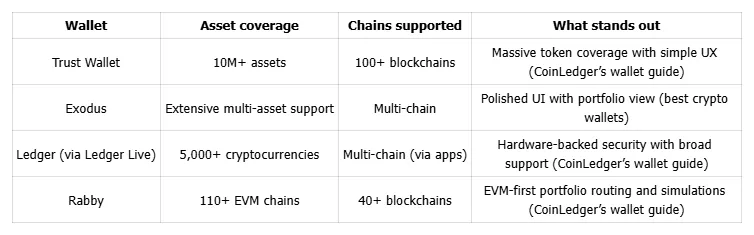
For tokenized assets that exist on multiple chains (e.g., wrapped treasuries, tokenized funds), this breadth simplifies allocation and rebalancing.
DeFi Integration for Enhanced Earning Opportunities
Decentralized finance (DeFi) uses smart contracts to enable lending, borrowing, swaps, and yield strategies without intermediaries. Wallets that connect directly to DeFi dApps unlock additional utility for tokenized assets—think of earning yield on tokenized T-bills or borrowing stablecoins against tokenized real estate equity where supported.
- MetaMask remains the primary gateway to Ethereum-compatible DeFi dApps (best crypto wallets).
- A variety of wallets, such as Crypto.com’s Onchain offerings, support cross-chain use cases, expanding access beyond a single network (best crypto wallets).
Ways DeFi can enhance returns or flexibility for tokenized asset holders include:
- Staking or rewards programs offered by issuers or protocols
- Liquidity provision in compliant pools
- Trading on decentralized exchanges
- Asset-backed lending and borrowing
Note: Returns vary and depend on protocol risk, market conditions, and compliance with applicable regulations.
User-Friendly Wallets Lowering Barriers to Entry
Intuitive wallets are making it easier for newcomers to engage with tokenized markets. Exodus, known for its sleek design and built-in swap feature, exemplifies how clear balances, simple buy/sell flows, and educational prompts facilitate entry into on-chain assets. Similarly, ZenGo eliminates seed phrases with a keyless, threshold-cryptography recovery model, making setup and backup much less stressful (CoinLedger’s wallet guide).
Essential UX features to look for:
- Mobile and desktop access with consistent navigation
- Guided onboarding and human-readable transaction prompts
- Instant support and robust help centers
- Simple, secure backup and recovery options
- Multi-language support for global accessibility
Robust Security Features Safeguarding Investments
Robust wallet security combines hardware protections, secure elements, audited code, and on-device confirmations to guard against theft and unauthorized use—critical for tokenized assets that can represent high-value, real-world claims.
- Trezor Safe 3 features open-source firmware with a secure element for tamper resistance (Forbes Advisor’s wallet review).
- Ledger Nano X combines Bluetooth and mobile support with compatibility for 5,000+ cryptocurrencies (CoinLedger’s wallet guide).
Security features to compare:
- PIN and biometric unlock to prevent local misuse
- Seedless or advanced recovery options (e.g., social/threshold recovery)
- On-device transaction review and confirmation
- Open-source firmware and independent audits
- Physical tamper resistance and secure element chips
Self-custody increases control but also personal responsibility: keep backups offline, validate apps and addresses carefully, and consider a hardware wallet for higher balances.
Web3 Compatibility Unlocking New Asset Utilities
Web3 refers to the decentralized internet stack where users interact directly with smart contracts and dApps. Web3-ready wallets allow investors to engage more actively: they can vote in governance, redeem or claim distributions, manage NFTs, and access in-app asset utilities.
- MetaMask is the default for EVM-based Web3 interactions (best crypto wallets).
- The Base wallet offers dApp integrations across EVM chains for smoother Web3 flows (best crypto wallets).
Practical uses for tokenized asset investors include:
- Storing proof-of-ownership NFTs tied to real-world assets
- Participating in governance voting for tokenized funds or DAOs
- Managing redemptions, claims, and on-chain disclosures
- Using gaming or experiential utilities attached to assets
- Executing cross-chain swaps when moving between ecosystems
Cross-Platform Accessibility for Seamless Management
Cross-platform wallets allow you to monitor and manage tokenized assets from any device without compromising security. This flexibility is invaluable for busy professionals who need timely access to governance actions or to rebalance on the go.
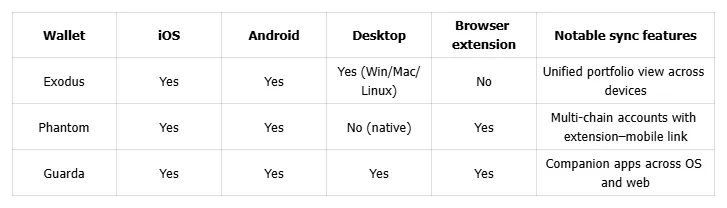
- Exodus runs on both mobile and desktop with synchronized portfolios.
- Phantom supports multi-chain accounts with web and mobile experiences.
- Guarda provides broad OS coverage and browser extension support.
LiquidityFinder’s 2025 wallet guide highlights how these products prioritize platform breadth and continuity.
A quick view of platform coverage:
Advanced Features for Experienced Investors
Sophisticated users often need deeper controls for treasury operations, compliance, and complex strategies. Rabby supports 110+ EVM chains and more than 40 blockchains, making it a strong choice for multi-chain DeFi routing (CoinLedger’s wallet guide). For high-assurance security, Trezor Safe 5 adds an upgraded touchscreen and open-source stack designed for improved usability and auditing (OneKey hardware roundup).
Advanced capabilities to consider:
- Multi-signature or MPC accounts for shared control
- Granular permissioning and connection whitelists
- DAO treasury tooling and spending policies
- Custom dApp integrations and transaction simulations
- Role-based access for teams and auditors
Checklist for choosing an advanced wallet:
- Map your ecosystems (EVM, Solana, Bitcoin, others) and confirm compatibility.
- Decide on custody model (hardware, MPC, multisig) based on team dynamics and risk.
- Verify security posture: audits, open-source coverage, hardware protections.
- Test transaction simulations and permission controls in a sandbox.
- Ensure cross-platform access and reliable recovery before funding.
- Confirm integrations with your target dApps, bridges, and custody policies.
- Document standard operating procedures for signers and recovery.
Frequently Asked Questions
What are tokenized assets and how do they work with a crypto wallet?
Tokenized assets are blockchain tokens representing ownership or rights to real-world assets. A crypto wallet stores your keys, lets you transfer tokens, and connects to apps where you buy, sell, or use them.
How do crypto wallets support fractional ownership of high-value assets?
Wallets hold divisible tokens, allowing you to own and manage small fractions of assets like real estate or art without needing to buy the entire asset.
Are tokenized assets in a crypto wallet legally equivalent to traditional ownership?
Not always; rights depend on the issuer’s legal structure and jurisdiction, with regulators emphasizing that tokenized securities remain classified as securities under existing laws.
How secure is holding tokenized assets in a self-custody wallet compared to platforms?
Self-custody provides full control with no platform counterparty risk, but you must manage backups and device security. Platforms may add safeguards but can introduce custodial risk.
Can tokenized assets in wallets be used as collateral in DeFi or lending?
Yes—if supported by a protocol—many wallets connect to DeFi apps that accept specific tokenized assets as collateral for loans or liquidity strategies, subject to risk and compliance.