How to Choose a Crypto Signal Provider: 7 Key Factors
November 25, 2026
Choosing a crypto signal provider requires more than comparing advertised win rates or joining the largest Telegram group. A provider should be assessed on the quality of its historical records, the transparency of its trading methodology, its approach to risk management, and the identity and commercial interests of the people behind the service.
A useful starting point is to ask whether you can independently review what the provider has published and understand how its claimed results were calculated. A credible-looking performance screenshot is not enough. You need to know whether losing signals are included, when each recommendation was issued, whether entry and exit prices were realistically achievable, and whether trading costs have been considered.

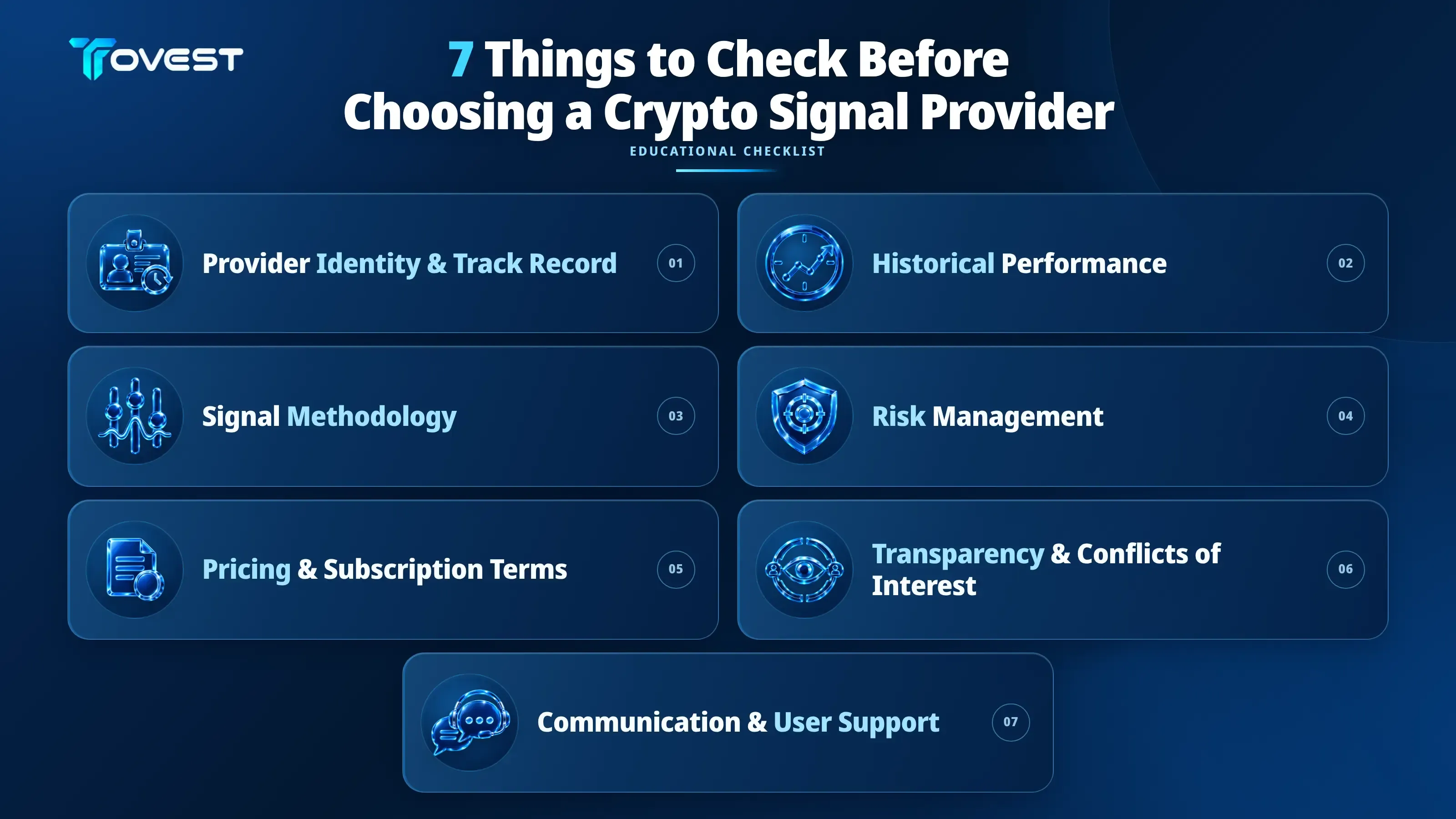
Before paying for a subscription, compare providers against these criteria:
Evaluating Investment Signal Providers
Before subscribing to an investment signal provider, investors should assess its credibility, historical performance, analytical methodology, risk management practices, pricing transparency, potential conflicts of interest, and communication standards.
1.Identity and Track Record
Verify whether the individuals or organisations operating the signal service are identifiable and whether their historical performance records are accessible and independently reviewable.
Warning signs: Anonymous operators, unverifiable trading histories, or selectively presented profit screenshots without complete performance records.
2.Performance
Review the provider's complete historical signal records and understand how its performance metrics are calculated. Check whether reported results account for losing trades, trading fees, slippage, and other relevant costs.
Warning signs: Unexplained win rates, selectively presented results, or guaranteed return claims without verifiable supporting data.
3.Methodology
Understand how trading signals are generated, including entry conditions, market analysis, the rationale behind each recommendation, and the criteria for invalidating a trading idea.
Warning signs: Signals provided without supporting analysis, clear entry conditions, or explanations of the underlying market rationale.
4.Risk Management
Examine the provider's stop-loss conditions, position-sizing recommendations, leverage disclosures, and overall approach to managing potential losses.
Warning signs: Claims of low-risk or risk-free trading, insufficient risk disclosures, or recommendations that encourage excessive leverage without explaining potential losses.
5.Pricing
Review the provider's subscription fees, renewal arrangements, cancellation policies, and any additional charges before committing to a paid service.
Warning signs: Hidden fees, unclear renewal terms, difficult cancellation procedures, or pressure to upgrade to more expensive subscription plans.
6.Conflicts of Interest
Determine whether the provider has affiliate relationships, exchange partnerships, referral arrangements, or other commercial incentives that may influence its trading recommendations.
Warning signs: Undisclosed promotional relationships, recommendations that primarily benefit the provider, or incentives that are not transparently communicated to subscribers.
7.Communication
Evaluate whether the provider delivers timely market updates, explains changes to existing signals, and transparently corrects previous recommendations when market conditions change.
Warning signs: Deleted losing signals, unexplained changes to entry or exit recommendations, or a lack of transparency when previous calls perform poorly.
No checklist can establish that a provider will generate profits. Its purpose is to help you distinguish verifiable information from marketing claims and decide whether a service is suitable for further consideration.
What Is a Crypto Signal Provider?
A crypto signal provider publishes trading ideas or alerts intended to help users assess potential market opportunities. Signals may be distributed through Telegram groups, websites, mobile applications, email newsletters or trading platforms.
A typical signal contains several elements:
- Trading pair or asset: The cryptocurrency being discussed, such as BTC/USDT.
- Direction: Whether the idea concerns a potential long or short position.
- Entry price: A suggested price or price range for entering a trade.
- Take-profit level: A price at which a trader may consider closing some or all of a position.
- Stop-loss level: A predefined price condition intended to limit exposure if the market moves against the trade.
- Timeframe: The period relevant to the trading idea, such as intraday or swing trading.
- Market rationale: An explanation of the conditions behind the recommendation.
Not every provider supplies all these details. Some publish concise alerts, while others include technical analysis, market commentary or educational material. The level of detail matters because users need enough information to understand the recommendation and assess whether its assumptions remain valid.
A signal is not an instruction that must be followed. Market prices can move before a user receives or acts on an alert. An entry price may no longer be available, liquidity may change, and a stop-loss order does not necessarily guarantee execution at the specified price during volatile conditions.
Signal Providers vs. Trading Platforms
A signal provider and a trading platform perform different functions. A provider generally communicates market analysis or trading ideas. A trading platform provides the environment in which users may access markets and place orders, subject to its available products and applicable restrictions.
Crypto Signal Providers vs. Crypto Trading Platforms
Crypto signal providers and crypto trading platforms serve different purposes in the cryptocurrency market. While both may support users in making trading decisions, their primary functions, services, and evaluation criteria are different.
1.Primary Role
A crypto signal provider publishes trading ideas, market analysis, and trading alerts to help users identify potential market opportunities.
A crypto trading platform provides access to cryptocurrency markets and trading services, allowing users to buy, sell, and manage digital assets.
2.Typical Output
Crypto signal providers typically deliver trading recommendations, including suggested entry levels, expected market direction, and risk parameters such as stop-loss and take-profit levels.
Crypto trading platforms typically provide trading functions, including order placement, account information, asset management, and access to available markets.
3.Trade Execution
A crypto signal provider may provide trading recommendations without directly executing trades on behalf of users. Users generally decide whether and how to act on those signals.
A crypto trading platform may facilitate or directly provide trade execution, depending on its operating structure and the services it offers.
4.Main Evaluation Focus
When evaluating a crypto signal provider, users should focus on signal quality, historical performance, transparency, analytical methodology, and risk management practices.
When evaluating a crypto trading platform, users should focus on operational reliability, security measures, fee structures, available trading products, and platform terms and conditions.
5.Key User Consideration
For a crypto signal provider, the main consideration is whether its trading analysis is credible, transparent, and suitable for the user's investment objectives and risk tolerance.
For a crypto trading platform, the main consideration is whether its services, security arrangements, trading features, and contractual terms meet the user's needs.
The distinction is important. A signal provider's recommendation does not establish that a particular trading venue is suitable, that an order can be filled at the suggested price, or that the provider has authority to manage a user's account. Users should review the terms and legal status of each service separately.
How to Choose a Crypto Signal Provider: 7 Key Criteriaz
1.Check the Provider's Identity and Track Record
Start by establishing who operates the service. Look for a consistent company or individual identity, an official website, clear contact information and a history of publishing market-related material. Where the provider claims to employ analysts or financial professionals, check whether those individuals can be independently identified.
An established social media account is not proof of professional competence. Account names, profile photographs and testimonials can be copied or fabricated. The US Securities and Exchange Commission (SEC) has specifically warned about investment-related social media scams involving impersonated professionals and misleading claims of high returns.
You can read the SEC's February 2026 investor alert, Social Media and Stock Tip Scams, for examples of these risks.
The provider's track record also needs scrutiny. A useful record should allow users to review signals over a defined period, including losing, cancelled and unresolved recommendations. Check whether the provider preserves original publication times and explains how it classifies a completed trade.
If only selected winning trades are visible, the available evidence is insufficient to assess overall performance.
2.Verify Historical Performance, Not Just Win Rates
Win rate is one of the most frequently promoted measures in crypto signal marketing. It is also one of the easiest to misinterpret.
A win rate generally represents the proportion of trades classified as successful within a stated sample. However, the figure is meaningful only when the provider explains what counts as a win, which signals are included and how the results are calculated.
Consider two hypothetical providers:
Comparing Crypto Signal Provider Performance
To evaluate the actual performance of two crypto signal providers, investors should look beyond win rates and consider both the average gains from winning trades and the average losses from losing trades.
1.Provider A
Provider A recorded 10 trades, consisting of 8 winning trades and 2 losing trades, resulting in an overall win rate of 80%.
Its average gain per winning trade was 1%, while its average loss per losing trade was 5%.
Based on these figures, the simple gross result was -2%, indicating that despite its high win rate, the larger losses outweighed the smaller gains.
2.Provider B
Provider B also recorded 10 trades, consisting of 5 winning trades and 5 losing trades, resulting in an overall win rate of 50%.
Its average gain per winning trade was 3%, while its average loss per losing trade was 1%.
Based on these figures, the simple gross result was +10%, indicating that its larger average gains more than offset its smaller losses.
3.Performance Comparison
The comparison highlights an important distinction between winning frequency and overall trading performance. Provider A has a higher win rate, but its losses are significantly larger than its gains. Provider B has a lower win rate, but its more favourable gain-to-loss ratio produces a better overall result.
Illustrative example only. These figures are hypothetical and do not represent the performance of any real provider. Results assume equal weighting for each trade and exclude fees, slippage, funding costs and compounding.
Provider A has the higher win rate, but its larger average loss produces a negative simple gross result in this example. Provider B has a lower win rate but a positive result under the stated assumptions.
This illustrates why win rate should be assessed alongside other measures:
- Average gain and average loss: Show how much winning and losing trades contribute to results.
- Risk-reward ratio: Compares potential or realised reward with the risk taken.
- Maximum drawdown: Describes the largest decline from a previous peak over the measured period.
- Sample size: Helps indicate whether a reported result is based on enough observations to be informative.
- Trading costs: Fees, spreads, slippage and, where relevant, funding payments can reduce realised performance.
Ask whether the published results are based on backtesting, simulated trading or live trades. These are not interchangeable. Historical testing applies a strategy to past data; paper trading records simulated decisions; live trading involves actual market execution and its associated costs and constraints.
Even a well-documented historical record cannot establish future performance or guarantee that subscribers will achieve the same results.
3.Understand the Signal Methodology
A provider should be able to explain, at an appropriate level, why a signal was issued. This does not mean revealing every proprietary detail. It does mean providing enough context for users to understand the market conditions and assumptions behind a recommendation.
For example, a signal might refer to a technical price level, a trend condition, trading volume or a broader market development. The explanation should identify the relevant timeframe and clarify what would invalidate the trading idea.
Look for answers to practical questions:
- What market conditions trigger a signal?
- Is the recommendation based on technical analysis, fundamental research, quantitative models or a combination?
- Does the provider explain why a particular entry range is being considered?
- What conditions would make the original analysis no longer relevant?
- Are changes to a signal documented with timestamps and explanations?
Be especially careful with vague claims that a proprietary algorithm or AI system can predict market movements with certainty. Automated analysis may process information or generate trading ideas, but it cannot eliminate market uncertainty.
The CFTC's customer advisory, AI Won't Turn Trading Bots into Money Machines, warns about schemes promoting AI-generated trading signals and algorithms with unreasonable or guaranteed returns. The relevant lesson is not that every automated tool is unreliable; it is that claims about technology should be evaluated through evidence rather than promotional language.
4.Evaluate Risk Management and Trading Instructions
A signal can identify a potential market opportunity without explaining how much risk a trader would take to act on it. That gap matters.
Review whether the provider discusses stop-loss conditions, position sizing, leverage and the possibility that a trade may move against the recommendation. A stated stop-loss level is a risk-management reference, not a guarantee that an order will execute at that exact price. In fast-moving or illiquid markets, execution can differ from the intended level.
Leverage deserves particular attention. It magnifies exposure to price movements and can accelerate losses. A provider that regularly discusses high-leverage trades should explain the associated risks rather than presenting leverage as a shortcut to larger profits.
Also consider whether the recommendations fit your own trading horizon and capacity to absorb losses. A strategy designed for frequent intraday decisions may be unsuitable for someone who cannot monitor markets throughout the day.
The most useful risk information is specific: it explains the assumptions behind a trade, the conditions under which the idea may fail, and the limits of the information being provided.
5.Review Pricing, Free Trials, and Subscription Terms
A crypto signal subscription should be evaluated on its full cost and contractual terms, not simply its advertised monthly price. A low-cost plan may provide limited information, while an expensive service may offer no independently verifiable evidence of better signal quality.
Before paying, check what the subscription actually includes. Does the fee cover all signals, or are important alerts restricted to premium tiers? Are market updates, entry revisions and exit notifications included? Is access limited to a fixed period, and does the subscription renew automatically?
Read the cancellation and refund terms before entering payment details. Look for the renewal date, cancellation process, refund eligibility and any additional charges. Be particularly cautious if a provider requires payment in cryptocurrency to a personal wallet and offers no clear business identity or payment record.
A free trial can help you assess the provider's communication and workflow, but it cannot establish long-term performance. Use the trial to observe whether signals arrive with complete instructions, whether changes are communicated promptly, and whether losing trades remain visible in the channel's history.
6.Check Transparency and Conflicts of Interest
A provider's incentives can influence the signals it distributes. For example, a service may earn referral commissions when subscribers register with a particular exchange, use a specific trading platform or purchase another product. That does not automatically make its analysis unreliable, but the relationship should be disclosed.
Ask whether the provider or its team members hold positions in the assets they discuss, receive compensation from exchanges or projects, or benefit when followers trade particular markets. Check whether sponsored content is clearly identified and whether the provider distinguishes research from promotion.
Also examine how the provider handles unsuccessful calls. A credible record should retain losing signals, cancelled setups and material revisions rather than displaying only selected profitable examples. If historical posts disappear or performance claims cannot be reconciled with original timestamps, treat the record as incomplete.
7.Assess Communication Quality and User Support
A useful signal should be understandable before a trader considers acting on it. The provider should explain the market context, the conditions that invalidate the setup and the assumptions behind its analysis. Vague instructions such as “buy now” or “big move coming” are not a substitute for a defined trading plan.
Evaluate how the provider communicates during volatile conditions. Are changes to entry levels, stop-losses or targets clearly marked? Are updates timestamped? Does the provider explain when a setup is no longer valid, rather than leaving subscribers to interpret silence?
Test the support process with practical questions about signal methodology, risk disclosures, subscription terms and conflicts of interest. Be wary of administrators who pressure members to deposit funds, promise personal account management without clear terms, or request passwords, private keys or seed phrases. Legitimate support should not require access to a user's wallet credentials.
How to Verify a Crypto Signal Provider's Accuracy
A provider's published performance is a claim to investigate, not proof of future results. The most useful approach is to create an independent record of signals and compare the original instructions with observable market data.
Build Your Own Signal Verification Record
Start before following the provider. Save each signal in its original form, including the message timestamp and time zone. Record the asset or trading pair, direction, entry range, stop-loss, take-profit levels, timeframe and stated rationale. Keep subsequent updates as separate entries rather than overwriting the original call.
For each signal, record whether the entry was realistically available after the message was published. A price touched before a signal appeared should not count as an executable entry. Similarly, if the provider changes an entry or target, preserve both the initial and revised instructions.
A practical tracking sheet can include:
- Signal reference: Original message link or archived screenshot, timestamp and time zone.
- Trade parameters: Asset, direction, entry, stop-loss, targets and timeframe.
- Updates: Any changes, cancellations or invalidation notices, with timestamps.
- Market comparison: Price data from a clearly identified exchange or data source.
- Outcome assumptions: Whether the entry was reached, which exit level was reached first, and how ambiguous price movements were treated.
- Estimated costs: Trading fees, spread, slippage and, where relevant, funding payments.
Apply the same rules to every signal. If both a stop-loss and take-profit appear within the same candle and the available data cannot establish which occurred first, mark the outcome as ambiguous instead of choosing the more favourable result. This avoids overstating performance.
Understand the Difference Between Backtesting and Live Results
Backtesting applies a strategy to historical market data. It can help assess how a defined set of rules might have behaved in past conditions, but the result depends on data quality, assumptions and methodology. It does not establish that subscribers received the same signals in real time or could execute them at the displayed prices.
Live results are more relevant to evaluating a signal service, but they still require scrutiny. Ask whether the record includes every signal, whether timestamps are independently verifiable, and whether reported entries reflect executable market prices. Check whether fees, spread, slippage and funding costs are included.
A useful distinction is whether a provider is presenting a theoretical strategy result, a record of published signals, or verified trading-account performance. These are different forms of evidence and should not be treated as interchangeable.
Why Win Rate Alone Is Not Enough
Win rate measures the proportion of recorded trades classified as wins. It does not show how much was gained or lost, how large positions were, or whether the results could be replicated after costs.
A strategy can win frequently but lose more on its occasional losing trades than it earns from multiple winners. Another strategy can have a lower win rate but a more favourable relationship between average gains and average losses. Neither outcome can be assessed from win rate alone.
When reviewing performance, look for the number of signals, average gain and loss, maximum drawdown, risk-to-reward assumptions and the period covered. Also check whether results are calculated using consistent position sizing and whether open or unresolved trades are included. If the provider does not explain its methodology, its headline percentage offers limited decision-making value.
How to Choose a Crypto Signal Provider on Telegram
Telegram makes it easy to distribute market commentary to large groups, but a channel's subscriber count or activity level does not verify the identity or competence of its administrators. Treat the channel as a communication venue, not as evidence of credibility.
Check the Official Channel and Admin Identity
Find the channel through the provider's independently verified website or other established official accounts. Do not rely solely on a Telegram link sent through a direct message. Check usernames carefully: impersonators may use similar names, copied logos or slightly altered handles.
Confirm who operates the channel and whether the provider publishes a business identity, contact details and clear service terms. Be cautious of private messages from accounts claiming to be administrators, especially when they offer exclusive signals or ask you to move funds.
Review Signal History and Community Behavior
Review older posts rather than judging a channel by its latest winning calls. Check whether losing signals remain visible, whether edits are transparent and whether members can ask reasonable questions. A channel dominated by testimonials, urgent deposit requests or claims of guaranteed returns deserves additional scrutiny.
Never share passwords, one-time verification codes, private keys or seed phrases with a signal provider or Telegram administrator. Do not transfer funds to a personal wallet simply because a group moderator recommends it.
The SEC's investor alert on group-chat investment scams, published in December 2025, warns that fraudsters may use investment-related group chats to build trust, impersonate professionals and promote fraudulent trading opportunities. The presence of other members or apparent success stories does not establish legitimacy.
How to Choose a Free Crypto Signal Provider
Understand What Free Signals Actually Offer
Free channels can be useful for observing a provider's analysis style, update frequency and transparency before considering a paid service. However, free access may cover only selected markets or promotional calls. It may not include the full signal history, detailed risk parameters or timely updates available to paying subscribers.
Compare what is actually published with what the provider advertises. If a free channel shows only winning outcomes while paid access is promoted through urgent messages, do not assume the missing record is evidence of stronger performance.
Check Whether the Provider Has Commercial Incentives
Some free services are supported by exchange referral programmes, sponsorships or paid upgrades. Identify how the provider earns revenue and whether those relationships are disclosed. If a recommendation repeatedly directs users to one platform, investigate whether the provider receives compensation and whether the platform is independently established.
Free access does not mean there is no cost or risk. You may still face trading fees, market losses, privacy risks or pressure to register with an unfamiliar service.
Red Flags to Avoid When Choosing a Crypto Signal Provider
Warning Signs When Evaluating Crypto Signal Providers
When choosing a crypto signal provider, investors should be aware of common warning signs that may indicate misleading claims, insufficient transparency, or potential financial risks. The following are key issues to identify and verify before relying on a provider's recommendations.
1.Guaranteed Profits or Claims of Risk-Free Returns
Cryptocurrency markets are inherently uncertain, and no trading strategy can guarantee consistent profits or eliminate investment risks. Providers promising guaranteed returns or risk-free trading may be using unrealistic claims to create false confidence and attract subscribers.
What to chat their signals cannot result in losses.
2.Selective or Missing Trade History
A provider that only showcases profitable trades without disclosing losing trades cannot establish a reliable record of its actual performance. Selectively presented screenshots may create a misleading impression of trading accuracy.
What to check: Compare original, timestamped trading signals with their subsequent outcomes to verify whether the reported performance reflects a complete and consistent trading history.
3.Pressure to Deposit or Trade Immediately
High-pressure tactics that encourage users to deposit funds or execute trades immediately can discourage independent research and proper risk assessment.
What to check: Independently verify the trading platform before depositing funds. Avoid sending money to personal wallets or unfamiliar accounts based solely on a provider's instructions.
4.Requests for Passwords, Private Keys, or Seed Phrases
Passwords, private keys, and wallet seed phrases provide access to sensitive accounts and digital assets. Sharing these credentials may allow others to gain control of funds or wallets.
What to check: Never disclose passwords, private keys, or seed phrases to a signal provider, regardless of the reason given.
5.Unverifiable Credentials or Regulatory Claims
Some providers may misrepresent their professional credentials, regulatory registration, licensing status, or industry affiliations to appear more trustworthy than they actually are.
What to check: Consult the relevant regulator's official register to verify the provider's claimed status and understand what activities its registration or authorisation actually permits.
6.Unclear Referral or Sponsorship Arrangements
Undisclosed referral commissions, exchange partnerships, or sponsorship arrangements may create financial incentives that influence a provider's recommendations.
What to check: Ask how the provider earns revenue, whether it receives referral commissions or sponsorship payments, and whether potential conflicts of interest are clearly disclosed.
Regulatory status requires particular care. Registration, licensing and authorisation are not interchangeable, and requirements differ by jurisdiction and activity. A provider's claim that it is “registered” does not, by itself, establish that its signal service is authorised, independently supervised or endorsed by a government authority. Verify any claimed status directly with the relevant regulator.
The CFTC's advisory on AI trading bots and signal strategies cautions consumers about claims that automated systems or artificial intelligence can generate guaranteed or unreasonably high returns. Technology does not remove market risk or guarantee that a strategy will perform as advertised.
Crypto Signal Provider Evaluation Checklist
Use this checklist to compare providers on evidence rather than marketing claims. The categories are practical due-diligence criteria, not an official certification or scoring standard.
Evaluating the Credibility of a Crypto Signal Provider
Before subscribing to a crypto signal service, investors should conduct a structured assessment of the provider's identity, trading history, performance methodology, risk management, commercial relationships, communication channels, subscription terms, and security practices.
1.Identity and Accountability
Verify the identity of the individuals or organisation operating the service. Review its official website, business information, contact details, and clearly defined service terms to understand who is responsible for providing the signals.
Warning signs: Anonymous operators, unverifiable business information, or no accountable contact through which users can raise questions or complaints.
2.Signal History
Request access to original, timestamped trading signals, including winning trades, losing trades, and cancelled recommendations. Review whether the provider maintains a complete and consistent record of its historical calls.
Warning signs: Screenshots showing only selected profitable trades, missing losing signals, or historical records that cannot be independently verified.
3.Performance Methodology
Understand how the provider calculates its reported performance. Verify the sample period, total number of trades, win/loss calculation method, and whether trading fees, slippage, and other costs are included.
Warning signs: Headline win rates or impressive return figures presented without a clear calculation methodology or supporting trading records.
4.Risk Instructions
Examine whether each trading signal provides clear entry conditions, invalidation levels, stop-loss rationale, and position-sizing guidance. Assess whether the provider communicates potential downside risks alongside expected opportunities.
Warning signs: Vague trading recommendations, missing risk parameters, or pressure to use excessive leverage without explaining the potential losses.
5.Conflicts of Interest
Investigate whether the provider receives referral commissions, sponsorship payments, or other financial incentives from cryptocurrency exchanges, token projects, or related businesses. Check whether the provider also holds or trades the assets it recommends.
Warning signs: Undisclosed compensation arrangements, repeated promotion of particular assets, or recommendations that may be influenced by undisclosed commercial interests.
6.Telegram Integrity
Verify the provider's official Telegram channel links, identify its administrators where possible, and assess whether trading updates and corrections are communicated transparently.
Warning signs: Impersonation accounts, unexplained deletion of losing signals, inconsistent message histories, or unsolicited direct messages requesting payments or personal information.
7.Subscription Terms
Review the total subscription price, payment arrangements, automatic renewal conditions, cancellation procedures, and refund policies before purchasing the service.
Warning signs: Hidden charges, unclear renewal or cancellation conditions, and high-pressure payment requests that discourage users from reviewing the terms.
8.Security Practices
Confirm that the provider does not request sensitive account credentials or direct access to users' cryptocurrency wallets. Understand how payments are collected and whether the payment arrangements are clearly documented.
Warning signs: Requests for passwords, private keys, seed phrases, or transfers of funds to personal wallets as a condition of accessing trading signals.
A provider does not need to satisfy every preference a trader has, but it should be possible to verify what it claims. If essential information is unavailable, treat that uncertainty as part of the risk rather than filling the gaps with assumptions.
Frequently Asked Questions
1.Who Is the Best Crypto Trading Signal Provider?
There is no universally best crypto trading signal provider. Suitability depends on the markets covered, the provider's transparency, the quality of its historical records, its risk methodology and the user's own experience. Compare providers using complete, timestamped signal histories rather than rankings, testimonials or advertised win rates.
2.How Do I Know If a Crypto Signal Provider Is Legitimate?
Check the operator's identity, official communication channels, subscription terms and complete signal history. Verify performance claims against original timestamps and market data, and investigate any claimed regulatory status through the relevant regulator. Avoid providers that guarantee returns, conceal losing trades or request sensitive wallet credentials.
3.Are Free Crypto Signals Worth Using?
Free crypto signals can help users assess a provider's analysis and communication style without paying a subscription. They should not be treated as evidence of reliable performance. Check whether calls are complete, whether losses remain visible and whether the provider earns referral or promotional revenue.
4.How Can I Verify a Crypto Signal Provider's Accuracy?
Save every original signal with its timestamp, entry, stop-loss, targets and subsequent updates. Compare the instructions with historical market prices using consistent rules, and account for fees, spread, slippage and funding where relevant. Track unresolved or ambiguous outcomes separately; do not rely on screenshots or a win-rate claim alone.
5.Is It Safe to Follow Crypto Signals on Telegram?
Telegram itself does not verify a signal provider's identity or performance. Confirm the channel through the provider's official website, check administrator identities and review the full message history. Never share passwords, verification codes, private keys or seed phrases, and do not transfer funds to a wallet controlled by a group administrator.
Expert Verdict
A crypto signal provider should earn credibility through evidence, not confidence or presentation. The decisive test is whether its identity, original calls, risk instructions, performance methodology and commercial incentives can be independently examined.
For traders comparing services, a complete and imperfect record is more informative than a polished collection of winning screenshots. If a provider cannot explain how its results are calculated, how losses are handled or how it is compensated, there is not enough information to make an informed decision. When transparency is missing, walking away is a sound risk-management choice.

