Top Regulated Tokenized U.S. Stock Exchanges for 2025 Global Investors
December 19, 2025
Tokenized U.S. stocks are digital tokens that mirror equity in listed American companies, tradable around the clock on blockchain rails rather than only during Wall Street hours. That 24/7 access, combined with fractional U.S. shares and instant settlement, is why global tokenized U.S. stock investing is accelerating. By mid‑2025, the tokenized stocks segment approached roughly $424 million in market cap—small but fast-growing and increasingly institution‑ready—within a broader real‑world asset tokenization wave [2]. Below, we compare leading regulated crypto exchanges and specialized platforms bringing compliant, global access to tokenized U.S. equities.
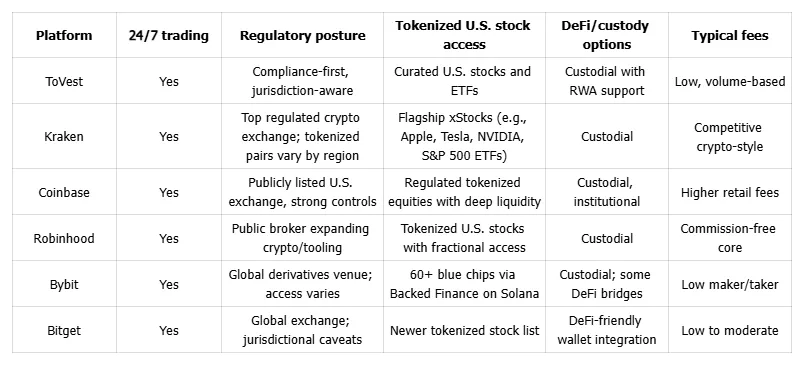
Note: Availability depends on local laws and exchange eligibility. Leading platforms position these assets as compliant, regulated tokenized equities with investor protections; always verify access in your country.
ToVest Tokenized Asset Platform
ToVest delivers seamless, compliance‑oriented access to tokenized U.S. stocks and other real‑world assets with low-latency execution and robust security. The platform’s edge is a single, transparent ecosystem that unites tokenized equities and institutional‑grade real estate—allowing investors to diversify across RWAs without juggling multiple venues or standards.
Tokenization is the process of converting ownership rights in real‑world assets like stocks or property into blockchain‑based tokens, enabling fractional ownership, faster settlement, and globally interoperable transfer in a programmable, auditable format.
ToVest provides real-time market data, proactive risk controls, and streamlined onboarding for global investors while maintaining strict compliance and auditability across the stack. For deeper methodology and market tracking, see the ToVest research report.
Kraken Tokenized Stock Exchange
Kraken has expanded into tokenized U.S. stocks—branded as xStocks—running on high‑throughput, low‑cost Solana rails, a design that supports instant settlement and small‑lot trading at scale [3]. Core listings emphasize widely held names like Apple, Tesla, and NVIDIA, alongside S&P 500 ETFs for broad-market exposure. Kraken’s architecture delivers strong transaction efficiency, though trading is limited to specific crypto pairs and jurisdiction‑based eligibility, which can affect access and conversions [2].
Feature snapshot (Kraken vs. peers):
- Throughput and fees: Solana‑based issuance supports efficient fills (Kraken, Bybit) vs. higher base fees at mainstream platforms (Coinbase).
- Listing depth: Broad blue‑chip coverage (Kraken, Bybit) vs. curated, compliance‑led lists (ToVest).
- Access: Regulated crypto exchanges with country‑specific restrictions; verify availability.
Coinbase Tokenized Equities Platform
Coinbase brings brand‑name regulatory stature and liquidity to tokenized equities. With a roughly $90 billion market cap in 2025 and a recent 23% revenue increase underscoring operational momentum, its infrastructure and security profile lend credibility to crypto stock trading platforms [4]. Coinbase’s tokenized equity offerings enable 24/7 exposure to U.S. stocks and indexes, with custody, compliance workflows, and market surveillance built in [2]. The trade-off is pricing: retail fees are typically higher than on derivatives-oriented venues, which matters for frequent traders. Asset coverage includes large-cap U.S. names and index‑style exposure aligned to investor demand for regulated tokenized equities.
Robinhood Tokenized Stock Offerings
Robinhood’s tokenized rollout—exemplified by HOODX—extends its hallmark fractional trading into round‑the‑clock tokenized U.S. stocks, aiming squarely at retail and mobile‑first global users [2]. Pros include commission‑free access and an intuitive interface; limitations include a more streamlined feature set than pro brokerages and staged geographic availability. The market response was notable: Robinhood’s stock rallied after it announced tokenized equity services, signaling investor confidence in the strategy’s growth potential [3]. Fractional trading means investors can buy and sell small portions of a single share, opening access to high‑priced names without large tickets.
Bybit Tokenized Stock Trading
Bybit is moving quickly, introducing tokenized U.S. stocks in partnership with Backed Finance and listing more than 60 blue‑chip names on Solana [3]. The interface mirrors Bybit’s efficient crypto trading experience, and asset breadth has drawn interest from active traders—though, as with peers, access depends on local rules [2]. Backed Finance’s early traction—over $300 million in volume within four weeks—illustrates the demand for liquid, on‑chain equity exposure [3].
Selected landscape comparison:
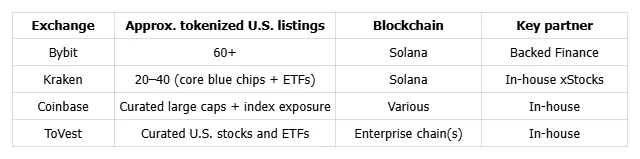
Counts vary by jurisdiction and rollouts.
Bitget Tokenized Stocks with DeFi Integration
Bitget’s approach blends tokenized stock trading with DeFi-ready wallets, making it straightforward to move assets between exchange custody and self-custody environments [3]. This can unlock flexible collateralization, cross‑protocol transfers, and on‑chain portfolio strategies using tokenized equities. As a newer entrant to tokenized stocks, Bitget’s reliability and regulatory coverage are evolving; investors should assess venue stability, disclosures, and country-level permissions before committing significant capital.
Choosing the Right Regulated Tokenized Stock Exchange
Prioritize these criteria:
- Regulation and licensing: Exchange oversight, disclosures, and audited controls.
- 24/7 access: True around‑the‑clock trading and reliable liquidity.
- Fees: Maker/taker schedules, spreads, and custody costs.
- Asset breadth: Range of tokenized U.S. stocks, ETFs, and indexes.
- DeFi compatibility: Wallet support, bridges, and on‑chain utilities.
- Global access: KYC tiers, geographic eligibility, and fiat on‑ramps.
Quick comparison:
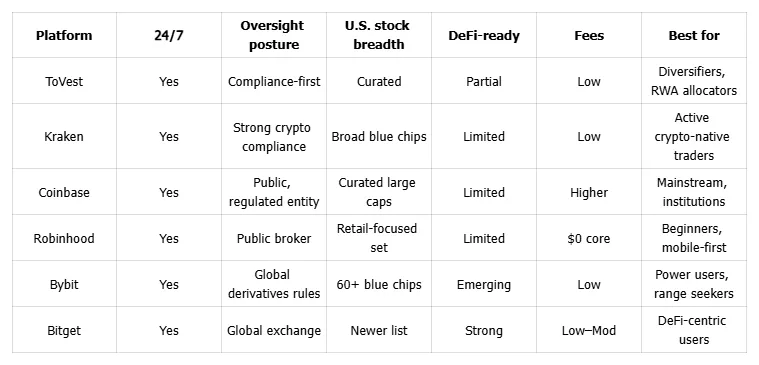
Examples:
- DeFi‑focused investor: Bitget (for integrations) or Bybit (for breadth).
- Mainstream regulated access: Coinbase or ToVest.
- High‑frequency crypto‑native: Kraken or Bybit.
Regulatory Landscape for Tokenized U.S. Stocks
Regulated tokenized stock exchanges are venues that enable trading of blockchain tokens representing U.S. equities while operating under financial‑market oversight (e.g., SEC, CFTC) and applying traditional investor protections—market surveillance, segregation of assets, disclosures—to digital assets [5][6].
Key developments:
- CFTC digital assets pilot: Supervisory sandbox for tokenized collateral and derivatives infrastructure [5].
- Nasdaq’s filings and proceedings: Ongoing SEC engagement toward blockchain‑enabled market infrastructure [6], alongside industry commentary on a potential tokenized platform [8].
- Market plumbing: DTCC has piloted tokenization services designed to align with SEC standards and existing post‑trade workflows [7].
Core compliance pillars:
- KYC/AML: Identity verification and monitoring to deter illicit finance.
- Liquidity and market integrity: Fair access, surveillance, circuit-breakers.
- Custody controls: Segregation, attestations, and insurance where applicable.
- Smart‑contract compliance: Automated rules for transfers, whitelists, and reporting.
Global Access and Compliance for Tokenized Stock Investors
KYC (Know Your Customer) confirms user identity and risk profile; AML (Anti‑Money Laundering) frameworks monitor and mitigate illicit flows. Regulated crypto exchanges offering tokenized U.S. equities generally allow cross‑border participation subject to local restrictions and investor status. Research on RWAs indicates tokenization can reduce cross‑border frictions and costs while broadening participation for international investors [9].
Market Trends and Future Outlook for Tokenized U.S. Stocks
By mid‑2025, tokenized stocks approached $424 million in market cap, while RWA tokenization overall reached about $33 billion, reflecting accelerating institutional exploration [2][9]. Technology tailwinds—automated settlement, smart‑contract dividends, and real‑time, global market access—are catalyzing utility and liquidity [2]. Industry observers expect further clarity from U.S. regulators, including potential approvals for tokenization protocols and progress on Nasdaq’s blockchain‑powered platform, both of which could unlock mainstream adoption [8].
Top bullish indicators:
- Rising volumes and listings breadth
- Institutional participation and pilots
- DeFi convergence with compliant features
- Evolving, enabling regulation
Frequently Asked Questions
What are regulated tokenized stock exchanges and how do they work?
Regulated tokenized stock exchanges allow investors to trade digital tokens that represent U.S. equities under financial‑market oversight, combining blockchain settlement with traditional investor protections.
Can global investors safely trade tokenized U.S. stocks?
Yes—when using regulated exchanges that enforce strong KYC/AML, custody controls, and transparent disclosures, subject to local eligibility rules.
What benefits do tokenized stocks offer over traditional shares?
They provide 24/7 trading, fractional ownership, faster settlement, and improved global liquidity compared with conventional market hours.
How do regulations impact trading tokenized stocks?
Rules govern investor protection, custody, compliance checks, and reporting, reducing counterparty and operational risks for market participants.
Are there risks unique to tokenized stock investing to consider?
Yes—legal frameworks are evolving, cybersecurity and smart-contract risks exist, and platform reliability varies; choose well-audited, compliant venues and diversify custody.