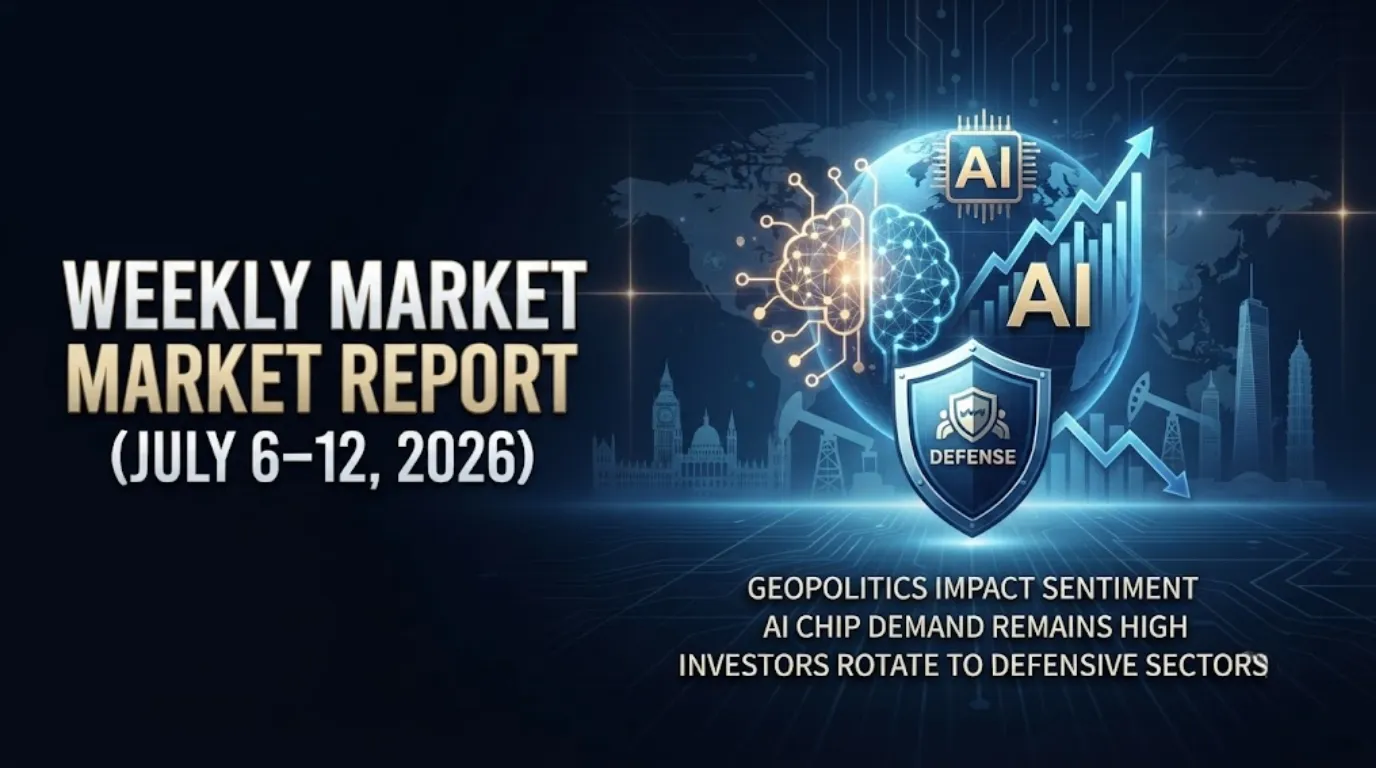
Weekly Market Report: Geopolitics, AI Records, and a Market Playing Defense
July 13, 2026
This was a week defined by contradiction. US equities set new all-time highs while semiconductor stocks sold off sharply. Gold slipped below $4,000 for the first time in months even as China loaded up on reserves. Bitcoin barely moved while a piece of legislation that formally bans a US central bank digital currency quietly passed. Oil surged on genuine supply-chain fear. And the AI industry launched more new models in five days than most quarters produce. Beneath the surface noise, one theme connected almost everything: a market increasingly split between structural long-term optimism and short-term defensive positioning, with capital rotating toward assets perceived as more durable than the next news cycle.
US Equities: Records on Monday, Reversals by Tuesday
The Dow Jones crossed 53,000 for the first time in its history on July 6, carried by renewed confidence in AI-linked earnings. The S&P 500 and Nasdaq followed higher. By July 7, the same enthusiasm that lifted markets reversed into a sharp semiconductor selloff — Micron fell 4.7%, dragging KLA, Marvell, Broadcom, and AMD lower with it. The Dow gave back the record. The pattern is increasingly familiar: AI optimism inflates valuation multiples, a single data point or earnings signal resets them, and the cycle repeats.
The standout event of the week was SK Hynix's US listing — the largest IPO of a foreign company in American market history, raising over $26 billion. Shares surged nearly 20% on the first trading day, a reminder that institutional appetite for semiconductor and memory exposure tied to AI infrastructure remains deep, even as the market simultaneously frets about AI valuation excess. The SK Hynix listing and the Micron selloff happening in the same week is not a contradiction — it is two sides of the same bet: high conviction in AI infrastructure demand, but low patience for any individual name that disappoints.
Read-through for tokenized assets: The volatility in AI-linked equities is a useful reminder that exposure to a structural theme through a single stock or sector carries concentration risk that diversified, asset-backed instruments do not. Tokenized real-world assets and tokenized equities with broader exposure profiles are increasingly relevant in a market where a single earnings miss can erase a week of gains.
Crypto: Defensive, But With a Structural Signal Worth Watching
Bitcoin spent the week range-bound between approximately $61,000 and $65,000, closing around $64,198 on July 12. The Fear & Greed Index sat at 26 — deep in "fear" territory — signaling that the market is in a defensive, wait-and-see posture rather than an active risk-taking one. Bitcoin dominance reached 56.24% of a total crypto market capitalization of approximately $2.29 trillion, a figure that tells a precise story: capital is not leaving the crypto market, it is consolidating into Bitcoin specifically, treating it as the most defensible position in the asset class while uncertainty persists.
Ethereum held a $1,700–$1,800 range. Altcoins including XRP and Solana moved with low conviction in either direction. This is not the setup of a market preparing to rally broadly — it is the setup of a market waiting for a catalyst that has not yet arrived.
The most structurally significant development of the week had nothing to do with price. Legislation banning a US central bank digital currency — CBDC — became law by automatic passage, a four-year prohibition on a government-issued digital dollar. The implications are meaningful: a CBDC ban removes one of the most credible structural threats to stablecoin-denominated crypto ecosystems, and to RWA tokenization infrastructure that relies on stablecoin settlement. This is not a price catalyst for this week — the market barely reacted — but it is a durable regulatory tailwind that compounds quietly alongside the deregulatory trend already underway.
Read-through for tokenized assets: Bitcoin dominance at 56% during a fear period is a classic flight-to-quality signal within crypto. The parallel in the RWA world is a shift toward tokenized gold and tokenized real-estate instruments over speculative token exposure. The CBDC ban is the more important long-term signal — it clears a regulatory overhang for stablecoin and RWA infrastructure that investors should not underestimate.
Gold: Short-Term Pressure, Long-Term Demand Intact
Gold had a difficult week. US military strikes against Iranian coastal provinces and the revocation of Iran's oil export licenses pushed the dollar and bond yields higher — a combination that typically weighs on gold. At one point, gold fell below $4,000 per ounce, its worst quarterly performance since 2013, before recovering to close the week around $4,120 — down approximately 1.4% week-over-week. Domestically, SJC gold bars declined to approximately 150 million VND per tael.
The bear case is straightforward: if the Fed holds rates higher for longer, the opportunity cost of holding gold rises. Bank of America revised its full-year 2026 gold price target down to $4,360 from a higher level; HSBC moved to $4,560. These are still high targets by historical standards — but they reflect a reassessment of the rate path rather than a reversal of the structural gold thesis.
The long-term demand picture, however, remains intact. China recorded its largest monthly increase in gold reserves in over two and a half years during June — central bank accumulation at that scale is patient, non-speculative demand that does not reverse on a single week of geopolitical headlines. When institutional and sovereign demand continues while price temporarily dips on macro noise, the divergence between short-term sentiment and long-term positioning becomes the most important data point for investors with a medium-term horizon.
Read-through for tokenized assets: This is precisely the environment where tokenized gold's structural advantages are most visible. A retail investor who owns physical gold faces storage costs, illiquidity, and friction selling into a temporary dip. A holder of tokenized gold can rebalance instantly, hold fractional positions, and stay exposed to gold's long-term demand thesis without the operational overhead that has historically made short-term management of physical gold difficult for non-institutional investors.
Oil: The Week's Clearest Move, and Its Limits
Brent crude rose approximately 6% on the week; WTI rose approximately 5%. The driver was unambiguous: Iranian retaliatory strikes against US military installations in the Gulf, following US strikes on Iranian coastal facilities. The market priced genuine supply-chain risk, specifically the possibility of disruption to the Strait of Hormuz — through which roughly 20% of global oil supply transits daily.
Two factors limited the panic: the US explicitly excluded energy infrastructure from its targeting list, and the Trump administration publicly signaled it does not expect a return to full-scale war. The market took those signals seriously enough to prevent an uncontrolled spike, but not seriously enough to ignore the Hormuz risk entirely. The result was a sharp, controlled move rather than a disorderly one.
Read-through for tokenized assets: Energy-linked geopolitical risk is the category of shock that tends to compress financial liquidity quickly and simultaneously support hard assets. Oil's 6% weekly move in this environment is a reminder of why commodity exposure — including through tokenized commodity instruments — functions differently in a portfolio than equity exposure during the same shock.
AI: Five Days, More New Models Than Most Quarters
The AI product calendar this week was unusually dense. OpenAI released GPT-5.6 across three variants — Sol, Terra, and Luna — alongside GPT-Live, a full-duplex voice model capable of simultaneous listening, speaking, and reasoning, and ChatGPT Work, an office-oriented AI agent. Meta launched Muse Spark Image on July 7, its first AI image product following Zuckerberg's AI restructuring, and previewed Muse Video — though Meta was simultaneously forced to withdraw a feature that used public Instagram images to generate AI output, following significant privacy criticism. SpaceX AI (formerly xAI) released Grok 4.5 on July 8, a model purpose-built for coding and AI agents, trained on tens of thousands of Nvidia GB300 GPUs and priced meaningfully below comparable Claude and GPT-5.6 tiers.
The legal dimension: Apple filed suit against OpenAI, alleging theft of trade secrets to develop hardware — a signal that AI litigation is now moving beyond regulatory skirmishes and into IP-level corporate conflict.
The semiconductor market's reaction to all of this was a selloff, not a rally — a sign that the market has already priced in a great deal of AI infrastructure demand and is now more sensitive to execution risk than to announcement headlines. The week's AI story is best read as a "delivery stress-test": the models are arriving, but investor patience for the gap between model capability and monetizable revenue is shortening.
Read-through for tokenized assets: As AI infrastructure spending becomes one of the dominant themes in global capital allocation, the question of which asset classes benefit structurally (not just narratively) matters. Compute-intensive AI investment tends to be deflationary for the cost of intelligence but inflationary for energy, real estate (data centers), and certain commodity inputs — all asset classes with tokenized exposure pathways that did not exist five years ago.
The Week in Summary: What the Market Is Actually Saying
Strip away the individual headlines and two readings emerge. The first: short-term positioning is defensive across almost every major asset class — crypto is consolidating into Bitcoin, gold is under pressure from rate expectations, equities are rotating between AI optimism and valuation anxiety, and oil is pricing genuine but bounded geopolitical risk. The second: the structural foundations for hard assets, tokenized real-world instruments, and crypto infrastructure are quietly strengthening — through central bank gold demand, a CBDC ban, continued AI infrastructure investment, and a deregulatory posture toward digital assets.
The weeks where markets look the most uncertain are often the weeks that matter most for medium-term positioning. The noise is loud; the signal — central bank demand, regulatory clarity, infrastructure buildout — is quieter but more durable.