Crypto vs Tokenized Assets: What's the Difference and Which Is Right for You?
July 30, 2026
The Short Answer
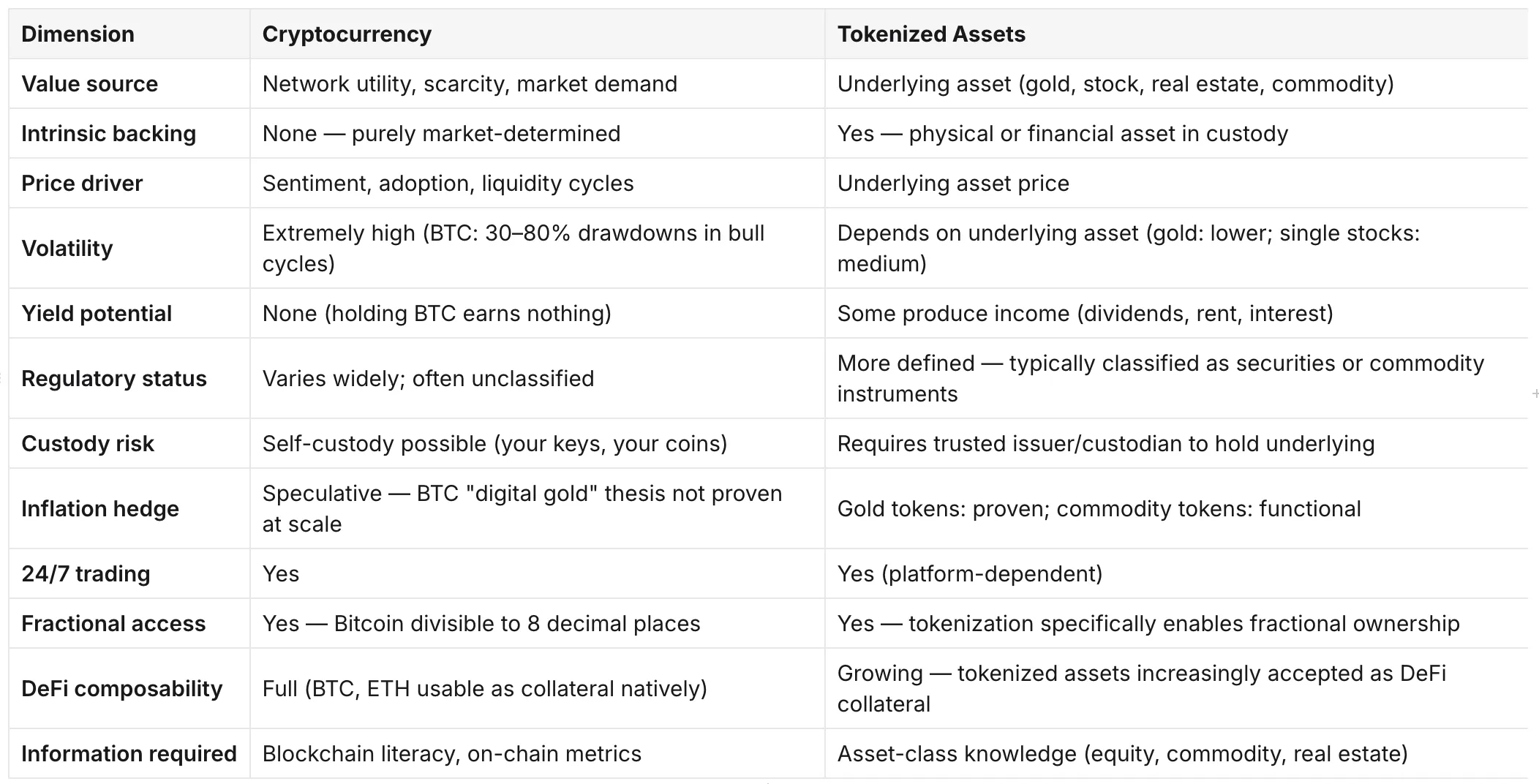
Cryptocurrency (Bitcoin, Ethereum, Solana) derives its value from network utility, scarcity, and market demand. There is no underlying physical asset. The price is what the market will pay — nothing more.
Tokenized assets (tokenized gold, tokenized Apple stock, tokenized oil, tokenized real estate) are digital tokens that represent ownership of something that already exists in the physical or financial world. The token's value is anchored to the underlying asset — a gram of gold, a share of Apple, a barrel of oil.
The distinction matters because it determines how you evaluate each investment, what risks you are taking, and what role each plays in a portfolio.
Both are blockchain-based. Both are accessible via a digital wallet. Beyond those two similarities, they are fundamentally different investment categories.
Side-by-Side: The Core Differences
What Cryptocurrency Actually Is
Cryptocurrency is a native digital asset — it was born on a blockchain and exists nowhere else. There is no vault holding Bitcoin on your behalf. There is no underlying company generating cash flows for Ethereum. The asset is the network itself.
The investment thesis for cryptocurrency:
- Scarcity: Bitcoin has a hard cap of 21 million coins, enforced by code. Scarcity drives value when demand increases.
- Network effect: Ethereum's value comes from the applications built on it — DeFi protocols, NFT markets, tokenized asset platforms. More applications = more demand for ETH to pay fees.
- Store of value narrative: Bitcoin's "digital gold" thesis — that it will function as an inflation hedge and wealth preservation tool over long time horizons — has attracted institutional adoption but is not definitively proven across a full economic cycle.
- Speculative premium: A significant portion of crypto prices at any given time reflects future adoption expectations, not current utility. This is the source of both extraordinary upside and catastrophic drawdowns.
Concrete examples:
- Bitcoin (BTC): No underlying asset. Value = market consensus on its monetary properties and scarcity.
- Ethereum (ETH): No underlying asset. Value = network usage fees and the applications running on it.
- Solana (SOL): No underlying asset. Value = transaction throughput and developer adoption of the Solana ecosystem.
- Memecoins (DOGE, SHIB, etc.): No underlying asset, no utility. Value = pure speculative demand and community momentum.
What Tokenized Assets Actually Are
Tokenized assets are representations of existing assets on a blockchain. The innovation is the delivery mechanism — blockchain-based ownership records — not the asset itself.
The investment thesis for tokenized assets:
- Direct ownership of known assets: You are buying gold, Apple stock, or commercial real estate — assets with centuries-long track records — in a more efficient delivery format.
- Fractional access: $50 can buy a fraction of a $400 Apple share or 0.015 ounces of gold. The blockchain enables precision fractional ownership that paper certificates cannot.
- Operational efficiency: No T+2 settlement, no paper transfer requirements, 24/7 liquidity, near-instant on-chain settlement.
- Portfolio integration: Tokenized assets behave like their underlying assets in a portfolio — gold tokens provide gold's inflation hedge, tokenized stocks provide equity market returns.
Concrete examples:
- PAXG (Paxos Gold): 1 token = 1 troy ounce of physical gold in Brinks vaults. Value = gold spot price.
- Tokenized Apple (AAPL token): 1 token = 1 share of Apple Inc. Value = Apple stock price.
- RWA tokenized real estate: 1 token = fractional ownership of a commercial building. Value = property value + rental income.
- Tokenized US Treasury fund (BUIDL): Token represents shares in a money market fund holding US government debt. Value = NAV of the fund.
Where They Overlap: The Confusion Zone
Several categories exist at the boundary between crypto and tokenized assets. These are often misclassified:
Stablecoins (USDT, USDC):
Stablecoins are cryptocurrency tokens that are pegged to the value of a fiat currency. USDT is a crypto token whose value is backed by dollar-denominated assets held by Tether Limited. This makes USDT a tokenized asset (tokenized US dollar) that looks and behaves like cryptocurrency in wallets and exchanges. The key question: is the backing real, audited, and redeemable? For regulated stablecoins, yes. For unaudited ones, potentially no.
Wrapped assets (WBTC):
Wrapped Bitcoin (WBTC) is an Ethereum-based token representing Bitcoin held in custody. It is Bitcoin (a cryptocurrency) delivered as an Ethereum token (a form of tokenization). The underlying is pure crypto, not a physical asset.
Utility tokens with real-world asset backing:
Some projects issue tokens that claim backing by physical assets but have not established verifiable custody arrangements. These are not equivalent to properly custodied tokenized assets — they are crypto tokens with an unverified backing claim.
Rule of thumb: If you can answer "where specifically is the underlying asset held, who audits it, and how do I redeem the token for the underlying?" — it is a tokenized asset with legitimate backing. If you cannot answer those questions, treat it as pure crypto risk.
Risk Profile Comparison
Cryptocurrency Risk Profile
High volatility, high potential return, no floor
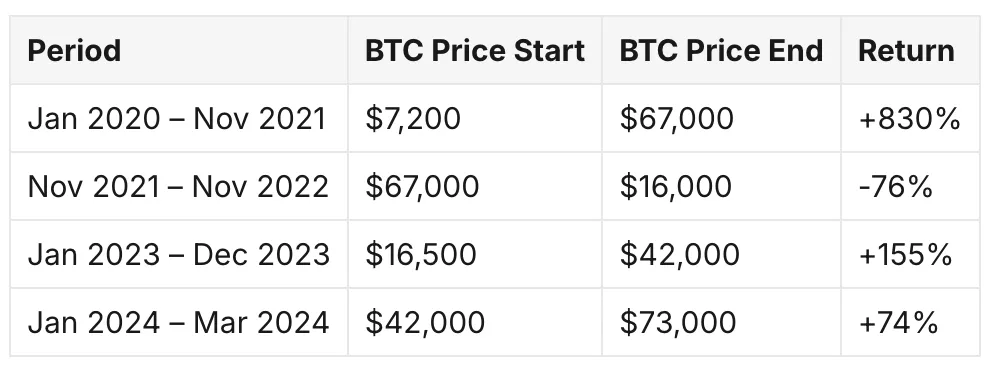
Bitcoin has experienced eight drawdowns of 30% or more since 2017, including:
- 84% decline from December 2017 to December 2018
- 54% decline in May 2021
- 77% decline from November 2021 to November 2022
Within those same periods, Bitcoin also delivered:
- 1,900% gain from January 2017 to December 2017
- 559% gain from October 2020 to November 2021
The pattern: crypto generates exceptional returns during adoption and liquidity expansion cycles, and severe losses during contractions. There is no fundamental floor — a cryptocurrency can theoretically go to zero if adoption collapses. Bitcoin is the least likely to do so; smaller cryptocurrencies have done so repeatedly.
Crypto-specific risks:
- Exchange hacks and insolvency (Mt. Gox 2014, FTX 2022)
- Protocol failures (Terra/LUNA 2022)
- Regulatory bans in specific jurisdictions
- Wallet loss / private key loss (estimated 3-4 million BTC permanently inaccessible)
- Liquidity crises during market stress
Tokenized Asset Risk Profile
Asset-class specific volatility, backed floor, issuer risk
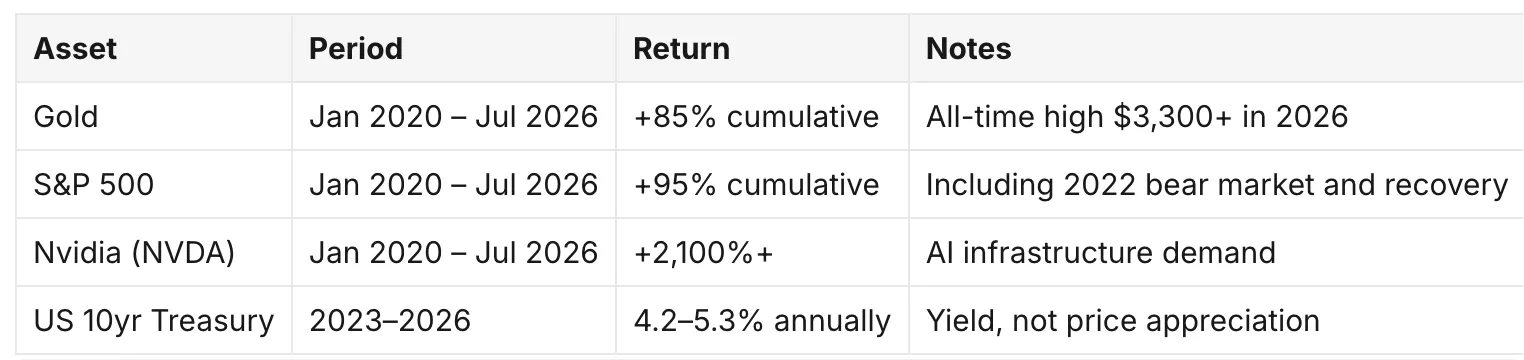
The volatility of a tokenized asset tracks the underlying:
- Tokenized gold: roughly the volatility of gold (~15-20% annual volatility historically)
- Tokenized S&P 500 stocks: roughly the volatility of equities (~15-20% annual volatility; individual stocks higher)
- Tokenized oil: commodity-level volatility (oil fell 65% in 2020; recovered 300% by 2022)
- Tokenized US Treasuries: near-zero price volatility (yield, not price appreciation)
Additional risks specific to tokenized assets:
- Issuer/custodian risk: If the entity holding the underlying asset fails, your token may lose value even if the asset market is performing well
- Regulatory classification risk: Securities regulators may reclassify certain tokenized assets, affecting platform availability
- Redemption mechanism risk: The ability to redeem tokens for underlying assets varies by platform and product
The key difference from pure crypto: Tokenized assets have an economic anchor. A tokenized gold token's value cannot go to zero while gold exists — because it represents a legal claim on physical gold. A meme coin's value can go to zero in 48 hours because it represents nothing.
Return Comparison: Historical Evidence
Cryptocurrency (Bitcoin) — Documented Returns
Tokenized Assets — Underlying Asset Returns
The honest comparison:
Bitcoin's best periods dramatically outperform tokenized assets. Bitcoin's worst periods dramatically underperform them. Gold lost 5% in 2021 while Bitcoin gained 59%. Bitcoin lost 76% in 2022 while gold lost only 2%.
For an investor who times crypto cycles correctly, crypto outperforms. For an investor who holds through full cycles, the risk-adjusted returns of tokenized assets are more predictable.
Which Is Right for You? A Decision Framework
There is no universal answer. The right allocation depends on your investment horizon, risk tolerance, and what role each asset plays in your portfolio.
Choose cryptocurrency exposure if:
- You have a long investment horizon (5+ years) and can absorb 50-80% drawdowns without forced selling
- You believe in the long-term adoption thesis for Bitcoin or Ethereum specifically
- You want asymmetric upside potential — the possibility of 5-10x returns that tokenized assets cannot match
- You have already covered your base financial needs and are investing genuinely discretionary capital
- You understand on-chain metrics and signal frameworks well enough to manage cycle risk
Appropriate allocation: Most financial advisors with crypto exposure suggest 1-10% of total investable assets in cryptocurrency for investors who are not crypto specialists. Higher allocations require active cycle management.
Choose tokenized assets if:
- You want exposure to a specific asset class (gold, equities, commodities) without the operational friction of traditional markets
- You hold USDT and want to deploy it into productive assets rather than purely speculative ones
- You are building a diversified long-term portfolio and want equity market returns without a brokerage account
- You want lower volatility than pure crypto with better return potential than cash
- You are investing capital that cannot afford a 70% drawdown — savings, medium-term goals
Appropriate allocation: Tokenized stocks and gold can function as core portfolio holdings — the same allocation you would give to a traditional brokerage account or gold ETF.
Consider both if:
- You want to construct a USDT-native portfolio that covers the full risk-return spectrum
- You are in a crypto bull cycle (MVRV in expansion, post-halving window) and want exposure to both the speculation layer (crypto) and the stability layer (tokenized assets)
- You are a Vietnamese or Southeast Asian investor with no access to traditional financial infrastructure — USDT + tokenized assets + crypto gives you a complete capital markets portfolio from a single wallet
Building a Balanced USDT Portfolio with Both
A practical portfolio framework using USDT as the base currency, incorporating both crypto and tokenized assets:
Conservative (capital preservation + moderate growth):
- 40% Tokenized US Treasuries / money market (4.5–5.5% yield, near-zero volatility)
- 30% Tokenized global stocks (fractional S&P 500 exposure, equity returns)
- 20% Tokenized gold (inflation hedge, lower volatility)
- 10% Bitcoin (cycle participation, asymmetric upside)
Balanced (growth + managed volatility):
- 20% Tokenized Treasuries / yield products
- 30% Tokenized stocks (focused on AI infrastructure, tech)
- 15% Tokenized gold and commodities
- 25% Bitcoin
- 10% Ethereum / major crypto
Growth (maximum upside, high risk tolerance):
- 10% Tokenized yield products (floor allocation)
- 20% Tokenized stocks (high-growth names)
- 10% Tokenized gold (defensive anchor)
- 40% Bitcoin
- 20% Ethereum and other major crypto
In each model, tokenized assets provide the portfolio's stability anchor. Crypto provides the performance multiplier during bull cycles. The allocation between them should shift with the market cycle — reducing crypto exposure as MVRV Z-Score approaches danger zones, increasing it when on-chain metrics signal deep value.
How ToVest Enables Both Sides of the Equation
ToVest is built around the insight that a Vietnamese retail investor should not have to choose between accessing crypto and accessing tokenized real-world assets — the same platform, the same USDT wallet, the same account.
On ToVest, a single USDT account gives access to:
- Tokenized stocks of major US companies (Apple, Nvidia, Tesla, Microsoft)
- Tokenized gold and commodities (oil, copper, energy transition metals)
- Pre-IPO equity in high-growth private companies
- Crypto assets with signal-informed allocation context
This matters because the "crypto vs tokenized assets" choice is a false binary for a well-structured portfolio. The real question is allocation — how much of each, in what proportion, at what point in the market cycle.
ToVest provides the products for both sides of that allocation in one place, accessible with USDT, without USD brokerage accounts, without currency conversion, and without the English-only interfaces of international platforms.
Build your USDT portfolio on ToVest →
Summary: Key Differences in Three Sentences
Cryptocurrency derives value from network adoption, scarcity, and market demand — with no underlying asset, no yield, and potentially unlimited upside or total loss. Tokenized assets derive value from their underlying physical or financial asset — with an economic anchor that prevents total loss but limits upside to what the underlying asset produces. A complete investment portfolio in 2026 benefits from both: tokenized assets for stability and real-asset exposure, crypto for cycle participation and asymmetric return potential.
Risk Disclosure
Both cryptocurrency and tokenized assets carry risk of partial or total loss. Cryptocurrency has experienced drawdowns of 76-84% from peak to trough in previous cycles. Tokenized assets carry issuer, custodian, smart contract, and liquidity risks in addition to underlying asset price risk. Past performance does not predict future results. This article is informational and does not constitute financial advice. Consult a qualified financial advisor before making investment decisions.