USDT Yield Strategies: Where Are Smart Investors Putting Their Stablecoins in 2026?
July 29, 2026
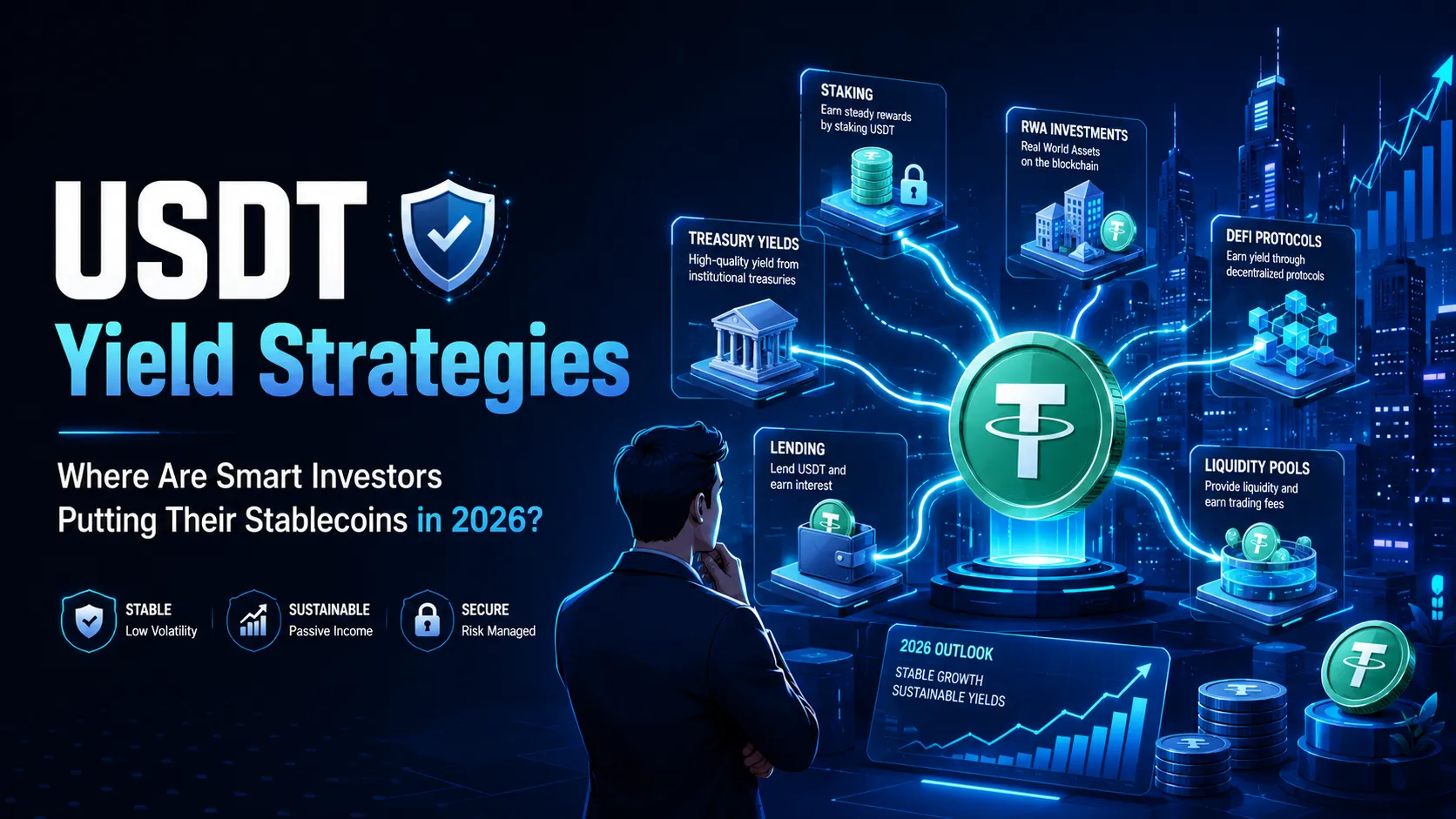
Why USDT Yield Is a 2026 Priority
USDT (Tether) is the world's largest stablecoin by market cap, with over $110 billion in circulation as of mid-2026. For investors in Vietnam and Southeast Asia, USDT has become the default dollar-denominated holding: a way to preserve USD purchasing power without a US bank account, while keeping capital liquid for investment deployment.
The question that follows logically: if you are holding USDT anyway, what can it earn?
In 2026, the answer to that question has more structure than at any previous point. Yield strategies for USDT range from near-zero-risk institutional lending products at 4-6% annually to higher-risk DeFi liquidity provision at 15-30%+. The landscape is wide enough that the strategy question matters more than the asset question — and wide enough that uninformed choices carry real risk.
This article maps the full landscape: what each strategy is, what it realistically yields, and what risk it carries.
The Four Risk Tiers of USDT Yield
The most useful framework for USDT yield is a risk-tiered map. Yield and risk move together — strategies offering dramatically higher returns than the risk-free rate are compensating for risks that are real, not imaginary.
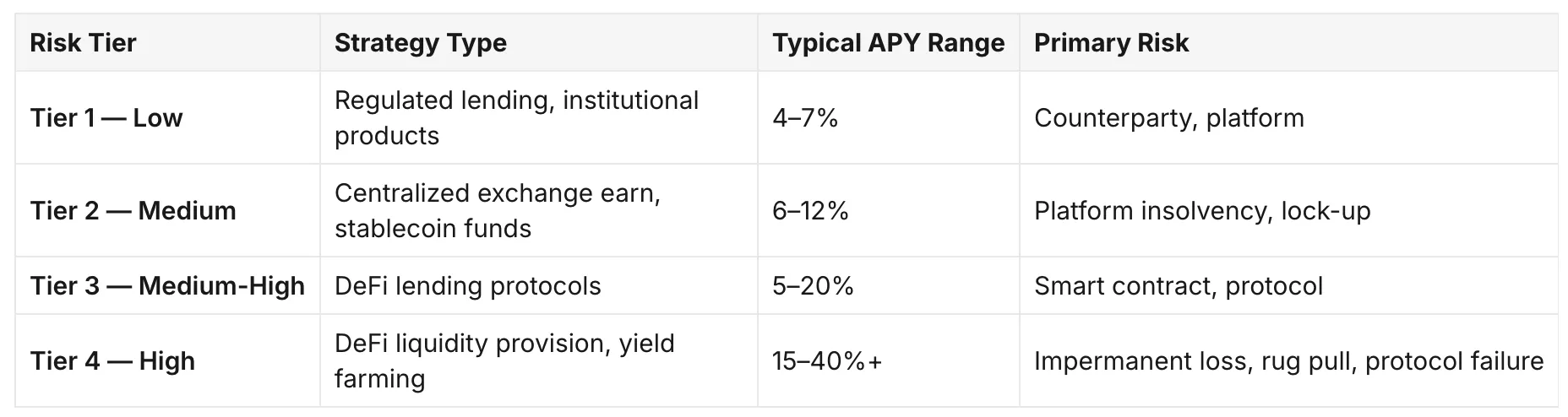
A USDT holder should be able to name which tier they are operating in and why. Any strategy offering Tier 4 returns with claims of Tier 1 risk is either misrepresented or misunderstood.
Tier 1: Low-Risk USDT Yield Strategies (4–7% APY)
Regulated Stablecoin Lending Products
Several regulated financial institutions now offer USDT lending products that place your stablecoin into short-duration, collateralized lending programs. The borrowers are typically institutional: trading firms, hedge funds, and crypto market makers who post collateral exceeding the loan value.
How it works:
- You deposit USDT into the platform
- The platform lends it to institutional borrowers at overcollateralized rates
- You receive interest daily, weekly, or monthly depending on the product
- Your capital is protected by the collateral requirements, not by an insurance fund
Typical yield: 4–7% annually, paid in USDT
Lock-up: Ranges from zero (instant withdrawal) to 30-day terms
Key risk: The platform itself — if it fails, recovery of your USDT depends on legal process and liquidation of collateral. Post-FTX, platform selection is the primary due-diligence question at this tier.
What to look for:
- Proof of reserves published by a third-party auditor
- Regulated entity status in Singapore, EU, or UAE
- Transparent borrower collateral requirements (overcollateralization ratio of 130%+ is the institutional standard)
Tokenized Money Market Funds
Several asset managers now offer tokenized money market funds that accept USDT as entry currency. The underlying assets are short-duration US Treasuries and high-grade commercial paper — the same instruments that traditional money market funds hold.
BlackRock's BUIDL and Franklin Templeton's FOBXX are the two largest institutional products in this category. Retail-accessible equivalents are appearing on regulated platforms in 2026.
Typical yield: 4.5–5.5% annually in the current rate environment (tracks short-term Treasury yields)
Key advantage: You are lending to the US government, not to a crypto trading firm — substantially lower counterparty risk than most crypto-native yield products
Tier 2: Medium-Risk USDT Yield Strategies (6–12% APY)
Centralized Exchange Earn Products
Major centralized exchanges (Binance Earn, OKX Earn, Bybit Earn) offer flexible and fixed-term USDT savings products. Flexible products allow withdrawal at any time; fixed-term products lock capital for 7, 14, 30, or 90 days in exchange for higher rates.
Typical yield:
- Flexible: 3–6% APY (lower due to on-demand liquidity)
- 30-day fixed: 6–10% APY
- 90-day fixed: 8–12% APY
Key risk: The exchange itself. If the exchange becomes insolvent — as FTX did in 2022 — your USDT in an earn product is an unsecured claim in bankruptcy proceedings, not a segregated asset. This is the critical distinction: exchange earn products are not savings accounts with deposit insurance.
Mitigation:
- Use only top-tier exchanges with proof of reserves (Binance, OKX, Kraken publish third-party attestations)
- Never hold more than you are prepared to lose on a single platform
- Prefer regulated exchanges with clear jurisdictional standing
Stablecoin-to-Stablecoin Liquidity Pools
Some DeFi protocols offer liquidity pools that pair USDT with other stablecoins (USDC, DAI, BUSD). Because both assets in the pool are dollar-pegged, impermanent loss — the main risk of standard liquidity provision — is near zero. You are essentially providing liquidity for traders who want to swap between stablecoin types.
Typical yield: 5–12% APY, paid in pool fees and sometimes protocol token rewards
Key risk: Smart contract vulnerability in the pool contract. Curve Finance's stablecoin pools, for example, have undergone multiple security audits — but no audit eliminates all risk. The Curve hack of July 2023 resulted in significant losses despite the protocol's reputation.
Tier 3: Medium-High Risk USDT Yield Strategies (5–20% APY)
DeFi Lending Protocols
Decentralized lending protocols — Aave, Compound, and several 2024-2026 successors — allow you to deposit USDT into a permissionless lending pool. Borrowers draw from the pool by posting overcollateralized crypto assets (ETH, BTC, etc.) as security.
How it works:
- You deposit USDT into the protocol
- Borrowers take USDT loans, posting 150%+ collateral value in ETH or other assets
- If collateral value drops below the liquidation threshold, smart contracts automatically liquidate it to repay the loan
- You receive interest in USDT continuously, determined by supply and demand in the pool
Typical yield: 4–15% APY (varies significantly with market conditions — rates spike during bull markets when leverage demand increases)
Key risks:
- Smart contract vulnerability: a bug in the protocol code can drain the pool
- Oracle manipulation: the price feeds that determine collateral values can be exploited
- Governance risk: protocol parameters can be changed by token holders in ways that harm lenders
Yield Aggregators
Yield aggregators (Yearn Finance and its successors) automatically move USDT between DeFi protocols to capture the highest available yield at any moment. You deposit once; the protocol rotates capital.
Typical yield: 6–20% APY, depending on market conditions
Key risks: All risks of the underlying protocols plus the aggregator's own smart contract risk — a single point of failure that, if exploited, affects the entire deposited pool.
Tier 4: High-Risk USDT Yield Strategies (15–40%+)
Standard DeFi Liquidity Provision (Non-Stablecoin Pairs)
Providing USDT liquidity alongside a volatile asset (ETH, BTC, altcoins) earns trading fees and protocol rewards. But it introduces impermanent loss: if the volatile asset's price moves significantly relative to USDT, you end up with less total value than if you had simply held both assets separately.
Why yields are high: You are being compensated for impermanent loss risk and smart contract risk simultaneously. When both risks materialize — a token crashes while the smart contract is exploited — losses are total.
Honest assessment: Only suitable for investors who understand impermanent loss mechanics quantitatively, can monitor positions actively, and are prepared for total loss of the invested capital.
High-Yield Protocol Rewards ("Yield Farming")
Some protocols offer extraordinarily high USDT yields — 30%, 50%, 100%+ APY — funded by emissions of their own newly created protocol tokens. These yields are only sustainable as long as the token price holds. When the protocol token depreciates — which it typically does as emissions increase supply — the real yield collapses.
The Terra/UST collapse in May 2022, which destroyed approximately $40 billion in value, was the most consequential example of this pattern at scale. Anchor Protocol was offering 19.5% APY on UST backed by unsustainable token emissions. When the mechanism broke, UST lost its dollar peg permanently.
Rule: Any USDT yield product offering more than 15% APY deserves a specific question: where does the yield come from? If the answer is "protocol token emissions," the yield is not real — it is a transfer of value from future token buyers to current yield recipients, which only works while new capital is entering.
How to Build a USDT Yield Stack
A USDT yield stack means allocating across tiers rather than concentrating in one strategy. This reduces the impact of any single platform failure or protocol exploit.
Conservative stack (capital preservation priority):
- 70% Tier 1: Regulated lending product or tokenized money market fund
- 20% Tier 2: Exchange earn (major regulated exchange, flexible term)
- 10% Tier 3: DeFi lending (Aave or equivalent, audited protocol)
- Target blended APY: approximately 5–7%
Balanced stack (yield and safety tradeoff):
- 40% Tier 1
- 30% Tier 2
- 20% Tier 3
- 10% Tier 4 (stablecoin LP only)
- Target blended APY: approximately 7–12%
Aggressive stack (maximum yield, high risk tolerance):
- 20% Tier 1
- 20% Tier 2
- 40% Tier 3
- 20% Tier 4
- Target blended APY: approximately 12–20%
The aggressive stack is not appropriate for capital that cannot be lost entirely. At Tier 3 and 4 concentrations, a major protocol exploit or platform insolvency can eliminate a significant portion of the stack.
Deploying USDT Productively on ToVest
ToVest offers a distinct USDT deployment pathway that sits outside the traditional yield-farming ecosystem — and serves a different investment purpose.
On ToVest, USDT is the entry currency for investing in real, productive assets:
- Tokenized stocks — buy fractional positions in Apple, Nvidia, Tesla, and other global companies with USDT
- Tokenized gold — allocate USDT to gold-backed tokens that track the spot gold price
- Tokenized commodities — deploy USDT into oil, copper, and energy transition metal positions
- Pre-IPO equity — invest USDT in structured pre-IPO opportunities in high-growth sectors
This is a different risk-return profile from stablecoin yield strategies. Rather than earning a fixed-rate return on USDT while keeping it in dollar-denominated form, ToVest converts USDT into exposure to real asset price appreciation. Tokenized stocks can return 20–40% in a strong year. They can also decline. The return profile is equity-like, not yield-like.
How the two approaches complement each other:
A USDT portfolio strategy in 2026 can use both:
- Yield layer — a portion of USDT generating 5–10% APY through Tier 1-2 strategies, preserving capital and generating consistent income
- Investment layer — a portion of USDT deployed via ToVest into tokenized stocks, gold, and commodities, targeting capital appreciation rather than fixed income
The yield layer funds ongoing expenses or reinvestment. The investment layer builds long-term portfolio value. USDT as a base currency connects both.
Start deploying USDT on ToVest →
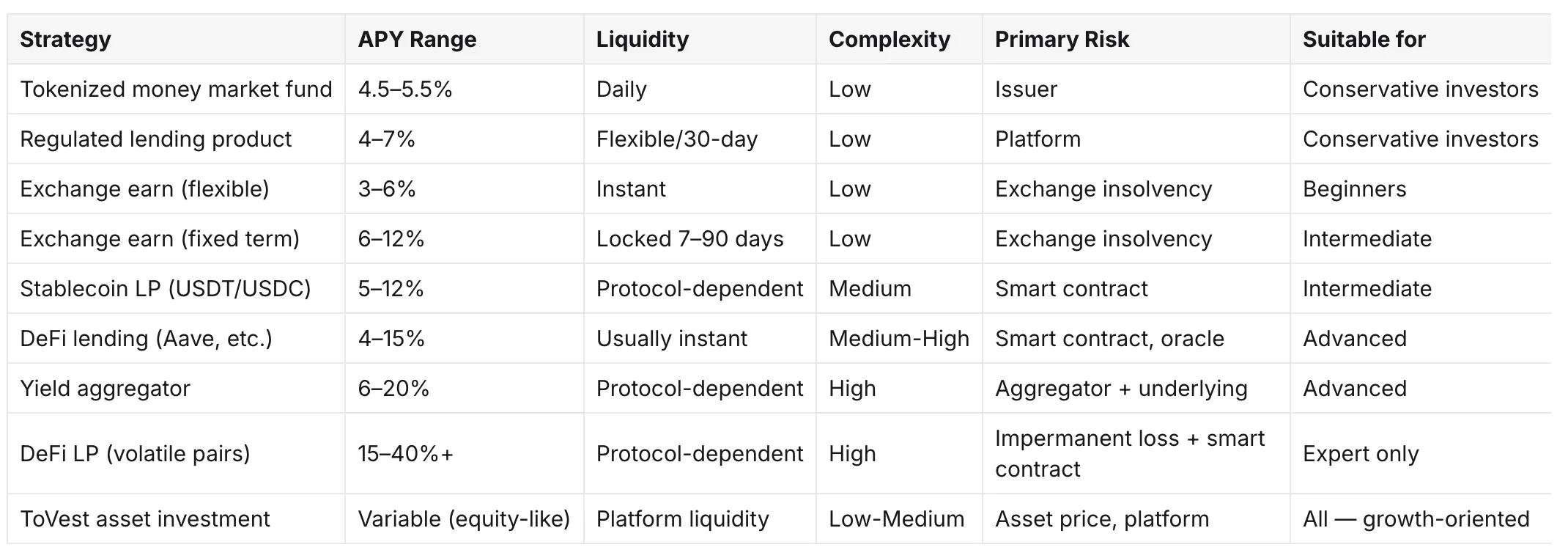
Yield Strategy Comparison Table
Frequently Asked Questions
What is the safest way to earn yield on USDT?
Tokenized US Treasury money market funds (BUIDL, FOBXX-equivalent retail products) provide the most conservative yield at 4.5–5.5% APY. The underlying assets are US government debt. The primary risk is the issuance platform, not the underlying asset.
Is staking USDT the same as earning yield on USDT?
Not precisely. "Staking" technically refers to locking assets to secure a proof-of-stake blockchain. USDT yield products are more accurately described as lending, liquidity provision, or fund investment. Exchanges use "staking" as a marketing term for all earn products. The underlying mechanism determines the risk — the label does not.
Can I earn daily income from USDT?
Yes — several strategies pay yield daily: DeFi lending protocols distribute interest every block (approximately every 12 seconds on Ethereum), exchange flexible earn products credit daily, and some lending platforms pay daily. The frequency of payment does not affect the annualized rate, only the compounding opportunity.
What happened to high-yield stablecoin products like Anchor Protocol?
Anchor Protocol offered 19.5% APY on UST (Terra's stablecoin) funded by unsustainable token emissions. When the mechanism broke in May 2022, UST lost its dollar peg permanently and the entire Terra ecosystem lost approximately $40 billion in value. This is the reference event for evaluating any stablecoin yield product offering rates that cannot be explained by real economic activity (lending, trading fees, Treasury yields).
What is a realistic sustainable USDT yield in 2026?
A sustainable yield is one backed by real economic activity: interest paid by borrowers, trading fees paid by traders, or Treasury yields on government debt. In the current rate environment, 4–10% annually is sustainable across Tiers 1-2. DeFi lending can produce 10–15% during high-leverage bull market periods. Anything consistently above 15% in a stable environment should be scrutinized for the source of yield.
How much USDT do I need to start?
Tier 1-2 strategies are accessible from small amounts — exchange earn products often start from $1 USDT. DeFi protocols have no minimum but gas fees on Ethereum make small deposits inefficient; consider layer-2 networks (Arbitrum, Optimism, Polygon) for smaller positions. ToVest accepts small USDT amounts for asset investment — no large minimum required.
Risk Disclosure
Stablecoin yield strategies are not equivalent to bank savings accounts. USDT is not insured by any government deposit insurance scheme. Yield products are not guaranteed. Material risks include:
- Platform insolvency: The platform holding your USDT can fail. FTX (2022), Celsius (2022), and BlockFi (2022) are documented examples of platform failures that resulted in total or partial loss of customer funds.
- Smart contract vulnerability: DeFi protocols can be exploited. Losses from DeFi exploits exceeded $1 billion in 2023 and 2024 combined.
- Peg instability: USDT itself carries counterparty risk — Tether Limited must maintain reserves sufficient to redeem all outstanding USDT at $1.00. Tether publishes quarterly reserve attestations. A peg break would affect the value of all USDT-denominated yield.
- Regulatory risk: Stablecoin regulation is actively evolving in the US, EU, and Asia. Changes could restrict product availability or require restructuring of yield programs.
- Lock-up risk: Fixed-term products prevent withdrawal during the term. If you need capital urgently, locked USDT is inaccessible.
Never allocate capital to USDT yield strategies that you cannot afford to lose. Diversify across platforms and strategy tiers. Understand the mechanism behind every yield product before depositing.