Unlocking Portfolio Growth: Benefits of Fractional Ownership in Real‑World Assets
December 19, 2025
Fractional ownership is opening doors to markets once reserved for institutions and ultra‑high‑net‑worth investors. By dividing real‑world assets (RWAs) into affordable shares, investors can buy stakes in properties, commodities, art, or even revenue streams without purchasing the entire asset. Today’s fractional investment platforms for real-world assets—supported by blockchain and modern trading systems—make it possible to invest smaller amounts, trade more flexibly, and access professional management and transparent data. Yes, there are platforms that allow fractional investment into RWAs, and they vary by asset class, trading model, and compliance approach. This guide explains how fractional ownership works, where it adds value, and how ToVest’s real‑time infrastructure helps investors participate confidently in tokenized assets.
Understanding Fractional Ownership in Real-World Assets
Fractional ownership divides an asset into shares, enabling several investors to own part of a high‑value item and share in its value and earnings. In the context of RWAs, this can include income‑producing real estate, fine art, precious metals, private credit, or renewable energy projects. Fractional investment is often enabled by RWA tokenization—converting ownership rights into digital tokens that can be recorded and traded on blockchain networks for greater transparency and settlement efficiency.
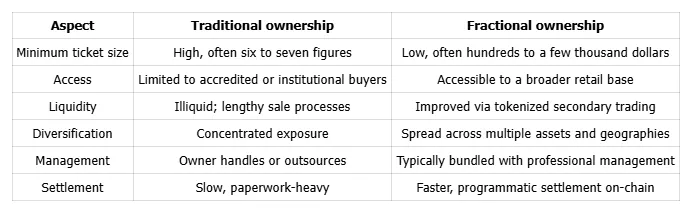
Below is a simple snapshot of how fractional ownership compares to traditional ownership.
Key Benefits of Fractional Ownership
Democratizing Access to High-Value Investments
Fractional ownership lowers the barrier to participate in high‑value assets, from luxury real estate to fine art. In real estate, minimums that once ran into millions now often start in the hundreds—sometimes as low as $500—enabling broader participation and portfolio experimentation without over‑concentration (see KPMG’s analysis of fractional real estate). Platforms emphasize inclusivity, expanding access for retail investors across income levels and geographies as part of a wider modernization of property investing highlighted by industry observers such as Lofty’s fractional property insights.
- Source: The New Frontier in Real Estate Investment by KPMG: https://assets.kpmg.com/content/dam/kpmgsites/in/pdf/2024/07/the-new-frontier-in-real-estate-investment-unlocking-the-potential-through-fractional-ownership.pdf.coredownload.inline.pdf
- Source: Top 5 Trends in Fractional Property Ownership by Lofty: https://www.lofty.ai/learn/top-5-trends-in-fractional-property-ownership
Enhancing Portfolio Diversification
By allocating smaller checks across multiple asset classes—including residential and commercial properties, art, gold, private credit, and carbon credits—investors can diversify beyond public equities and bonds. This reduces concentration risk and cushions portfolios against sector‑specific downturns, a point reinforced by research on diversified alternative allocations and RWA tokenization models.
- Source: Real World Asset Tokenization by 4IRE Labs: https://4irelabs.com/articles/real-world-asset-tokenization/
- Source: Is Fractional Ownership a Good Investment? by WebStreet: https://webstreet.co/insights/is-fractional-ownership-a-good-investment/
Examples of fractional-access assets:
- Real estate (single‑family rentals, commercial properties)
- Commodities and precious metals (e.g., vaulted gold)
- Fine art and collectibles (paintings, rare timepieces)
- Private credit and revenue‑sharing notes
- ESG assets (renewables, carbon projects)
Improving Liquidity Through Tokenization
Tokenization converts real-world assets into digital tokens that represent ownership shares and can be transacted on compliant marketplaces and secondary venues. Legal analysts note that tokenization can enhance liquidity by enabling global, around‑the‑clock trading and faster settlement, especially when paired with standardized compliance rails and transfer restrictions where required.
- Source: Tokenization of Real World Assets by Katten: https://katten.com/tokenization-of-real-world-assets-opportunities-challenges-and-the-path-ahead
How tokenization and liquidity work (step‑by‑step):
- Asset onboarding and due diligence
- Legal structuring and compliance documentation
- Token creation representing fractional ownership rights
- Primary offering on a compliant platform
- Secondary trading and market‑making for liquidity
- Distributions and reporting via smart contracts or platform ledgers
Access to Professional Asset Management
Most fractional platforms engage professional managers to handle acquisitions, operations, audits, insurance, and reporting—lowering the burden on individual investors. For example, rentals may be operated by third‑party property managers, with investors receiving their pro‑rata share of net income in line with the structure documented at issuance.
- Source: Real World Asset Tokenization by 4IRE Labs: https://4irelabs.com/articles/real-world-asset-tokenization/
Generating Passive Income Opportunities
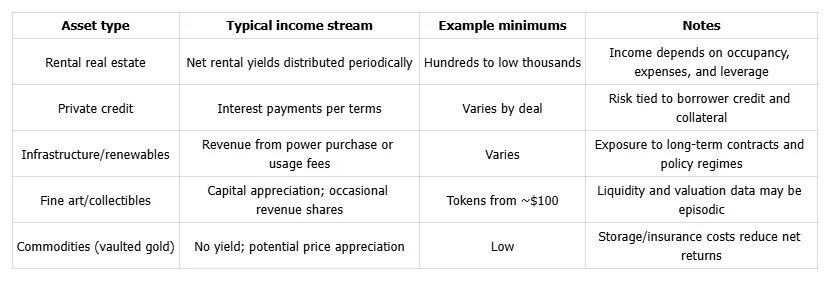
Fractional ownership can offer recurring income and potential appreciation. Investors may receive dividends from rental yields, interest on private credit notes, or revenue shares from intellectual property. In fine art, some tokenized offerings start as low as $100 per token, broadening access to blue‑chip works and their potential upside.
- Source: RWA Tokenization Use Cases in 2025 by XBTO: https://www.xbto.com/resources/real-world-asset-tokenization-use-cases-in-2025
Passive income profile by asset type:
Technology Enabling Fractional Ownership
Role of Blockchain in Fractional Investment
Blockchain is a decentralized ledger that records ownership and transactions immutably, allowing participants to verify records independently. Industry commentary highlights how blockchain‑based RWA platforms improve transparency, programmability, and efficiency for fractional ownership, using smart contracts to automate distributions, compliance checks, and cap‑table updates.
- Source: Real World Assets And Fractional Ownership (Nasdaq): https://www.nasdaq.com/articles/real-world-assets-and-fractional-ownership-revolutionizing-investment-for-a-new
Tokenization and Trading Infrastructure
Tokenization maps real‑world ownership interests to digital tokens that can move between approved wallets in near real time. Platforms like ToVest pair tokenization with secure, ultra‑low‑latency trading, deep market data, and real‑time transparency—allowing investors to monitor prices, volumes, distributions, and audit trails on demand. This infrastructure shortens settlement cycles, simplifies compliance automation, and supports more continuous secondary markets.
Recommended reading:
- ToVest Academy: https://tovest.com/en-US/blog/academy
Platforms Supporting Fractional Investment in Real-World Assets
Overview of Leading Fractional Ownership Platforms
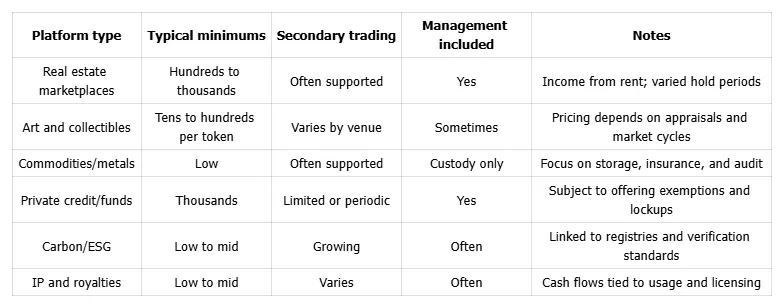
The marketplace spans specialized verticals and multi‑asset hubs. Typical platform types include:
A key trend is that more issuers, including US funds, are exploring public blockchains for tokenized vehicles—improving transferability and auditability while embedding compliance controls described in legal analyses of tokenization frameworks.
- Source: Use Cases & Emerging Trends in RWA Tokenization (GrowthTurbine): https://www.growthturbine.com/blogs/use-cases-emerging-trends-in-rwa-tokenization
How ToVest Supports Fractional Ownership and Trading
ToVest is built for serious RWA investors who want speed, coverage, and clarity.
- Asset coverage: Real estate, commodities and precious metals, private credit, digital businesses, and more
- Trading: Ultra‑low‑latency order execution with deep market data and programmatic APIs
- Security: Institutional‑grade custody controls, KYC/AML, and audited smart‑contract workflows
- Transparency: Real‑time dashboards for prices, volumes, distributions, and compliance events
- Analytics: Portfolio‑level risk, scenario analysis, and tax‑ready reporting
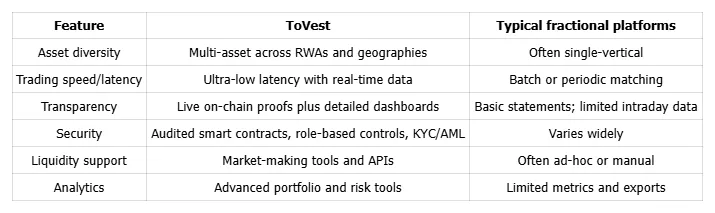
Feature comparison:
Explore our latest research and market structure insights:
- ToVest Reports: https://tovest.com/en-US/blog/report
Emerging Trends in Fractional Ownership
Expansion Across Diverse Asset Classes
Fractional investing is broadening beyond property to luxury autos and watches, fine art, gold, private credit, revenue‑sharing deals, and even digital businesses and ESG assets such as carbon credits. This expansion helps investors tailor exposure to thematic and inflation‑resilient assets while fine‑tuning risk and duration profiles.
- Source: Fractional Ownership: The Future of Asset Investment (RWA.io): https://www.rwa.io/post/fractional-ownership-the-future-of-asset-investment
- Source: RWA Tokenization Use Cases in 2025 (XBTO): https://www.xbto.com/resources/real-world-asset-tokenization-use-cases-in-2025
Regulatory Developments and Market Impact
Regulatory frameworks are adapting to tokenized RWAs, with clearer guidance on disclosures, transfer restrictions, and investor protections. As standards cohere, market trust and institutional participation continue to rise—supporting safer, more scalable fractional ownership models.
- Source: Use Cases & Emerging Trends in RWA Tokenization (GrowthTurbine): https://www.growthturbine.com/blogs/use-cases-emerging-trends-in-rwa-tokenization
Appeal to Younger and Tech-Savvy Investors
Millennials and Gen Z are allocating a larger share of portfolios to alternatives, aided by mobile‑first platforms, lower minimums, and intuitive interfaces that demystify tokenized assets.
- Source: Top 5 Trends in Fractional Property Ownership (Lofty): https://www.lofty.ai/learn/top-5-trends-in-fractional-property-ownership
How platforms like ToVest meet this demand:
- Mobile and API access for real‑time monitoring and execution
- Low entry minimums and fractional order sizes
- Clear education tracks and explainers for RWA tokenization
- Transparent performance and fee reporting
Challenges and Considerations for Investors
Liquidity and Secondary Market Risks
Liquidity varies by asset, platform volume, and the presence of market makers or liquidity providers. Less popular assets and newer venues may have longer holding periods or wider spreads; review historical volumes, tick sizes, and exit mechanisms before allocating.
- Source: The Next Big Wave in DeFi (GrowthTurbine): https://www.growthturbine.com/blogs/the-future-of-asset-ownership-why-rwa-tokenization-is-the-next-big-wave-in-defi
Key checks:
- Average daily volume and order book depth
- Market‑making commitments and fee schedules
- Transfer restrictions or lockups
Shared Ownership Complexities
Co‑ownership can require voting on major actions, handling cash‑flow timing, and aligning on exit preferences. Many platforms codify governance with smart contracts or legal agreements, but investors should understand decision thresholds, fee waterfalls, and dispute‑resolution processes.
Regulatory and Security Considerations
Rules differ by jurisdiction and asset type. Conduct due diligence on licensing, disclosures, and custody; confirm KYC/AML controls, data protections, and third‑party smart‑contract audits. A quick checklist:
- Is the issuer and platform licensed where required?
- Are offering documents and risks clearly disclosed?
- Are contracts audited and custody segregated?
- What are incident response and insurance provisions?
Frequently Asked Questions
What Is Fractional Ownership in Real-World Assets?
Fractional ownership allows multiple investors to collectively own shares of high‑value assets, with each stake represented by tokens or traditional shares.
How Does Fractional Ownership Lower Investment Barriers?
By dividing assets into affordable shares, investors can participate with smaller amounts instead of buying an entire property or collectible.
What Liquidity Advantages Does Fractional Ownership Provide?
Tokenized shares can be traded on compliant digital marketplaces, enabling faster entry and exit compared to traditional asset sales.
Can Fractional Ownership Generate Passive Income?
Yes—investors may receive rental yields, interest, royalties, or distributions aligned with their ownership share and the asset’s performance.
What Risks Should Investors Consider With Fractional Ownership?
Primary risks include limited liquidity, co‑owner governance conflicts, regulatory variability, and platform security or operational risks.