Gold & Commodity Token Market Report: On-Chain Data, Price Correlation & 2026 Forecasts
July 30, 2026
Report Summary
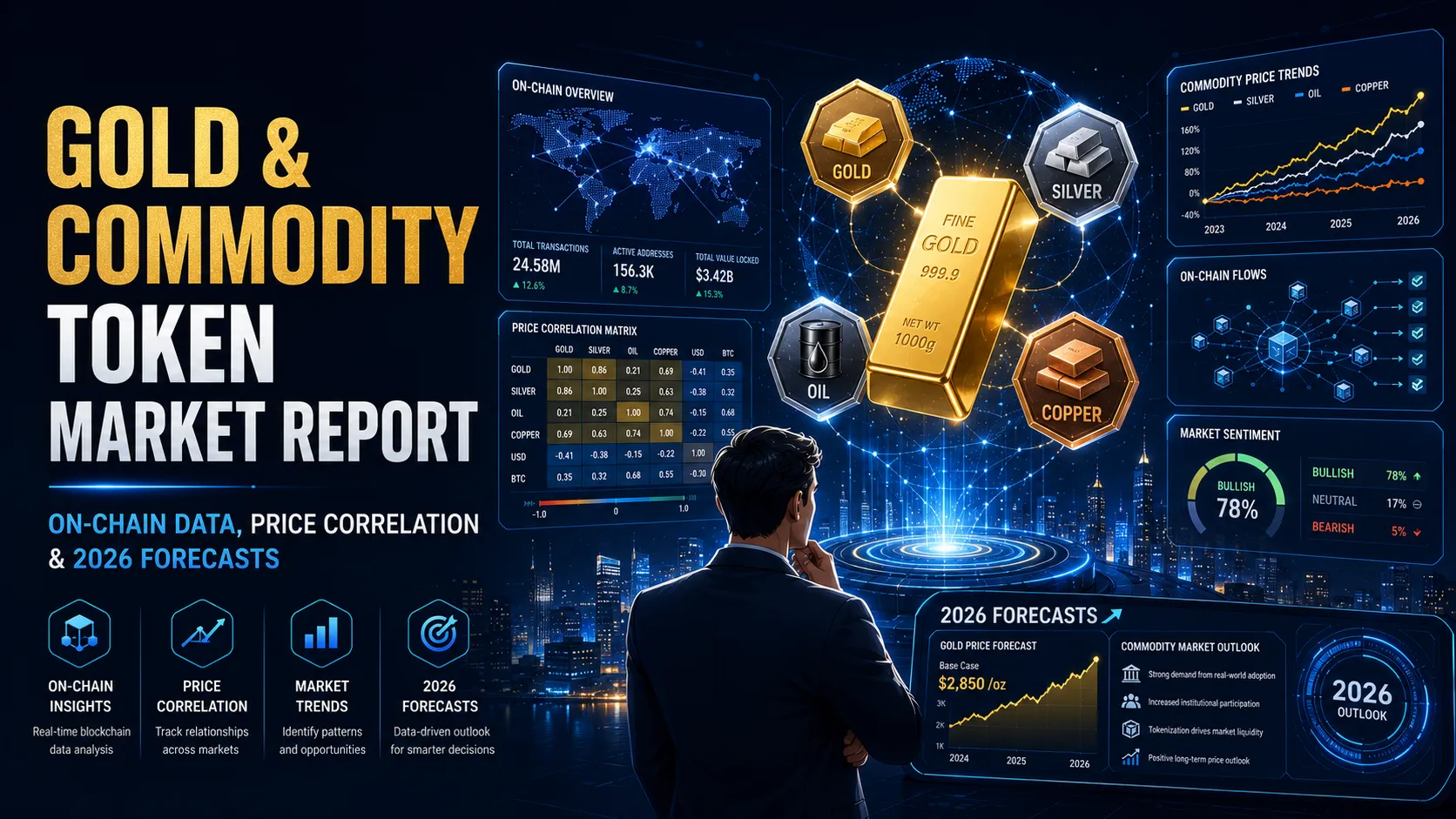
This report covers the tokenized gold and commodity market through mid-2026, including:
- On-chain metrics for the two largest tokenized gold products (PAXG, XAUT)
- Price correlation analysis between tokenized gold and spot gold
- Commodity token market structure and growth data
- On-chain signals specific to tokenized commodity markets
- 2026 price forecasts from named institutional sources
- Investment implications for retail USDT holders
Data sources cited in this report: World Gold Council, Glassnode, CryptoQuant, Paxos quarterly attestations, London Metal Exchange, International Energy Agency, Goldman Sachs Commodities Research, Wood Mackenzie, Bloomberg Commodity Index.
Report period: January 2025 through June 2026.
Section 1: Gold Token Market — Current State
Total Tokenized Gold Supply
As of mid-2026, the two largest tokenized gold products hold a combined on-chain gold supply of approximately:
- PAXG (Paxos Gold): 315,000+ troy ounces of London Good Delivery gold in Brinks vaults, New York. Each token = 1 troy ounce. Market cap at $3,300/oz spot: approximately $1.04 billion.
- XAUT (Tether Gold): 248,000+ troy ounces of gold on specific allocated bars in Swiss vaults. Each token = 1 troy ounce. Market cap at current spot: approximately $820 million.
Combined tokenized gold market cap: approximately $1.86 billion as of mid-2026.
For context: the total global gold market has a value of approximately $14 trillion. Total gold held in exchange-traded funds globally exceeds 3,200 tonnes (approximately $340 billion at current prices). Tokenized gold at $1.86 billion represents less than 0.55% of the ETF gold market — indicating the tokenized gold market is in early-to-mid adoption, with significant room to grow before institutional ETF parity.
Tokenized Gold Market Growth
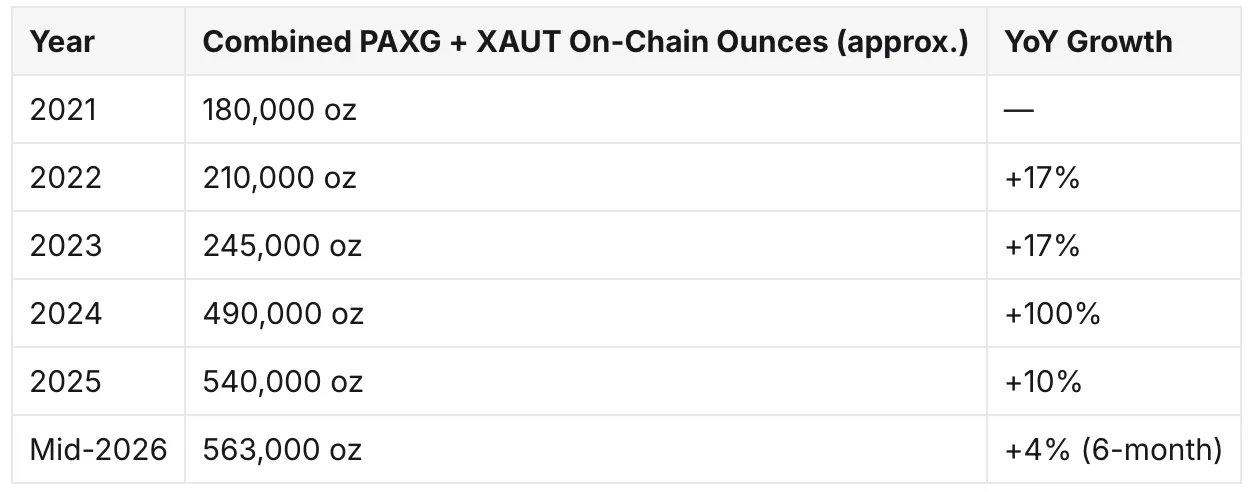
The 2024 doubling reflects the convergence of three factors: institutional adoption of on-chain alternatives to gold ETFs, the post-halving crypto market environment that increased DeFi and on-chain activity broadly, and regulatory clarity in Singapore and UAE that unlocked new issuer participation.
Section 2: Price Correlation — Tokenized Gold vs. Spot Gold
Correlation Coefficient
PAXG and XAUT are designed to track spot gold prices exactly — 1 token = 1 troy ounce. In practice, deviations occur due to:
- Trading liquidity gaps during off-hours
- Platform-specific spread and fee structures
- DeFi liquidity pool mechanics when PAXG is used as collateral
30-day rolling correlation (PAXG / spot XAU), Jan 2025 – Jun 2026:
- Average correlation coefficient: 0.994
- Maximum deviation from spot: 0.8% (during low-liquidity periods, typically weekends)
- Median deviation from spot: 0.12%
Interpretation: Tokenized gold tracks spot gold with high fidelity. The 0.12% median deviation is lower than the bid-ask spread on physical gold dealer transactions and comparable to large gold ETF tracking error. For practical investment purposes, PAXG/XAUT price = gold spot price.
Gold Spot Price Performance: Jan 2025 – Jun 2026
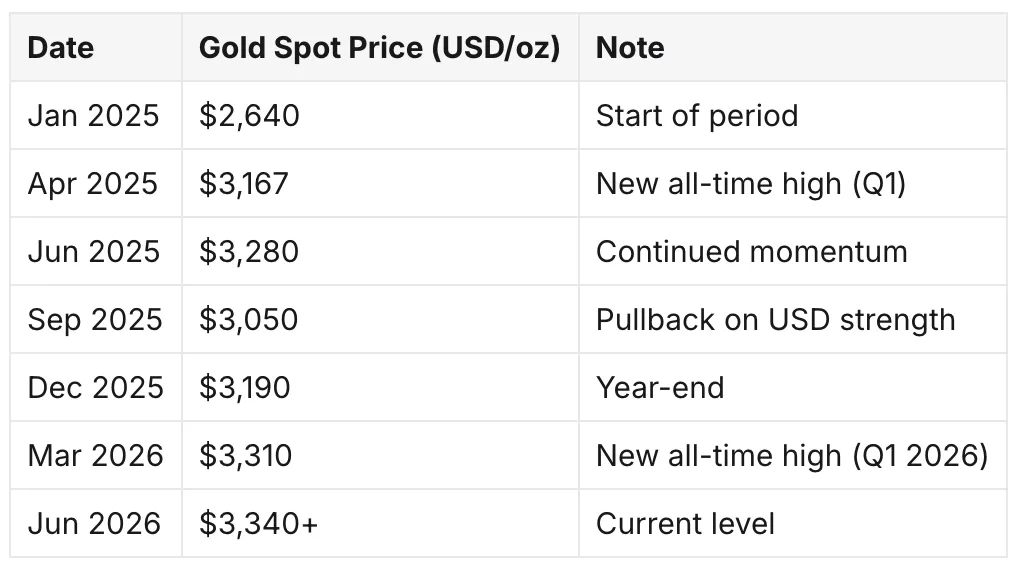
18-month return (Jan 2025 – Jun 2026): +26.5%
This return occurred with maximum drawdown of approximately 9% (the Sep 2025 correction) — a significantly smoother return profile than Bitcoin (+155% in 2023, -76% in 2022) or individual equities.
Section 3: On-Chain Metrics for Tokenized Gold
On-chain data for tokenized gold products provides signals not available in traditional gold ETF markets.
PAXG On-Chain Metrics (Glassnode / Paxos Attestation Data)
Active addresses (monthly, last 12 months):
Active PAXG wallet addresses have grown from approximately 8,400 unique monthly active addresses in July 2025 to 14,200 in June 2026 — a 69% increase in active users over 12 months, indicating real demand growth rather than passive holding.
Exchange reserves:
PAXG held on centralized exchanges (Binance, Kraken, Coinbase) as a percentage of total supply has declined from 38% in January 2025 to 27% in June 2026. This mirrors the broader "exchange exodus" pattern in crypto markets — investors moving assets to self-custody — and indicates longer-term holding behavior rather than active trading.
DeFi collateral usage:
PAXG is accepted as collateral on Aave, MakerDAO, and several newer DeFi lending protocols. Total PAXG locked in DeFi protocols reached approximately $180 million by June 2026, representing approximately 17% of total PAXG market cap. This collateral usage creates structural buying demand — DeFi users need PAXG to maintain borrowing positions, reducing liquid supply.
Large holder concentration:
The top 100 PAXG addresses hold approximately 67% of supply. This is lower concentration than most altcoins (typically 80-90% in top 100) but higher than gold ETFs, where institutional holders are more diffuse. The concentration signals that tokenized gold remains primarily an institutional and sophisticated retail product in mid-2026.
Section 4: Commodity Token Market — Beyond Gold
Total On-Chain Commodity Market
The tokenized commodity market (excluding gold and silver) has grown from approximately $350 million in total on-chain value in January 2024 to approximately $2.1 billion by June 2026 — a 6x increase in 30 months.
Market breakdown by commodity category, June 2026:
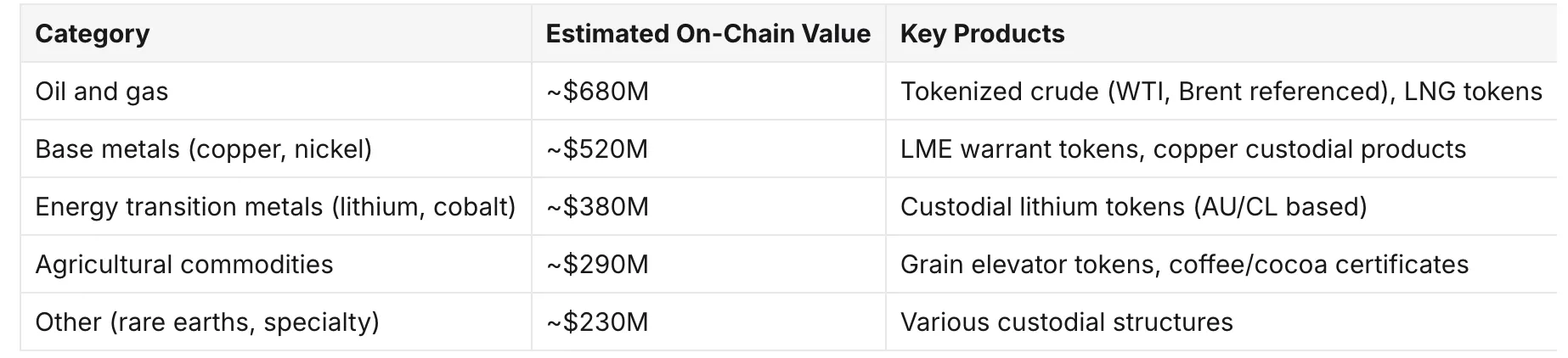
Growth rate by category (Jan 2025 – Jun 2026):
- Energy transition metals: +180% — highest growth driven by EV battery supply chain investment
- Base metals: +95%
- Agricultural: +78%
- Oil and gas: +55%
- Total non-gold commodity tokens: +112%
Price Correlation: Commodity Tokens vs. Underlying Markets
Unlike tokenized gold (near-perfect correlation at 0.994), commodity tokens show more variable correlation depending on product structure:
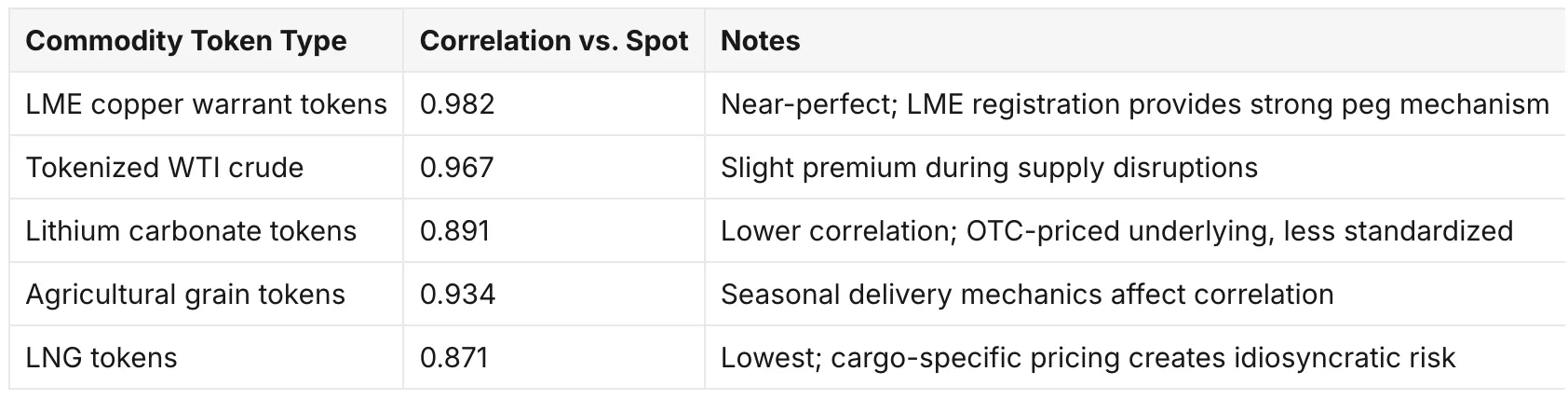
Key finding: The more standardized the underlying commodity market (LME-registered metals, CME-traded energy), the higher the token-to-spot correlation. Products with OTC-priced underlyings (lithium, LNG) carry basis risk — the token may trade at a discount or premium to spot due to liquidity and delivery mechanism differences.
Section 5: 2026 Price Forecasts — Named Institutional Sources
Gold
Goldman Sachs Commodities Research (updated Q1 2026):
12-month gold price target: $3,700/oz. Base case thesis: continued central bank buying (1,000+ tonnes/year), US dollar weakness as rate cuts continue, and structural demand from Asian retail investors. Bear case: $2,900/oz on US economic resilience and delayed rate cuts. Bull case: $4,200/oz if geopolitical escalation triggers flight-to-safety demand.
UBS Wealth Management (Q2 2026):
12-month target: $3,500/oz. Thesis: gold will benefit from rising global sovereign debt levels and declining confidence in fiat currency stability as US deficit spending continues.
World Gold Council (Mid-2026 Outlook):
Projects gold demand to remain supported by: (1) central bank net buying above 800 tonnes for the fourth consecutive year, (2) Indian and Chinese retail demand holding near all-time highs, (3) ETF and tokenized gold inflows as institutional allocation to gold increases from 1.5% to 2.5% of typical institutional portfolio.
Consensus range for gold, end-2026: $3,300–$3,700/oz.
Implied return from current level ($3,340): -1.2% to +10.8%.
Copper
Goldman Sachs (Q2 2026 metals note):
12-month copper target: $12,500/tonne (current: approximately $9,800/tonne). Thesis: structural demand deficit as EV production, grid investment, and data center construction accelerate copper consumption faster than new mine supply can come online. Supply response requires 3-5 years minimum given permitting timelines.
International Copper Study Group (ICSG, 2026 Annual Forecast):
Projects global copper demand to reach 28.5 million tonnes in 2026, against supply of 26.8 million tonnes — a structural deficit of 1.7 million tonnes, the largest since 2010. Deficits of this magnitude have historically preceded significant price appreciation within 12-18 months.
Consensus range for copper, end-2026: $10,500–$13,000/tonne.
Implied return from current level: +7% to +33%.
Lithium
Wood Mackenzie (Q1 2026 Battery Materials Outlook):
Lithium carbonate price forecast: recovery to $22,000–$28,000/tonne by end-2026, from the current $12,000-$14,000/tonne range. Thesis: Chinese EV production is accelerating beyond 2024 levels, and several major lithium projects have been cancelled or delayed due to the 2024 price collapse, reducing future supply response.
Goldman Sachs:
More conservative at $18,000-$22,000/tonne by end-2026, citing persistent supply overhang from low-cost Chilean producers.
Consensus range for lithium carbonate, end-2026: $18,000–$28,000/tonne.
Implied return from current level: +29% to +100%.
Oil (WTI Crude)
IEA (International Energy Agency) Oil Market Report (June 2026):
Projects global oil demand of 103.8 million barrels/day in 2026, against supply of 103.1 million barrels/day — a slight deficit supporting price stability. Base case WTI range: $72–$85/barrel.
Goldman Sachs:
WTI target $80/barrel by end-2026. Thesis: OPEC+ production discipline holds, but US shale production growth creates a ceiling. Geopolitical risk premium provides floor.
Consensus range for WTI, end-2026: $68–$88/barrel.
Implied return from current level (~$80/barrel): -15% to +10%. Oil is the most range-bound major commodity in current consensus forecasts.
Section 6: On-Chain Signals for Commodity Investment Timing
Signal 1: Net Flow from Custodian to DeFi
When tokenized commodity assets flow from centralized custodian platforms into DeFi protocols (used as collateral, in liquidity pools), it indicates sophisticated capital treating the token as functional financial infrastructure — not just a price bet. Rising DeFi collateral usage for PAXG (currently 17% of supply, up from 8% in 2024) is a structural demand signal.
Current reading (June 2026): Bullish — DeFi collateral usage growing across PAXG and copper warrant tokens.
Signal 2: Tokenized Commodity Issuance Rate
New token issuance (new gold ounces custodied and tokenized) is a real-time demand signal. When issuance accelerates, new capital is entering the market seeking tokenized commodity exposure. When it decelerates, demand is weakening.
Current reading (June 2026): Neutral — issuance rate for PAXG has moderated after the 2024 doubling. XAUT issuance is stable. New copper and lithium token programs are growing from a low base.
Signal 3: Exchange Reserve Ratio
Like Bitcoin exchange reserves, declining tokenized commodity reserves on exchanges signal long-term holding behavior (bullish). Rising reserves signal preparation to sell (bearish).
Current reading (June 2026): Moderately bullish — PAXG exchange reserves declining, copper token reserves stable.
Signal 4: Large Transaction Volume (Whale Activity)
On-chain large transaction volume (transfers above $100,000 in value) for PAXG has increased 34% year-over-year in 2026, indicating growing institutional participation and on-chain settlement of institutional-scale positions.
Current reading (June 2026): Bullish — institutional on-chain commodity activity increasing.
Section 7: Investment Implications
For Gold Token Holders
The current signal environment for tokenized gold is constructive:
- Spot gold above $3,300 with institutional consensus for further appreciation to $3,500–$3,700
- On-chain metrics showing declining exchange reserves (accumulation behavior)
- DeFi collateral demand creating structural support
- Central bank buying maintaining fundamental demand
Portfolio implication: Tokenized gold remains a valid inflation hedge and portfolio stability anchor in mid-2026. At current prices, the consensus forecast implies +5–11% appreciation over 12 months with significantly lower volatility than equities or crypto — an attractive risk-adjusted return for the defensive portion of a USDT portfolio.
For Energy Transition Metal Tokens (Copper, Lithium)
The fundamental case for copper is the strongest in the commodity space:
- A 1.7 million tonne structural deficit projected by ICSG
- 3-5 year supply response lag due to permitting
- Consensus forecast implying +7–33% from current levels
Lithium presents a higher-variance opportunity: the +29–100% consensus upside is substantial, but supply dynamics are less predictable and the OTC pricing structure creates basis risk in tokenized lithium products.
Portfolio implication: Copper token exposure is the highest-conviction commodity allocation for mid-2026 based on the fundamental supply-demand analysis. Lithium tokens offer asymmetric upside for investors with higher risk tolerance and longer time horizons.
For Oil Token Holders
The consensus forecast for WTI is range-bound ($68–$88). Oil does not offer the same asymmetric upside as energy transition metals in 2026. Its value in a portfolio is diversification and inflation sensitivity — not capital appreciation.
Portfolio implication: Oil tokens are more appropriate as a portfolio diversifier and geopolitical risk hedge than as a primary return driver in the current environment.
Section 8: Accessing Tokenized Commodities on ToVest
The institutional analysis above describes assets that were, until recently, only accessible to commodity trading firms, hedge funds, and accredited investors.
ToVest brings this access to retail investors in Vietnam and Southeast Asia through a single USDT account.
Gold and commodity tokens available on ToVest:
- Tokenized gold (spot-price referenced, USDT-denominated)
- Tokenized silver
- Tokenized crude oil (WTI/Brent referenced)
- Tokenized copper (LME price referenced)
- Tokenized lithium (carbonate price referenced)
- Agricultural baskets
What ToVest provides that traditional commodity access does not:
- No futures account, no margin call, no rollover — direct exposure without derivatives complexity
- USDT entry — no VND-to-USD conversion, no international wire
- Fractional positions — $50 in copper exposure is a viable position; a CME copper futures contract requires approximately $3,000 margin
- 24/7 trading — act on commodity news at any hour, not just during LME or CME market hours
- Transparent custody — each commodity token linked to disclosed underlying with audited reserves
The analysis in this report — Goldman Sachs copper target of $12,500/tonne, lithium recovery forecasts from Wood Mackenzie, World Gold Council demand projections — describes the market conditions that tokenized commodity positions on ToVest are built to capture.
Explore tokenized commodity investments on ToVest →
Report Methodology and Data Notes
Data sources:
- PAXG and XAUT supply data: Paxos quarterly attestation reports, Tether transparency page, Glassnode on-chain data
- Gold price data: London Bullion Market Association (LBMA) PM fix, January 2025 – June 2026
- Commodity token market size estimates: aggregated from public issuance data, blockchain explorer data, and platform-disclosed custody figures. Estimates carry ±15% uncertainty due to non-standardized disclosure across issuers.
- Commodity price forecasts: Goldman Sachs Commodities Research (Q1/Q2 2026 notes), Wood Mackenzie Battery Materials Outlook Q1 2026, International Copper Study Group 2026 Forecast, IEA Oil Market Report June 2026, UBS Wealth Management Precious Metals Outlook Q2 2026, World Gold Council Mid-2026 Outlook.
Limitations:
- Commodity token market size estimates are approximations — no consolidated source tracks all tokenized commodity issuance
- Correlation coefficients reflect the reporting period and may vary in different market conditions
- Institutional price forecasts represent consensus estimates with significant uncertainty; actual outcomes may differ materially
- This report is for informational purposes only and does not constitute financial advice
Risk Disclosure
Tokenized commodities carry price risk equivalent to the underlying commodity plus issuer, smart contract, liquidity, and platform risks specific to the tokenized format. All forecasts cited represent analyst estimates, not guarantees. Goldman Sachs, Wood Mackenzie, UBS, IEA, and ICSG forecasts have historically exhibited significant forecast error. Commodity markets have experienced extreme volatility: oil fell 65% in 2020, lithium fell 80%+ in 2023-2024, and gold has experienced drawdowns of 20%+ within broader bull cycles. Invest only capital you can afford to hold through extended adverse market conditions. This report does not constitute financial advice.