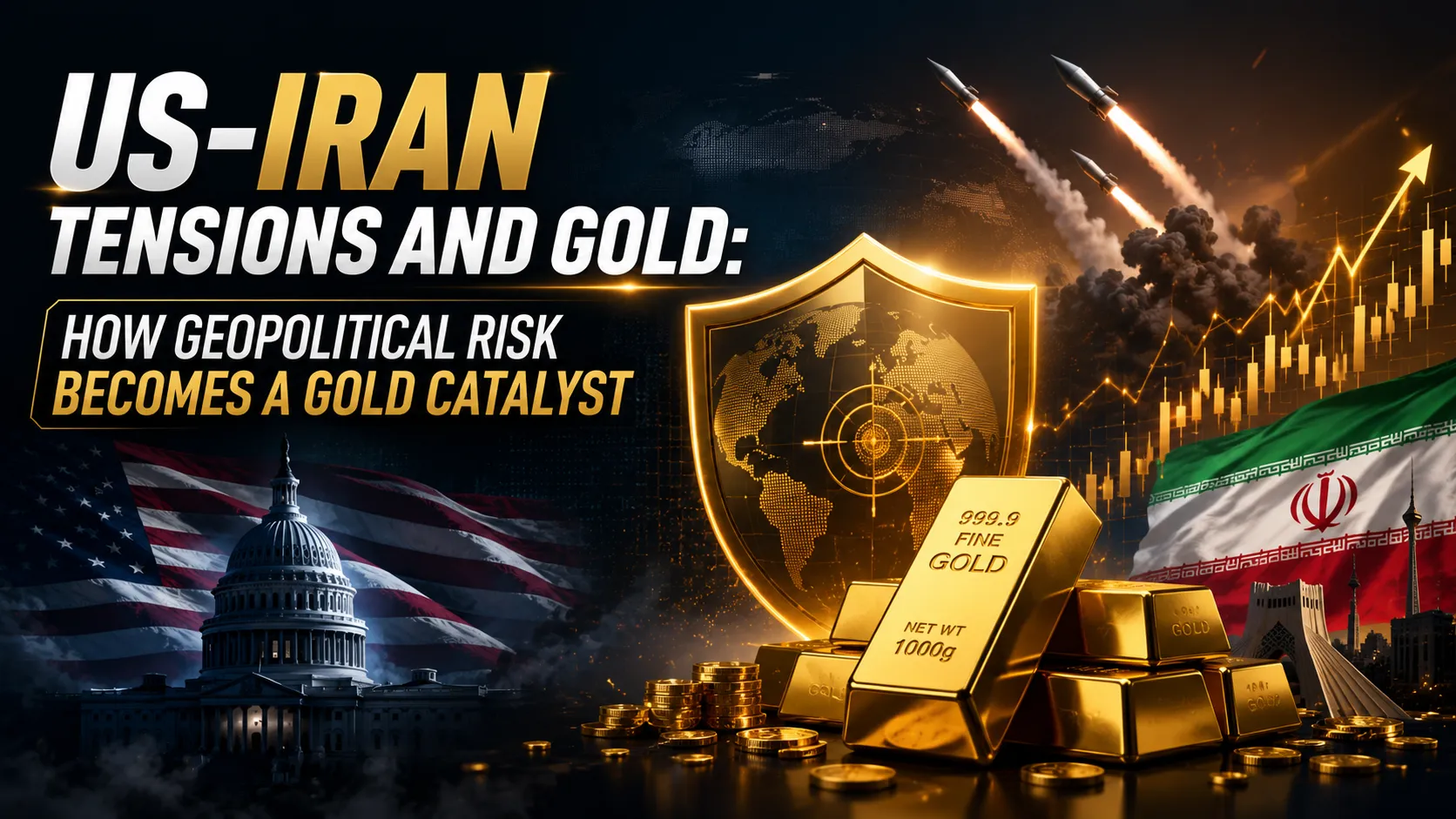
US-Iran Tensions and Gold: How Geopolitical Risk Becomes a Gold Catalyst
July 14, 2026
Why Every Gold Investor Is Watching the Middle East Right Now
Gold does not move on earnings reports. It does not respond to product launches or management changes. Gold moves on fear, uncertainty, and the erosion of trust in financial systems — and few combinations produce more of all three than a military confrontation between the United States and Iran.
In 2025, the US-Iran standoff has re-escalated through a familiar cycle: nuclear program advancement, US sanctions tightening, missile threats, proxy conflicts across Iraq, Syria, Yemen, and Lebanon — and the ever-present risk that one miscalculation triggers a direct confrontation in the Strait of Hormuz, through which 20% of the world's oil supply transits daily.
Gold has responded accordingly — and the relationship between US-Iran tensions and gold prices is not random. It is structural, historical, and predictable enough to be actionable for investors who understand the mechanism.
The Historical Record: US-Iran Events and Gold Price Reactions
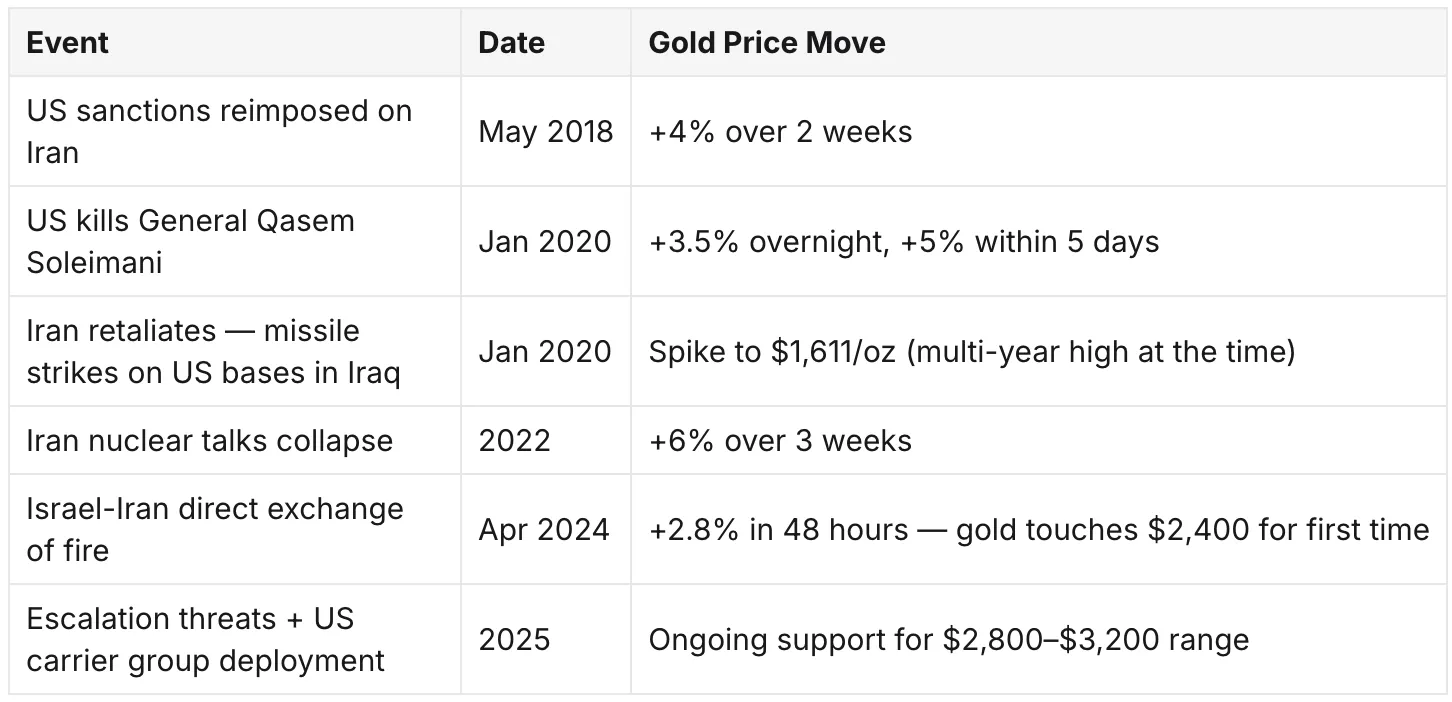
attern: Every significant US-Iran escalation event has produced an immediate gold price spike, with sustained elevation if the threat continues. The magnitude of the move correlates with the perceived probability of direct military conflict and oil supply disruption.
Why US-Iran Tensions Specifically Move Gold — The 3 Mechanisms
Mechanism 1: The Safe Haven Flight
When geopolitical risk spikes, institutional investors, sovereign wealth funds, and retail investors simultaneously reduce exposure to equities, high-yield bonds, and emerging market currencies — and reallocate to assets perceived as stores of value. Gold is the primary beneficiary of this flight-to-safety rotation.
The logic is simple: gold cannot be defaulted on, sanctioned, frozen, or destroyed by geopolitical events. A US Treasury bond can theoretically be made inaccessible to foreign holders. A bank account can be frozen. A stock can collapse. Gold in physical or tokenized form — held outside the banking system — cannot be targeted by any government action.
Iran itself understands this. Since 2018, Iran has been one of the largest buyers of physical gold globally, precisely to circumvent US dollar-based sanctions. When the US and Iran escalate tensions, both sides are effectively validating gold's role as the ultimate sanction-proof asset.
Mechanism 2: The Oil Price Transmission Channel
The Strait of Hormuz is the single most important maritime chokepoint in the global energy system. Iran has repeatedly threatened to close it — and has the military capability to significantly disrupt traffic even without a full closure.
Any credible Strait of Hormuz threat sends oil prices higher. Higher oil prices feed directly into inflation expectations. And gold is the most established hedge against inflation.
Mechanism 3: Dollar Uncertainty and De-dollarization Acceleration
The US uses the dollar as a weapon against Iran through sanctions — and Iran, Russia, China, and other nations have responded by accelerating moves away from dollar-denominated trade. When US-Iran tensions escalate, they visibly demonstrate the US dollar's role as a geopolitical tool rather than a neutral reserve currency.
This accelerates the de-dollarization narrative, which is structurally bullish for gold. Central banks that want to hold reserves that cannot be weaponized by Washington are buying gold — and US-Iran escalation is one of the most visible reminders of why they are doing so.
The 4 Scenarios: What Happens to Gold in Each?
Scenario 1: Diplomatic Resolution / Nuclear Deal
Probability (2025 estimate): Low — 10–15%
Gold impact: Short-term dip of 3–6% as risk premium deflates. Medium-term: neutral to positive, as de-dollarization and central bank buying continue regardless.
What to watch: Any formal JCPOA revival or direct US-Iran diplomatic talks signal this scenario.
Scenario 2: Sustained Tension / Current Status Quo
Probability: High — 55–60%
Gold impact: Continued support for the $2,800–$3,200 range. Gold maintains a geopolitical risk premium of approximately $100–200/oz above what pure monetary policy would dictate.
What to watch: Sanctions enforcement intensity, IAEA inspection reports, proxy conflict activity in Yemen/Iraq.
Scenario 3: Localized Military Exchange (Limited Strikes)
Probability: Moderate — 20–25%
Gold impact: Immediate spike of 5–10% within 48–72 hours. If the conflict is contained, a partial retracement follows — but gold typically does not fully return to pre-event levels, establishing a new higher floor.
What to watch: US carrier group movements, Israeli military posture, Iranian missile test frequency.
Scenario 4: Major Conflict / Strait of Hormuz Disruption
Probability: Low — 5–10%
Gold impact: Gold would almost certainly breach $4,000/oz in this scenario. Oil would spike to $150–200/barrel. Global risk assets would sell off sharply. This is the tail risk that keeps institutional gold allocations elevated even when immediate tensions seem manageable.
What to watch: Any Iranian action against shipping in the Persian Gulf or Red Sea at scale.
What Makes 2025 Different From Past Escalations
Three factors make the current US-Iran environment more structurally supportive of gold than previous cycles:
1. Iran's Nuclear Program Is More Advanced Than Ever
The IAEA confirmed in 2024 that Iran has enriched uranium to 60% purity — technically within weeks of weapons-grade 90%. This is not the Iran of 2015. The red lines are closer, and the window for a nuclear deal that satisfies all parties is narrower.
2. US Domestic Politics Limit Diplomatic Flexibility
The political environment in Washington makes a formal nuclear agreement with Iran extremely difficult to ratify. This means the most likely outcomes are either military action or continued stalemate — neither of which is bearish for gold.
3. The Broader Geopolitical Context Has Changed
US-Iran tensions in 2025 do not exist in isolation. They sit within a broader context of Russia-Ukraine, China-Taiwan risks, and Middle East instability. Each of these simultaneously supports gold demand. The cumulative geopolitical risk premium embedded in gold is higher than at any point since the 1970s.
4. Central Bank Demand Is Insulating Gold From Downside
Even when US-Iran tensions temporarily ease and tactical traders take profits, central bank buying — led by China, India, Turkey, and Poland — continues to absorb any dip. This creates a structural floor under gold that did not exist in previous geopolitical cycles.
Gold's Track Record in War and Conflict: The Long View
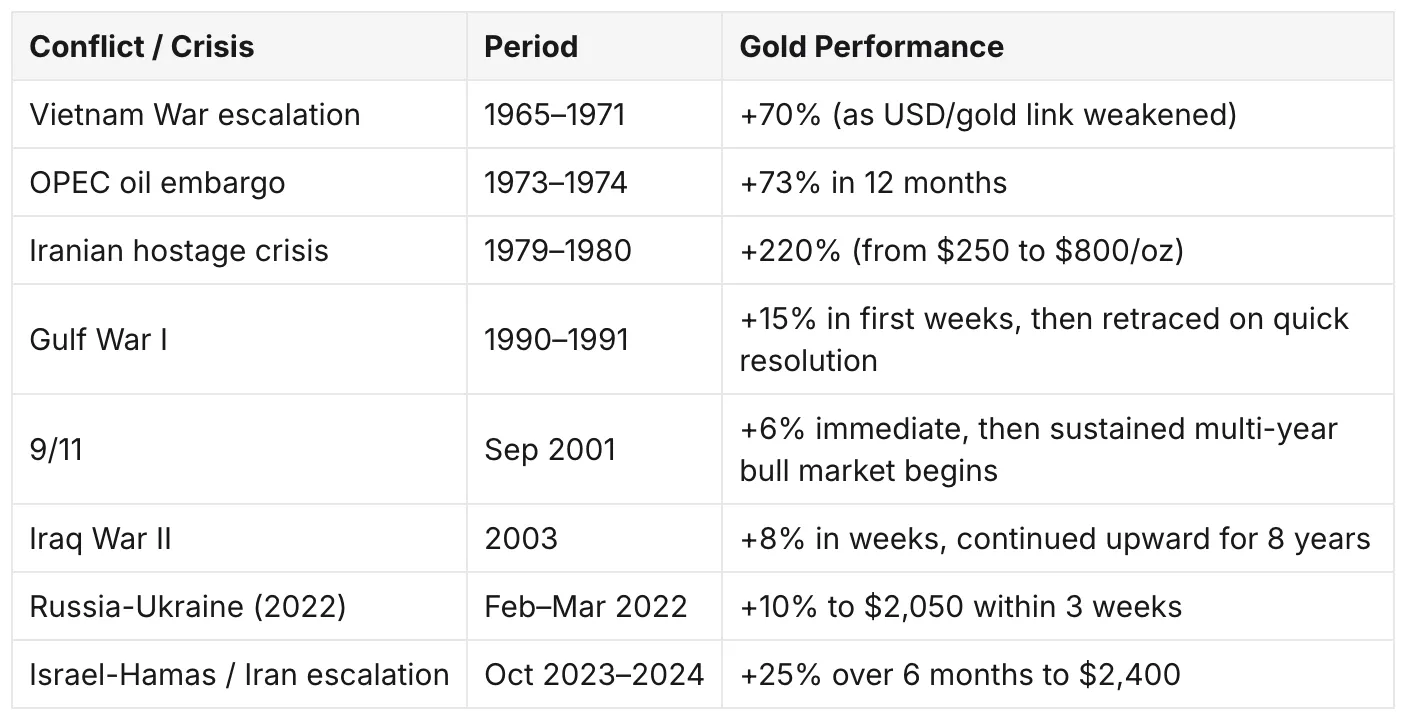
The consistent pattern: Short, decisive conflicts with clear winners produce spikes followed by partial retracements. Prolonged, unresolved conflicts with no clear end date produce sustained multi-year gold bull markets. The US-Iran dynamic — by its very nature — is a prolonged, structurally unresolved conflict. This makes it categorically more supportive of gold than a one-off military strike.
Practical Strategy: How to Position in Gold Given This Environment
For conservative investors:
- Maintain gold as 10–15% of portfolio
- Prioritize tokenized gold for liquidity — unlike physical gold, you can sell in seconds 24/7
- Do not try to time individual news events — the structural case supports holding through volatility
For active investors:
- Watch for escalation triggers (Strait of Hormuz incidents, IAEA reports, US sanctions announcements) as entry signals
- Gold typically moves fastest in the 24–72 hours after a major headline — early positioning before news breaks is more valuable than chasing the spike
- Use the diplomatic resolution scenario as a buying opportunity on dips, given structural central bank support
For USDT holders on ToVest:
- Tokenized gold is directly accessible — no broker, no physical storage, no minimum commitment
- Converting a portion of USDT holdings to tokenized gold is a direct hedge against both oil-driven inflation and dollar uncertainty that US-Iran risk creates
- 24/7 trading means you can react to overnight geopolitical headlines that traditional markets cannot
Frequently Asked Questions (FAQ)
Q: Does US-Iran tension always make gold go up?
A: Not always in a straight line — but historically, every major US-Iran escalation has produced a meaningful gold price move upward within 72 hours. The magnitude depends on how close the event is to direct military conflict. Partial retracements occur when tensions ease, but gold typically does not fully return to pre-escalation levels.
Q: What would happen to gold if the US attacked Iran?
A: A direct US military strike on Iran would almost certainly produce an immediate gold spike of 8–15% within days. If Iran retaliates by threatening or disrupting the Strait of Hormuz, the spike could be larger. Historical analogues suggest gold could test $3,500–$4,000/oz in a sustained conflict scenario.
Q: Why does gold go up during geopolitical conflict?
A: Three reasons: (1) investors flee risky assets into stores of value, and gold is the primary safe haven; (2) conflict typically raises oil prices, which raises inflation, which benefits gold; (3) geopolitical instability accelerates de-dollarization as countries seek reserve assets that cannot be weaponized.
Q: Is gold a good investment even without a US-Iran conflict?
A: Yes — the structural case for gold in 2025 exists independently of any single geopolitical event. Central bank accumulation, real interest rate expectations, and de-dollarization trends all support gold regardless of whether US-Iran tensions escalate or de-escalate.
Q: What is tokenized gold and how does it protect against geopolitical risk?
A: Tokenized gold is a blockchain-based token directly backed by physical gold. It tracks gold prices in real time, can be bought and sold 24/7, and requires no physical storage. In a geopolitical risk event — such as a US-Iran escalation — tokenized gold holders benefit from the same price appreciation as physical gold holders, but with instant liquidity.
Q: How much gold should I hold in my portfolio?
A: Most financial frameworks suggest 5–15% of a portfolio in gold or gold equivalents as a geopolitical and inflation hedge. The appropriate level depends on your risk tolerance and overall portfolio composition. In an elevated geopolitical risk environment like 2025, the upper end of that range is more justifiable.
The Bottom Line
The US-Iran standoff is not a short-term news story. It is a structural feature of the global geopolitical landscape that has persisted for over four decades — and it shows no signs of resolution. Every round of escalation reinforces the case for gold as the world's most reliable store of value when governments, currencies, and alliances cannot be trusted.
For investors in 2025: the question is not whether to hold gold. The question is how much — and whether you are holding it in a form that gives you the liquidity to act when the next headline breaks at 2am.
Tokenized gold on ToVest answers that second question directly.
Hedge your portfolio against geopolitical risk with tokenized gold on ToVest — available 24/7, settled in USDT, no minimum investment.